Iwatsuki Castle (Saitama Prefecture) Complete Guide | A Thorough Explanation of History, Structure, Highlights, and Visiting Information
What is Iwatsuki Castle?
Iwatsuki Castle (Iwatsuki-jo) is a flatland castle located in Iwatsuki Ward, Saitama City, Saitama Prefecture. It is also known as Ukijo, Shiratsuru Castle, Iwatsuki Castle, and Iwatsuki Castle. Built on the tip of the Iwatsuki branch of the Omiya Plateau, it is known as a castle with a vast outer fortification (sogamae) that utilized the Motoarakawa River as a natural moat.
It existed for approximately 400 years, from the late Muromachi period until its abandonment in the early Meiji period. During the Sengoku period, it played an important role as a strategic point in the Kanto region, and during the Edo period, it served as the administrative center of the Iwatsuki Domain. Currently, part of the castle site is a prefecturally designated historical site and serves as Iwatsuki Castle Ruins Park, a place of relaxation for citizens.
History of Iwatsuki Castle
Various Theories Surrounding the Castle’s Construction and Builder
Regarding the construction of Iwatsuki Castle, there are theories that have long been accepted as established facts, as well as new theories based on recent research.
The Theory of Construction by Ota Doshin and Dokan
Traditionally, Iwatsuki Castle was believed to have been built in 1457 (Choroku 1) by Ota Doshin and his son, Dokan. According to this theory, Ota Dokan, who was the chief retainer of the Ogigayatsu Uesugi clan, built the castle at the command of his lord, Uesugi Mochitomo, to oppose Ashikaga Shigeuji, the Koga Shogun. It is sometimes counted as one of Ota Dokan’s three famous castles, along with Edo Castle and Kawagoe Castle.
The Theory of Construction by the Narita Clan
Recent research suggests that the castle was built by Narita Sukekazu, the grandfather of Narita Chikatakazu, the lord of Oshi Castle. This theory presents a different perspective on the construction period and builder compared to the theory attributed to Ota Dokan, but due to a lack of definitive historical sources, the builder and construction year remain uncertain.
In any case, Iwatsuki Castle, built on the border between the territories of the Ogigayatsu Uesugi clan and the Koga Kubo Ashikaga clan, was an important military base from the beginning of the Sengoku period.
Iwatsuki Castle in the Sengoku Period
Ota Clan Era
After its construction, Iwatsuki Castle came under the control of the Ota clan. During the time of Ota Sukemasa (Dokan’s great-grandson), they were a powerful force in the Kanto region, but as the Hojo clan’s power expanded, they came under its influence.
Hojo Clan Era and Castle Renovation
In the late Sengoku period, Iwatsuki Castle came under the control of the Later Hojo clan. The Hojo clan considered Iwatsuki Castle important as a key point in governing Kanto and carried out large-scale renovations. In particular, the castle’s defensive capabilities were strengthened by adding two outworks, the Shinguruwa and Kajiguruwa, at the southern end.
During this period of renovation, the Shoji-bori, a castle construction technique favored by the Hojo clan, was employed, and its remains have been confirmed through archaeological excavations. A Shoji-bori is a special structure with a grid-like earthen embankment at the bottom of the moat, effectively hindering enemy intrusion.
Toyotomi Hideyoshi’s Siege of Odawara
In 1590 (Tensho 18), when Toyotomi Hideyoshi’s Siege of Odawara began, Iwatsuki Castle, a crucial stronghold for the Hojo clan, withstood a siege. However, it was attacked by the Toyotomi army led by Asano Nagamasa and ultimately surrendered. This marked the end of Hojo rule.
Iwatsuki Castle in the Edo Period
A Residence of a Tokugawa Fudai Daimyo
After the fall of the Hojo clan, when Tokugawa Ieyasu entered the Kanto region, Kōriki Kiyonaga, a Tokugawa family vassal, entered Iwatsuki Castle with a stipend of 20,000 koku. From then on, Iwatsuki Castle was positioned as an important base for the Edo shogunate’s governance of the Kanto region, and various fudai daimyo such as the Aoyama, Abe, Itakura, Toda, Fujii Matsudaira, Ogasawara, and Nagai clans successively served as castle lords.
The Era of the Ōoka Clan
In 1756 (Hōreki 6) during the mid-Edo period, Ōoka Tadamitsu (a distant relative of Ōoka Tadasuke, known as a renowned magistrate), who was a close advisor to Tokugawa Ieshige, entered the domain. From then until the abolition of the feudal domains and establishment of prefectures, the Ōoka clan remained the ruling family. During the Ōoka era, Iwatsuki Castle strengthened its character as a castle of the shogunate and functioned as a center of governance during the “peaceful era.”
Domain School and Culture
In Iwatsuki during the Edo period, the Confucian scholar Kodama Nanka founded a private school, which later became the domain school, “Senkyokan.” This building still remains in the city today, preserving a cultural aspect of Iwatsuki.
Meiji Era and Castle Abolition
With the abolition of the feudal domains in 1871 (Meiji 4), the Iwatsuki domain was abolished, and Iwatsuki Castle was also abandoned. Many of the castle’s structures were demolished, and the castle site was sold to private individuals or used as public land.
Structure of Iwatsuki Castle
Characteristics of the Layout
Iwatsuki Castle is a vast flatland castle with a comprehensive layout (sogamae) that utilized the Moto-Arakawa River as a natural outer moat. The entire castle complex stretched approximately 2.6 km east-west and 3 km north-south, and had a unique structure with multiple baileys arranged like islands in a marshy area.
The Great Enclosure (Sogamae)
The most distinctive feature of Iwatsuki Castle is its great enclosure (sogamae), which surrounded the entire castle town. Utilizing the Moto-Arakawa River as the outer perimeter, the defensive line encompassed a vast area, including not only the castle grounds but also samurai residences and merchant districts. This structure created a unified defensive system for both the castle and the surrounding town.
Layout of the Main Enclosures
Honmaru
Located in the center of the castle, the Honmaru was the core area housing the lord’s residence and administrative functions. It was surrounded by earthen ramparts and moats, providing a strong defensive structure.
Ninokuruwa and Sannomaru
The Ninokuruwa and Sannomaru were positioned surrounding the Honmaru, forming a tiered defensive line. It is believed that these enclosures housed the residences of senior retainers and barracks.
Shin-kuruwa and Kaji-kuruwa
Located at the southern end of the castle, Shin-kuruwa and Kaji-kuruwa are outworks added by the Hojo clan at the end of the Sengoku period. They constitute the main part of the current Iwatsuki Castle Ruins Park, and the remains of medieval castles, such as earthworks, dry moats, and barbicans, are well-preserved.
Archaeological excavations have uncovered Hojo clan-specific shoji-bori (screen-like moats) in this area, providing evidence of large-scale renovations by the Hojo clan.
Scale of the Moats
Iwatsuki Castle is also known as “a castle boasting one of the largest moats.” Not only did it utilize the Moto-Arakawa River as an outer moat, but several large moats were also located within the castle grounds. These moats are thought to have functioned not only defensively but also as waterways for transporting supplies.
Castle Gates and Entrances
Iwatsuki Castle had multiple gates, each with a robust defensive structure. The entrance (koguchi) was equipped with defensive structures such as masugata (square enclosures) and umadashi (outworks), employing ingenious methods to make enemy intrusion difficult.
Existing Remains and Highlights
Iwatsuki Castle Ruins Park
The southern end of the Iwatsuki Castle ruins, the sites of the Shin-kuruwa and Kaji-kuruwa (new enclosures) are now developed as Iwatsuki Castle Ruins Park. The vast 13-hectare site preserves both castle remains and natural forest, serving as a place of relaxation for citizens.
Prefectural Designated Historic Site
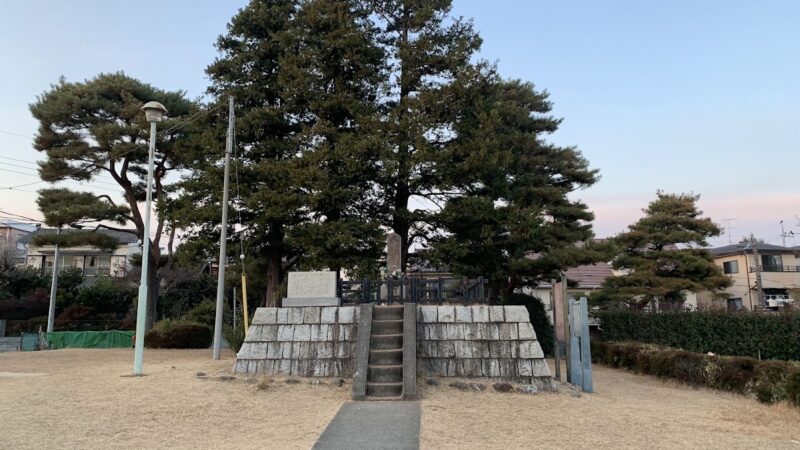
The areas of Shin-kuruwa and Kaji-kuruwa are designated as a Saitama Prefecture historic site and are protected as valuable remains of a medieval castle.
Yatsuhashi Bridge
The park’s symbol is the vermilion-painted Yatsuhashi bridge spanning the Iris Pond. This bridge evokes the atmosphere of the castle ruins and is also a popular photo spot.
A Famous Cherry Blossom Spot
Iwatsuki Castle Ruins Park is known as a famous cherry blossom spot, with approximately 500 cherry trees blooming in the spring. A cherry blossom festival is held annually, attracting many visitors. With stalls and other attractions, it’s a major local event.
Earthworks and Dry Moats
Within the park, earthworks and dry moats from the Sengoku period remain in excellent condition. The earthworks around the Kaji-kuruwa (blacksmith’s enclosure) are particularly high, giving a real sense of the scale of the defensive facilities at the time. The dry moats are also deeply dug, making them valuable learning materials for studying the structure of medieval castles.
Relocated Castle Gates
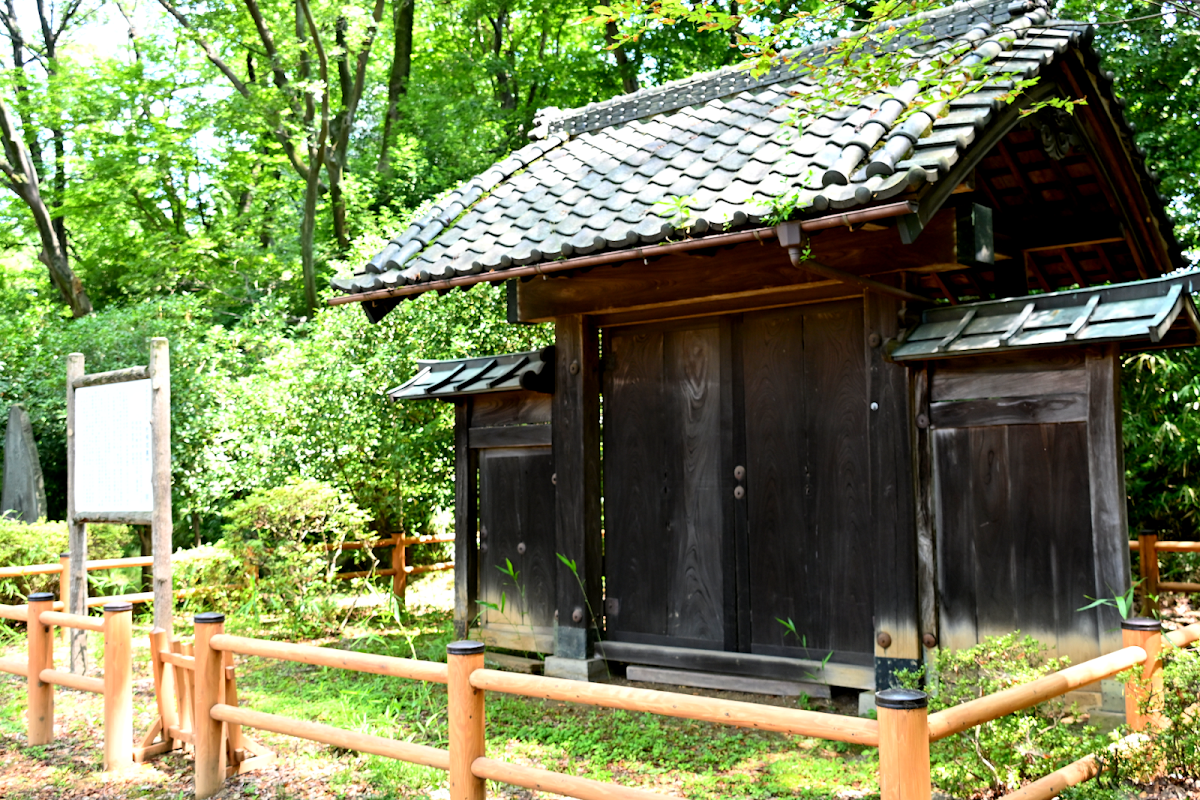
Some of the gates of Iwatsuki Castle have been relocated to temples and shrines within the city and still exist today. These gates are valuable cultural assets that convey the architectural style of the Edo period.
Shoji-bori (Screen Moat) Confirmed by Archaeological Excavation
Archaeological excavations conducted within the park have uncovered the remains of a shoji-bori, a type of moat unique to the Hojo clan’s castle construction techniques. Although the site is now backfilled, the survey results are presented on display panels and other materials, providing clues to understanding the castle’s structure during the Hojo clan era.
Other Park Facilities
Iwatsuki Castle Ruins Park has various facilities in addition to the castle ruins.
- Romancecar Kinugawa Exhibition: A real Romancecar train is on display in the park, popular with train-loving children.
- Tennis Courts and Baseball Field: The park also boasts excellent sports facilities, used for recreational activities by local residents.
- Wanpaku Plaza: A playground with play equipment, a popular spot for families.
- Picnic Plaza: A plaza with a fountain, perfect for relaxing.
- Battery Cars: A new attraction installed in February 2020.
History and Culture of Iwatsuki Castle Town
Samurai Residences and Merchant District
During the Edo period, the castle town of Iwatsuki was laid out with samurai residences and merchant districts neatly arranged around the castle. Samurai residences spread out within the castle walls, while the merchant district formed outside. Even today, streets that retain the atmosphere of the castle town remain, allowing visitors to enjoy historical walks.
Iwatsuki, the Town of Dolls
Iwatsuki is also known as the “town of dolls.” Doll making has flourished since the Edo period, and it is particularly famous nationwide as a production center for Hina dolls and May Festival dolls. It is believed that the cultural foundation of the castle town nurtured this traditional craft.
Senkyokan
The private school founded by the Confucian scholar Kodama Nanka later became the domain school, “Senkyokan.” This building still remains in the city today, conveying the history of Iwatsuki’s educational culture.
Access and Visiting Information
Transportation Access
Access by Train
- Get off at Iwatsuki Station on the Tobu Urban Park Line (Noda Line), approximately 21 minutes on foot.
- Also accessible from Higashi-Iwatsuki Station on the same line.
Access by Bus
- You can also use local buses from Iwatsuki Station (get off at the Iwatsuki Castle Ruins Park bus stop).
Access by Car
- Approximately 10 minutes from the Iwatsuki Interchange on the Tohoku Expressway.
- Parking available (free).
Opening Hours and Admission Fee
Iwatsuki Castle Ruins Park is open year-round, and admission is free. However, reservations and usage fees are required for facilities such as tennis courts and baseball fields.
Estimated Visiting Time
If you plan to thoroughly explore the castle ruins within the park, allow approximately 1-2 hours. During cherry blossom season or if you also want to enjoy the park’s facilities, you will need more time.
Best Season
Spring (Late March to Early April)
The most popular time is during the cherry blossom festival, when approximately 500 cherry trees are in full bloom. However, crowds are expected.
Early Summer (May to June)
The irises in the iris pond are in full bloom, creating a beautiful landscape in combination with the Yatsuhashi bridge.
Autumn (November)
The autumn foliage is also beautiful, and you can enjoy a relatively quiet stroll through the castle ruins.
Nearby Tourist Attractions
Iwatsuki Doll Museum
Opened in 2020, this museum specializes in dolls, allowing visitors to learn about the history and culture of dolls, a traditional craft of Iwatsuki. It is within walking distance of Iwatsuki Castle Ruins Park.
Kuizu Shrine
The main shrine of Iwatsuki, this shrine has long been a center of local faith. It has deep ties to the history of the castle town.
Exploring the Castle Town of Iwatsuki
You can stroll through the streets that retain the atmosphere of a castle town. Old merchant houses and temples and shrines are scattered throughout, allowing you to experience a historical atmosphere.
Resources for Learning About Iwatsuki Castle
Official Information from Saitama City
The official Saitama City website provides detailed information about the Iwatsuki Castle ruins. You can read expert explanations about the results of archaeological excavations and the historical background.
Castle Research Websites
Castle-specialized websites such as Kojodan and Nippon Jiro Meguri feature numerous reviews and photos from actual visitors, which are helpful for gathering information before your visit.
Related Books
Books dealing with castles in Saitama Prefecture and history books dealing with the Kanto region during the Sengoku period include descriptions of Iwatsuki Castle. For deeper learning, it is recommended to refer to these specialized books.
Historical Significance of Iwatsuki Castle
A Key Point in Kanto Governance
Iwatsuki Castle was a crucial base for governing the Kanto region from the late Muromachi period through the Edo period. As a border castle between the Ogigayatsu Uesugi clan and the Koga Shogunate, and as a key part of the Edo Shogunate’s control of Kanto, it consistently occupied a politically and militarily important position.
Evolution of Castle Construction Techniques
The structure of Iwatsuki Castle changed over time, from its construction period through the Hojo clan era and the Edo period. In particular, the renovations by the Hojo clan introduced advanced castle construction techniques such as shoji-bori (a type of moat), demonstrating its transitional characteristics from medieval to early modern castles.
Center of Regional Culture
The castle town of Iwatsuki was not merely a military base, but also a cultural center. Educational activities at the domain school, Senkyokan, and the development of traditional crafts such as doll making are cultural legacies nurtured by the integrated castle and castle town.
Summary
Iwatsuki Castle was a hilltop castle located in Saitama City, Saitama Prefecture, and is an important castle with a history spanning approximately 400 years. While there are theories that it was built by Ota Dokan or the Narita clan, and the builder remains unconfirmed, it played a crucial role as a strategic point in the Kanto region during the Sengoku period and as the administrative center of the Iwatsuki Domain during the Edo period.
It boasted a vast outer fortification with the Moto-Arakawa River as its outer moat, and advanced castle construction techniques, such as shoji-bori (screen-like moats), were introduced, particularly during the Hojo clan’s rule. Currently, part of the castle site has been developed into Iwatsuki Castle Ruins Park, a prefecturally designated historical site.
Within the park, remnants such as earthworks and dry moats are well-preserved, and it is also known as a famous spot where approximately 500 cherry trees bloom in spring. Visitors can also enjoy the townscape of Iwatsuki, which retains the atmosphere of a castle town, and its cultural aspects as a town of dolls, making it a valuable spot to experience history and culture.
Iwatsuki Castle Ruins Park is relatively easy to access, about a 21-minute walk from Iwatsuki Station on the Tobu Urban Park Line, or about a 10-minute drive from the Iwatsuki Interchange on the Tohoku Expressway. Admission is free, and the park is open year-round, making it easy to visit.
Iwatsuki Castle Ruins offers something for everyone, from those interested in Kanto history and castle tours to those who simply want to enjoy cherry blossoms and nature. Why not visit this historic castle site and reflect on its former glory as a strategically important location in the Kanto region?