
Hirayanagi Kurōdo Residence Ruins (Kawaguchi City, Saitama Prefecture) Complete Guide: A Thorough Explanation of the Remains of a Sengoku Period Warlord’s Residence and its Historical Value
Located in the Motogō district of Kawaguchi City, Saitama Prefecture, the Hirayanagi Kurōdo Residence Ruins are a valuable historical site that conveys the reality of regional governance in Musashi Province during the Sengoku period. It was the residence of Hirayanagi Kurōdo, a senior retainer of Ōta Sukemasa, the lord of Iwatsuki Castle, and is now preserved on the grounds of the Kawaguchi City Minami-Hirai Community Center Motogō Branch. This article provides a detailed and comprehensive explanation of the Hirayanagi Kurōdo Residence Ruins, including its historical background, the condition of the remains, and related historical sites in the surrounding area.
Basic Information on the Hirayanagi Kurōdo Residence Site
Location and Access
Location: 4-12-6 Motogō, Kawaguchi City, Saitama Prefecture 332-0011
Nearest Station: Kawaguchi Motogō Station, Saitama Rapid Railway (Saitama Stadium Line)
Access Method:
- Approximately 10-15 minutes on foot from Kawaguchi Motogō Station
- Located southeast of the station, past a residential area
- Currently within the grounds of the Kawaguchi City Minamihei Community Center Motogō Branch
Visiting Information:
- Admission Fee: Free
- Visiting Hours: No restrictions (Viewing is possible from outside the community center grounds)
- Parking: Parking available for community center users (limited number of spaces)
Historic Site Designation Status
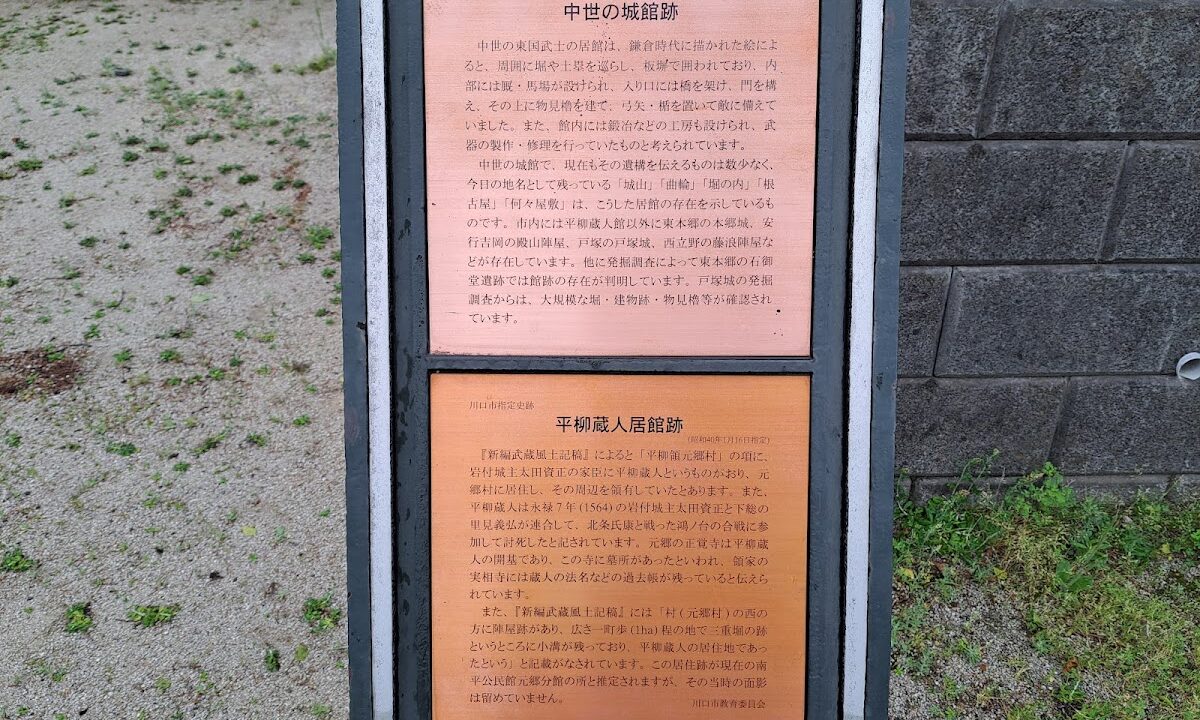
The Hirayanagi Kurōdo Residence Site is recognized as a cultural property of Kawaguchi City, and a stone monument and information board have been installed at the site. Although the remains themselves no longer exist, it is carefully preserved locally as a regional historical site of high historical value. ## Who was Hirayanagi Kurando?: The Life of a Sengoku Period Warlord
Hirayanagi Kurando’s Career and Role
Hirayanagi Kurando was a warlord who was active from the late Muromachi period to the Sengoku period. His real name is also said to have been Hirayanagi Takatsuna. As a senior retainer of Ota Sukemasa, who was based at Iwatsuki Castle (present-day Iwatsuki Ward, Saitama City, Saitama Prefecture), he was in charge of governing the southern part of Musashi Province.
Kurando was not merely a warlord, but also served as a regional administrator. He is believed to have governed fifteen villages in the Hirayanagi territory, centered around Motogo Village, and was responsible for collecting land tax, maintaining public order, and mobilizing troops.
Relationship with Ota Sukemasa
Ota Sukemasa was the great-grandson of Ota Dokan, known for building Edo Castle, and as the lord of Iwatsuki Castle, he held power in the northern and central parts of Musashi Province. Ota Sukemasa was allied with Uesugi Kenshin (then Nagao Kagetora, who had inherited the position from Uesugi Norimasa), the Kanto Kanrei (governor of the Kanto region), and was in conflict with the Odawara Hojo clan.
Hirayanagi Kurōdo held an important position within Ota Sukemasa’s retainers and is believed to have always accompanied Sukemasa in his military actions. His role was particularly significant during expeditions to the Shimōsa region, given his geographical proximity to Motogō.
The Second Battle of Kōnodai and the End of Hirayanagi Kurōdo
Hirayanagi Kurōdo’s name is etched in history during the Second Battle of Kōnodai in 1564. This large-scale battle took place in what is now Kōnodai, Ichikawa City, Chiba Prefecture, and pitted the combined forces of Ota Sukemasa and Satomi Yoshihiro against the Hojo army led by Hojo Ujiyasu.
Battle Summary:
- Ota Sukemasa and Satomi Yoshihiro of Awa formed an alliance to oppose the Hojo clan.
- The allied forces deployed at Kōnodai in Shimōsa Province.
- Hojo Ujiyasu led a large army into battle.
- After fierce fighting, the allied forces were defeated.
Hirayanagi Kurōdo fought bravely as the vanguard of the allied forces in this battle, but is said to have been killed in action by the fierce attack of the Hojo army. His lord, Ota Sukemasa, narrowly escaped the battlefield, but it was a crushing defeat with many important retainers lost.
The Fate of Hirayanagi Kurōdo’s Residence After His Death
After Kurōdo’s death, it is said that Hirayanagi Kurōdo’s residence was attacked and burned down by the forces of the Later Hojo clan. Having lost its lord, the residence lost its defensive capabilities and became a target for retaliatory attacks by the Hojo.
This incident is thought to have temporarily brought the fifteen villages of the Hirayanagi domain under the control of the Hojo clan, but the detailed subsequent events are unclear due to a lack of historical records.
Fifteen Villages of the Hirayanagi Domain: A Medieval Regional Governance System
Composition of the Fifteen Villages of the Hirayanagi Domain
According to the “Shinpen Musashi Fudoki-ko” (New Compilation of the Topography of Musashi Province), the Hirayanagi domain, governed by Hirayanagi Kurōdo, consisted of the following fifteen villages:
- Motogō Village – The main village of the Hirayanagi domain, the location of Kurōdo’s residence
- Yahē Shinden Village
- Ryōke Village
- Araikata Village
- Jūnigatsuda Village
- Hizume Village
- Nikenzaike Village
- Kamishinden Village
- Nakai Village
- Kobuchi Village
- Tsuji Village
- Maeda Village
- Kawaguchi Village
- Iizuka Village
- Ukima Village
These villages correspond to the area from the southern part of present-day Kawaguchi City to Kita Ward, Tokyo. The fact that Motogo Village played a central role as the main village, and that the residence of Hirayanagi Kurōdo was located there, indicates that it was the political and military center of this region.
Medieval Village Governance System
The system of governance like that of the Hirayanagi domain was a typical form of regional rule during the Sengoku period (Warring States period). Lord Hirayanagi Kurōdo was responsible for the following:
- Collection of land tax: Collecting rice and local products from each village
- Military mobilization: Mobilizing soldiers from each village during wartime
- Maintaining public order: Suppressing bandits and mediating disputes
- Irrigation management: Supervising the maintenance and management of irrigation canals
By establishing his residence in Motogō village, he had created a system that allowed him to efficiently govern all fifteen villages.
Structure and Remains of the Hirayanagi Kurōdo Residence
The Appearance of the Residence as Seen in Edo Period Records
The *Shinpen Musashi Fudoki Kō* (New Compilation of the Topography of Musashi Province) contains the following description of the Hirayanagi Kurōdo Residence:
> “It is a plot of land about one square chō (approximately 109 meters on each side), and small ditches remain around it, indicating the remains of a triple moat.”
Decipherment:
- One square chō: A square plot of land with sides of approximately 109 meters
- Triple moat: The residence was surrounded by a triple moat
- Small ditches remain: Traces of the moat remained even in the late Edo period (when the Fudoki Kō was compiled)
From this description, it can be understood that the Hirayanagi Kurōdo Residence was a relatively large residence equipped with a triple moat as a defensive structure. A triple moat was a considerably strong defensive structure for a samurai’s residence at that time, indicating the high status of Hirayanagi Kurōdo and the military importance of this region.
Characteristics of a Flatland Castle
The Hirayanagi Kurōdo Residence is classified as a “flatland castle” (hirajiro). A flatland castle is a castle built on flat land. Unlike mountain castles or hill castles, it cannot rely on natural terrain for defense, so it required the construction of numerous artificial defensive structures such as moats and earthworks.
Characteristics of a Flatland Castle:
- Convenient for daily life and territory management due to its flatland location
- Defense is primarily based on moats and earthworks
- Easy to construct water moats (when the groundwater level is high)
- Unsuitable for stationing large armies
In the case of the Hirayanagi Kurōdo Residence, the presence of a triple moat suggests that it was not merely a residence, but a “residential castle” with some military function.
Current Status of Remains
Unfortunately, very few remains of the Hirayanagi Kurōdo Residence remain today. Due to urbanization since the Meiji era, the moats have been filled in and the earthworks have been leveled.
Things you can see on site:
- Stone monument: A memorial marking the site of the former residence
- Information board: An explanatory board describing the historical background
- Place name: The place name “Motogo” retains traces of the past
The site of the Kawaguchi City Minamihei Community Center Motogo Branch is thought to correspond to the center of the former residence. A stone monument, quietly standing amidst a residential area, silently tells of the fact that a Sengoku period warlord’s residence once stood here.
Related historical sites and points of interest in the surrounding area
Motogo Hikawa Shrine: A shrine associated with Hirayanagi Kurōdo
Motogo Hikawa Shrine, located within walking distance of the Hirayanagi Kurōdo residence site, is a shrine said to have been founded by Hirayanagi Kurōdo.
Characteristics of Motogo Hikawa Shrine:
- Founding Period: Founded in the late Muromachi period by Hirayanagi Kurōdo, according to tradition.
- Deity Enshrined: Susanoo-no-Mikoto
- Alternate Name: “Shrine of Happiness”
- Benefits: Successful fertility, prosperity of descendants, safe childbirth
- Features: Komainu (guardian lion-dogs) believed to grant safe childbirth, monthly changing Goshuin (shrine seals)
Motogo Hikawa Shrine was the guardian shrine of the fifteen villages of the Hirayanagi domain and the center of local faith. Even after Hirayanagi Kurōdo’s death in battle, it was carefully preserved by the local residents and continues to be revered as the tutelary deity of the Motogo area.
The shrine also offers items such as a pair of magatama (comma-shaped beads) for child protection, attracting not only history buffs but also many visitors praying for safe childbirth and successful child-rearing.
Shōgaku-ji Temple: The Family Temple of Hirayanagi Kurōdo
Near the site of Hirayanagi Kurōdo’s residence is Shōgaku-ji Temple, considered to be the family temple of Hirayanagi Kurōdo.
Overview of Shōgaku-ji Temple:
- Sect: Shingon-shu Chizan-ha
- Mountain Name/Temple Name: Hōjuzan Jizōin Shakujō-ji
- Head Temple: A branch temple of the head temple Chishaku-in (Kyoto)
- Historical Building: The temple gate is said to have been relocated from Utsunomiya Castle
- Relationship with the Shogunate: Also known as a temple associated with the Tokugawa shogunate
Shōgaku-ji Temple is said to have been built to commemorate Hirayanagi Kurōdo, or it is said to have been a prayer temple for the Hirayanagi family even before Kurōdo’s death. The temple grounds contain ancient trees and stone monuments that evoke a sense of history, allowing visitors to reflect on the past in a tranquil atmosphere.
The legend that the gate of Utsunomiya Castle was relocated suggests that Shogaku-ji Temple was not merely a local temple but held considerable prestige.
Iwatsuki Castle Ruins: The Base of Lord Ota Sukemasa
The Iwatsuki Castle Ruins, the base of Ota Sukemasa, the lord of Hirayanagi Kurōdo, are located in present-day Iwatsuki Ward, Saitama City. It’s about a 30-minute train ride from Kawaguchi City.
Features of Iwatsuki Castle Ruins:
- Location: Ota, Iwatsuki Ward, Saitama City, Saitama Prefecture
- National Historic Site (designated as Iwatsuki Castle Ruins)
- Parts of the earthworks and moats still exist
- Developed as Iwatsuki Castle Ruins Park
When visiting the Hirayanagi Kurōdo Residence Ruins, visiting the Iwatsuki Castle Ruins, the base of his lord, will provide a better overall understanding of regional governance in Musashi Province during the Sengoku period.
Historical Significance of the Hirayanagi Kurōdo Residence Site
Value in Local History Research
Despite the scarcity of remaining structures, the Hirayanagi Kurōdo Residence Site holds significant importance in local history research.
Research Value:
- Realities of the Medieval Regional Governance System: The specific area of control—fifteen villages of the Hirayanagi domain—has been identified.
- Political Situation in Southern Musashi Province: The front line of the power struggle between the Ōta and Hōjō clans.
- Structure of the Residence Castle: An example of a flatland castle with a triple moat.
- Lifestyle of Sengoku Period Warlords: What were the residences of local warlords like?
In particular, the detailed records in the “Shinpen Musashi Fudoki Kō” (New Compilation of the Topography of Musashi Province) indicate that the remains were relatively well preserved until the late Edo period, demonstrating that the local residents at the time remembered and cherished the achievements of Hirayanagi Kurōdo.
Place in the History of the Battle of Kōnodai
The Second Battle of Kōnodai is one of the important turning points in the history of the Sengoku period in the Kanto region. The defeat in this battle significantly weakened Ōta Sukemasa’s power and solidified the Hōjō clan’s dominance in Musashi Province.
The death of Hirayanagi Kurōdo is remembered as a symbolic event representing the end of a loyal warrior within this major historical context. Records of Kurōdo’s valiant efforts and death are documented in multiple historical sources, including the “Shinpen Musashi Fudoki Kō” (New Compilation of the Topography of Musashi Province), suggesting that it was deeply etched in the memories of the local people.
Importance in the History of Kawaguchi City
The area of present-day Kawaguchi City flourished as a casting industry during the Edo period and developed into an industrial city in the modern era. However, prior to this, in the medieval period, it was ruled by local lords such as the Hirayanagi clan.
The Hirayanagi Kurōdo Residence Site is one of the few historical sites that concretely demonstrates the medieval history of Kawaguchi City, playing an important role in the formation of the region’s identity. The place name Motogo itself originates from “Hongo (Honmura) of the Hirayanagi Domain,” and the name itself tells a story of history.
Visiting Guide to the Hirayanagi Kurōdo Residence Ruins
Estimated Visit Time and Model Course
Estimated Visit Time:
- Residence Ruins Only: 15-20 minutes
- Including Surrounding Historical Sites: 2-3 hours
Recommended Model Course:
- Kawaguchi Motogo Station (Start)
- Motogo Hikawa Shrine (10-minute walk) – Worship and receiving a Goshuin (30 minutes)
- Hirayanagi Kurōdo Residence Ruins (5-minute walk) – Viewing the stone monument and exploring the surrounding area (20 minutes)
- Shōgaku-ji Temple (10-minute walk) – Visiting the temple grounds (30 minutes)
- Kawaguchi Motogo Station (15-minute walk – Goal)
If you have extra time, we also recommend extending your trip to the Iwatsuki Castle Ruins in Saitama City. ### Photography Tips
The Hirayanagi Kurōdo Residence Site is located in a residential area, so consideration for local residents is necessary when taking photographs.
Photography Spots:
- Stone monument and information board: A monument marking the site of the residence
- Community center building: The residence site is now used as a modern public facility
- Surrounding streetscape: An area that retains the atmosphere of the former Hirayanagi domain
Precautions when taking photographs:
- Avoid photographing houses or individuals that could be identified
- Be considerate of community center users
- Early morning or evening hours are recommended for quiet photography
Nearby Dining and Rest Facilities
There are several restaurants and cafes scattered around Kawaguchi Motogō Station.
Recommended Areas:
- In front of Kawaguchi Motogō Station: Restaurants mainly chain stores
- Motogō Shopping Street: Local diners and cafes
- Around Kawaguchi Station: A wider variety of restaurants (one train stop away)
Enjoying local cuisine in between visiting historical sites is also a highlight of the trip.
Points to Note When Visiting the Hirayanagi Kurōdo Residence Site
Considerations During Your Visit
- Be aware that this is a residential area: Please refrain from loud conversations and noise.
- Do not interfere with the use of the community center: The community center is an active public facility.
- No trespassing on private property: Only the area around the stone monument is accessible for viewing.
- Take your trash with you: There are no trash cans in the vicinity.
Seasonal Highlights
The Hirayanagi Kurōdo Residence Site can be visited year-round, but each season has its own unique characteristics.
Spring (March-May):
- The cherry blossoms at Motogo Hikawa Shrine are beautiful.
- The weather is pleasant, making it ideal for strolling.
Summer (June-August):
- The greenery is lush, making it easy to imagine the atmosphere of the former residence.
- Heatstroke prevention is necessary.
Autumn (September-November):
- The autumn leaves are beautiful, making it the perfect season for historical walks.
- There are relatively few tourists, allowing for quiet sightseeing.
Winter (December-February):
- The air is clear, making it ideal for photography.
- Take thorough precautions against the cold.
Accessibility Information
- Kawaguchi Motogo Station has an elevator.
- The path to the residence site is flat and accessible by wheelchair.
- The area around the monument is paved, making it easy to visit.
- There is a ramp at the community center.
Learning about the Sengoku Period Community from the Hirayanagi Kurōdo Residence Site
The Warring States Period in Southern Musashi Province
In the mid-16th century, when Hirayanagi Kurōdo was active, southern Musashi Province was a turbulent region where multiple powers were vying for influence.
Major Powers:
- Later Hōjō Clan (Odawara): Expanding its power from Sagami Province to southern Musashi Province
- Ōta Clan (Iwatsuki): Allied with the Uesugi Clan to oppose the Hōjō Clan
- Uesugi Clan (Echigo → Kantō): Conflicting with the Hōjō Clan as Kantō Kanrei (Governor of the Kantō region)
- Satomi Clan (Awa): Influencing the Kantō region from the Bōsō Peninsula
Hirayanagi Kurōdo’s residence was located at the southern edge of the Ōta Clan’s sphere of influence, close to the border with the Hōjō Clan’s sphere of influence—a truly frontline base. This geographical location likely necessitated the construction of a robust defensive structure such as the triple moat.
The Role and Responsibilities of Regional Lords
Regional lords like Hirayanagi Kurōdo were not merely warriors, but also administrators of their local communities.
Main Roles:
- Military Responsibilities: Military service to the lord, defense of the territory
- Administrative Responsibilities: Collection of land tax, management of household registers, mediation of disputes
- Economic Responsibilities: Maintaining agricultural production, management of markets
- Religious Responsibilities: Maintenance of shrines and temples, organizing festivals
The fact that the Motogo Hikawa Shrine is attributed to Hirayanagi Kurōdo is evidence that he fulfilled his religious responsibilities as a feudal lord. Shrines were not merely places of worship, but also important mechanisms for strengthening the bonds of the village community.
Impact of the Battle of Kōnodai on the Region
The death of Hirayanagi Kurōdo and the burning of his residence had a significant impact on the people of the fifteen villages in the Hirayanagi territory.
Anticipated Impacts:
- Change of Rulers: From the Ota clan to the Hojo clan (temporary or permanent)
- Change in Tax System: Changes to the land tax system by the new rulers
- Social Unrest: Decline in agricultural production and deterioration of public order due to war
- Population Change: Migration of people fleeing the war
However, the continued existence of the Motogo Hikawa Shrine indicates that the local community itself survived the war. Even though the rulers changed, the village community continued.
Summary: The Layered History Told by the Hirayanagi Kurōdo Residence Site
At first glance, the Hirayanagi Kurōdo Residence Site appears to be nothing more than a small stone monument in a residential area. However, behind it lies a layered history: the reality of regional rule in Musashi Province during the Sengoku period, the major historical event of the Battle of Kōnodai, and the loyalty and final moments of a single warrior, Hirayanagi Kurōdo.
Modern Kawaguchi City has transformed from a town of foundries to an industrial city and then a residential city, but the place name Motogo and the site of Hirayanagi Kurōdo’s residence quietly continue to tell the story of this area as the center of the Hirayanagi domain in the Middle Ages.
Even though the historical remains have been lost, the achievements of Hirayanagi Kurōdo live on in the memory of the region and in historical documents such as the “Shinpen Musashi Fudoki Kō” (New Compilation of the Topography of Musashi Province). When you visit Kawaguchi City in Saitama Prefecture, be sure to visit this small historical site and reflect on the local community during the Sengoku period.
A visit to Motogo Hikawa Shrine, a quiet time at Shōgaku-ji Temple, and contemplation before the stone monument at the site of Hirayanagi Kurōdo’s residence will be a valuable opportunity to escape the hustle and bustle of modern life and engage in a dialogue with history. Through the life of Hirayanagi Kurōdo, a single warrior, you will be able to feel closer to the people who lived through the turbulent Sengoku period.


