Complete Guide to Fukaya Castle (Saitama Prefecture): From the Residence of the Fukaya Uesugi Clan in the Sengoku Period to the Present Day
Basic Information about Fukaya Castle
Fukaya Castle (Fukaya-jō) is a historical castle located in Honjumachi, Fukaya City, Saitama Prefecture. Also known as “Boke-jō” (Quince Castle), it served as the base of the Fukaya Uesugi clan and was the political and military center of northern Musashi Province for approximately 130 years.
Basic Data of the Castle
- Location: 17 Honjumachi, Fukaya City, Saitama Prefecture, and other locations
- Former Province: Fukaya, Hanzawa District, Musashi Province
- Castle Structure: Flatland Castle (Some sources also describe it as a hilltop castle)
- Builder: Uesugi Fusanori
- Year of Construction: Kōshō 2 (1456)
- Main Lords: Fukaya Uesugi clan, Matsudaira Tadateru, Matsudaira Tadashige, Sakai Tadakatsu
- Year of Abandonment: Kan’ei 11 (1634)
- Remains: Earthworks, part of the dry moat, remains of the outer moat
- Designation: Saitama Prefecture Designated Historic Site, Fukaya City Designated Historic Site (part of the outer moat)
- Common Name/Alternate Name: Mokko Castle
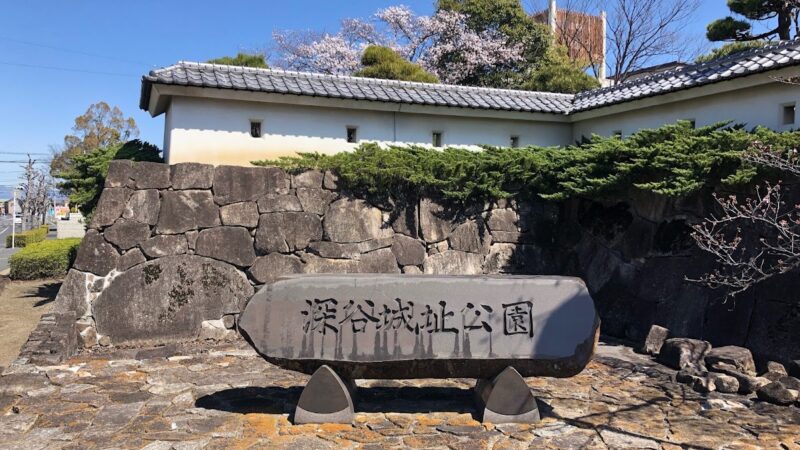
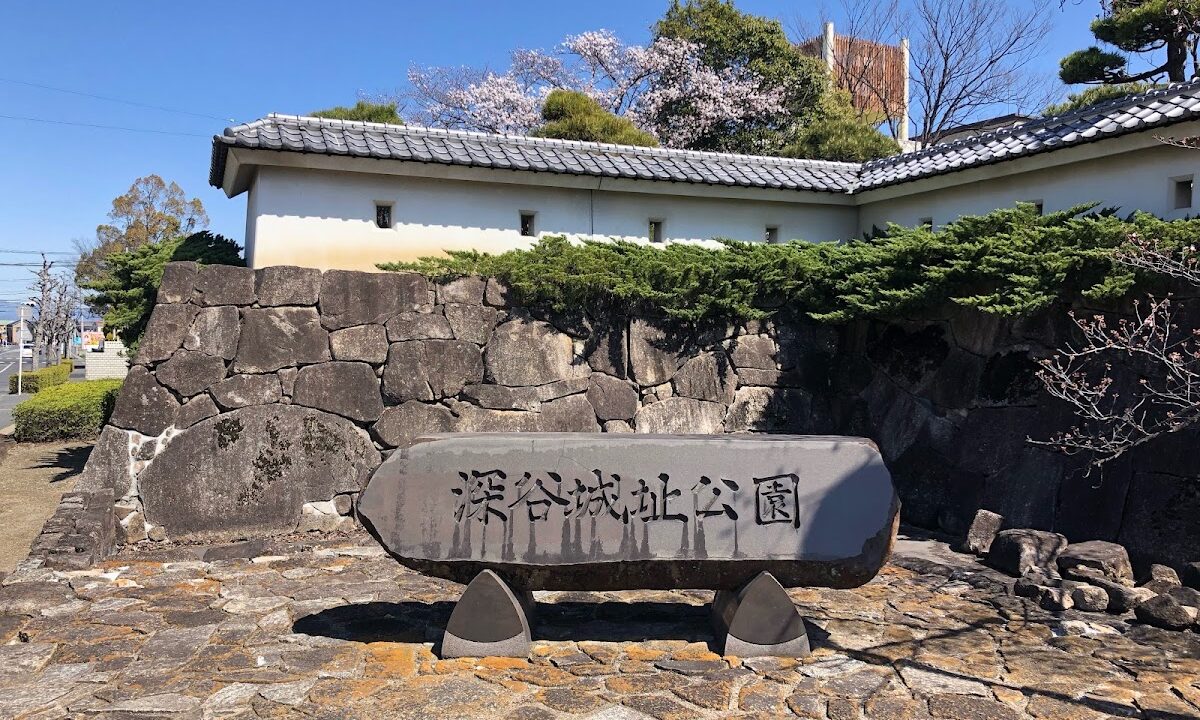
Fukaya Castle is currently maintained as Fukaya Castle Ruins Park and serves as a place of relaxation for citizens. The park covers approximately 17,977 square meters and features replica stone walls and fences, creating a space that evokes the image of a castle in its heyday.
History of Fukaya Castle
Background of Construction and the Establishment of the Fukaya Uesugi Clan
The construction of Fukaya Castle dates back to the mid-Muromachi period, specifically to the second year of Kōshō (1456). The builder, Uesugi Fusakane, was the son of Uesugi Norifusa, a member of the Yamanouchi Uesugi family, and became the founder of the Fukaya Uesugi clan, ruling over the Fukaya area.
The construction of the castle was influenced by the complex political situation in the Kanto region at the time. The conflict between the Kamakura Shogun and the Kanto Kanrei Uesugi clan, and the establishment of the Koga Shogun, made northern Musashi Province a militarily important region. Fukaya Castle was built as a base to prepare for invasions by the Koga Shogun and as a strategic point to secure the Uesugi clan’s sphere of influence.
Fukaya Castle in the Sengoku Period
The Fukaya Uesugi clan used this castle as their base for generations, extending their influence to the northern part of Musashi Province. Especially in the 16th century, the Kanto region entered an era of warfare with the rise of the Later Hojo clan.
Initially, the Fukaya Uesugi clan allied with the Yamanouchi Uesugi and Ogigayatsu Uesugi clans to oppose the Hojo clan. However, as the Hojo clan’s power grew, the Fukaya Uesugi clan also deepened their relationship with the Hojo clan. During the Tenbun era (1532-1555), the Fukaya Uesugi clan is considered to have effectively fallen under the influence of the Hojo clan.
The Siege of Odawara and the Surrender of Fukaya Castle in 1590
A major turning point in the history of Fukaya Castle was Toyotomi Hideyoshi’s Siege of Odawara in 1590. Because the Fukaya Uesugi clan sided with the Hojo clan, they became a target of attack by the Toyotomi forces.
When the forces of Maeda Toshiie and Uesugi Kagekatsu invaded Musashi Province, Fukaya Castle surrendered, bringing an end to the rule of the Fukaya Uesugi clan. The era of the Fukaya Uesugi clan, which lasted approximately 130 years, came to a close.
Fukaya Castle and the Fukaya Domain in the Edo Period
After the Siege of Odawara, Tokugawa Ieyasu, who was appointed to the Kanto region, valued the area of Fukaya. Following the Battle of Sekigahara in 1600, Matsudaira Tadateru, the sixth son of Tokugawa Ieyasu, entered Fukaya Castle.
The Era of Matsudaira Tadateru (1602-1616)
In 1602, Matsudaira Tadateru became the lord of the Fukaya Domain with a 10,000 koku stipend. However, Tadateru was transferred to the Echigo Takada Domain in 1606, making his time in Fukaya relatively short.
Matsudaira Tadashige’s Era (1616-1619)
After Tadateru’s transfer, Matsudaira Tadashige entered Fukaya Castle in 1616 (Genna 2) as the lord of the 20,000-koku Fukaya Domain. However, Tadashige was also transferred to the Himeji Domain in Harima Province in 1619 (Genna 5).
Sakai Tadakatsu’s Era and the Castle’s Abandonment (1619-1634)
In 1619 (Genna 5), Sakai Tadakatsu entered Fukaya Castle as the lord of the 20,000-koku Fukaya Domain. However, in 1632 (Kanei 9), Tadakatsu was transferred to the Matsushiro Domain in Shinano Province.
This transfer led to the abolition of the Fukaya Domain, and Fukaya Castle was officially abandoned in 1634 (Kanei 11). Approximately 180 years after its construction, the history of Fukaya Castle as a fortress came to an end.
Layout and Structure of Fukaya Castle
Castle Arrangement and Scale
Fukaya Castle was built as a flatland castle, boasting a size of approximately 600 meters east-west and 500 meters north-south. It had a terraced layout with the main keep (Honmaru) at its center, surrounded by the second bailey (Ninmaru), third bailey (Sanmaru), and eastern bailey (Higashi-kuruwa).
The castle’s defenses consisted mainly of earthworks and moats. A distinctive feature of Fukaya Castle is its defensive system, which skillfully utilized multiple moats and earthworks despite being a flatland castle. A triple moat system—inner, middle, and outer moats—protected the castle grounds, with the outer moat being particularly large, measuring over 15 meters wide and over 3 meters deep.
Main Keep and Second Bailey
The main keep (Honmaru) was located in the center of the castle and housed the residence of the Fukaya Uesugi clan. The main keep was surrounded by earthworks 3-4 meters high and separated from the other baileys by an inner moat.
The second bailey (Ninokuruwa) was located north and west of the main bailey (Honmaru), and it is believed that it housed the residences of retainers and buildings for administrative affairs. A wooden bridge spanned the second bailey and the main bailey, designed to be dropped for defense in times of emergency.
Third Bailey and Outer Enclosure
The third bailey formed the outer edge of the castle, where samurai residences and merchant districts were located. An outer moat surrounded the third bailey, forming the boundary with the castle town.
The eastern bailey (Higashi-kuruwa) was positioned as a projection on the eastern side of the castle, serving as an important defensive base against attacks from the east. The current Fukaya Castle Ruins Park corresponds to a part of this eastern bailey.
Current State and Remains of Fukaya Castle
Existing Remains
Unfortunately, most of the remains of Fukaya Castle have been lost due to development after its abandonment. However, with careful searching, several remains that evoke the castle’s former glory can still be found.
Outer Moat Remains (Fukaya City Designated Historic Site)
The most clearly preserved remains are those of the outer moat surrounding Fuji Sengen Shrine. These remains are designated as a historic site by Fukaya City and are valuable historical artifacts that allow us to appreciate the scale of the castle at the time. While parts are now used as waterways, the shape of the moat remains clearly visible.
Fuji Sengen Shrine is adjacent to the east side of Fukaya Castle Ruins Park. Walking through the shrine grounds, you can see the depressions of the moat and the rises of the earthworks. Marker posts have also been installed, making the location of the remains easy to understand.
Traces of Earthworks
Slight traces of earthworks remain around Fukaya Castle Ruins Park. In particular, the elevation differences on the north and east sides of the park show remnants of the earthworks from that era.
Topography of the Moat Remains
The layout of roads and waterways in the city shows traces of the former moat. Walking around the area surrounding Fukaya Castle, one may notice unnatural depressions and waterways; these are highly likely to be remnants of the castle’s moats.
Development of Fukaya Castle Ruins Park
Fukaya Castle Ruins Park is a park developed on the site of the former eastern enclosure. The park contains the following facilities and amenities:
Replica Stone Walls and Fences
In one corner of the park, there are replica stone walls and white-walled fences designed to resemble a castle. These are not based on historical fact, but are intended to create the atmosphere of a castle ruin, while helping to imagine the castle’s appearance in its heyday.
Fukaya Castle Ruins Monument
A stone monument inscribed with “Fukaya Castle Ruins” stands in the park, indicating that this is a historical castle site. Information boards are also installed around the monument, allowing visitors to learn about the history and structure of Fukaya Castle.
Park Facilities
Fukaya Castle Ruins Park is a well-maintained recreational area for citizens, equipped with playground equipment, benches, and restrooms. Cherry trees are also planted, making it a popular spot for cherry blossom viewing in spring.
Access to Fukaya Castle
Access by Train
The nearest station to Fukaya Castle Ruins Park is Fukaya Station on the JR Takasaki Line. Fukaya Station is conveniently accessible from both Tokyo and Gunma prefectures.
Walking Access from Fukaya Station
- Approximately 15 minutes on foot from the north exit of Fukaya Station
- Distance: Approximately 1.2 kilometers
- Route: Exit the station and head northwest towards Honjucho.
Fukaya Station is characterized by its brick-style exterior, modeled after Tokyo Station, in honor of Eiichi Shibusawa, a great figure born in Fukaya City. The station building itself is also a point of interest.
Access by Car
From the Kan-Etsu Expressway
- Approximately 20 minutes (approx. 12 kilometers) from Hanazono Interchange
- Approximately 25 minutes (approx. 15 kilometers) from Honjo-Kodama Interchange
From National Route 17
- Accessible via National Route 17 through Fukaya city center
Parking Information
Fukaya Castle Ruins Park does not have its own parking lot. We recommend using nearby coin-operated parking lots or parking lots around Fukaya Station and accessing the park on foot.
Highlights of Fukaya Castle and Surrounding Spots
How to Enjoy Fukaya Castle Ruins Park
Fukaya Castle Ruins Park is a park where you can enjoy various activities, not just historical walks.
Historical Exploration
Read the explanatory signs in the park and imagine the layout of the former castle. Visiting the remains of the outer moat around Fuji Asama Shrine will give you a real sense of the castle’s scale.
Seasonal Scenery
In spring, cherry blossoms bloom in profusion, making it a popular spot for cherry blossom viewing. In autumn, the autumn leaves can be enjoyed, allowing visitors to appreciate the scenery of each season.
Fuji Sengen Shrine
Adjacent to Fukaya Castle Ruins Park, Fuji Sengen Shrine is the site where the outer moat remains are best preserved. Visitors can explore the shrine grounds and observe the remains. The shrine itself has a rich history and is cherished as a center of local faith in Fukaya.
Shibusawa Eiichi Related Facilities
Fukaya City is the birthplace of Shibusawa Eiichi, known as the “father of Japanese capitalism.” When visiting Fukaya Castle Ruins Park, we recommend also visiting the following Shibusawa Eiichi related facilities.
Shibusawa Eiichi Memorial Museum
Located about 15 minutes by car from Fukaya Station, the memorial museum offers detailed information about the life and achievements of Shibusawa Eiichi.
Seishido and Seifutei
This Western-style building is designated as a National Important Cultural Property and is associated with Eiichi Shibusawa. It is located about 10 minutes by car from Fukaya Castle Ruins Park.
Attractions around Fukaya Station
Fukaya Station
The brick-style station building, modeled after Tokyo Station, is a popular photo spot. It was built in homage to Tokyo Station, which used bricks from the Nippon Brick Manufacturing Company, which Eiichi Shibusawa helped establish.
Fukaya Green Onions
Fukaya City is famous as a production area for “Fukaya green onions.” You can enjoy dishes using Fukaya green onions at restaurants around the station.
Cultural Property Designation and Preservation Activities of Fukaya Castle
Status of Designated Cultural Properties
The Fukaya Castle ruins are protected as a Saitama Prefecture designated historical site. Furthermore, the outer moat ruins around Fuji Asama Shrine are a Fukaya City designated historical site and are recognized as an important historical heritage of the region.
Efforts for Preservation and Utilization
The Fukaya City Board of Education is working on the preservation and utilization of the Fukaya Castle ruins. Activities include regular on-site surveys and holding history lectures for citizens, all aimed at passing on the value of the site as a local historical heritage to future generations.
In recent years, research on Fukaya Castle has progressed, and the possibility of discovering new remains through archaeological excavations has been pointed out. Further progress in research is anticipated.
Evaluation of Fukaya Castle and Points to Note When Visiting
Evaluation from Castle Enthusiasts
Fukaya Castle’s remains are not particularly well-preserved. According to the “Kojodan” (Castle Enthusiasts’ Group) evaluation, the average score is 2.36 out of 5, and the average visiting time is around 30 minutes. Some may find it unsatisfying in terms of enjoying the remains.
However, it is a castle of extremely high historical importance, having been the base of the important Sengoku period daimyo, the Fukaya Uesugi clan, and having been the castle lord of a son of Tokugawa Ieyasu in the early Edo period.
Points to Note When visiting Fukaya Castle, keeping the following points in mind will make your visit more fulfilling.
- Prior Study: Learning about the history and structure of Fukaya Castle beforehand will deepen your understanding at the site.
- Checking the Outer Moat Remains: The remains of the outer moat around Fuji Sengen Shrine are a must-see.
- Observing the Topography: Walk around the park and try to imagine the extent of the former castle grounds.
- Utilizing Information Boards: Carefully reading the information boards in the park will help you understand the history of the castle.
- Exploring the Surrounding Area: Accessing the castle on foot from Fukaya Station and walking around while looking for remnants of the castle town is also recommended.
Estimated Visit Time
- Fukaya Castle Ruins Park only: Approximately 30 minutes
- Exploring the surrounding area including the outer moat remains: Approximately 1 hour
- Round trip from Fukaya Station and exploring the surrounding area: Approximately 2 hours
Research and References on Fukaya Castle
Research on Fukaya Castle is progressing in the fields of regional history research and medieval castle research. The main references are as follows:
- *Medieval Castle Sites in Saitama Prefecture* (Saitama Prefectural Board of Education)
- *History of Fukaya City* (Fukaya City)
- *Comprehensive Survey of Japanese Castles*, Volume 5 (Shin Jinbutsu Oraisha)
- Articles related to Fukaya Castle in various castle research journals
These documents provide detailed explanations of Fukaya Castle’s layout, historical changes, and the activities of the Fukaya Uesugi clan.
Summary: Historical Significance of Fukaya Castle
Although the remaining structures of Fukaya Castle are limited, it is an important castle for understanding the history of the Kanto region from the Sengoku period to the early Edo period.
It existed for approximately 130 years as the base of the Fukaya Uesugi clan and played a central role in the politics and military of northern Musashi Province. The historical flow of events—the castle’s surrender during the Siege of Odawara, the establishment and abolition of the Fukaya Domain in the early Edo period, and the subsequent abandonment of the castle—symbolizes the transition from the Sengoku period to the Edo period.
The current Fukaya Castle Ruins Park is a valuable site that conveys the region’s history and is also a beloved place of relaxation for citizens. When you visit Fukaya City, why not take a look at these historic castle ruins and reflect on what it was like in the past?
By visiting the Shibusawa Eiichi-related facilities around Fukaya Station and enjoying Fukaya leek cuisine, you can comprehensively enjoy the history and culture of Fukaya City.