Complete Guide to the History and Highlights of Kobanawa Castle (Fukaya City, Saitama Prefecture) | The Origin of the Fukaya Uesugi Clan
Kobanawa Castle is a Muromachi period flatland castle located in Kokusaiji, Fukaya City, Saitama Prefecture. Known as the first residence of the Fukaya Uesugi clan, it is now part of the grounds of Kokusaiji Temple. This article provides a detailed explanation of Kobanawa Castle, from its historical background to existing remains and access methods.
Basic Information on Chōbana-wa Castle
Castle Overview
Common Name/Alternate Name: Kokusaiji-kan
Location: Kokusaiji, Fukaya City, Saitama Prefecture
Former Province: Musashi Province
Classification/Structure: Flatland Castle
Builder: Uesugi Norifusa
Year of Construction: Muromachi period (late 14th century)
Year of Abandonment: Kōshō 2 (1456)
Main Lords: Chōbana-wa Uesugi clan (Fukaya Uesugi clan)
Remains: Earthworks, artificial hills
Designated Cultural Property: Fukaya City Designated Historic Site
Chōbana-wa Castle is located approximately 20-25 minutes on foot east of JR Fukaya Station. The entire current Kokusaiji Temple grounds are the castle site, and the earthworks from that time remain in good condition behind the main hall.
History of Chōbana Castle
Background of Construction and Uesugi Norihide
Chōbana Castle was built in the late 14th century by Uesugi Kurōdo Norihide, the sixth son of Yamanouchi Uesugi Noriaki, the first Kantō Kanrei (governor of the Kantō region). The purpose of its construction was to secure a military base to counter Nitta Yoshimune, the son of Nitta Yoshisada.
Uesugi Noriaki was a powerful samurai who served as steward for Ashikaga Motouji, the Kamakura Shogun. It is believed that Norihide was stationed in northern Musashi Province as part of the Uesugi clan’s expansion of power in the Kantō region. Norihide built the castle in this area and became the ancestor of the Fukaya Uesugi clan (Chōbana Uesugi clan).
The Castle of Three Generations of the Fukaya Uesugi Clan
Chōbana Castle served as the first residence of the Fukaya Uesugi clan for three generations:
- First Generation: Uesugi Norihide – Builder of the castle and founder of the Fukaya Uesugi clan
- Second Generation: Uesugi Norimitsu – Succeeded Norihide and further developed the castle.
- Third Generation: Uesugi Norinobu – Successor to Norimitsu and defended the castle.
According to the “Shinpen Musashi no Kuni Fudoki Kō” (New Compilation of the Topography of Musashi Province), Chōbana Castle at the time was a large residence boasting dimensions of “94 ken east-west and 69 ken north-south” (approximately 170 meters x 125 meters). This record indicates that it was not merely a fort, but a full-fledged castle facility functioning as a base for regional control.
Relocation to Fukaya Castle and Abandonment
In 1456 (Kōshō 2), the fourth head of the Uesugi clan, Uesugi Mutsu-no-kami Norifusa (also known as Norikuni), built a new castle, Fukaya Castle, which was better suited for defense, and moved his base there. Consequently, Chōbana Castle is believed to have closed its doors after approximately 80 years of history and was abandoned.
The following points are speculated as reasons for the relocation to Fukaya Castle:
- Topographical advantage overlooking a wider plain
- Convenience of transporting goods using the Tone River system
- The need for a new base to govern an expanding territory
After its abandonment, the Chōbana Castle site was developed as the grounds of Kokusaiji Temple, founded by Uesugi Norihide, and came to serve as the family temple of the Fukaya Uesugi clan.
Layout and Structure of Chōbana Castle
Characteristics as a Flatland Castle
Chōbana Castle is a typical flatland castle, built on flat land rather than utilizing the rugged terrain of a mountain castle. Located in the plains of northern Musashi Province, it was a suitable location for managing surrounding farmland and roads.
While flatland castles are inferior to mountain castles in terms of defense, they had the following advantages:
- Easy to conduct daily administrative and economic activities
- Easy to transport supplies and assemble troops
- Closer proximity to the people, making governance easier
Castle Size and Enclosure Configuration
As mentioned above, the “Shinpen Musashi no Kuni Fudoki-ko” (New Compilation of the Topography of Musashi Province) records that the castle measured “94 ken east-west and 69 ken north-south.” This was a considerable size for the time, and it is presumed to have been a castle with multiple enclosures (kuruma).
Based on the current topography of the Kokusaiji Temple grounds, the following structure is possible:
- Main Enclosure (Honmaru): Believed to have been located around the current main hall.
- Second Enclosure: Arranged to surround the main enclosure.
- Earthwork: Defensive structure surrounding the enclosure (still existing).
- Moat: Possibly located outside the earthwork (currently buried).
Defensive Measures
Even though it was a flatland castle, Chōbana Castle incorporated various defensive measures:
- Earthwork: Earthworks several meters high surrounded the enclosure, preventing enemy intrusion.
- Watchtower: A watchtower was erected to monitor the surrounding area (the remains of the watchtower still exist).
- Main Gate: The castle’s main gate was heavily fortified (the remains of the main gate still exist).
- Artificial Hill: A raised platform for observation and command (still remains behind the main hall).
Highlights of the Current Chōbana Castle Ruins
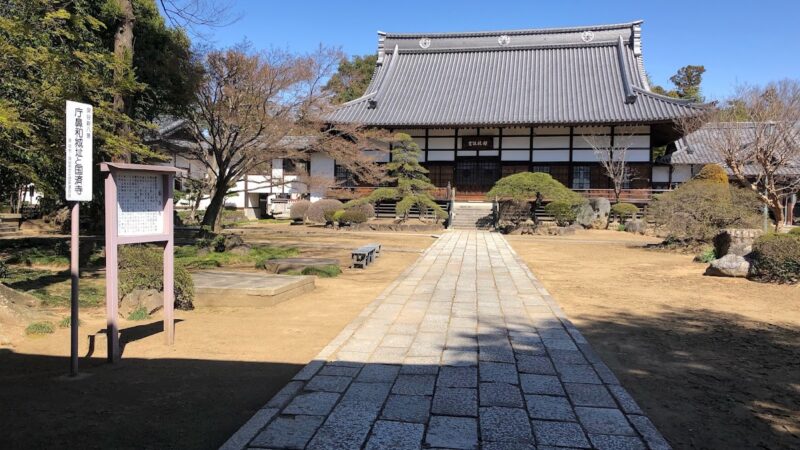
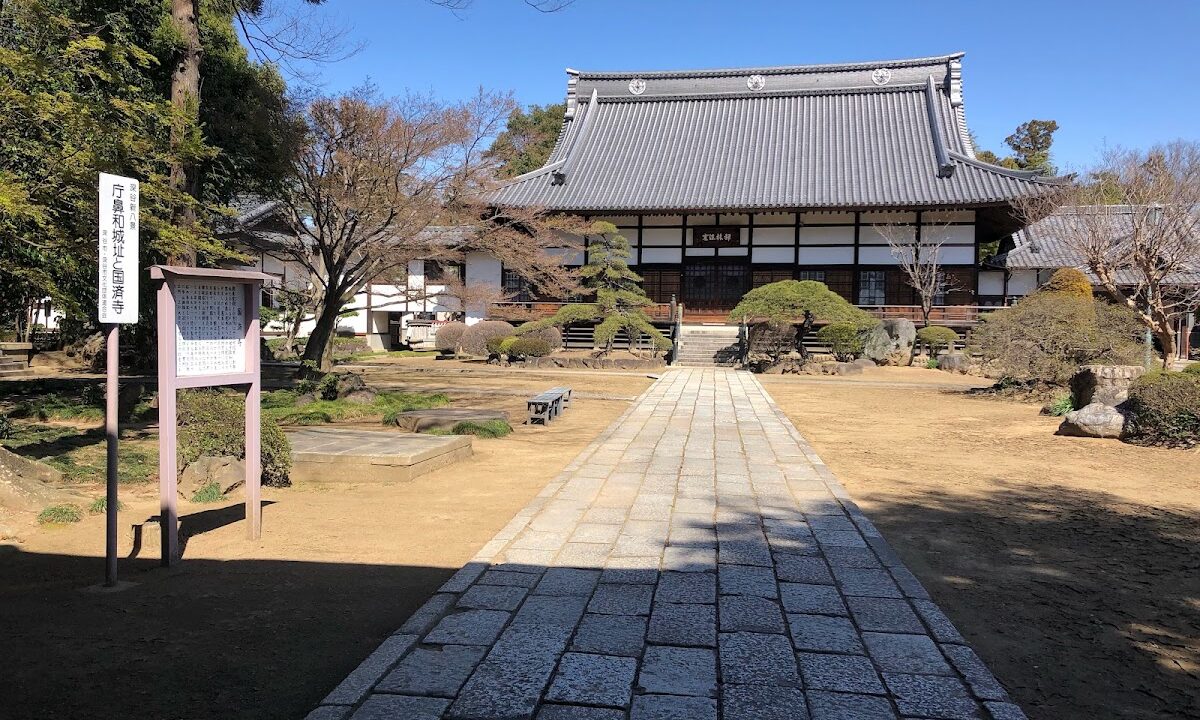
Kokusaiji Temple and Castle Ruins
The Chōbana Castle ruins are currently located within the grounds of Kokusaiji Temple and are protected as a designated historical site by Fukaya City. Kokusaiji Temple was founded by Uesugi Norihide and serves as the family temple of the Fukaya Uesugi clan, housing the tombs of successive clan heads.
The Kokusaiji Temple Sanmon Gate is a designated cultural property of Fukaya City and a valuable structure that preserves the architectural style of the Edo period. Passing through the gate, a tranquil temple grounds unfolds, allowing visitors to feel the weight of history.
Remaining Structures
The main remains of Chōbana Castle are as follows:
Earthwork Remains
Behind the main hall, earthworks dating back to the Muromachi period are well-preserved. Approximately 2-3 meters high, they give a sense of the scale of the defensive facilities at the time. While climbing onto the earthworks is not permitted, their grandeur can be appreciated up close.
Artificial Hill (Observation Platform)
Behind the main hall remains an artificial hill, believed to be the foundation of a watchtower or a raised platform used as a command post. Although now overgrown with trees, it was an important structure for surveying the surrounding area in the past.
Watchtower Site
An information board has been erected on the temple grounds at the location where the watchtower is believed to have stood. While the tower itself no longer exists, its location allows us to imagine the structure of the castle at that time.
Main Gate Site
The site of the main gate, the Otemon, can also be seen. Currently, a stone monument and an explanatory sign stand there, indicating that this was once the main entrance to the castle.
Burial Grounds of the Uesugi Clan
Within the grounds of Kokusaiji Temple, the graves of successive heads of the Fukaya Uesugi clan, including Uesugi Norihide, are neatly arranged. These gravestones are a valuable historical site that conveys the history of the Fukaya Uesugi clan, attracting many history enthusiasts.
The cemetery is located east of the main hall, offering a tranquil setting for reflection on history. The tombstones bear the posthumous names of each family head, allowing visitors to trace the lineage of the Fukaya Uesugi clan from the Muromachi period to the Sengoku period.
Information Boards and Explanations
Within the temple grounds, there are detailed information boards installed by the Fukaya City Board of Education, where you can learn about the history and structure of Chōbana Castle. The boards include a map of the castle’s layout and a historical timeline, making it easy for first-time visitors to understand the overall structure of the castle.
The Fukaya Uesugi Clan and the History of the Kanto Region
The Yamanouchi Uesugi Clan and the Kanto Kanrei
Uesugi Norihide, the ancestor of the Fukaya Uesugi clan, was a member of the Yamanouchi Uesugi clan. The Yamanouchi Uesugi clan held the important position of Kanto Kanrei (Kanto Deputy) during the Muromachi period, wielding immense power as representatives of the shogunate in the Kanto region.
The Kanto Kanrei (Governor of the Kanto region) was an official position that assisted the Kamakura Kubo (the Ashikaga clan of Kanto) and was responsible for governing the eight Kanto provinces (Sagami, Musashi, Awa, Kazusa, Shimosa, Hitachi, Kozuke, and Shimotsuke). Uesugi Noriaki, as the first Kanto Kanrei, established the foundation of the Uesugi clan in Kanto.
Independence and Development of the Fukaya Uesugi Clan
With Norihide stationed in Fukaya, the Fukaya Uesugi clan developed as an independent force. While maintaining a degree of independence from the main Yamanouchi Uesugi clan, they maintained a cooperative relationship and became a powerful feudal lord in northern Musashi Province during the Sengoku period.
The Fukaya Uesugi clan expanded its power even after moving its base from Chōbana Castle to Fukaya Castle, forming a major force by subjugating surrounding local lords during the Sengoku period. However, in the later Sengoku period, they faced pressure from the Hojo clan and ultimately came under the control of the Later Hojo clan.
Conflict with the Nitta Clan
The direct impetus for the construction of Chōbana Castle was the conflict with Nitta Yoshimune. The Nitta clan were descendants of Nitta Yoshisada, a powerful general of the Southern Court, and were enemies of the Uesugi clan, who supported the Northern Court.
Uesugi Noriaki, in order to curb the Nitta clan’s expansion, stationed Norihide in northern Musashi Province and had Chōbana Castle built. This castle is believed to have served as a frontline base against the Nitta clan.
Access and Visiting Information
Access by Train
Nearest Station: JR Takasaki Line, Fukaya Station
Distance from Station: Approximately 20-25 minutes on foot (approximately 1.5 km)
Exit the east exit of Fukaya Station and head towards National Route 17. Follow the signs and you will arrive at Kokusaidera Temple. The path is flat and easy to walk, but the sun is strong in the summer, so a hat or parasol is recommended.
Access by Car
Kan-Etsu Expressway: Approximately 20 minutes from Hanazono Interchange
National Route 17: Approximately 10 minutes from Fukaya city center
Parking: Kokusaiji Temple has a parking lot for visitors (free). However, space is limited, so caution is advised during busy periods such as long holidays.
Notes for Visitors
- Kokusaiji Temple is an active temple, so please observe proper visiting etiquette.
- While viewing the interior of the main hall is usually not permitted, you can freely view the exterior and grounds.
- Please refrain from climbing on the earthworks or ruins.
- Photography is permitted, but please be considerate of other visitors.
- Please take all your trash with you.
Estimated Visiting Time
Approximately 30 minutes to 1 hour is a guideline for strolling through the grounds and viewing the ruins. Those who want to immerse themselves in history or enjoy taking photographs should allocate 1 hour or more.
Nearby Attractions
Fukaya Castle Ruins
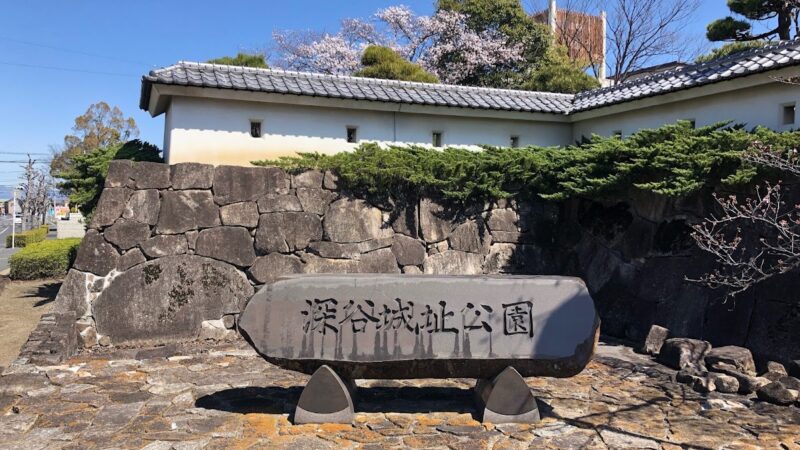
The ruins of Fukaya Castle, where the Fukaya clan relocated their base from Chōbana Castle, are also located within Fukaya City. Currently, it is maintained as Fukaya Castle Ruins Park, and parts of the earthworks and moats remain. Visiting both Chōbana Castle and Fukaya Castle together will allow you to gain a deeper understanding of the history of the Fukaya Uesugi clan.
Location: Honjumachi, Fukaya City, Saitama Prefecture
Access: Approximately 15 minutes on foot from JR Fukaya Station
Shibusawa Eiichi Memorial Museum
Fukaya City is the birthplace of Shibusawa Eiichi, known as the father of modern Japanese economics. At the Shibusawa Eiichi Memorial Museum, you can learn about Eiichi’s life and achievements.
Location: 1204 Shimo-Tege, Fukaya City, Saitama Prefecture
Opening Hours: 9:00 AM – 5:00 PM (Last entry 4:30 PM)
Closed: New Year’s Holidays
Fukaya Station (Brick Station Building)
Fukaya Station’s building is a beautiful brick structure modeled after Tokyo Station. Fukaya City is famous for brick production, and this building is cherished as a symbol of that history.
Recommended Points for Castle Fans
A Typical Example of a Muromachi Period Flatland Castle
Chōbana-wa Castle is a valuable example for understanding the structure of a Muromachi period flatland castle. It showcases a simple yet practical design, different from the complex layouts of the Sengoku period.
An Important Center for Uesugi Clan Research
As the birthplace of the Fukaya Uesugi clan, a branch of the Kanto Kanrei Uesugi clan, this is an indispensable historical site for studying the history of the Uesugi clan. It provides clues to understanding the activities of the branch families that separated from the Yamanouchi Uesugi clan.
Well-Preserved Earthworks
The earthworks behind the main hall are remarkably well-preserved for a Muromachi period structure. With minimal later alterations, it’s a valuable historical site that allows us to appreciate the civil engineering techniques of the time.
A Quiet Stroll Through the Castle Ruins
Kokusaiji Temple is located in a quiet residential area, allowing visitors to leisurely explore the castle ruins away from the hustle and bustle. It’s rarely crowded, providing an ideal environment for reflecting on history.
Summary
Chōbana Castle is a valuable Muromachi period castle site remaining in Fukaya City, Saitama Prefecture. It functioned as the first residence of the Fukaya Uesugi clan for approximately 80 years, and has since become the grounds of Kokusaiji Temple.
The existing earthworks, mounds, watchtower remains, and main gate remains are valuable historical materials that convey the structure of a Muromachi period flatland castle. Furthermore, the tombs of successive heads of the Fukaya Uesugi clan, including Uesugi Norihide, attest to the fact that this site remained the spiritual center of the Fukaya Uesugi clan.
Its convenient location, within walking distance of JR Fukaya Station, is one of its attractions. Visiting it along with other nearby tourist spots such as the Fukaya Castle Ruins and the Shibusawa Eiichi Memorial Museum will allow you to gain a deeper understanding of Fukaya City’s rich history.
For castle enthusiasts, history buffs, and those who enjoy a quiet historical site tour, Chōbana Castle is well worth a visit. When you visit Fukaya City, be sure to stop by Kokusaiji Temple and experience the atmosphere of the Muromachi period.