Complete Guide to Tsuneyama Castle Ruins | A Sengoku Period Mountain Castle Spanning Okayama City and Tamano City, and the Legend of the Tsuneyama Women’s Army
What is Tsuneyama Castle? | An Overview of Okayama Prefecture’s Leading Sengoku Period Mountain Castle
Tsuneyama Castle is a Japanese castle (mountain castle) built on the summit of Mt. Tsuneyama, approximately 300 meters above sea level, spanning Sakagawa in Minami Ward, Okayama City, and Utogi, Yokichi, and Kime in Tamano City, Okayama Prefecture. It is protected as a designated historical site of Okayama City and Tamano City, and functioned as an important military base in Bizen Province during the Sengoku period.
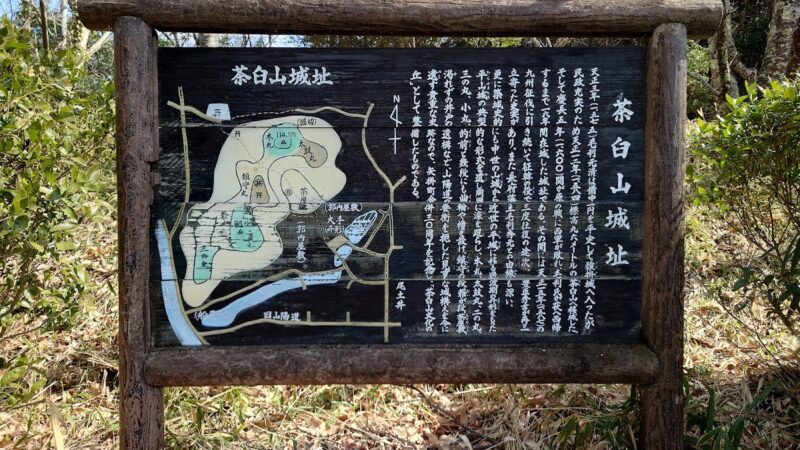
The Tsuneyama Castle ruins are known as a “renkaku-shiki yamajo” (a mountain castle ruin consisting of fourteen baileys), built during the Sengoku period. As one of the prefecture’s leading mountain castles, its lords include the Ueno, Togawa, and Iki clans, and it is particularly famous nationwide as the site of the “Battle of the Tsuneyama Women’s Army” in 1575.
Currently, the castle ruins are maintained as “Tsuneyama Park,” and a hiking trail has been established, making it relatively easy to visit. Near the summit, remnants such as dry moats, earthworks, and stone walls are well-preserved, making it a valuable historical site where visitors can experience the structure of a Sengoku period mountain castle firsthand.
Location and Strategic Importance of Tsuneyama Castle
Tsuneyama is located at the base of the Kojima Peninsula, a strategically important location near the border between Bizen and Bitchu provinces. This location offered a view of the Seto Inland Sea and was strategically crucial for monitoring both land and sea routes. Even today, the summit offers panoramic views of the Okayama Plain, the Seto Inland Sea, and even the mountains of Sanuki.
At an altitude of 300 meters, it was a medium-sized mountain castle for its time, but it features a highly defensible layout that takes advantage of the steep terrain. Built on a ridge, this approximately 200-meter-long enclosure-style mountain castle showcases skillful construction techniques that cleverly utilize the natural terrain.
History of Tsuneyama Castle | From Construction to Abandonment
Construction by the Ueno Clan (Late 15th Century)
Tsuneyama Castle was first built by the Ueno clan, who were based near Shimomichi District in Bitchu Province. It is believed to have been built around 1490 (Entoku 2) as part of the Ueno clan’s consolidation of control over the region after seizing the Kumano Shrine territory in Kojima District, Bizen Province.
The Ueno clan were powerful local lords in Bitchu Province, and Tsuneyama Castle functioned as a base for their expansion into Bizen Province. While the initial castle is thought to have been relatively small, it is believed to have been gradually expanded and strengthened amidst the turmoil of the Sengoku period.
Changes in Castle Lords during the Sengoku Period
The lords of Tsuneyama Castle changed several times in accordance with the changing circumstances of the Sengoku period. The following individuals are known as the main lords of the castle:
- Ueno clan: Builders of the castle and rulers for a long period.
- Togawa clan: Served as lords of the castle for a time as vassals of the Ukita clan.
- Iki clan: Involved as a powerful local lord of Bizen Province.
Especially during the time of Ueno Hizen-no-kami Takanori (Takanori), the castle was most developed, growing into a large mountain castle with fourteen baileys. During this period, Tsuneyama Castle became known as one of the strongest castles in Bizen Province.
The Battle of Tsuneyama and the Battle of the Tsuneyama Women’s Army in 1575
The most famous event in the history of Tsuneyama Castle is the “Battle of Tsuneyama” which took place in 1575. This battle was part of the Mori clan’s invasion of Bizen Province.
The Mori army, led by Kobayakawa Takakage, attacked Tsuneyama Castle, riding the momentum of their pacification of Bitchu Province. Lord Ueno Hizen-no-kami Takanori, the castle lord, resisted fiercely, but was defeated by the overwhelming difference in troop numbers and committed suicide.
At this time, Takanori’s wife, Tsuruhime, refused to surrender even after her husband’s death, and it is said that she led over thirty ladies-in-waiting and women from the castle to challenge Nomi Munekatsu, a general of the Mori army, to a duel. Tsuruhime’s female army fought bravely, but ultimately all were killed, meeting a glorious yet tragic end.
This “Battle of the Women’s Army at Tsuneyama” became known nationwide as a tale of female valor during the Sengoku period, and gave rise to many stories and legends in later generations.
Renovations under Mori Rule
After the Battle of Tsuneyama, Tsuneyama Castle came under the control of the Mori clan. The Mori clan considered Tsuneyama Castle important as a base for controlling Bizen Province and renovated and strengthened the castle.
The documents of Motokiyo Hota contain the phrase, “We intend to order construction work on Tsuneyama Castle soon,” confirming that the Mori clan was planning the castle’s repairs. It is believed that the construction of stone walls and the expansion of the baileys took place during this period.
Abandonment of the Castle and its Aftermath
After the Battle of Sekigahara (1600), when the Mori clan was transferred to western Japan, Tsuneyama Castle ceased to serve its purpose. By the early Edo period, it had already been abandoned, losing its function as a castle.
However, the legend of the Tsuneyama Women’s Army was passed down among the local people, and the belief in Tsuruhime and others continued throughout the Edo period. Even after the Meiji era, it was preserved as an important historical heritage site of the region.
Layout and Remains of Tsuneyama Castle | Structure of a Concentric Mountain Castle
A Concentric Mountain Castle Consisting of Fourteen Baileys
Tsuneyama Castle is classified as a “concentric mountain castle.” The “renkaku-shiki” style is a castle layout where multiple baileys (kuruma) are arranged linearly around a central bailey, a typical arrangement that utilizes the ridgeline of a mountain castle.
Tsuneyama Castle consists of fourteen baileys, making it one of the larger mountain castles in Okayama Prefecture. Each bailey is arranged in a terraced fashion, utilizing the difference in elevation, creating a mutually defensive structure.
Structure of the Main Bailey (Honmaru)
The central bailey, believed to be the main bailey, is located at the highest point of the castle. It is surrounded by a moat with steep cliffs (artificially carved cliffs) and fortified with earthen ramparts up to 2 meters high.
The main bailey is estimated to be approximately 40 meters east-west and 30 meters north-south, and is thought to have housed the lord’s residence and command post. Even today, flat terrain remains, allowing us to imagine what it looked like in those days.
Moats and Earthen Rampant Works
Notable defensive features of Tsuneyama Castle include multiple moats and earthen ramparts. The moats (horikiri) were dry moats dug to cut across the ridgeline, serving as an important defensive line to prevent enemy intrusion.
At least three moats have been identified around the main enclosure, some reaching depths of over 3 meters. These moats remain remarkably well-preserved, making them valuable historical relics demonstrating the castle-building techniques of the Sengoku period.
The earthen ramparts (domidori) were earthen walls built along the edges of the enclosures, enhancing defensive capabilities and also functioning as building foundations. Remains of these ramparts, approximately 1-2 meters high, can be found in various locations.
Remains of Stone Walls
Stone wall remains have also been confirmed at Tsuneyama Castle. These are believed to have been constructed during renovations under the Mori clan’s rule, and are important historical relics showing the transitional period from the late Sengoku period to the early modern castle era.
The stone walls are found around the main enclosure and in some of the enclosures, built using the nozurazumi technique (a method of stacking natural stones as they are). Although small in scale, they are valuable examples of stone walls being used in mountain castles.
Ascent Route and Outpost
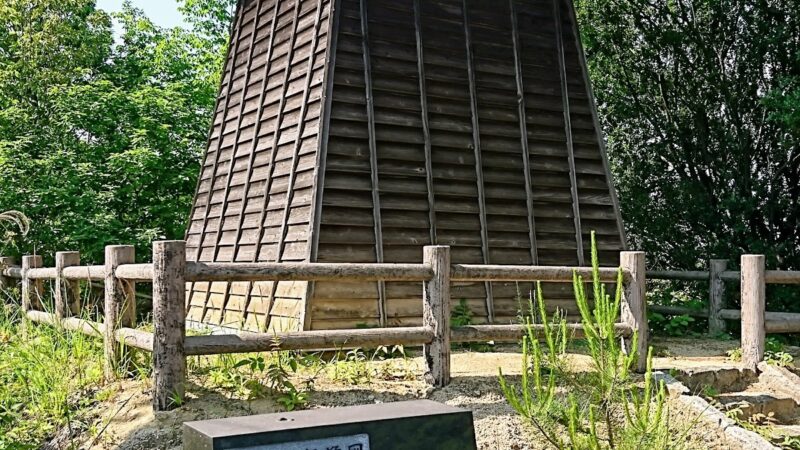
Currently, the ascent route from the prefectural road is well-maintained, and it takes about 5 minutes to reach the outpost. The outpost was a fortified enclosure that functioned as a forward base for the castle, and a steel tower now stands there.
From the outpost to the main enclosure, it is necessary to climb further along the ridge, and several remains of fortified enclosures can be seen along the way. The ascent route is thought to largely follow the main entrance road (the road to the front entrance) from the Sengoku period.
Tsuneyama Women’s Army Gravestone | Tsuruhime and 34 Stone Monuments
Origin of the Women’s Army Gravestone
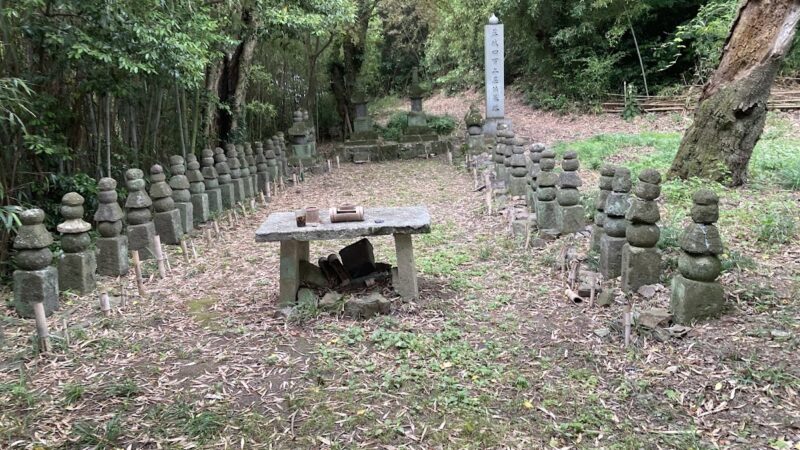
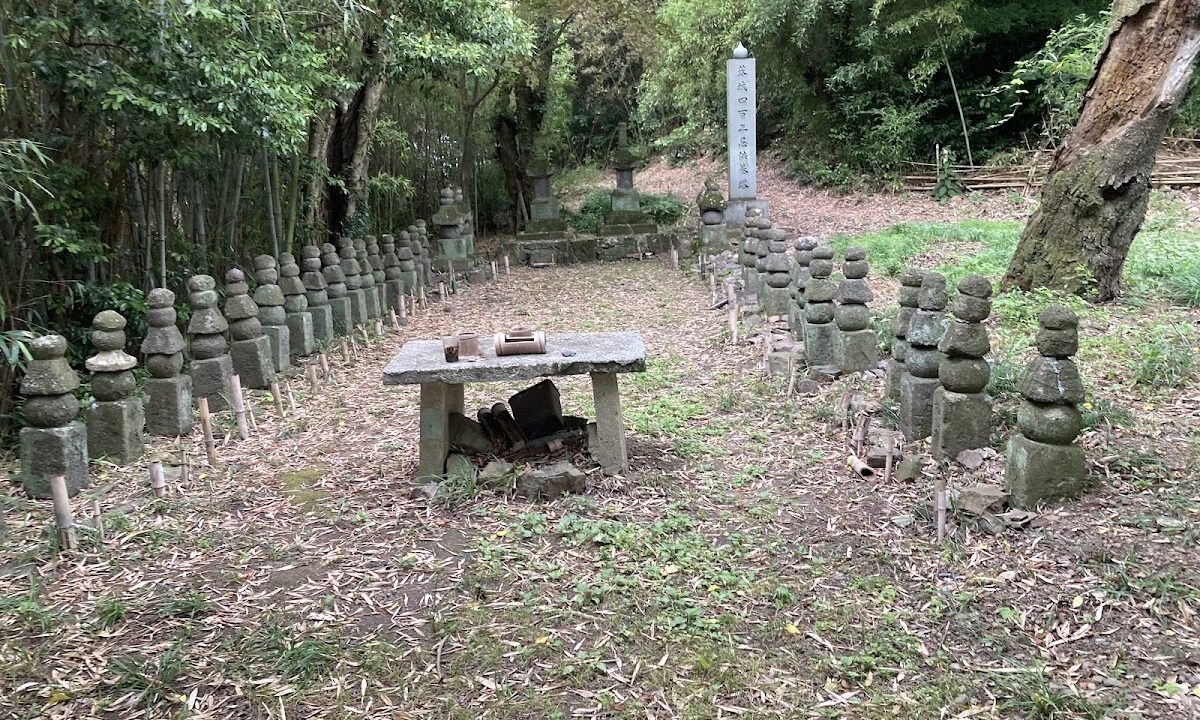
Near the summit of Tsuneyama Castle ruins is a burial site called the “Women’s Army Gravestone.” This is a memorial to Tsuruhime and her 34 ladies-in-waiting who died in the Battle of Tsuneyama in 1575 (Tensho 3).
Based on the legend that Tsuruhime and 34 other women fought back and met a glorious end, 34 stone monuments still stand quietly amid the deep dew of grass. These stone monuments are said to have been erected by local people during the Edo period.
The Legend of Tsuruhime
Tsuruhime lived with her husband, Ueno Takanori, in Tsuneyama Castle. After Takanori’s death in battle, Tsuruhime, determined to “protect the castle despite being a woman,” gathered the women within the castle and armed them.
According to legend, Tsuruhime, wielding a naginata (a type of pole weapon), led the charge and challenged Nomi Munekatsu, a general of the Mori clan, to a duel. Although ultimately outnumbered and defeated, her bravery is said to have deeply impressed the enemy generals.
Current State of the Graves and Visiting the Site
Currently, the graves of the women’s army are one of the important points of interest at the Tsuneyama Castle ruins. The 34 stone monuments are weathering, but they are carefully preserved by local people.
Every year, a memorial service is held by local volunteers, continuing the tradition of commemorating Tsuruhime and the courage of the women’s army. The area around the graves is well-maintained, allowing visitors to pay their respects in peace.
While the individual names are not inscribed on the stone monuments, each one symbolizes the women who fought alongside Tsuruhime, making it a valuable historical site that conveys the tragedy of the Sengoku period.
Excavation Survey and Artifacts at Tsuneyama Castle Ruins
Excavation Survey by the Okayama Prefectural Board of Education
In 1980, the Okayama Prefectural Board of Education conducted a full-scale excavation survey at Tsuneyama Castle Ruins. The results of this survey were published as the 10th volume of the “Okayama Prefecture Buried Cultural Properties Report,” and are important resources for understanding the structure and age of Tsuneyama Castle.
The survey revealed the layout of the baileys, the structure of the moats, and the construction methods of the stone walls. It also confirmed that the castle had been renovated and expanded over multiple periods.
Main Excavated Artifacts
The excavation has yielded various artifacts that tell the story of life during the Sengoku period:
- Roof Tiles: Fragments of roof tiles used in buildings have been unearthed, indicating that some buildings had tiled roofs.
- Bizen Ware: Numerous Bizen ware jars, pots, and plates used in daily life have been unearthed.
- Iron Products: Iron products such as sword fragments, arrowheads, and nails have been identified.
- Ceramics: Fragments of Chinese celadon and white porcelain have also been unearthed, demonstrating the high economic power of the castle lord.
These excavated artifacts are stored at the Okayama Prefectural Ancient Kibi Cultural Properties Center and the Tamano City Board of Education, and some are on display.
Castle Transformation Revealed by the Investigation
The archaeological excavation has revealed that Tsuneyama Castle can be divided into at least three periods:
- Phase 1 (Late 15th Century – Early 16th Century): The initial construction period by the Ueno clan. A relatively small mountain castle.
- Phase 2 (Mid-16th Century – 1575): The expansion period by the Ueno clan. It developed into a large-scale castle with fourteen baileys.
- Phase 3 (After 1575): The renovation period by the Mori clan. Introduction of modern elements such as the construction of stone walls.
This transformation is a good example of how mountain castles of the Sengoku period became larger and more complex over time.
Access Information | How to Get to Tsuneyama Castle Ruins
Location
Sakagawa, Minami-ku, Okayama City, Okayama Prefecture and Utogi, Yokichi, and Kime, Tamano City
Tsuneyama Castle Ruins are located on the border between Okayama City and Tamano City, and therefore straddle both cities. The main trailhead is on the Okayama City side.
Access by Public Transportation
From JR Uno Line “Tsuneyama Station”:
- Approximately 40 minutes on foot from Tsuneyama Station (to the trailhead)
- Approximately 20-30 minutes on foot from the trailhead to the summit
When using public transportation, Tsuneyama Station is the nearest station. However, since it is a bit of a distance from the station to the trailhead, you may want to consider taking a taxi.
Access by Car
From Okayama City Center:
- Head south on National Route 30, then take Prefectural Route 21 (Okayama-Kojima Line) for approximately 30 minutes.
- Set your car navigation system to “Tsuneyama Castle Ruins” or “Okayama City, Minami Ward, Sakagawa”.
From the Seto-Chuo Expressway:
- Approximately 15 minutes from Kojima Interchange via Prefectural Route 21.
Parking
There are several parking spaces near the trailhead. However, some areas are unpaved, so caution is advised. The parking lot can become full on holidays and during peak seasons, so early arrival is recommended.
Precautions for Hiking
- Estimated Time: Approximately 20-30 minutes one way from the trailhead to the summit, allowing about 1 hour round trip.
- Clothing: As you will be walking on mountain trails, athletic shoes or trekking shoes are recommended.
- Items to Bring: It is a good idea to bring drinks, a towel, and insect repellent (in summer).
- Season: Spring and autumn are suitable for hiking. Heat protection is necessary in summer, and warm clothing in winter.
- Opening Hours: There are no specific restrictions, but please try to descend before sunset.
The hiking trail is relatively well-maintained, but there are steep slopes and slippery sections, so please climb with caution.
Points of Interest at Tsuneyama Castle Ruins
Main Enclosure (Honmaru) Site
The main enclosure site at the summit is the most important point of interest at Tsuneyama Castle Ruins. The remains of the flattened enclosure are clearly visible, and the surrounding earthworks and cliffs can also be seen. Standing here, you’ll be greeted by a 360-degree panoramic view, the same one the castle lord must have gazed upon.
Moats and Earthworks
The moats surrounding the main enclosure are remnants that allow you to truly appreciate the defensive structures of the Sengoku period. The dry moats, over 3 meters deep, cut across the ridge, demonstrating the advanced castle-building techniques of the time. Observing them together with the earthworks provides a clear understanding of the castle’s defensive system.
Graves of the Female Soldiers
The 34 stone monuments of the female soldiers symbolize the history of Tsuneyama Castle. These monuments, nestled in a quiet forest, convey the tragedy of the Sengoku period. Take your time to pay your respects and remember the courage of Tsuruhime and her ladies-in-waiting.
View
The view from the mountaintop is magnificent; on a clear day, you can see the Okayama Plain, the Seto Inland Sea, and even the Sanuki Mountains of Shikoku. This view speaks volumes about why Tsuneyama was chosen as a military base.
Tourist Attractions Around Tsuneyama Castle Ruins
Attractions in Minami Ward, Okayama City
Kojima Bay Embankment: A legacy of large-scale civil engineering work from the Meiji era, located about 15 minutes by car from Tsuneyama Castle Ruins.
Nadazaki Town Coast: An area where you can enjoy the beautiful scenery of the Seto Inland Sea, and also enjoy swimming and fishing.
Tourist Attractions in Tamano City
Shibukawa Coast: A beautiful coast selected as one of “Japan’s Top 100 Beaches,” located about 20 minutes by car from Tsuneyama Castle Ruins.
Ojigatake: Part of the Seto Inland Sea National Park, a tourist spot where you can enjoy unique rock formations and spectacular views.
Miyama Park: A vast park where you can enjoy flowers in all four seasons, and a popular spot for families.
Cultural Property Designation and Preservation Activities of Tsuneyama Castle Ruins
History of Historic Site Designation
Tsuneyama Castle Ruins were officially designated as an Okayama City Historic Site on July 27, 2010. The portion on the Tamano City side is also a Tamano City Historic Site, and both cities are responsible for its protection.
The following points were evaluated as reasons for the designation:
- High historical value as the stage of the “Battle of Tsuneyama”
- Well-preserved remains such as the terraced structure of the baileys and stone walls
- An important site for understanding the Sengoku period history of this region
- A valuable example showing the transition process to early modern castles
Preservation Activities and Maintenance
Preservation activities are continued by local volunteers and history enthusiasts, including regular grass cutting and maintenance of hiking trails. Information provision for visitors is also being improved through the installation of guide signs and updates of explanatory panels.
The Okayama City Board of Education and the Tamano City Board of Education are collaborating to formulate a preservation and management plan for the castle ruins, with further development and utilization planned for the future.
Future Challenges
Several challenges remain in the preservation and utilization of the Tsuneyama Castle ruins:
- Measures against weathering and collapse of the remains
- Impact of tree growth on the remains
- Ensuring the safety of visitors
- Effective utilization as a tourist resource
These challenges require cooperation between the administration and the local community.
Basic Information to Know Before Visiting Tsuneyama Castle
Basic Information for Visitors
- Admission Fee: Free
- Visiting Hours: No restrictions (however, descending before sunset is recommended)
- Closed Days: None
- Estimated Time Required: Approximately 1.5 to 2 hours for hiking and sightseeing
- Toilets: None near the trailhead. It is recommended to use the restroom beforehand.
- Shop: None. Please prepare your own drinks and other necessities in advance.
Contact Information
Okayama City Board of Education, Cultural Properties Division
- Phone: 086-803-1611
Tamano City Board of Education, Social Education Division
- Phone: 0863-32-5577
For details regarding the current state of the castle ruins and visits, please contact the above.
References
For further information about Tsuneyama Castle, please refer to the following:
- Okayama Prefectural Board of Education, “Report on the Excavation Survey of Tsuneyama Castle Ruins,” “Okayama Prefecture Buried Cultural Properties Report,” Vol. 10, 1980
- Okayama City Board of Education, “Cultural Properties of Okayama City”
- Tamano City History Compilation Committee, “History of Tamano City”
- “Comprehensive Survey of Japanese Castles,” Vol. 13 (Hiroshima/Okayama)
- Kazusa Hirai, “Mastering Sengoku Period Mountain Castles”
These documents can be viewed at the Okayama Prefectural Library, Okayama City Library, Tamano City Library, etc.
Summary | The Charm and Value of Tsuneyama Castle Ruins
Tsuneyama Castle Ruins is a historical site with many attractions, representing Okayama Prefecture’s Sengoku period mountain castles. The structure of this mountain castle, consisting of fourteen baileys, its well-preserved remains such as moats and earthworks, and above all, the historical drama of the “Battle of the Tsuneyama Women’s Army,” all contribute to the value of this castle site.
The breathtaking view of the Seto Inland Sea from the 300-meter-high summit allows you to relive the scenery seen by the castle lords of the Sengoku period. Standing on the site where Tsuruhime and her 34 female soldiers met their end, you can feel the tense atmosphere of the Sengoku period.
This historical site, spanning Okayama City and Tamano City, is a valuable cultural heritage of both cities and a place that should be carefully preserved as a teaching tool for learning about the region’s history. It is a place worth visiting not only for history buffs but also for those who enjoy hiking and nature walks.
Enjoying the beautiful scenery of the Seto Inland Sea while feeling the spirit of the Sengoku period—Tsuneyama Castle ruins is a special place where you can spend such a luxurious time. Please visit this mountain castle full of historical romance at least once.