Kitagata Castle (Gifu Prefecture) Complete Guide: History and Highlights of the Castle of Ando Morinari, One of the Three Lords of Western Mino
Kitagata Castle (Kitagata-jo) was a flatland castle from the Sengoku period located in Kitagata-cho, Motosu-gun, Gifu Prefecture. Known as the residence of Ando Morinari, one of the Three Lords of Western Mino who served Oda Nobunaga, it played an important role as a political and military stronghold in Mino Province. Currently, it is a Gifu Prefecture designated historical site, and traces of it remain around the Oi Shrine.
History of Kitagata Castle
Construction and the Iga Clan Era
Kitagata Castle is said to have been built during the Meio era (1492-1501) by Iga Tarōzaemon Mitsunari. At that time, Mino Province was under the control of the Toki clan, the shugo (provincial governor), and Kitagata Castle functioned as an important base in Sekida-gun, Mino Province.
The Iga clan ruled this area for generations, expanding their power as a local powerful family. The flatland castle design indicates that this region was located on a plain and was a strategically important transportation hub. The terrain, situated between the Ibi River and the Neo River, was well-suited for transporting goods via water and for defense.
Ando Morinari and the Three Lords of Western Mino
Kitagata Castle first appears on the historical stage when Ando Morinari (1513-1582) became its lord. The fourth-generation head of the Iga clan changed his surname to Ando, and Morinari served as a senior retainer of the Toki clan, the shugo (military governor) of Mino Province.
Morinari, along with Inaba Yoshimichi (Ittetsu) and Ujiie Naomoto (Bokuzen), was known as one of the “Three Lords of Western Mino,” and was a powerful figure in western Mino Province. These three figures influenced the political situation of Mino Province, playing a particularly important role during the time of Saito Dosan and his son, Saito Yoshitatsu.
Submission to Oda Nobunaga
In 1567 (Eiroku 10), when Oda Nobunaga conquered Mino Province, the three lords of western Mino, including Ando Morinari, submitted to Nobunaga. Morinari fought in various battles as a vassal of Nobunaga, and his military achievements led to the confirmation of his territory.
Kitagata Castle was positioned as one of Nobunaga’s important bases in his control of Mino, and Morinari played a representative role in western Mino for Nobunaga, whose base was Gifu Castle (then Inabayama Castle).
Collusion with Takeda Katsuyori and Exile
In 1575 (Tensho 3), Ando Morinari’s fate changed dramatically. After the Oda-Tokugawa allied forces defeated Takeda Katsuyori at the Battle of Nagashino, Morinari was suspected of colluding with Takeda Katsuyori. This suspicion led to Morinari’s expulsion from Oda Nobunaga and his departure from Kitagata Castle.
While there are various theories regarding the veracity of the alleged betrayal, it has been suggested that Nobunaga may have been wary of Morinari, who wielded considerable power as one of the three powerful figures of Western Mino. After his exile, Morinari wandered from place to place, waiting for an opportunity to rise again.
Uprising after the Honnoji Incident and the Battle of Kitagata
On June 2, 1582 (Tensho 10), when Oda Nobunaga was killed by Akechi Mitsuhide in the Honnoji Incident, Ando Morinari saw this as an opportunity to rise again and raised an army. Morinari returned to Kitagata Castle and attempted to reclaim his former territory.
However, Inaba Ittetsu (Yoshimichi) and his son, Inaba Sadamichi, who were also part of the three powerful figures of Western Mino, did not allow Morinari to raise an army. The Inaba father and son attacked Kitagata Castle, and a fierce battle ensued. This battle is known as the “Battle of Kitagata.”
Ultimately, Kitagata Castle fell, and Ando Morinari was killed in action. He was 70 years old at the time of his death. This battle in the north led to the abandonment of Kitagata Castle, ending its role as a castle during the Sengoku period.
Kitagata Jinya (Fortified Residence) in the Edo Period
During the Edo period, the Kitagata Jinya was established on this site. Built in 1669 by Toda Mitsukata, it functioned as a base for a hatamoto (direct retainer of the shogun). While the Kitagata Jinya was a different type of facility from the Sengoku-era Kitagata Castle, its establishment in the same location indicates the continued importance of this area.
Structure and Scale of Kitagata Castle
Castle Layout
Kitagata Castle was built as a typical flatland castle. The Kitagata Castle site is estimated to have covered an area of approximately 160 meters east-west and 340 meters north-south, with the northwest corner being the east side of the current Oi Shrine.
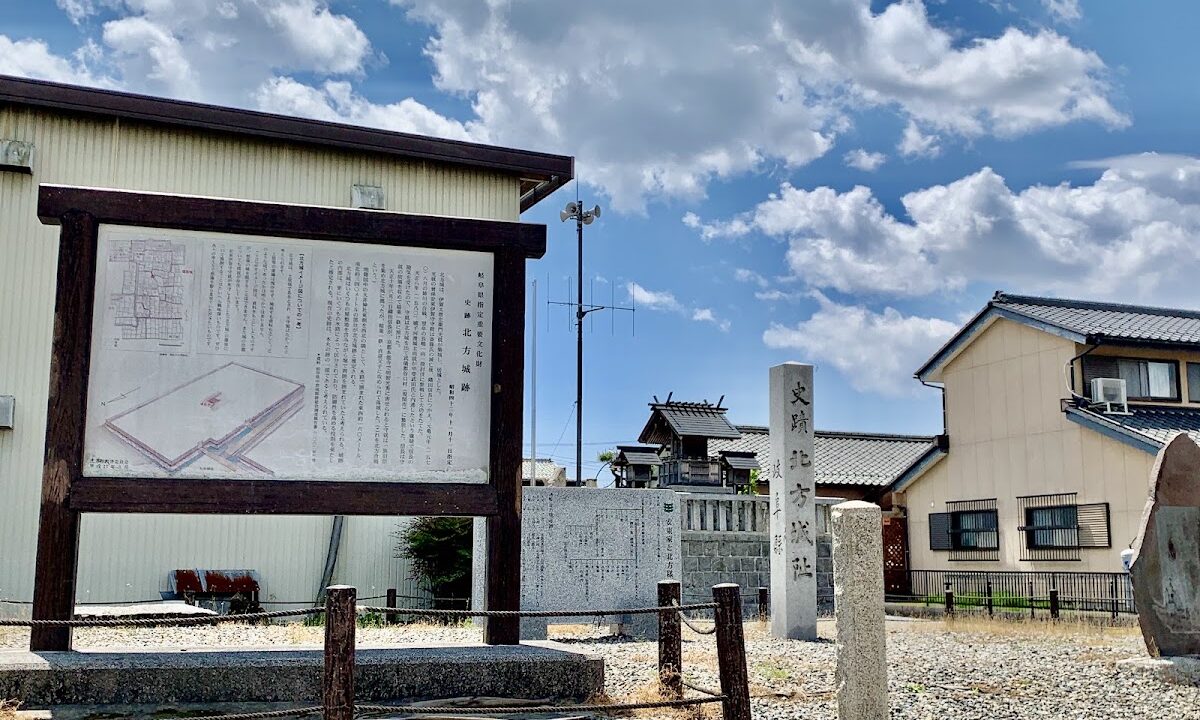
The main keep, the central part of the castle, is thought to have been located around the area where the current Kitagata Castle site monument and explanatory sign are located. It is presumed that the main keep (Honmaru) was surrounded by the second and third baileys (Ninmaru and Sannomaru), but detailed remains have been lost to date.
Characteristics as a Flatland Castle
The reason Kitagata Castle was built as a flatland castle lies in the region’s topography and strategic location. Situated on a plain between the Ibi River and the Neo River, its defensive capabilities were enhanced by surrounding it with a moat.
While flatland castles are less defensively strong than mountain castles, they excel in territorial management, resource accumulation, and function as a transportation hub. Such a flatland castle was suitable for the Ando clan’s activities as a powerful force in western Mino.
Moats and Earthworks
It is believed that Kitagata Castle during the Sengoku period was surrounded by multiple moats. Water moats, drawn from the Ibi River and Neo River, surrounded the castle, preventing enemy intrusion. Earthworks were also constructed, forming a defensive line through the combination of moats and earthworks.
Although very few of these remains survive today, the surrounding topography and old maps allow us to imagine the castle’s appearance at the time.
Current Status and Highlights of Kitagata Castle Ruins
Gifu Prefecture Designated Historic Site
Kitagata Castle Ruins were designated a Gifu Prefecture Historic Site in 1973. This indicates that Kitagata Castle holds an important position in the history of Gifu Prefecture.
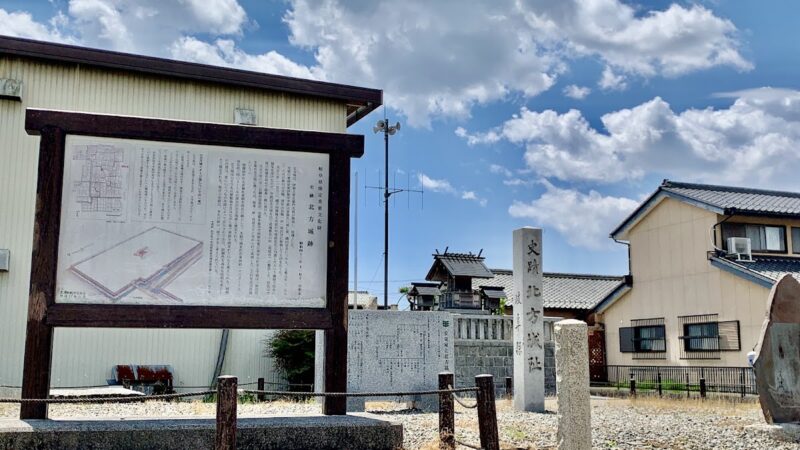
Currently, a stone monument and an explanatory sign are installed at the castle ruins, conveying the history of Kitagata Castle to visitors. The explanatory sign contains information about the castle’s history and Ando Morinari, allowing visitors to learn about Kitagata Castle during the Sengoku period.
Around Oi Shrine
The central part of Kitagata Castle was located in the area southeast of the current Oi Shrine. Oi Shrine is cherished by the local people as the tutelary shrine of Kitagata Town, and walking around the shrine grounds and surrounding area allows visitors to feel the atmosphere of the former castle.
The castle grounds are believed to have extended from the east side of Oi Shrine, with the northwest corner being the northernmost point. A stroll around the shrine area allows you to appreciate the scale of the castle at that time.
The Site of Ando Morinari’s Death
Separate from the Kitagata Castle ruins, there is also a legend about the place where Ando Morinari died in battle. It is said to be located a 5-minute walk west along the railway tracks from Kitagata Higashiguchi Station on the Meitetsu Ibi Line (now defunct), and is revered locally as the site of Morinari’s final moments.
It is said that Morinari fought against the Inaba army in the Kitagata Battle, and despite being 70 years old, fought to the very end. This site of his death serves as a reminder of Morinari’s life as a warrior.
Castle Notes (Points of Interest)
Here are some points of interest when visiting the Kitagata Castle ruins:
- Stone Monument and Information Board: Located in what is believed to be part of the main keep, it provides detailed information about the history of Kitagata Castle.
- Oi Shrine: Located in the northwest corner of the castle grounds, this is a place where you can feel the atmosphere of the former castle.
- Surrounding Topography: By observing the topography—a plain sandwiched between the Ibi River and the Neo River—you can understand the location of Kitagata Castle as a flatland castle.
- Townscape of Kitagata: The townscape of Kitagata, which developed as a castle town, partially retains traces of the past.
Access and Visiting Information
Access by Public Transportation
Kitagata Castle Ruins can be accessed by public transportation. The nearest station was formerly Kitagata-Higashiguchi Station on the Meitetsu Ibi Line, but the line is now discontinued.
Currently, you can access the site in the following ways:
- Take a Gifu Bus from JR Gifu Station or Meitetsu Gifu Station and get off at “Kitagata Town Hall” or “Kitagata Bus Terminal,” then walk for about 5 minutes.
- Take a taxi from JR Hozumi Station for about 10 minutes.
Access by Car
Access by car is also convenient:
- Approximately 15 minutes from Tokai-Kanjo Expressway, Ohno-Kobe IC
- Approximately 25 minutes from Meishin Expressway, Gifu-Hashima IC
Parking is available at the Ooi Shrine’s visitor parking lot, but spaces are limited, so please consider using public transportation.
Visiting Hours and Fees
Kitagata Castle Ruins are an outdoor historical site, and visits are free. There is no fee. The average visit time is about 15-20 minutes, but if you want to explore the surrounding historical sites and the townscape of Kitagata, a stay of about an hour is recommended.
Points to Note When Visiting
- The castle ruins are located within a residential area, so please be considerate of the local residents.
- Photography of explanatory signs and monuments is permitted, but please refrain from entering private property.
- The sun is strong in summer, so we recommend bringing a hat or parasol.
- In rainy weather, some areas may be slippery, so please be careful.
Nearby Tourist Attractions
Gifu Castle (Inabayama Castle)
Located approximately 8 kilometers southeast of Kitagata Castle, Gifu Castle was the base of operations for Oda Nobunaga when he ruled Mino Province. After Ando Morinari pledged allegiance to Nobunaga, he was incorporated into Nobunaga’s system of rule centered around Gifu Castle.
This mountain castle was built on the summit of Mt. Kinka, and currently features a reconstructed keep. From the observation deck, you can enjoy a panoramic view of the Nobi Plain. It is a place you should definitely visit to understand its relationship with Kitagata Castle.
Sumomata One-Night Castle (Sumomata Castle)
Located approximately 6 kilometers southwest of Kitagata Castle, Sumomata Castle is said to have been built by Oda Nobunaga as a base for his conquest of Mino Province. It is known for the legend that Toyotomi Hideyoshi (then known as Kinoshita Tokichiro) built it in a single night.
Currently, it is maintained as a historical museum where you can learn about the Sengoku period in Mino Province.
Ogaki Castle
Located approximately 10 kilometers west of Kitagata Castle, Ogaki Castle was a base for the Western Army during the Battle of Sekigahara. As a central castle in western Mino, it had deep ties to Kitagata Castle.
Currently, it features a reconstructed castle tower and extensive exhibits on the history of Ogaki City and the Battle of Sekigahara.
Kitagata Town Historical and Folk Museum
Located within walking distance of the Kitagata Castle ruins, the Kitagata Town Historical and Folk Museum allows you to learn about the history and culture of Kitagata Town. The museum also displays materials related to Kitagata Castle and Ando Morinari, allowing for a deeper understanding when visiting before or after a visit to the castle ruins.
The Three Generals of Western Mino and Kitagata Castle
What are the Three Generals of Western Mino?
The Three Generals of Western Mino refer to three warlords who held power in western Mino Province: Ando Morinari, Inaba Yoshimichi (Ittetsu), and Ujiie Naomoto (Bokuzen). These three served as important retainers of the Toki clan, the governors of Mino Province, and later served Saito Dosan and Saito Yoshitatsu.
While each of the three was a powerful force individually, their cooperation allowed them to influence the politics and military affairs of western Mino Province. Their actions played a crucial role in Oda Nobunaga’s conquest of Mino.
The Life of Ando Morinari
Ando Morinari was born in 1513 and died in battle in 1582 at the age of 69 (or 70). Among the three leading figures of Western Mino, he was particularly renowned for his bravery and achieved numerous victories in battles.
Regarding Morinari’s character, while he was known for his strong loyalty, he is also said to have sometimes acted independently. Regarding the suspicion of collusion with Takeda Katsuyori, there is a theory that he was not actually colluding, and that he was banished due to a misunderstanding or political judgment by Nobunaga.
The uprising after the Honnoji Incident was Morinari’s last chance to restore his honor. However, he was defeated in battle against his former colleagues, Inaba Ittetsu and his son Sadamichi, and died in battle at the advanced age of 70. This is remembered as an example of his life as a warrior.
Relationship with Inaba Yoshimichi (Ittetsu)
Inaba Yoshimichi (Ittetsu) was one of the three leading figures of Western Mino and had a long-standing relationship with Ando Morinari. However, after Morinari was banished due to suspicions of collusion with Takeda Katsuyori, their relationship deteriorated drastically.
In the Battle of Kitagata following the Honnō-ji Incident, Ittetsu and his son, Sadamichi, attacked Morinari, ultimately killing him. This battle symbolized the tragic aspect of the Sengoku period, where former comrades fought on opposing sides.
Historical Significance of Kitagata Castle
Position in Mino Province
Kitagata Castle played a crucial role throughout the Sengoku period as an important base in western Mino Province. Located at a strategic transportation hub between the Ibi River and the Neo River, it also functioned as a center for the collection of supplies.
As the residence of Andō Morinari, one of the three powerful figures of western Mino, this castle had a significant impact on the political and military situation of Mino Province. Even under Oda Nobunaga’s rule of Mino, Kitagata Castle was one of the important bases for governing western Mino.
Value in the Study of Flatland Castles
Kitagata Castle occupies an important position in the study of castles as a flatland castle from the Sengoku period. During the Sengoku period, when mountain castles were the norm, flatland castles represented a balance between territorial management and defense, and Kitagata Castle is a prime example.
It is believed to have possessed characteristics unique to flatland castles, such as a defensive system utilizing moats and an integrated structure with the castle town. Further archaeological excavations and research are expected to reveal more about the castle’s features.
Importance in Local History
For Kitagata Town, Kitagata Castle is an important historical heritage site that forms the town’s identity. The fact that it was the residence of the renowned warrior Ando Morinari is a source of pride for the town.
Its preservation and utilization as a Gifu Prefecture-designated historical site contribute to local history education and tourism promotion, making it an indispensable element in telling the history of Kitagata Town.
Model Itinerary for Visiting Kitagata Castle
Half-Day Course (Approx. 3 Hours)
- Arrive at Kitagata Town Hall Bus Stop (9:00)
- Visit Kitagata Castle Ruins (9:10-9:40) – Stone monument, explanatory sign, and surrounding area walk
- Visit Oi Shrine (9:40-10:00)
- Visit the Site of Ando Morinari’s Death (10:10-10:30)
- Visit Kitagata Town Historical and Folk Museum (10:40-11:40)
- Lunch in Kitagata Town (11:50-)
Full-Day Course (Including Surrounding Castles)
- Visit Kitagata Castle Ruins (9:00-10:00)
- Kitagata Town Historical and Folk Museum (10:10-11:10)
- Lunch (11:30-12:30)
- Travel and visit to Sumata Ichiyajo Castle (13:00-14:30)
- Travel and visit to Gifu Castle (15:00-17:00)
This course allows you to visit the major castles of Mino Province, starting from Kitagata Castle, and experience the history of Oda Nobunaga’s conquest and rule of Mino.
Summary
Kitagata Castle was a flatland castle that played an important role in Mino Province during the Sengoku period, serving as the residence of Ando Morinari, one of the three great figures of western Mino. From its construction during the Meio era until its fall in Tensho 10 (1582), it was one of the political and military centers of western Mino Province for approximately 90 years.
Currently, it is preserved as a Gifu Prefecture designated historical site, and a stone monument and explanatory plaque are installed around Oi Shrine. Although very few remains are left, understanding the surrounding topography and historical background allows us to imagine what the castle looked like at the time.
Kitagata Castle, with its dramatic history encompassing Oda Nobunaga’s rule over Mino Province, the chaos following the Honnoji Incident, and its fall during the Northern Battle, is an indispensable historical site for understanding Mino Province during the Sengoku period. When visiting Gifu Prefecture, be sure to stop by the Kitagata Castle ruins and reflect on the history of Ando Morinari and the Three Lords of Western Mino.
Visiting it along with other nearby castles such as Gifu Castle and Sumata Castle will provide a deeper understanding of Oda Nobunaga’s conquest of Mino. Although small in scale, the Kitagata Castle ruins offer a valuable opportunity to experience the history of the Sengoku period firsthand, making it a must-visit historical site for castle enthusiasts and history buffs.