Takakoshi Castle (Okayama Prefecture) Complete Guide | History and Highlights of the Bitchu Mountain Castle Associated with Hojo Soun
What is Takakoshi Castle?
Takakoshi Castle is a medieval mountain castle located in Higashiebara-cho, Ibara City, Okayama Prefecture, at an elevation of 172m and a relative height of approximately 140m. Also known as Takakoshi Mountain Castle, it functioned as a stronghold for Ebara Manor in Gotsuki District, Bitchu Province. This castle has recently attracted attention in research as the place where Ise Shinkuro Moritoki (later Hojo Soun), known as the ancestor of the Odawara Hojo clan, spent his youth.
Currently, it is maintained as Takakoshi Castle Ruins Park, and a stone monument marking “the birthplace of Hojo Soun” stands on the mountaintop. It is a popular historical site among castle enthusiasts and history buffs, offering a glimpse into the historical romance of the Sengoku period.
History of Takakoshi Castle
Construction History and the Kamakura Period
There are various theories regarding the construction date of Takakoshi Castle, but the oldest record states that it was built in 1281 (Kōan 4) by Utsunomiya Sadatsuna under the orders of the regent Hōjō Tokimune in preparation for the Mongol invasions. During this period, as part of strengthening the defense system in western Japan, castles were developed in strategic locations along the Sanyōdō road.
Takakoshi Castle was strategically located overlooking the Sanyōdō road and the Oda River, and was second only to Sarukakeyama Castle (Yakage Town) in importance as a strategic stronghold on the Sanyōdō road in Bitchū Province. It was a castle that controlled a crucial transportation hub, overlooking the Sanyōdō road from Yakage towards Sarukakeyama Castle to the east, and the point where the road from Kasaoka towards Yakage merges with the Sanyōdō road to the south.
The Era of the Bitchu Ise Clan
It is said that in the second year of Kyōtoku (1453) during the mid-Muromachi period, Ise Shinzaemon made this his castle. This Bitchu Ise clan expanded their power as local lords who ruled Ebara Manor. Ebara Manor was originally the territory of the Nasu clan, known for Nasu Yoichi, but later came under the rule of the Ise clan.
During the Sengoku period, the Bitchu Ise clan controlled the region from Takakoshi Castle, and their name frequently appears alongside other Bitchu generals in military chronicles describing battles during the Tenbun and Eiroku periods (1532-1570). During this period, the Ise clan was a powerful local force in the Bitchu region.
Hōjō Sōun and Takakoshi Castle
The most historically significant reason for Takakoshi Castle’s importance is its connection to Hōjō Sōun (Ise Shinkurō Moritoki), a turbulent figure of the Sengoku period. Traditionally, there have been various theories regarding Soun’s origins, including those from Ise Province and Kyoto. However, recent research suggests that he was from the Bitchu Ise clan, which is considered the most likely origin.
The theory that Ise Shinkuro Moritoki was born at Takakoshi Castle as the son of Ise Morisada, the lord of the Bitchu Ise clan, and spent his youth there, is gaining attention. Considering that young Soun honed his martial arts and academics at this mountain castle in Bitchu, and later advanced into the Kanto region to lay the foundation for the Odawara Hojo clan, Takakoshi Castle can be considered the cradle that nurtured a hero of the Sengoku period.
Even after Soun’s advance into the Kanto region, the Bitchu Ise clan maintained their power with Takakoshi Castle as their base, but the extent to which their direct relationship with the Odawara Hojo clan continued is unclear.
The Decline of the Ise Clan and the Era of the Shishido Clan
In the late Sengoku period, the Bitchu Ise clan gradually declined, and Takakoshi Castle became the possession of Shishido Takaie, a local lord of Aki Province. The Shishido clan was a family known as important retainers of the Mori clan, and it is believed that they were entrusted with governing this region when the Mori clan expanded into Bitchu Province.
During the period when Shishido Takaie controlled Takakoshi Castle, the castle functioned as one of the Mori clan’s bases for controlling Bitchu. The Mori clan used Kasaoka as a naval port, and Takakoshi Castle was positioned to monitor the road leading to Kasaoka, so its military value remained high.
Abandonment and Aftermath
After the Battle of Sekigahara in 1600, the Mori clan was ordered to relocate to Suo and Nagato Provinces. Consequently, the Mori clan’s rule in Bitchu Province came to an end, and Takakoshi Castle was abandoned. In the Edo period, this region came under the control of shogunate territories and small domains, and Takakoshi Castle was never used as a military facility.
After the modern era, the Takakoshi Castle ruins were largely neglected. However, as attention began to focus on its connection to Hojo Soun, preservation and maintenance activities were spearheaded by the local Ibara City and the Takakoshi Castle Ruins Commemoration Association. Currently, it is maintained as Takakoshi Castle Ruins Park, with a path leading to the castle and information boards.
Takakoshi Castle’s Layout and Structure
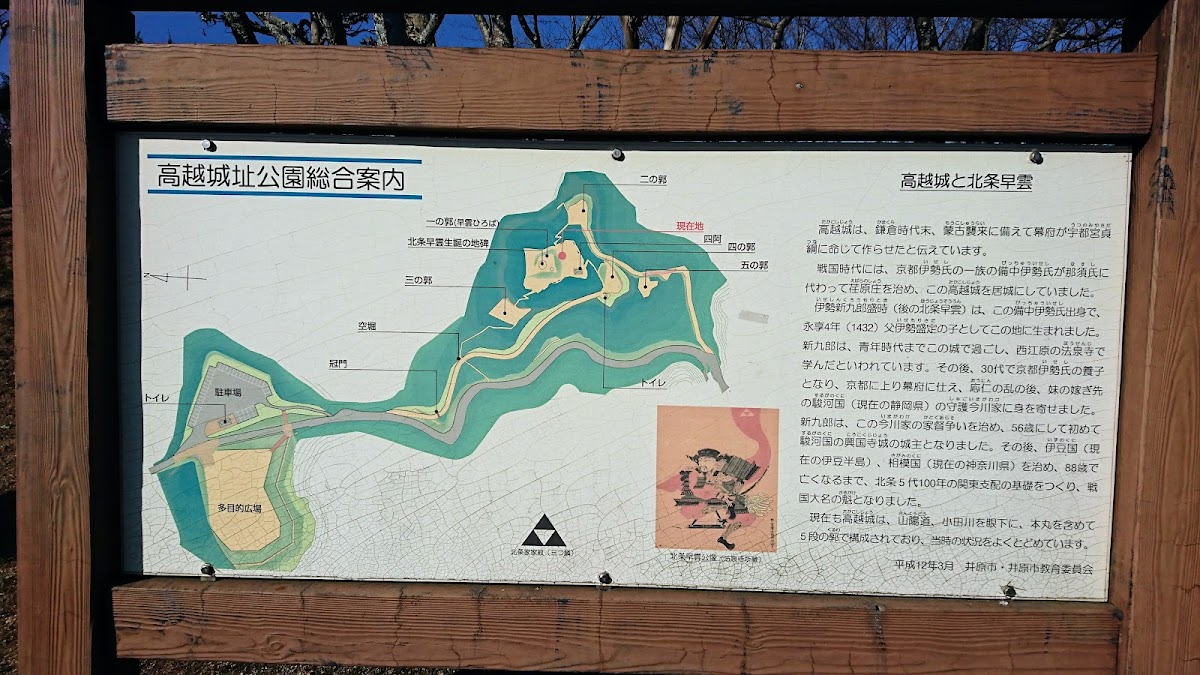
Main Enclosure (Honmaru)
Located at the summit of Mount Takakoshi, the main enclosure is the central bailey of Takakoshi Castle. Within the main enclosure is a slightly elevated earthen platform, where the “Takakoshi Castle” monument and the “Hojo Soun Birthplace Monument” stand. This platform is thought to be the site of a watchtower, serving as the highest point in the castle and functioning as a lookout point.
While the main enclosure is relatively compact in size, it is of a standard size for a mountain castle, and it is presumed to have housed the lord’s residence and command post. Even today, the flat areas remain well-preserved, allowing us to imagine its appearance in its heyday.
Surrounding Enclosures
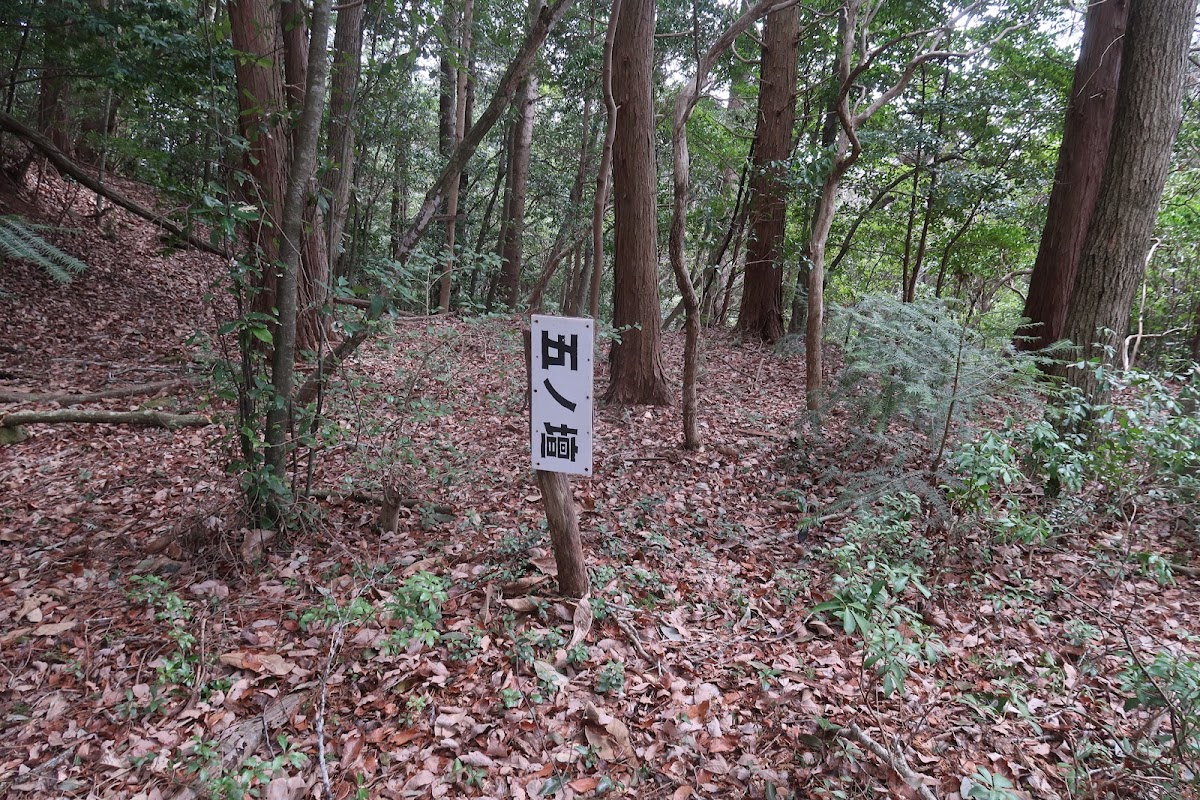
Enclosures are arranged on three sides—east, south, and north—centered around the main enclosure. These enclosures functioned as defensive belts and lower enclosures, forming a multi-layered defensive structure.
The lower eastern enclosure (enclosure iii) has a relatively large flat area and is thought to have been used as a soldier’s encampment or a storage area for supplies. Along the path descending east from this enclosure, a noteworthy remains—a stone-lined well—can be found.
Stone-Lined Well
Located along the path descending from the eastern enclosure, the stone-lined well is one of the important remains of Takakoshi Castle. Securing water was a matter of life and death in mountain castles, and this well functioned as a water source during sieges. The stone structure remains today, making it a valuable example of medieval castle engineering.
Remnants of small enclosures and earthworks protecting the water source can also be seen around the well, illustrating its importance.
Moats and Earthworks
As defensive structures for this mountain castle, moats and earthworks were constructed in various places, cutting across the ridges. These functioned as barriers to prevent enemy intrusion, and were particularly concentrated along the approach route to the main enclosure.
The moats were artificially excavated while utilizing the natural terrain, showcasing typical defensive techniques of medieval mountain castles. Earthworks also partially remain, serving to reinforce the edges of the enclosures.
Ascent Route and Gate
The current ascent route was constructed in later periods, but traces of the original route remain. While clear remains of the gate (koguchi) are difficult to confirm, the entrance to the enclosures exhibits a bend, suggesting a defensive structure.
As a mountain castle, Takakoshi Castle possesses the typical characteristics of a medieval mountain castle in the Bitchu region, with a layout that skillfully utilizes the natural terrain. While large-scale stone walls are not visible, a robust defensive system was constructed using earthworks, moats, and the arrangement of enclosures.
Highlights of Takakoshi Castle
Monument Commemorating the Birthplace of Hojo Soun
The “Monument Commemorating the Birthplace of Hojo Soun,” located in the main enclosure at the mountaintop, is one of the biggest highlights of Takakoshi Castle. This monument was erected to commemorate the birth and upbringing of Hojo Soun, a hero of the Sengoku period, and is considered a sacred site for Soun fans.
Standing before the monument, one can feel the romance of history as young Soun spent his time in this mountain castle in Bitchu, laying the foundation for his later conquest of the Kanto region.
Stunning Views
The views from the mountaintop, at an altitude of 172m, are a major attraction of Takakoshi Castle. On a clear day, you can see the old Sanyo Road, the Oda River, and the town of Ibara below, and even as far as Kasaoka in the distance.
This view speaks volumes about why Takakoshi Castle was considered a strategically important military location. The location, which allowed for monitoring traffic routes in all directions (east, west, north, and south), provided ideal conditions for a castle during the Sengoku period (Warring States period).
Stone-lined Well
The aforementioned stone-lined well is in excellent condition and is a valuable relic for understanding the daily life aspects of a medieval castle. Looking into the well, one can appreciate the skill and depth of the stonework, and is amazed by the high level of castle construction technology of the time.
Earthworks and Enclosures
The earthworks and flat areas remaining in each enclosure provide clues to imagining the castle’s structure in its heyday. In particular, the arrangement of enclosures around the main enclosure is an excellent learning tool for studying the typical layout of a medieval mountain castle.
For castle enthusiasts, there is the pleasure of touring each enclosure with a layout map in hand, and considering defensive lines and movement routes.
Development as Takakoshi Castle Ruins Park
Currently, the Takakoshi Castle ruins have been developed into a park, with access paths and information boards installed. Cherry blossoms bloom in spring, and it is a popular place of relaxation for local residents. Every year, events are held, primarily organized by the Takakoshi Castle Ruins Commemoration Association, providing opportunities to learn about the history of Hojo Soun and the Bitchu Ise clan.
Access to Takakoshi Castle
Access by Public Transportation
By Train
- Get off at JR Hakubi Line “Ibara Railway Ibara Station,” then take a taxi for about 10 minutes.
- Get off at Ibara Railway “Ibara Station” or “Soun-no-Sato Ebara Station,” then walk for about 30-40 minutes to the castle entrance.
Soun-no-Sato Ebara Station is named after Hojo Soun and is conveniently located near Takakoshi Castle. While it’s within walking distance from the station to the castle entrance, it’s a bit of a distance, so it’s recommended to allow ample time for your visit.
Access by Car
By Car
- Approximately 20 minutes from Sanyo Expressway “Kasaoka IC”
- Approximately 25 minutes from Sanyo Expressway “Kamogata IC”
A parking lot is available near the castle entrance and is free of charge. The walk from the parking lot to the main keep at the summit takes approximately 15-20 minutes. While the path is well-maintained, it is a mountain trail, so comfortable walking shoes are recommended.
Points to Note When Visiting
- Although the path is well-maintained, a certain level of physical fitness is required as it is a mountain castle.
- Caution is needed as the ground can become slippery during and after rain.
- Insect repellent is recommended in summer, and warm clothing in winter.
- Bring drinking water in advance (there are no vending machines at the summit).
- It is efficient to check the viewing route beforehand using the information boards and castle layout maps.
Nearby Tourist Attractions
Sarukakeyama Castle (Yakage Town)
Located approximately 10km east of Takakoshi Castle, Sarukakeyama Castle is a mountain castle known as the largest stronghold on the Sanyo Road in Bitchu Province. Like Takakoshi Castle, it played an important role in the Sengoku period history of Bitchu, and visiting both together will help you understand the Bitchu mountain castle network.
Ibara City Tanaka Museum of Art
This museum primarily exhibits works by Tanaka Fusetsu, a Japanese painter from Ibara City. Visiting before or after your visit to Takakoshi Castle allows you to experience local culture.
Bisei Astronomical Observatory
Located in Bisei-cho, Ibara City, this observatory is known for its beautiful stargazing. Combining a visit to Takakoshi Castle with a visit to Bisei Observatory allows you to fully enjoy the nature and history of Ibara City.
Points to Note When Visiting Takakoshi Castle
Estimated Visiting Time
Allow approximately one hour for a round trip from the parking lot. Ideally, allow 1.5 to 2 hours if you want to carefully observe the castle’s layout and enjoy photography.
Best Season
Spring (late March to early April) is cherry blossom season, making the castle ruins park vibrant. Autumn (late October to mid-November) offers beautiful autumn foliage and pleasant weather for visiting the castle. Summer is hot and insect-heavy, so early morning visits are recommended. Winter offers clear air and excellent views, but warm clothing is necessary.
Preparation for Historical Learning
Learning basic knowledge about Hojo Soun and the Bitchu Ise clan before your visit will deepen your understanding at the site. We recommend preparing by reading related books and websites.
Current Research on Takakoshi Castle and Hojo Soun
In recent years, the Bitchu Ise clan theory has gained attention in research on Hojo Soun’s origins. Compared to the traditional theories of Ise Province and Kyoto, the theory that he originated from the Bitchu Ise clan based at Takakoshi Castle is gaining support through the re-examination of historical materials and advancements in genealogical research.
In Ibara City, recognizing this historical importance, the Takakoshi Castle Ruins Commemoration Association is actively engaged in preservation and utilization activities. Annual commemoration events include lectures by researchers and tours of the castle ruins, sharing the latest research findings with local residents and history enthusiasts.
Takakoshi Castle is not merely a local mountain castle, but a crucial historical site holding the key to exploring the roots of Hojo Soun, one of the greatest heroes of the Sengoku period. Further research and development are expected in the future.
Summary
Located in Ibara City, Okayama Prefecture, Takakoshi Castle is a mountain castle that holds an important position in the study of Sengoku history, as it was the residence of the Bitchu Ise clan where Hojo Soun spent his youth. Built on a mountaintop 172 meters above sea level, the castle boasts a strategic location controlling a key point on the Sanyo Road, and remnants such as stone-lined wells, baileys, and earthworks remain well-preserved today.
Now developed as Takakoshi Castle Ruins Park, the mountaintop, where the “Monument to the Birthplace of Hojo Soun” stands, offers magnificent views, making it an attractive spot where you can enjoy both historical romance and natural beauty.
Access is relatively easy, and it can be visited by Ibara Railway’s “Soun-no-Sato Ebara Station” or by car. For anyone interested in the Sengoku period history of Bitchu Province, a fan of mountain castles, or a fan of Hojo Soun, Takakoshi Castle is a historical site you shouldn’t miss.
When you visit Ibara City, be sure to climb Takakoshi Castle and experience the breath of history in the place where the Sengoku hero Hojo Soun spent his youth.