Complete Guide to Nezu Castle (Tomi City, Nagano Prefecture) | A Thorough Explanation of the Famous Castle of the Shigeno Three Families
What is Nezu Castle?
Netsu Castle (Netsu-jo) is a medieval mountain castle located in Nezu, Tomi City, Nagano Prefecture. Also known as Nezu Castle or Shimo Castle, it served as the base of the Nezu clan, a powerful local family in Shinano Province. Built on a mountain 826 meters above sea level, the castle still retains well-preserved remains such as earthworks, moats, and baileys, and is designated as a historical site by Tomi City.
The most distinctive feature of Nezu Castle lies in its complex defensive system, composed of two castle complexes: the “lower castle” and the “upper castle.” The mountain visible north from the Tobu Yunomaru Service Area on the Chuo Expressway is Shiroyama (Castle Mountain), and recent tree felling has made it visible from the highway.
The Nezu clan, a branch of the Shigeno clan, a prominent family of Shinano Province, was a powerful family known as one of the “Three Shigeno Families,” alongside the Unno and Mochizuki clans. Nezu Castle was a formidable stronghold that served as the Nezu clan’s residence for generations, playing a crucial role as a political and military center in eastern Shinano Province.
History of Nezu Castle
Establishment and Development of the Nezu Clan
The Nezu clan branched off from the Shigeno clan, which was based in Chiisagata District of Shinano Province during the late Heian period. The Shigeno clan had close ties to the Seiwa Genji clan and wielded considerable power in Shinano Province. The Nezu clan, in particular, controlled Nezu-go (present-day Nezu district of Tomi City), establishing a castle and solidifying their power base there.
From the Kamakura period to the Muromachi period, the Nezu clan served as vassals of Shinano Province, establishing their control over the region. In particular, records show that the Nezu clan played an active role on the side of the Northern Court during the Nanboku-chō period (Northern and Southern Courts period), and it is believed that the castle’s fortifications were developed during this time.
Nezu Castle in the Sengoku Period
During the Sengoku period (Warring States period), the Nezu clan sought survival while maintaining complex relationships with surrounding clans such as the Unno and Sanada clans. In the Battle of Unno-daira in 1541, a combined force of Takeda Nobutora, Murakami Yoshikiyo, and Suwa Yorishige attacked the Unno clan, significantly altering the power balance in eastern Shinano Province.
After this battle, the Nezu clan chose to submit to the Takeda clan. During Takeda Shingen’s invasion of Shinano, Nezu Castle is believed to have functioned as one of the Takeda clan’s important bases in controlling eastern Shinano. Under Takeda rule, the defensive capabilities of Nezu Castle were further strengthened, and many of the remains visible today are presumed to have been developed during this period.
After the fall of the Takeda clan in 1582, Mori Nagayoshi, a vassal of Oda Nobunaga, invaded Shinano Province, and the Nezu clan came under his control. However, the situation became chaotic again after the Honnoji Incident, and the Nezu clan struggled to survive amidst the conflict between the Uesugi, Sanada, and Tokugawa clans.
Nezu Castle in the Early Modern Period
In the Edo period, Nezu Castle was abandoned and lost its military function. Some members of the Nezu clan are believed to have survived as hatamoto (direct retainers of the shogun) and relocated to other areas. The castle ruins were neglected for a long time, but in recent years, local preservation activities have become active, and investigations and restoration of the remains are progressing.
Currently, the Nezu Castle ruins are protected as a historical site of Tomi City and welcome visitors from history enthusiasts and castle fans. It is affectionately known locally as “Shiroyama” (Castle Mountain) and is an important cultural asset that conveys the history of the region.
Structure and Layout of Nezu Castle
Structure of the Lower Castle (Main Castle)
The lower castle of Nezu Castle is a mountain castle built on the summit of Shiroyama Mountain, at an altitude of 826 meters. Locally known as “Nezu Castle Mountain,” it is recognized as the main castle. The relative height is approximately 130 meters, and the approach from the foot of the mountain is designed to be highly defensible, utilizing the steep terrain.
The main enclosure (Honmaru) is located at the summit and is surrounded by earthen ramparts. These ramparts remain clearly visible today, reaching a maximum height of approximately 2 meters, with some sections exceeding 4 meters in width at the base. The main enclosure measures approximately 40 meters east-west and 30 meters north-south, possessing relatively small but robust defensive features.
Crossing the moat from the main enclosure leads to the second, third, and fourth enclosures, arranged in succession. These enclosures are arranged in a stepped pattern, each demarcated by moats and cliffs. The moat is approximately 3-5 meters deep, and in some places, it retains the distinct shape of a V-shaped moat.
Multiple koguchi (entrances) have been identified, and particularly along the approach to the main enclosure, there are traces of the use of flanking fire techniques. This is a defensive technique designed to attack the enemy’s flank, demonstrating the high level of castle construction technology during the Sengoku period.
Several vertical moats have been identified on the north and west sides of the castle grounds. These were excavated to prevent enemy incursions from the ridge. Some of these vertical moats extend for more than 10 meters along the slope, functioning as a defensive line.
The remains of a pond also exist within the castle grounds, which is thought to have been used as a water source. Securing water was a matter of life and death for mountain castles, and the existence of this pond suggests that Nezu Castle was designed with a long-term siege in mind.
Structure of the Upper Castle
The Upper Castle is built on a different mountaintop located northwest of the Lower Castle. While the lower castle is accessible on foot, a forest road (farm road) leads from the Himekozawa settlement to the west, making it accessible by car.
The main enclosure of the upper castle is located on the mountaintop and is a long, east-west oriented enclosure following the terrain. The interior is mostly sloped, with limited flat areas, but it is presumed to have functioned as a lookout post or signal fire station.
Although smaller in scale than the lower castle, the upper castle is thought to have functioned as a supplementary fort or watchtower, complementing the lower castle. Combining the two castles allows for a wider area of surveillance and defense.
Presence of Stone Walls
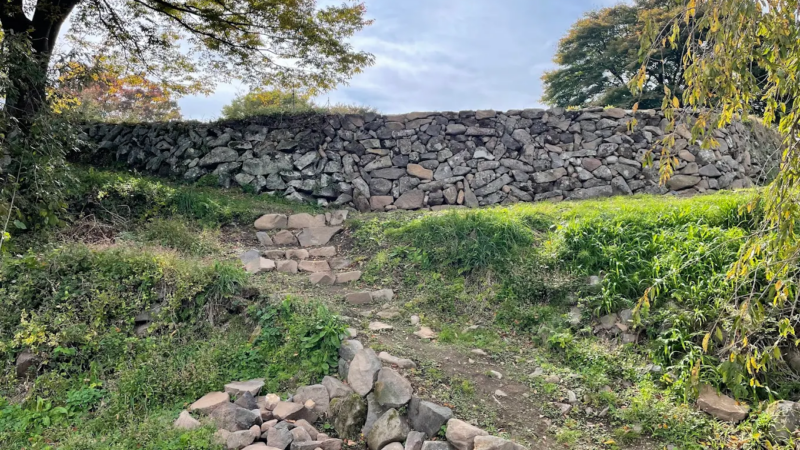
Stone walls have been confirmed in some areas of Nezu Castle. Since examples of stone walls are relatively rare in mountain castles in Shinano Province, this is a noteworthy feature. The stone walls are found around the main enclosure and near the entrance, employing the nozurazumi technique of stacking natural stones. Although small in scale, they played an important role in enhancing the castle’s defensive capabilities.
Highlights of Nezu Castle
Well-Preserved Earthworks
The greatest highlight of Nezu Castle is the earthworks surrounding the main enclosure. Recent restoration work has cleared trees, allowing for a clearer view of the earthworks’ shape. Walking along the earthworks allows you to experience the scale and structure of the castle at that time.
The height and width of the earthworks reveal that Nezu Castle was not merely a residence, but a military facility designed for full-scale battles. The earthworks on the north side of the main enclosure are particularly well-preserved, retaining much of their original appearance.
Clear Moats
The moats separating each enclosure are also a highlight. The moat between the main enclosure and the second enclosure is particularly deep and clear, allowing you to observe the cross-sectional shape of the V-shaped moat. Standing at the bottom of the moat and looking up, you’ll be amazed by the height and steepness of the cliffs on both sides.
Moats were not merely demarcation structures, but important defensive features that prevented enemy advances and made entry into the castle difficult. Seeing the moats of Nezu Castle firsthand allows you to understand the defensive philosophy of medieval mountain castles.
View from the Chuo Expressway
From near the Tobu Yunomaru Service Area on the Chuo Expressway, you can view the castle hill of Nezu Castle. The clearing of trees allows for a distant view of the mountain’s shape and the layout of the baileys, helping you grasp the overall layout of the castle.
When you stop at the service area, be sure to pay attention to the mountains to the north. You’ll realize how strategically important Nezu Castle was built, offering a panoramic view of the surrounding area.
Vertical Moats
The vertical moats excavated into the slopes of the castle grounds are also not to be missed. Multiple vertical moats are arranged in parallel, effectively preventing enemy incursions from the ridge. The vertical moats skillfully utilize the natural terrain of the slope, demonstrating the high level of castle-building technology during the Sengoku period.
Pond Remains
The pond remains within the castle grounds are valuable relics that demonstrate the ingenuity used to secure water sources in mountain castles. Although it is usually dry now, the shape of the depression confirms that it was once a pond. This pond allowed Nezu Castle to be designed to withstand sieges.
Access Information
Access by Car
Access to the Lower Castle
- Approximately 10 minutes by car from the “Tobu Yunomaru IC” on the Joshinetsu Expressway
- The mountain visible to the north from the “Tobu Yunomaru SA” on the Chuo Expressway is Shiroyama (Castle Mountain)
- There is parking space for several cars near the castle entrance (unpaved)
Access to the Upper Castle
- Use the forest road (farm road) from the Himekozawa settlement
- The forest road has some narrow sections, so caution is required when driving
- It may be impassable depending on the weather, so prior confirmation is recommended
Access by Public Transportation
Nearest Station
- Approximately 40 minutes on foot or 10 minutes by taxi from “Tanaka Station” on the Shinano Railway
- Also accessible on foot from “Oya Station” on the Shinano Railway (approximately 50 minutes)
Route Bus
- There is a community bus operating within Tomi City, but it does not go directly to the castle ruins
- A walk is required from the nearest bus stop
Points to Note When Visiting the Castle
- As it is a mountain castle, appropriate clothing and shoes for mountain climbing are necessary.
- The climbing path has steep sections and can be slippery in rainy weather and winter, so caution is advised.
- Insect repellent is recommended in summer, and warm clothing in winter.
- Always bring drinking water.
- There is a possibility of bear sightings, so carrying a bell or similar device is recommended.
- As the castle ruins are a historical site, damage to the remains and collection of plants are strictly prohibited.
Nearby Tourist Spots
Unno-juku
Located about 15 minutes by car from Nezu Castle, Unno-juku preserves the historical townscape that flourished as a post town on the Hokkoku Kaido road. Buildings from the Edo and Meiji periods line the streets, and it has been designated as an Important Preservation District for Groups of Traditional Buildings. It is also a place associated with the Unno clan, who had close ties to the Nezu clan, and visiting both together will allow you to gain a deeper understanding of Shinano’s history.
Sanada Clan Main Castle Ruins
Like the Nezu clan, the Sanada clan also traced its lineage back to the Shigeno clan. The ruins of the Sanada clan’s main castle, their stronghold, are located nearby. The Sanada and Nezu clans had a complex relationship during the Sengoku period, and comparing the two castles provides insight into the power dynamics of the time.
Tobu Yunomaru Service Area
The Tobu Yunomaru Service Area on the Chuo Expressway is known as a spot offering views of Nezu Castle. The service area also has a shop selling local specialties, making it convenient for breaks and shopping.
Yunomaru Plateau
Located at an altitude of 1800 meters, the Yunomaru Plateau is a popular tourist destination known for its alpine plants in summer and beautiful autumn foliage. Ski resorts and campgrounds are also available, making it enjoyable throughout the year. Enjoying nature in conjunction with a visit to Nezu Castle is highly recommended.
Nezu Castle and the Three Shigeno Families
The Nezu clan, along with the Unno and Mochizuki clans, was a prominent family known as the “Three Shigeno Families.” These three families built their power primarily in the Chiisagata and Saku districts of Shinano Province, playing a crucial role in Shinano’s history from the Heian period to the Sengoku period.
The Unno clan was based in Unno-sho (present-day Tomi City area), and is the origin of the name Unno-juku. They reigned as a powerful local clan in eastern Shinano Province until their downfall in the Battle of Unno-daira.
The Mochizuki clan was based in Mochizuki, Saku District (present-day Mochizuki, Saku City), and controlled the area known for producing famous horses called “Mochizuki no Koma.” They used Mochizuki Castle as their residence and extended their influence throughout the Saku region.
The Nezu clan was based in Nezu-go, and used Nezu Castle as their residence. Although relatively small among the three families, the Shigeno family survived the Sengoku period and successfully maintained their lineage into the early modern period.
By visiting the castle ruins of these three Shigeno families, you can experience the rise and fall of medieval powerful families in Shinano Province.
Investigation and Development of Nezu Castle
The Nezu Castle ruins are designated as a historical site of Tomi City, and in recent years, efforts have been made toward preservation and utilization. In particular, the visibility of the remains has improved due to the felling of trees, allowing for a clearer observation of the castle’s structure.
Investigations by local history enthusiasts and castle researchers are also being continuously conducted, leading to the discovery of new remains and clarification of the castle’s layout. Further development and the installation of information boards are expected in the future.
Tomi City is promoting initiatives to utilize castle ruins within the city, including Nezu Castle, as historical tourism resources, and guided tours and events are also held. Checking Tomi City’s tourism information before visiting will allow for a more fulfilling visit.
Best Season to Visit Nezu Castle
Nezu Castle is accessible year-round, but each season offers its own unique charm.
Spring (April-May)
This season features fresh greenery and mild weather, making it ideal for climbing the castle. However, the ground may be muddy due to snowmelt.
Summer (June-August)
The lush greenery creates a beautiful contrast between the castle ruins and nature. However, overgrown vegetation can obscure some of the ruins. Insect repellent is essential.
Autumn (September-November)
This is the most suitable season for visiting. The autumn foliage is beautiful, and the weather is stable. The vegetation begins to wither, making it ideal for observing the ruins.
Winter (December-March)
Snowfall can make climbing difficult, but during periods of light snowfall, the trees shed their leaves, making observation of the ruins easier. However, warm clothing and non-slip footwear are essential.
Recommended Points for Castle Enthusiasts
Nezu Castle is especially recommended for the following people:
- Those who want to experience the charm of an earthen castle: While it lacks the flashiness of stone walls and keeps, the basic elements of an earthen castle, such as earthworks, moats, and vertical trenches, are well-preserved.
- Those interested in the medieval history of Shinano: As the residence of the Nezu clan, one of the three Shigeno families, it is an important historical site for learning about the medieval history of Shinano Province.
- Those who want to enjoy castle ruins in peace: It is not as crowded as famous tourist spots, allowing you to carefully observe the remains.
- Those who enjoy hiking in mountain castles: With a moderate elevation difference, it is a mountain castle that can be enjoyed by beginners to intermediate hikers.
Summary
Nezu Castle is a valuable medieval mountain castle site remaining in Tomi City, Nagano Prefecture. As the residence of the Nezu clan, one of the three Shigeno families, it played an important role in the history of eastern Shinano Province. This castle site boasts many attractions, including a complex defensive system consisting of two castles, a lower castle and an upper castle, well-preserved remains such as earthworks and moats, and a location visible from the Chuo Expressway.
Recent improvements have enhanced the visibility of the remains, making it more accessible for castle enthusiasts. Visiting this site along with Unno-juku and other surrounding castle sites will allow you to experience the flow of history from the medieval to the early modern period in Shinano Province.
When visiting Tomi City, be sure to stop by the Nezu Castle ruins and feel the history of the Shigeno Three Families and the spirit of the Sengoku period.