Complete Guide to Uenotaira Castle (Minowa Town, Kamiina District, Nagano Prefecture) | History and Highlights of the Birthplace of the Ina Genji Clan
What is Uenotaira Castle?
Uenotaira Castle is a Japanese castle ruin located in Higashi-Minowa, Minowa Town, Kamiina District, Nagano Prefecture. As a central mountain castle in Ina District, Shinano Province, it played an important role from the late Heian period to the Sengoku period. Currently, it is protected as a Nagano Prefecture designated historical site and is highly valued for its historical significance as the birthplace of the Ina Genji clan.
From the castle ruins, a spectacular view of the Ina Valley unfolds, and it is also known as a tourist spot where visitors can enjoy seasonal flowers such as cherry blossoms and daffodils in spring, and lavender and sunflowers in summer. The castle grounds, built on the tip of a hill, extend approximately 450 meters east-west and 200 meters north-south, and have a distinctive layout with multiple baileys arranged in parallel.
Basic Information on Kaminohira Castle
Location: 2699-4 Higashi-Minowa, Minowa-machi, Kamiina-gun, Nagano Prefecture
Former Province: Ina-gun, Shinano Province
Classification/Structure: Hilltop castle, multi-bailey style
Construction Period: Late Heian period (estimated late 11th to early 12th century)
Builder: Minamoto no Tamekimi (Ina no Uma Taifu Tamekimi)
Main Lords: Ina clan, Chiku clan
Year of Abandonment: Around 1553 (Tenbun 22)
Designated Cultural Property: Nagano Prefecture Designated Historic Site (designated 1976)
Remains: Baileys, earthworks, moats, vertical moats
Elevation: Approximately 780 meters
History of Kaminohira Castle
Late Heian Period: Castle Construction by Minamoto no Tamekimi and the Establishment of the Ina Genji Clan
The history of Kaminohira Castle dates back to the late Heian period. It is said that Minamoto no Tamekimi, also known as Ina no Uma Taifu Tamekimi, settled in the Ina Valley of Shinano Province and built a castle there. Minamoto no Tamekimi was a warrior descended from the Seiwa Genji clan, dispatched from the central government to develop and govern the Ina region.
With Tamekimi’s establishment in the Ina Valley, the so-called “Ina Genji” clan was formed. This is an important example of the formation process of a local warrior group and is considered historically significant as a typical example of a central Minamoto clan member settling in a provincial area and building their own independent power.
Tamekimi’s main lineage subsequently expanded its power throughout the Ina region, using Kaminohira Castle as its base. The family that adopted the name Ina clan maintained its power primarily in the northern Ina Valley and was active as a powerful samurai family in the region from the late Heian period to the early Kamakura period.
Kamakura Period: To the Castle of the Chiku Clan
In the mid-Kamakura period, Kaminohira Castle became the residence of the Chiku clan, a branch of the Suwa clan. The Chiku clan were descendants of the Suwa clan, who served as chief priests of Suwa Grand Shrine, and were a powerful samurai group with influence primarily in the southern Ina Valley.
There are various theories regarding how the Chiku clan established their base at Kaminohira Castle, but it is believed that the decline of the Ina clan led to the expansion of the Suwa clan’s influence into the northern Ina Valley. The Chiku clan strengthened their control over Ina County from Kaminohira Castle and served as retainers of the Kamakura Shogunate.
Traditional research has suggested that Kaminohira Castle was abandoned by the end of the Kamakura period. However, the archaeological excavations described later would overturn this conventional theory.
Sengoku Period: Takeda Shingen’s Invasion of Ina and the Fall of the Castle
Excavation surveys conducted from 1998 to 2000 revealed numerous remains and artifacts from the Sengoku period. This proved that Kaminohira Castle functioned as a castle during the Sengoku period, bringing new insights to castle history research.
During the Sengoku period, the Chiku clan continued to use Kaminohira Castle as their base. However, when Takeda Shingen advanced into the Ina region during the Tenbun era (1532-1555), they initially submitted to the Takeda clan. The Takeda clan’s invasion of Shinano progressed in stages, and various local lords in the Ina Valley successively came under the Takeda’s control.
However, in 1553, the generals of Ina revolted against the Takeda clan. Records show that in response to this rebellion, Takeda Shingen immediately led his army to invade Ina, and Kaminohira Castle was attacked and fell. With this fall, Kaminohira Castle disappeared from the historical stage.
Modern Era: Historic Site Designation and Preservation Activities
Since the Meiji era, the Kaminohira Castle ruins have been carefully preserved by local people. In 1976, it was designated a Nagano Prefecture Historic Site, becoming subject to public protection.
Excavation surveys starting in 1998 provided an opportunity to re-evaluate the historical value of the castle ruins. Surveys conducted by the Minowa Town Board of Education confirmed the remains of buildings from the Sengoku period, earthworks, and moats, and the excavated artifacts, such as pottery and iron products, revealed aspects of life at that time.
Currently, the castle ruins have been developed into a park, serving as a place of relaxation for local residents and tourists. Information boards and explanatory signs have been installed, allowing visitors to learn about the castle’s history and structure.
Layout and Structure of Kaminohira Castle
Location and Topographical Characteristics
Kaminohira Castle is built on the tip of a hill jutting out to the east. Located at an altitude of approximately 780 meters, it boasts an excellent location overlooking the Ina Valley. This topographical advantage was crucial not only for military defense but also for monitoring and controlling the Ina Valley’s transportation routes.
The eastern side of the castle is a steep cliff, forming a natural stronghold. The western side has a relatively gentle slope, but its defenses are reinforced by artificial moats and trenches. This layout, skillfully utilizing the difference in topography between the east and west, exhibits typical characteristics of a medieval mountain castle.
Arrangement and Structure of Enclosures
The castle grounds of Kaminohira Castle measure approximately 450 meters east-west and 200 meters north-south. It has a linear structure with multiple enclosures arranged almost parallel to each other in an east-west direction.
The main enclosure (honmaru) is located in the center of the castle and has the largest flat area. Earthen ramparts surrounded the main enclosure, and a gate (koguchi) was provided. Archaeological excavations have revealed postholes within the main enclosure, confirming the existence of buildings such as a residence or warehouse.
Secondary enclosures are located to the east and west of the main enclosure. These enclosures are situated at a lower level than the main enclosure and are separated by elevation differences. It is presumed that the secondary enclosures contained residences for retainers, barracks, and storage facilities for supplies.
Defensive Structures
Several defensive structures characteristic of medieval mountain castles have been identified at Kaminohira Castle.
Horikiri: Dry moats separating enclosures, serving as an important defensive line to prevent enemy intrusion. At Kaminohira Castle, particularly clear horikiri remain along the western ridge.
Tatebori: Vertical moats dug along slopes, serving to hinder lateral movement of enemies. Multiple vertical moats have been identified on the north and south slopes of the castle.
Earthworks: These are earthen walls built around the enclosures, serving both defensive and concealing functions. The earthworks around the main enclosure remain relatively well-preserved.
These defensive structures were likely renovated and strengthened during the Sengoku period, reflecting the heightened military tensions in preparation for the Takeda clan’s invasion of Ina.
What the Excavation Revealed
The excavation conducted from 1998 to 2000 yielded results that significantly rewrote the history of Kaminohira Castle.
Remains from the Sengoku Period
The investigation confirmed remains of buildings, earthworks, and moats from the Sengoku period. Of particular note is the discovery of numerous artifacts from the mid-16th century. This overturns the conventional theory that the castle was abandoned during the Kamakura period, demonstrating that Kaminohira Castle was in use until the Sengoku period.
Postholes and foundation stones were detected at the building sites, revealing the existence of multiple buildings. Based on the size and layout of the buildings, their functions as the lord’s residence, vassal’s quarters, and warehouses are estimated.
Excavated Artifacts
The excavation yielded a diverse range of artifacts. Among the ceramics, Tenmoku tea bowls, plates, and bowls from Seto and Mino ware were identified, indicating a high standard of living for the castle lord’s class. Chinese celadon and white porcelain were also unearthed, suggesting trade relations with distant regions.
Iron artifacts included sword guards, nails, and agricultural tools such as sickles. These are important as materials reflecting both daily life and military activities.
In addition, numerous artifacts related to daily life, such as millstones, whetstones, and carbonized rice, were confirmed, providing concrete insights into life within the castle at that time.
Results of Radiocarbon Dating
Chronological studies of the excavated artifacts and radiocarbon dating have clearly determined the age of each structure of Kaminohira Castle. The concentration of artifacts dating from the first half to the mid-16th century confirms that the castle was actively used during the Tenbun era (1532-1555).
This period coincides precisely with the time when Takeda Shingen advanced into the Ina region, leading to heightened tensions with local powerful families, including the Chiku clan. The excavation results provide valuable archaeological evidence confirming historical facts recorded in historical documents.
Highlights of Kaminohira Castle
Views from the Castle Ruins
The greatest attraction of Kaminohira Castle Ruins is undoubtedly the magnificent panoramic view of the Ina Valley. From near the main enclosure of the castle ruins, you can see the rural landscape of the Ina Valley below, and the mountain ranges of the Central Alps (Kiso Mountains) and the Southern Alps (Akaishi Mountains) in the distance.
On clear days, the light, especially in the morning and evening, is beautiful, making it a popular spot for photography. The lords of the Sengoku period must have contemplated the governance and defense of their territories while gazing upon this view.
A Single Cherry Tree and Seasonal Flowers
A magnificent single cherry tree stands at the castle ruins, blooming beautifully in spring. This cherry tree is beloved by the locals, and many visitors come to admire the blossoms during the flowering season. The contrast between the blue sky and the cherry blossoms viewed from beneath the tree is breathtaking.
Besides the cherry blossoms, you can enjoy seasonal flowers around the castle ruins. In early spring, daffodils bloom profusely, and in early summer, lavender spreads a purple carpet. In summer, sunflowers bloom cheerfully towards the sun, lifting the spirits of visitors.
These flowers are carefully cultivated by the locals, creating a charming space where the historical castle ruins and the beauty of nature harmonize.
Visiting the Remains
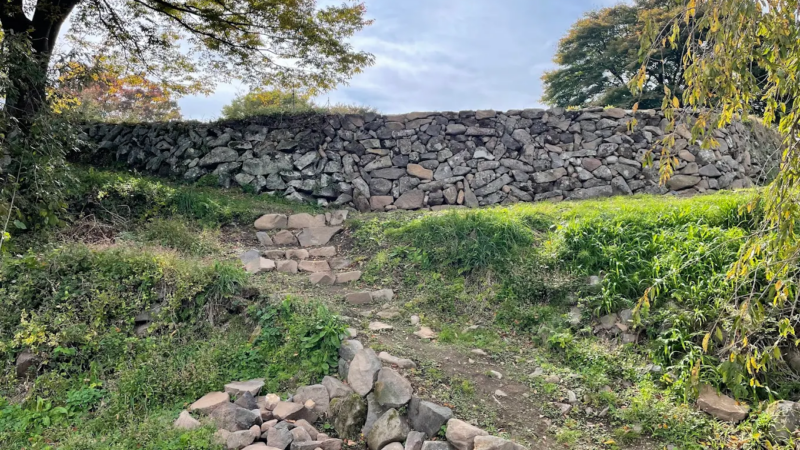
At the castle ruins, you can actually see the remains of a medieval mountain castle. The earthworks around the main enclosure are relatively well-preserved, allowing you to experience the defensive facilities of the time. You can also see the elevation differences separating the baileys and the traces of vertical moats remaining on the slopes.
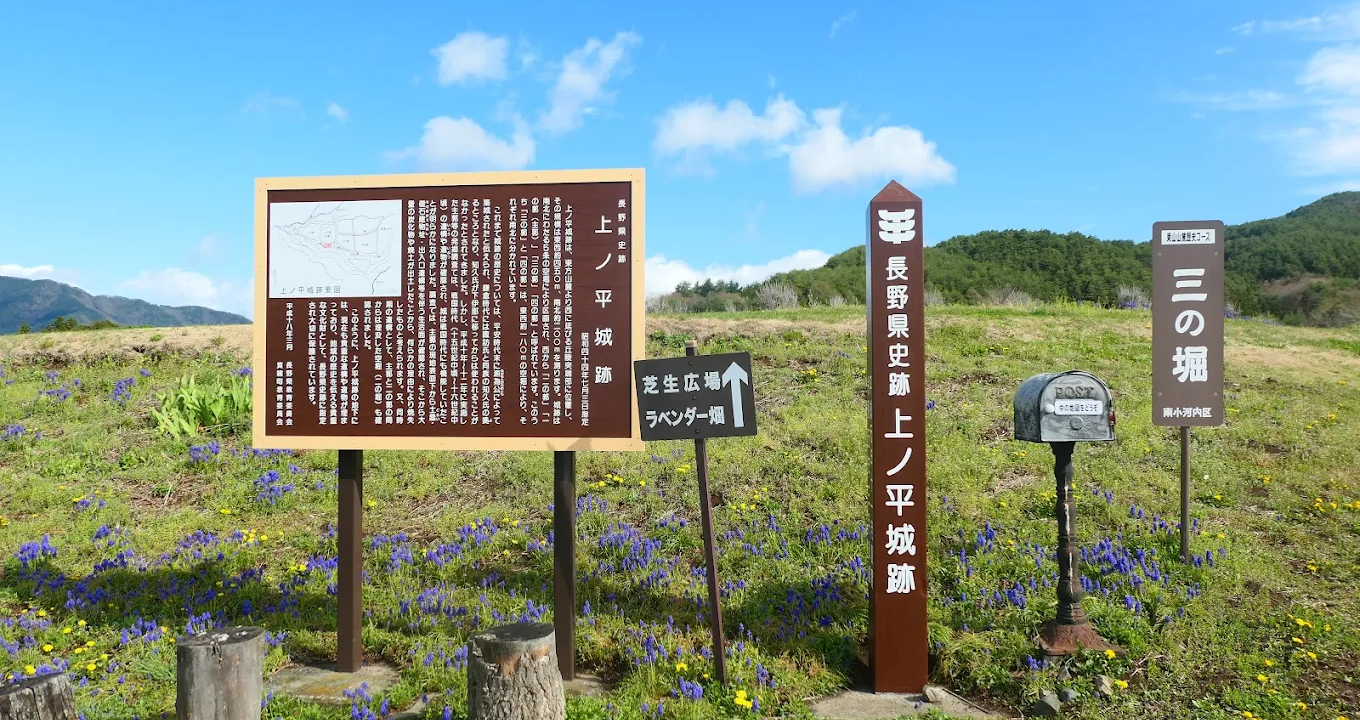
Information boards are installed within the castle ruins, allowing you to learn in detail about the castle’s history and structure. There are also guide boards introducing the results of archaeological excavations, allowing you to understand the castle ruins from an archaeological perspective.
When viewing the remains, imagining the people who once lived here and prepared for battle will allow you to feel the history more deeply.
Historical Significance of the Ina Genji and Chiku Clan
Establishment and Development of the Ina Genji
The Ina Genji clan began with Minamoto no Tamekimi settling in the Ina Valley. In the late Heian period, as the power of the central government weakened in the provinces, there were increasing examples of nobles and samurai dispatched to various regions taking root locally and building their own power bases.
Minamoto no Tamekimi was one of them, entrusted with the development and governance of the Ina Valley, and eventually made this area his base. The descendants of Tamekimi adopted the name Ina clan and expanded their influence, primarily in the northern part of the Ina Valley. Several branch families emerged from the Ina clan, each establishing themselves as minor lords within their respective communities.
The existence of the Ina Genji clan is noteworthy in Japanese history research as an important example illustrating the formation process of local samurai groups in the medieval period. The process by which prestigious central clans settled in the provinces and transformed into local lords is an essential element in understanding the structure of medieval society.
The Rise of the Chiku Clan
The Chiku clan was a branch of the Suwa clan, who served as the chief priest of Suwa Grand Shrine, and held power in the southern part of the Ina Valley as descendants of the Suwa clan. In the mid-Kamakura period, the Chiku clan became lords of Kaminohira Castle and, as influential samurai of Ina County, were appointed as retainers of the Kamakura Shogunate.
It is believed that the Chiku clan’s shift to Kaminohira Castle from the Ina clan was due to the expansion of the Suwa clan’s power and the decline of the Ina clan. The Suwa clan, based at the influential Suwa Grand Shrine in Shinano Province, wielded considerable power, and their family spread throughout Shinano.
The Chiku clan continued to operate from their base at Kaminohira Castle until the Sengoku period, but ultimately became subordinate to the Takeda clan after Takeda Shingen’s invasion of Ina. However, the rebellion of 1553 and the subsequent fall of the castle marked the end of the Chiku clan’s rule over Kaminohira Castle.
Takeda Clan’s Control of Ina
Takeda Shingen’s invasion of Ina was a crucial part of his control over Shinano during the Sengoku period. The Takeda clan, based in Kai Province (present-day Yamanashi Prefecture), actively expanded into Shinano Province.
The Ina Valley was an important transportation route connecting Kai and Shinano, and also a region with rich agricultural productivity. For the Takeda clan, control of the Ina Valley was essential for gaining control of all of Shinano.
When the Takeda clan’s influence extended to Ina during the Tenbun era, local powerful families, including the Chiku clan, initially submitted to the Takeda. However, as the Takeda’s rule strengthened, the independence of the local families was threatened. The rebellion of 1553 (Tenbun 22) was the result of this tension exploding.
Takeda Shingen swiftly suppressed the rebellion and seized control of various castles in Ina, including Kaminohira Castle. From then on, the Ina Valley came under the firm control of the Takeda clan and became an important base for their administration of Shinano Province.
Access Information and Visitor Guide
Transportation Access
Access by Car:
- Approximately 15 minutes from the Chuo Expressway “Ina IC”
- Approximately 20 minutes from the Chuo Expressway “Komagane IC”
- Accessible via Prefectural Road from National Route 153
Access by Public Transportation:
- Approximately 30 minutes on foot or 5 minutes by taxi from JR Iida Line “Ina-Matsushima Station”
- Bus services are limited, so please check in advance.
Parking
A free parking lot is available near the castle ruins entrance. Approximately 10 regular cars can be parked. It can get crowded during peak tourist seasons such as cherry blossom season, so we recommend visiting with plenty of time to spare.
Please refrain from parking in front of the information board or on the side of the road. Please use the designated parking area.
Visiting Hours and Fees
- Visiting Hours: Always open (from sunrise to sunset)
- Admission Fee: Free
- Estimated Time Required: Approximately 30 minutes to 1 hour
Notes for Visitors
- As the castle ruins are designated as a historical site, please do not damage or remove any remains.
- There are steep slopes and steps, so please wear comfortable shoes.
- Insect repellent is recommended in summer, and warm clothing in winter.
- Please take all your trash with you.
- The use of fire is strictly prohibited.
Recommended Time to Visit
Spring (Early to Mid-April): The single cherry tree is in full bloom, and this is the time when the most tourists visit. The contrast between the cherry blossoms and the scenery of the Ina Valley is magnificent.
Early Summer (May to June): Lavender and other flowers bloom, and you can enjoy a stroll in the refreshing weather.
Summer (July-August): Sunflowers bloom in abundance, creating a vibrant atmosphere. However, heat protection is necessary.
Autumn (October-November): This is a perfect time to enjoy the autumn foliage and crisp air, with panoramic views of the distant mountains.
Winter (December-March): The castle ruins amidst the snow offer a picturesque scene, but caution is needed as the ground can be slippery.
Nearby Tourist Attractions
Minowa Town Local History Museum
This facility allows you to learn about the history of Kaminohira Castle and the cultural properties of Minowa Town. Some artifacts unearthed during archaeological excavations are on display, and visiting before or after your castle ruins visit will deepen your understanding.
Kayano Plateau
Located in the eastern part of Minowa Town, this plateau features a campsite and ski resort. Enjoy outdoor activities in a rich natural environment.
Momiji Lake (Minowa Dam)
This artificial lake is known as a famous spot for autumn foliage. In autumn, the lakeside is adorned with beautiful autumn leaves, attracting many tourists.
Red Buckwheat Village
Minowa Town is known for its cultivation of red buckwheat, and in autumn, the fields of red buckwheat flowers are magnificent. You can enjoy delicious Shinshu soba at local soba restaurants.
Preservation and Utilization of the Kaminohira Castle Ruins
Value as a Cultural Property
The Kaminohira Castle Ruins are legally protected as a Nagano Prefecture designated historical site. With a long history spanning from the Heian period to the Sengoku period, it is highly valued for its historical significance as the birthplace of the Ina Genji clan.
In particular, the archaeological excavation that confirmed its use during the Sengoku period has made it an important case study in the study of medieval castles. It is a good example of how the actual state of the castle, which could not be understood from conventional historical documents alone, has been revealed through archaeological methods.
Local Utilization
In Minowa Town, the Kaminohira Castle Ruins are positioned as a historical symbol of the region and are utilized as a tourist resource. Landscape maintenance and flower planting around the castle ruins are supported by the volunteer activities of local residents.
Events such as the spring cherry blossom festival are held at the castle ruins, contributing to the revitalization of the local community. As a space where history, nature, and the activities of the local people harmonize, the Kaminohira Castle Ruins will be passed down to future generations.
Future Challenges and Prospects
The preservation and utilization of the castle ruins require continuous efforts. Maintenance, including managing the weathering of the remains, overseeing vegetation, and updating explanatory signs, requires considerable effort and expense.
On the other hand, disseminating information to let more people know about the historical value of the castle ruins is also important. New methods of utilization adapted to the modern era, such as creating restored CG images using digital technology and providing explanations through smartphone apps, are being considered.
The collaboration of local residents, government officials, and researchers to protect and pass on the value of the Kaminohira Castle ruins is a major challenge, and at the same time, a great opportunity for the future.
Summary
The Kaminohira Castle ruins, located in Minowa-machi, Kamiina-gun, Nagano Prefecture, were an important mountain castle that functioned from the late Heian period to the Sengoku period. It was built by Minamoto no Tamekimi, the ancestor of the Ina Genji clan, later became the residence of the Chiku clan, and ultimately fell during Takeda Shingen’s invasion of Ina.
Archaeological excavations have confirmed its use during the Sengoku period, bringing new insights to the study of medieval castles. Currently, it is protected as a Nagano Prefecture designated historical site and is a popular tourist destination, offering spectacular views of the Ina Valley and beautiful flowers throughout the seasons.
The Kaminohira Castle ruins, where historical value and natural beauty harmonize, are a valuable cultural asset that conveys the history of Ina-gun in Shinano Province, and a special place that allows visitors to feel the spirit of the Middle Ages. When visiting the Ina Valley, be sure to stop by.
Reference Materials
- Minowa Town Board of Education, “Report on the Excavation Survey of the Kaminohira Castle Ruins, FY 1999-2000”
- Nagano Prefecture Board of Education, “Medieval Castle Sites in Nagano Prefecture”
- “Minowa Town History”
- Various castle research literature and on-site explanatory signs
Related Matters
- Ina Genji: A samurai group from the Ina Valley in Shinano Province, descended from Minamoto no Tamekimi
- Chiku Clan: A branch of the Suwa clan, who became the lord of Kaminohira Castle
- Takeda Shingen: A Sengoku period daimyo of Kai Province, who controlled most of Shinano Province, including the Ina Valley
- Ina District, Shinano Province: The area corresponding to present-day Kamiina District and Shimoina District in Nagano Prefecture
- Medieval Mountain Castle: A defensive castle built utilizing the mountainous terrain
- Minowa Town: A town belonging to Kamiina District in Nagano Prefecture, where the Kaminohira Castle ruins are located