Fujimi Castle (Komoro City, Nagano Prefecture): A Complete Guide to its History and Highlights | The Charm of Mountain Castle Ruins and Stone Walls
Located in Komoro City, Nagano Prefecture, Fujimi Castle, also known as Omuro Castle, is a medieval mountain castle. Built on a mountain 836 meters above sea level with a relative height of approximately 130 meters, this castle is known for its magnificent layout, featuring numerous baileys and stone walls, which are rare for mountain castles in the eastern Shinano region. Currently, it is maintained as Iizunayama Park (Komoro Kogen Museum of Art) and is popular with history enthusiasts and hikers.
History and Construction Background of Fujimi Castle
Construction Date and Various Theories
The construction date of Fujimi Castle is uncertain, but several theories exist. The most prominent theories are that it was built by the Oi clan as a defense against the Shigeno clan and that it was developed by Takeda Shingen as a branch castle of Nabefuta Castle when he advanced into the Saku region during the Tenbun era (1532-1555). Nabefuta Castle was the predecessor of Komoro Castle and was an important base for the Takeda clan when they controlled the eastern Shinano region. Fujimi Castle is located about 2 kilometers northeast of Nabefuta Castle and is thought to have been strategically used as a border castle or fort.
Role in the Sengoku Period
During the Sengoku period, this region was the front line where the forces of the Takeda, Uesugi, and Hojo clans intersected. Fujimi Castle played an important role as a subsidiary castle protecting Komoro Castle (Nabefuta Castle) and preparing for invasions from the north.
It is believed that the Takeda clan renovated and strengthened existing mountain castles during their conquest of the Saku region, and Fujimi Castle is positioned as one of them. The layout and use of stone walls, which reflect the Takeda style of castle construction, suggest that it was renovated during this period.
Changes After the Fall of the Takeda Clan
After the fall of the Takeda clan in 1582, this region came under the control of Oda Nobunaga. However, the situation became chaotic again after the Honnoji Incident. Subsequently, Shibata Yasutada, a subordinate of Tokugawa Ieyasu, entered Komoro Castle, and this region came under the influence of the Tokugawa clan.
In the Edo period, while Komoro Castle was developed as the domain’s administrative center, Fujimi Castle is believed to have ceased its military role and been abandoned. The remaining structures mainly retain their appearance from the Sengoku period.
Structure and Layout of Fujimi Castle
Overall Placement and Utilization of Topography
Fujimi Castle’s layout is centered on the mountaintop at an altitude of 836 meters, skillfully utilizing the terrain. Its location, with a relative height of approximately 130 meters, is extremely advantageous defensively, creating a natural stronghold that makes enemy attacks difficult.
The castle grounds extend across the area of the present-day Iizunayama Park, with multiple baileys arranged in a stepped pattern around the main enclosure. It possesses a relatively large structure for a mountain castle, suggesting it functioned as a permanent military base.
Arrangement and Characteristics of the Baileys
The most distinctive feature of Fujimi Castle is its complex layout with countless meticulously arranged baileys. The main enclosure is located at the highest point, surrounded by the second and third baileys.
Each bailey is demarcated by earthen ramparts, with some sections utilizing stone walls. The use of stone walls is limited in mountain castles in the eastern Shinano region, making Fujimi Castle’s stone walls a valuable historical relic. The baileys are separated by moats, demonstrating defensive measures throughout the castle.
Highlights of the Stone Wall Remains
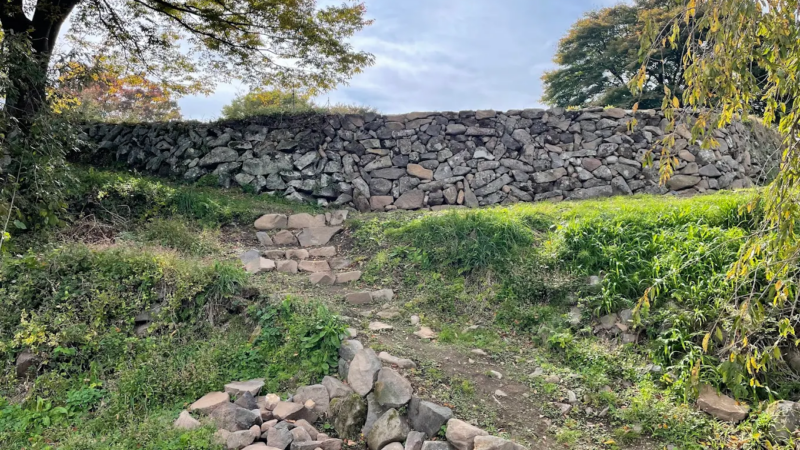
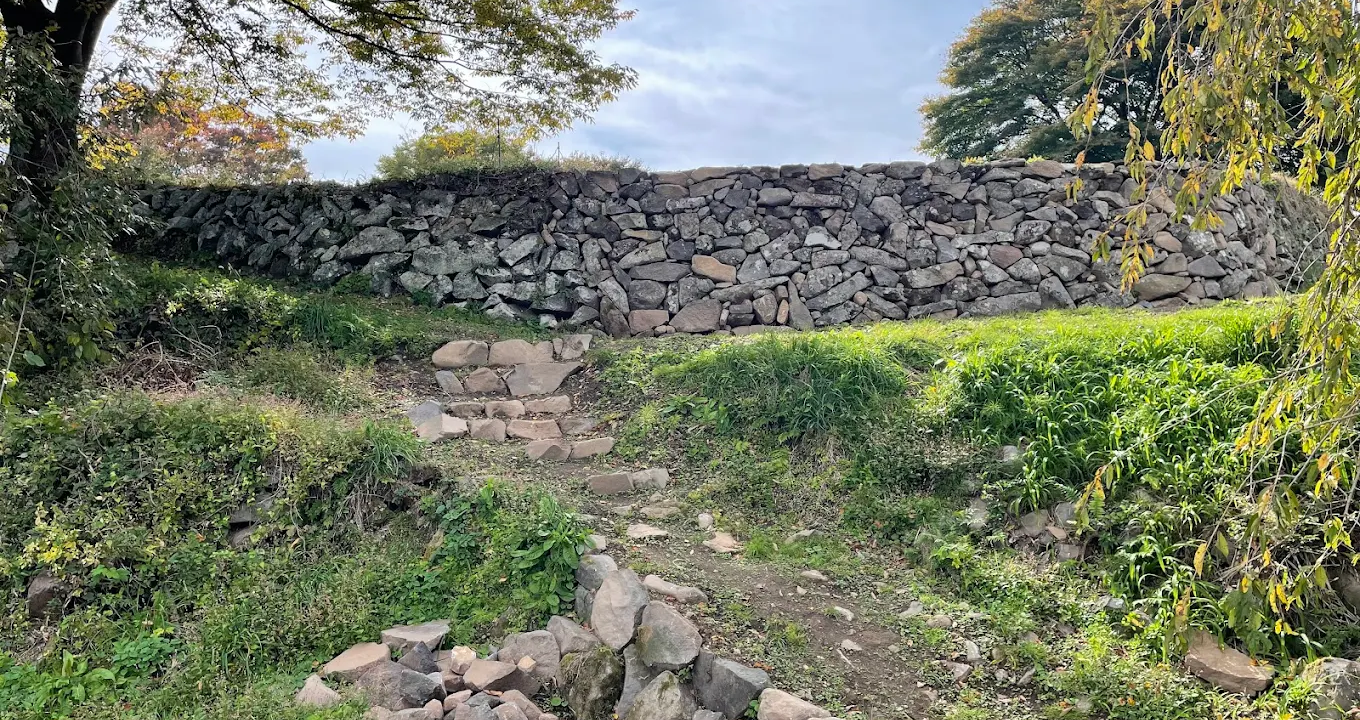
The most noteworthy remains at Fujimi Castle are the stone walls. Unusually for a mountain castle in eastern Shinano, several sections of the castle feature stone walls constructed using the “nozurazumi” method, where natural stones are piled up.
These stone walls are believed to have been built during renovations by the Takeda clan and are important evidence of the influence of the Takeda style of castle construction. While the walls are only about 1-2 meters high, they are strategically placed along the edges of the enclosures and near the entrances, enhancing their defensive capabilities.
Their relatively good state of preservation makes them a valuable opportunity to observe the stonework techniques of the time up close.
Moats and Earthworks
Moats separating the enclosures are also important defensive structures of Fujimi Castle. Digged to cut across the ridgeline, these moats functioned as powerful barriers to prevent enemy intrusion.
Earthworks surround the main enclosure, and some parts remain clearly visible today. The height of the earthworks varies depending on the location, but they reach nearly 2 meters in some places, indicating that they were fully functional as defensive positions.
Highlights and Notes on Fujimi Castle
View from the Main Enclosure
From the main enclosure, you can see Mount Asama, Mount Tateshina, and, on a clear day, even Mount Fuji in the distance. One theory suggests that the name “Fujimi Castle” (meaning “castle that looks like Fuji”) originates from its location overlooking Mount Fuji.
During the Sengoku period (Warring States period), this view played a crucial role in monitoring enemy movements. Today, it’s an excellent viewpoint for enjoying the magnificent scenery of Shinshu (Nagano Prefecture).
Design of the Entrance and Passageways
The entrances to the castle, known as “koguchi,” feature defensive structures combining stone walls and earthworks. The winding passageways, designed to prevent direct intrusion, were a clever way for a small number of defenders to defend against a large number of enemies.
In particular, the entrance to the main enclosure has a flanking fire structure, demonstrating the high level of castle construction technology.
Current Status as Iizunayama Park
Currently, the Fujimi Castle ruins have been developed into Iizunayama Park, with the Komoro Kogen Museum of Art located next to it. Walking paths are provided within the park, allowing visitors to enjoy exploring the castle ruins.
In spring, the cherry blossoms are beautiful, and in autumn, the autumn leaves are stunning, making it a popular spot for combining historical exploration with nature walks. Information boards are also installed, making it easy for first-time visitors to understand the castle’s structure.
Photo Spots
The remains of the stone walls, earthworks, and moats are ideal for photography. The texture of the stone walls is particularly beautiful when photographed in the morning light.
Photos of the view from the main enclosure are also popular, allowing for enjoyable shots with the scenery of each season. In winter, the snow cover creates an even more magical atmosphere.
Access and Visiting Information
Access by Car
Approximately 10 minutes from the Komoro Interchange on the Joshinetsu Expressway. Head north on National Route 141 and follow the signs to reach Iizunayama Park.
Parking is available at the Iizunayama Park (Komoro Kogen Museum of Art) parking lot. It is free of charge and has space for approximately 50 regular-sized cars. ### Access by Public Transportation
Approximately 15 minutes by car or taxi from JR Koumi Line’s Komoro Station. Since bus service is limited, it is recommended to check the timetable in advance.
Renting a bicycle from Komoro Station is also an option, but due to the elevation difference, an electric-assist bicycle is recommended.
Precautions When Visiting the Castle
- Time Required: Approximately 15-20 minutes on foot from the parking lot to the main enclosure
- Difficulty: Beginner to Intermediate (mountain trails included)
- Clothing: Comfortable walking shoes, long-sleeved shirt and long pants recommended
- Season: Spring to autumn is best; be aware of snow in winter
- Items to Bring: Drinking water, insect repellent (summer)
The walking paths are well-maintained, but there are some steep slopes and stairs. Caution is advised as the paths can become slippery after rain.
Visiting Hours and Fees
Fujimi Castle Ruins (Iizunayama Park) is open all day and admission is free. However, a separate admission fee is required if you wish to use the Komoro Kogen Museum of Art.
Recommended visiting time is 1-2 hours. If you want to carefully observe the remains, allow 2-3 hours.
Nearby Tourist Attractions
Komoro Castle (Kaikoen)
Located approximately 2 kilometers southwest of Fujimi Castle, Komoro Castle is a must-see tourist spot. Originally Nabefuta Castle, the main castle of Fujimi Castle, it served as the administrative center of the Komoro Domain during the Edo period.
Currently, it is maintained as Kaikoen, and important cultural properties such as the San-no-mon Gate, Otemon Gate, and stone walls remain. It is also known as a place associated with Shimazaki Toson, and you can enjoy a literary walk.
Komoro Kogen Museum of Art
Adjacent to the Fujimi Castle Ruins, this museum exhibits works mainly by artists associated with Shinshu (Nagano Prefecture). Visiting it in conjunction with exploring the castle ruins allows you to enjoy Komoro from both a historical and artistic perspective.
Mount Asama
Mount Asama, an active volcano towering north of Komoro city, can be seen from Fujimi Castle. There are many hot spring resorts at the foot of Mount Asama, making a soak in the hot springs after visiting the castle ruins a particularly delightful experience.
Mountain Castles of the Saku Region
Around Fujimi Castle, numerous medieval mountain castles are scattered, including Rakuganji Castle, Tomono Castle, and Taguchi Castle. For those who enjoy visiting mountain castles, a visit to these castle ruins is highly recommended.
Historical Background of Fujimi Castle and Komoro
Strategic Importance of Shinano Province
Shinano Province (present-day Nagano Prefecture) was a strategically important location during the Sengoku period, where powerful daimyo such as Kai (Yamanashi Prefecture), Echigo (Niigata Prefecture), and Sagami (Kanagawa Prefecture) vied for supremacy. The Saku region, in particular, was a crucial transportation hub connecting Kanto and Chubu, making it militarily and economically significant.
The Takeda Clan’s Management of Eastern Shinano
Takeda Shingen began his full-scale expansion into the Saku region during the Tenbun era, bringing many local lords under his control. By establishing Komoro as a base, he was able to expand towards Ueda and Karuizawa, solidifying his foundation for control of Eastern Shinano.
Fujimi Castle was positioned as an important subsidiary castle within this strategic plan, playing a crucial role in northern defense.
Komoro in the Edo Period
During the Edo period, Komoro developed as the residence of a Fudai daimyo (hereditary vassal daimyo). A castle town formed around Komoro Castle, and it flourished as a post town on the Nakasendo road.
Although Fujimi Castle had already been abandoned by this time, its remains were recognized as a valuable historical site that conveys the region’s history.
Significance of Visiting Fujimi Castle
Understanding the Mountain Castle Culture of Eastern Shinano
Fujimi Castle is an important historical site for understanding the mountain castle culture of the Eastern Shinano region. You can learn about the specific castle-building techniques of the Sengoku period, such as the use of stone walls, complex layouts of baileys, and defensive features like moats.
Examples of Takeda-style Castle Construction
Fujimi Castle, with its lingering traces of renovations by the Takeda clan, is a valuable example of Takeda-style castle construction. Comparative research with other Takeda-related castles allows for a deeper understanding of the Takeda clan’s military strategy.
Fusion of Nature and History
Now developed as Iizunayama Park, the Fujimi Castle ruins are a space where historical remains and the natural environment harmonize. The ability to enjoy the changing seasons while strolling through history is a major attraction of this castle site.
Current Status and Challenges of Fujimi Castle Research
Results of Archaeological Excavations
Multiple surveys and layout investigations have been conducted at the Fujimi Castle ruins. This has resulted in detailed records of the layout of baileys and the structure of the stone walls, gradually revealing the overall picture of the castle.
However, due to limited excavation and a small number of unearthed artifacts, many aspects of the castle’s construction date and period of use remain unclear.
Future Preservation and Utilization
The preservation and utilization of the Fujimi Castle ruins are positioned as an important part of Komoro City’s cultural property policy. While efforts have been made to improve visitor convenience through the development of walking paths and the installation of information boards, balancing the preservation and utilization of the remains remains a challenge.
In particular, the stone wall remains are susceptible to weathering and vegetation, requiring regular preservation treatment. Preservation activities in cooperation with local residents and history enthusiasts are highly anticipated.
Summary: The Historical Value of Fujimi Castle
Fujimi Castle in Komoro City, Nagano Prefecture, is an important mountain castle site that tells the story of military strategy in the eastern Shinano region during the Sengoku period. As a branch castle of Nabefuta Castle (the predecessor of Komoro Castle), it functioned as a border castle supporting the Takeda clan’s control of the Saku region.
Fujimi Castle Ruins in eastern Shinano boasts rare stone wall remains, a complex layout of baileys, moats, and earthworks—valuable relics that convey the castle-building techniques of the Sengoku period (Warring States period)—all in excellent condition. Currently developed as Iizunayama Park, it’s an attractive spot where you can enjoy historical walks and nature observation simultaneously.
Visiting it in conjunction with Komoro Castle (Kaikoen) will allow you to gain a deeper understanding of the history of this region from the Sengoku period to the Edo period. The view of Shinshu from the 836-meter-high summit allows you to relive the landscapes seen by Sengoku warlords.
Fujimi Castle Ruins is a worthwhile place to visit not only for mountain castle enthusiasts and history buffs, but also for those who enjoy nature walks and photography. The 130-meter climb provides moderate exercise, making it a refreshing historical exploration for both mind and body.