Complete Guide to Muramatsu Castle (Gosen City, Niigata Prefecture): The Castle Town of the Hori Clan (30,000 Koku) and the History of the Late Edo Period
What is Muramatsu Castle?
Muramatsu Castle (Muramatsu-jo) is a Japanese castle located in Muramatsu, Gosen City, Niigata Prefecture. Also known as Muramatsu-kan or Muramatsu-jin’ya, it is known as the site of the administrative office of the Muramatsu Domain, a 30,000 Koku domain of the Hori clan in Kanbara District, Echigo Province.
Currently, it is maintained as Muramatsu Castle Ruins Park, and remains such as the earthworks of the main keep and the masugata koguchi (square-shaped gate) are preserved, making it an important historical heritage site of Gosen City. The Muramatsu Local History Museum is also located next door, making it a valuable facility for learning about the region’s history.
History of Muramatsu Castle
An Old Residence from the Uesugi Period
The origins of Muramatsu Castle date back to the Sengoku period (Warring States period). It is believed that a residence-like building was constructed on this site during the time of Uesugi Kenshin, who was based at Kasugayama Castle (Joetsu City, Niigata Prefecture). At the time, it is believed that the fortress served more as a base for regional control than as a military stronghold.
The Hori Clan’s Arrival and the Establishment of the Yasuda Domain
In 1639 (Kanei 16), Hori Naotoki, the second son of Hori Naoyori, the lord of the Murakami Domain (lord of Murakami Castle), was granted 30,000 koku of land in Yasuda, Kanbara District, establishing the Yasuda Domain. The Hori clan was a prestigious family descended from Hori Hidemasa, who served Oda Nobunaga and Toyotomi Hideyoshi. The lineage descended from Okuda (Hori) Naomasa, a retainer of Hidemasa, became the Hori family of the Muramatsu Domain.
Construction of the Jinya in 1644 (Shoho 1)
In 1644 (Shoho 1), the domain’s administrative office was moved from Yasuda to Muramatsu by Hori Naoyoshi, the second lord and eldest son of Hori Naotoki. At this time, a jinya (fortified residence) was built by renovating the old residence from the Uesugi era, and the development of the castle town began simultaneously. The Hori clan was originally a daimyo without a castle, so initially, the site was not a full-fledged castle but rather a fortified residence (jinya). However, the construction of this jinya led to the development of Muramatsu as the center of the domain.
Promotion to Castle Lord Status and Major Renovation in 1850
The most important turning point in the history of Muramatsu Castle was the event of 1850 (Kaei 3). During the time of the 9th lord, Hori Naonaka, the domain, despite being relatively small at 30,000 koku, was granted the status of castle lord. This was a special treatment from the shogunate and demonstrated the high status of the Hori clan.
With this promotion to castle lord status, the Muramatsu jinya underwent a major renovation, transforming it into Muramatsu Castle. The main keep (Honmaru Goshōin) and the second bailey (Ninokuruwa Minami Goten) were renovated, and the earthworks and moats were expanded. It was reborn as a castle with a size of approximately 240 meters east-west and 330 meters north-south.
The Boshin War and the Burning of Muramatsu Castle
In 1868, the first year of the Meiji era, when the Boshin War broke out, the Muramatsu Domain joined the Ouetsu Reppan Alliance. However, as the superiority of the new government forces became clear, the Muramatsu Domain deliberately set fire to Muramatsu Castle, causing it to burn down. This was a difficult decision made to prevent the new government forces from using the castle.
As a result of this fire, almost all of the buildings of Muramatsu Castle were lost just 18 years after the major reconstruction in the Kaei era. Muramatsu, which also suffered several major fires, lost many historical documents, and only a limited amount of historical materials remain today.
Changes Since the Modern Era
After the Meiji Restoration, the site of Muramatsu Castle was left neglected for a long time, but between 1979 and 1984, the land was acquired by Muramatsu Town (now Gosen City). Subsequently, development as Muramatsu Castle Ruins Park began in 1987 (Showa 62), and it remains so to this day.
Within the park, the Muramatsu Local History Museum and the Folk Artifacts Museum were constructed and are used as facilities to convey the history and culture of the region.
Structure and Layout of Muramatsu Castle
Structure of the Main Enclosure
The main enclosure of Muramatsu Castle had a layout based on a square shape, with a masugata koguchi (square-shaped gate) located in the center of the east side. A masugata koguchi is a structure in which the passageway is turned at a right angle to prevent enemy intrusion, and is one of the measures taken to enhance defensive capabilities.
A distinctive feature is that the southeast corner protruded to the east. This protruding section is thought to have functioned as a flanking position, allowing for attacks from the flank.
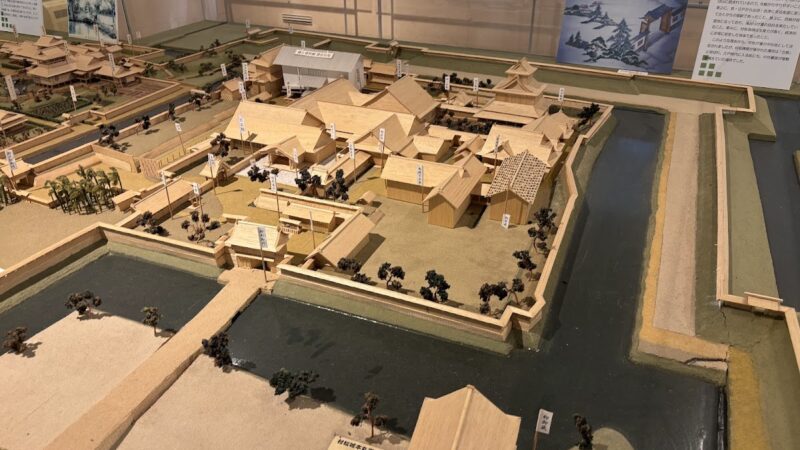
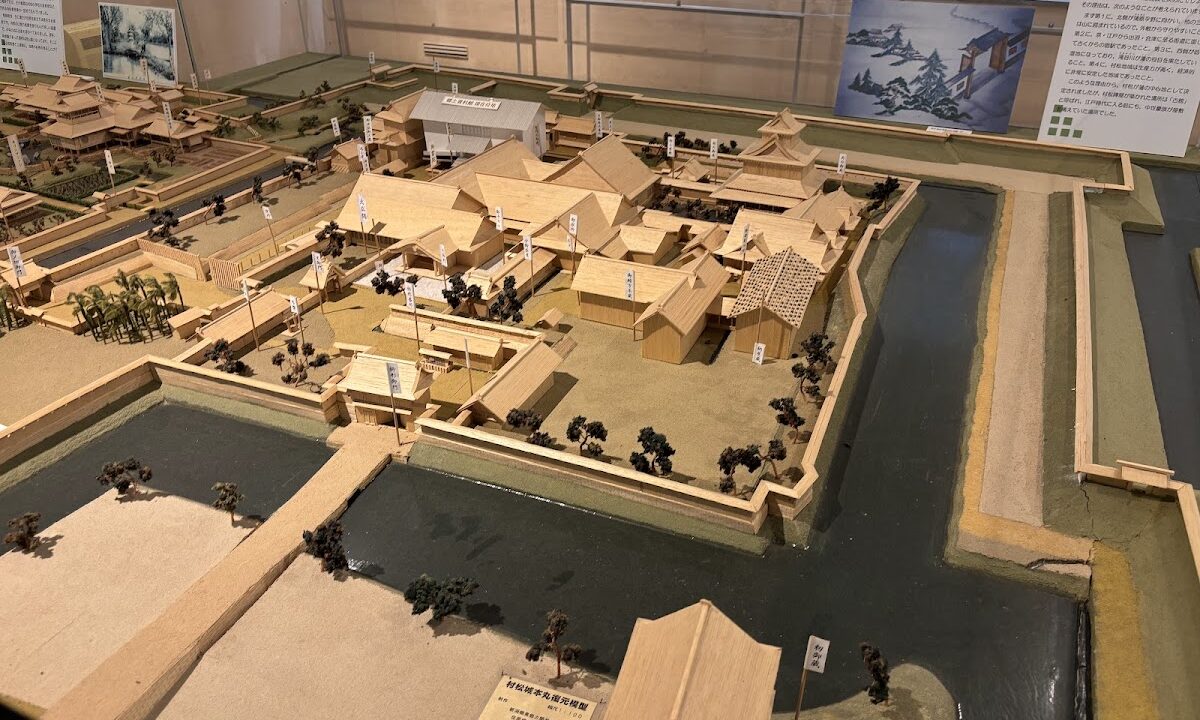
The main enclosure also housed the Honmaru Goshoin (main lord’s residence), which functioned as the lord’s living quarters and place for conducting official business. Currently, the Muramatsu Local History Museum has created and displays 1/100 scale models of the Honmaru Goshoin (main keep) and the Ninomaru Minami Goten (second keep’s south palace), allowing visitors to learn about their appearance in the past.
Ninomaru and Outer Enclosure
The Ninomaru was located south of the Honmaru. The Ninomaru contained buildings such as the Ninomaru Minami Goten, and was a concentration of important facilities of the domain.
The Takitani River flowed to the east of the castle, and this river also served as the outer moat. Currently, the Jyoato Bridge spans this river, leading to the site of the former Otemon (main gate). The Otemon was located near the southeast corner of the Gosen City Muramatsu Branch Office.
Remains of Earthworks and Moats
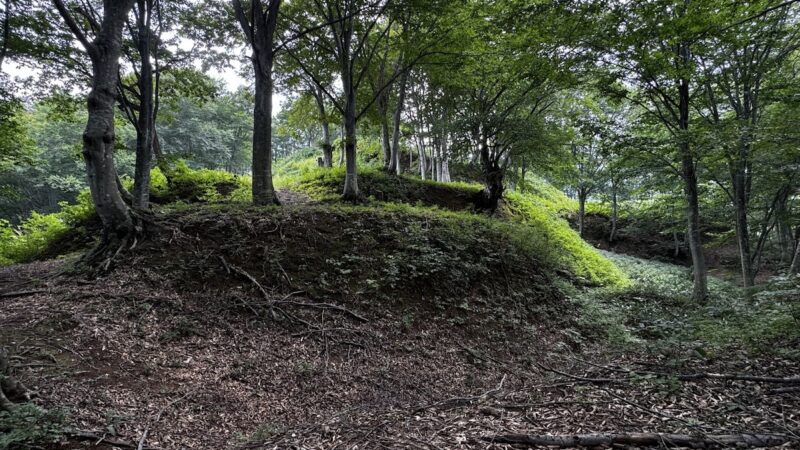
At the current Muramatsu Castle Ruins Park, the earthworks surrounding the Honmaru remain in good condition. These earthworks were earthen walls designed to prevent enemy intrusion and were the main defensive structure of Muramatsu Castle.
You can see particularly well-preserved earthworks and moats from the south to the east of the Muramatsu Local History Museum. These remains are valuable historical materials that convey the structure of a castle from the late Edo period.
Turret Base and Stone Walls
In the center of the park, the stone walls of a turret base remain, with a gazebo built on top. This turret base played an important role in the castle’s defense and is thought to have been a facility for monitoring the surrounding area.
The structure of the stone walls gives us a glimpse into how the castle was fully developed as a fortress during the major reconstruction in the Kaei era.
Highlights of Muramatsu Castle
Muramatsu Castle Ruins Park
Muramatsu Castle Ruins Park is a historical park developed around the main keep area. Walking paths are maintained within the spacious grounds, allowing visitors to stroll through the castle ruins while enjoying the changing seasons.
Information boards within the park provide detailed explanations of the castle’s structure and history, allowing even first-time visitors to understand the overall picture of Muramatsu Castle.
Remains of the Masugata Koguchi (Square Enclosure)
The Masugata Koguchi, remaining in the center of the eastern side, is one of the most important highlights of Muramatsu Castle. The structure of the entrance, formed by earthworks, is a valuable relic demonstrating Edo period castle construction techniques.
Walking around the entrance, you can see various ingenious measures taken to prevent enemy intrusion, allowing you to experience the defensive system of the time.
Muramatsu Local History Museum
Located within Muramatsu Castle Ruins Park, the Muramatsu Local History Museum is a facility where you can learn about the history of the Muramatsu Domain and the local culture. Inside, 1/100 scale models of the Honmaru Goshoin (main keep) and Ninomaru Minami Goten (second bailey south palace) are on display, allowing you to see a reconstructed version of Muramatsu Castle before it was destroyed by fire.
The museum also displays historical materials related to the Hori clan, administrative documents of the Muramatsu Domain, and illustrations depicting the castle town. In particular, the “Muramatsu Castle Town Map,” created during the Horeki era (1751-1764), is extremely valuable as it conveys the appearance of the castle town at that time, especially considering that many documents were lost in several major fires in Muramatsu. ### Exhibition of Kambara Railway Vehicles
A distinctive exhibit at Muramatsu Castle Ruins Park is the preservation and display of actual vehicles from the now-defunct Kambara Railway. These vehicles are placed next to the stone walls of the watchtower base and are cherished as the only monument in the historical space of the castle ruins.
The Kambara Railway was a local railway connecting Gosen City and Kamo City, supporting regional transportation. While the combination of a railway vehicle and a castle ruin might seem mismatched at first glance, it is an important exhibit that conveys the modern history of Muramatsu.
Folk Tools Museum
Adjacent to the local history museum, the Folk Tools Museum displays farming tools and daily life implements used from the Edo period to the early Showa period. It is a valuable facility that allows visitors to learn about the lives of ordinary people in Muramatsu, which flourished as a castle town.
About the Hori Clan of Muramatsu Domain
Genealogy of the Hori Clan
The Hori clan of the Muramatsu Domain was a prestigious samurai family descended from Hori Hidemasa, who served Oda Nobunaga and Toyotomi Hideyoshi. Hori Hidemasa was known as “Meijin Kyutaro” and was highly valued under the Toyotomi regime.
The direct ancestor of the Hori family of the Muramatsu Domain was Okuda (Hori) Naomasa, who served Hori Hidemasa. His descendant, Hori Naoyoshi, served as the lord of the Murakami Domain, and the history of the Muramatsu Domain began when his second son, Naotoki, was granted 30,000 koku in Yasuda.
From Castleless Daimyo to Castle Lord Status
The Hori family remained a castleless daimyo throughout the Edo period. A castleless daimyo is a daimyo who is not permitted to possess a castle and uses a fortified residence as their domain office. While 30,000 koku was not particularly large, the high status of the Hori family led to their special appointment as castle lords in 1850 (Kaei 3).
This promotion to castle lord status demonstrated the trust placed in them by the shogunate and the high status of the Hori family, and was a great honor for the Muramatsu Domain.
The Muramatsu Domain at the End of the Edo Period
During the Boshin War, the Muramatsu Domain joined the Ouetsu Reppan Alliance. This was an alliance of various domains in the Tohoku region, centered around the Aizu Domain, formed to oppose the new government forces.
However, as the war situation worsened, the Muramatsu Domain burned down its own castle and ultimately submitted to the new government. This decision allowed the Muramatsu Domain to survive after the Meiji Restoration, and its last lord, Hori Naoaki, was granted the status of a nobleman.
The Castle Town of Muramatsu
Formation of the Castle Town
With the construction of the Jinya (fortified residence) in 1644, the development of the Muramatsu castle town began. Samurai residences, merchant districts, and temples and shrines were systematically arranged around the castle, creating the appearance of a 30,000-koku castle town.
The “Muramatsu Castle Town Map,” created during the Horeki era, reveals the orderly layout of the town and the arrangement of major facilities. The castle town was also a transportation hub where east-west roads intersected, and commerce flourished.
Great Fires and Reconstruction
Muramatsu suffered several major fires throughout the Edo period. In a castle town densely populated with wooden buildings, fires inevitably caused extensive damage.
Many historical documents were lost in these fires, but reconstruction was carried out each time, maintaining the town’s function as a castle town. The limited amount of historical materials remaining today is largely attributed to the impact of these disasters.
Access and Visiting Information
Location
Muramatsu Castle Ruins Park is located in Muramatsu (Joka 1-chome), Gosen City, Niigata Prefecture. It is near the Gosen City Muramatsu Branch Office and easily accessible from the city center.
Access
Using Public Transportation
- Approximately 15 minutes by car from JR Ban’etsu West Line “Gosen Station”
- If using a bus from Gosen Station, take a bus bound for Muramatsu and get off at the “Muramatsu” bus stop, then walk for approximately 5 minutes.
Using a Car
- Approximately 10 minutes from Ban’etsu Expressway “Yasuda IC”
- Parking is available adjacent to the Muramatsu Local History Museum.
Visiting Hours
Muramatsu Castle Ruins Park is always open and you can freely stroll around. However, the Muramatsu Local History Museum has opening hours, so it is recommended to check in advance if you plan to visit the museum.
General opening hours are from 9:00 AM to 5:00 PM (last entry at 4:30 PM), and it is often closed on Mondays (or the following day if Monday is a public holiday) and during the New Year holidays.
Points to Note When Visiting
Allow approximately 1-2 hours to visit the Muramatsu Castle Ruins. By exploring the ruins within the park and learning about history at the local history museum, you can gain a comprehensive understanding of Muramatsu Castle and the Muramatsu Domain.
We especially recommend taking your time to carefully observe the remains of the masugata koguchi (square-shaped gate) and earthworks, referring to the information boards. The model exhibits at the local history museum are also very useful for understanding the castle’s appearance before it was destroyed by fire.
Nearby Attractions
Tourist Spots in Gosen City
Gosen City is known as the “City of Flowers,” and is particularly famous for its tulips and peonies. In spring, a riot of colorful flowers blooms, attracting many tourists.
Gosen City is also known as a silk weaving center, and traditional weaving techniques are still passed down today.
Nearby Castles
Other historical castles are scattered around Muramatsu Castle.
Yasuda Castle (Yasuda, Agano City) was the residence of the Hori clan before the establishment of the Muramatsu Domain. This site is important for understanding the history before the relocation to Muramatsu.
Shibata Castle (Shibata City) was the residence of the powerful Mizoguchi clan of Echigo Province, and structures such as the three-story turret have been restored. It is relatively close to Muramatsu Castle, making a visit to both highly recommended.
Murakami Castle (Murakami City) was the castle where Hori Naoyoshi served as lord, and is an indispensable historical site for tracing the roots of the Hori clan of the Muramatsu Domain. The remains of the mountain castle are well-preserved and well worth seeing.
Cultural Value of Muramatsu Castle
Castle Architecture of the Late Edo Period
Muramatsu Castle is a rare example of a major reconstruction from a jinya (fortified residence) to a castle in 1850, during the late Edo period. This period was a time when the shogunate’s finances were strained, and the construction of new castles and large-scale renovations were severely restricted.
The fact that the Hori clan was able to obtain the status of castle lord and carry out major renovations demonstrates their political power and the trust they received from the shogunate, making it a historically very interesting case.
Importance in Local History
Muramatsu Castle is a valuable historical site that tells the history of a small domain in Echigo Province. Often overshadowed by larger domains such as the Uesugi clan and the Nagaoka Domain, it is an important historical heritage site that reveals how a small domain of 30,000 koku managed its affairs and survived the turmoil of the late Edo period.
The historical materials housed in the Muramatsu Local History Museum and the remaining traces of the castle town are valuable resources for studying local communities during the Edo period.
Preservation and Utilization
The development of the castle ruins into a park and the construction of the museum, which began in the late Showa period, were important efforts to preserve the region’s historical heritage and pass it on to future generations. Currently, it is properly maintained by Gosen City and is also used as a place of recreation for citizens.
A distinctive feature of this site is that it incorporates modern history, such as the display of Kambara Railway rolling stock, into the castle ruins, creating a place that conveys the multifaceted history of Muramatsu.
Summary
Muramatsu Castle is the site of the Hori clan’s 30,000-koku residence, located in Gosen City, Niigata Prefecture. Beginning with the construction of a fortified residence in 1644, and undergoing a major renovation and promotion to castle lord status in 1850, it functioned as the center of the Muramatsu domain until its destruction by fire during the Boshin War in 1868.
Currently, it is maintained as Muramatsu Castle Ruins Park, and the remains of the main keep, such as the earthworks and the masugata koguchi (square-shaped gate), are well preserved. The Muramatsu Local History Museum displays models of the main keep’s study and the second bailey’s south palace, allowing visitors to see what the castle looked like before its destruction.
Muramatsu Castle is steeped in historical and cultural value, from its unique transformation from a fortified residence to a castle during the late Edo period, to the choices made by the Muramatsu domain during the turmoil of the Bakumatsu era, and the ongoing efforts to preserve and utilize it today.
When visiting Niigata Prefecture, be sure to visit Muramatsu Castle Ruins Park in Gosen City and reflect on the history of the Hori clan’s 30,000 koku domain and the path taken by this small Echigo domain. Surrounded by the tranquil beauty of nature throughout the seasons, you can slowly experience the history of the Edo period at this peaceful castle site.