Arato Castle (Niigata Prefecture) Complete Guide | History and Highlights of a Sengoku Period Mountain Castle Built During the Otate Rebellion
What is Arato Castle?
Arato Castle was a Sengoku period mountain castle located in Yuzawa Town, Minamiuonuma District, Niigata Prefecture. Built on a mountaintop at an altitude of approximately 789 meters, above the Shibahara Tunnel on the current National Route 17 (former Mikuni Kaido), this castle is deeply connected to the important historical event known as the “Otate Rebellion,” which occurred after the death of Uesugi Kenshin.
The castle ruins were designated a Niigata Prefecture historical site on March 31, 1976, and are highly valued as an extremely valuable medieval mountain castle site with a clearly defined construction date and a completely preserved castle structure.
The most distinctive features of Arato Castle lie in its purpose of construction and strategic positioning. This castle was not merely a base for territorial control, but a “beacon castle” (rokeout castle) built in a short period of time, ranging from a few days to a few weeks, with a clear military purpose: to prevent invasions by specific hostile forces.
History
Background of the Otate Rebellion and the Construction of Arato Castle
The history of Arato Castle begins with the sudden death of Uesugi Kenshin on March 13, 1578 (Tensho 6). Uesugi Kenshin, a renowned general of Echigo, had no biological children, and two adopted sons were candidates for succession. One was Uesugi Kagekatsu, the son of his sister, and the other was Uesugi Kagetora, the seventh son of Hojo Ujiyasu, a prominent family in the Kanto region.
After Kenshin’s death, a succession dispute erupted between these two adopted sons. This is the civil war known as the “Otate Rebellion.” Kagetora established his base at Otate, below Kasugayama Castle, hence the name.
Kagekatsu gained the upper hand by securing the main keep of Kasugayama Castle, but Kagetora had the powerful backing of the Hojo clan of the Kanto region, including his own father, Hojo Ujimasa. To support his younger brother Kagetora, Hojo Ujimasa planned military intervention from Kanto into Echigo.
History and Purpose of Castle Construction
On June 27, 1578 (Tensho 6), Uesugi Kagekatsu ordered Fukazawa Toshishige and Tosaka Yoemonjo to construct Arato Castle. This construction had a clear strategic purpose.
The Mikuni Kaido (present-day National Route 17), a major route from Kanto to Echigo, was an important transportation route that crossed the Mikuni Pass from Gunma Prefecture into Niigata Prefecture. Arato Castle was located at a strategic point overlooking the Mikuni Kaido and was expected to function as a “wedge” to prevent the Hojo army from invading Echigo.
The area near Shibahara Pass, chosen as the construction site, was a strategically important location close to the Echigo border. By building a castle here, it became possible to monitor the movements of the Hojo army and blockade the roads as needed.
Role in the Otate Rebellion
Arato Castle played a crucial role from the moment it was built. Hojo Ujimasa actually dispatched troops and attempted to invade Echigo via the Mikuni Road. However, the presence of Arato Castle greatly restricted the Hojo army’s advance.
The castle’s commanders, Fukazawa Toshishige and Tosaka Yoemonjo, utilized the rugged mountainous terrain and the sturdy castle structure to defend it. While there are records of the Hojo army temporarily capturing Arato Castle, Kagekatsu’s forces recaptured it, ultimately succeeding in preventing the Hojo army from penetrating deep into Echigo.
The Otate Rebellion ended in March 1579 when Kagetora committed suicide, and Uesugi Kagekatsu inherited the headship of the Uesugi family. Arato Castle played a vital role in this victory by cutting off reinforcements from the Kanto region.
Arato Castle After the Rebellion
It is believed that Arato Castle was maintained for a certain period after the end of the Otate Rebellion as a monitoring base for the Mikuni Kaido road connecting Echigo and Kanto. However, when Uesugi Kagekatsu became a subordinate of Toyotomi Hideyoshi and was transferred to Aizu in 1598, it is presumed that Arato Castle was abandoned.
After its abandonment, Arato Castle was left untouched, which conversely preserved its original structure almost entirely. This is one of the reasons why Arato Castle is highly valued academically today.
Overview
Castle Size and Structure
Arato Castle is a small but extremely skillfully designed mountain castle. The main components are as follows:
Honmaru (Main Enclosure)
The Honmaru, the center of the castle, is located on the mountaintop and is surrounded by earthen ramparts. A relatively flat space is secured, and it functioned as a place for the castle lord and the main garrison to be stationed.
Ninokuruwa and Sanomaru
The Ninokuruwa and Sanomaru are located around the Honmaru (main enclosure). These enclosures are separated by dry moats (moats that do not hold water), forming a multi-layered defensive structure. The entrances to each enclosure are fortified with a defensive structure called an outer masugata, a design intended to make enemy intrusion difficult.
Defensive Structures
The following defensive structures are placed throughout the castle:
- Belt Enclosure: A long, narrow enclosure that surrounds the main enclosure in a belt-like shape, serving to thicken the layers of defense.
- Horizontal Moat: A horizontal moat that separates enclosures, restricting enemy movement.
- Horikiri: A moat dug to cut across a ridge, preventing attacks from the rear.
- Vertical Moat: A moat dug vertically along a slope, preventing enemy lateral movement.
These defensive structures, despite the castle being built in a limited period, represent the pinnacle of castle-building technology of the Sengoku period, with their intricate arrangement.
Characteristics of the Castle’s Layout
The layout (design and arrangement) of Arato Castle is highly regarded by experts as an excellent example of late Sengoku period mountain castle technology.
What is particularly noteworthy is that, despite being built in a short period of time, it incorporates all the necessary defensive techniques. This indicates that the castle builders under Uesugi Kagekatsu possessed extensive experience and knowledge accumulated in the construction of mountain castles in Echigo.
The castle’s layout makes maximum use of the terrain, with steep slopes functioning as natural fortifications. Furthermore, its position overlooking the Mikuni Kaido road is an exquisite combination of military surveillance and road blockade functions.
Strategic Aspects of the Location
The area around Shibahara Pass, where Arato Castle was built, is a mountainous region at an altitude of approximately 789 meters. Located directly above the current National Route 17 Shibahara Tunnel, it was a crucial transportation hub connecting Echigo and the Kanto region.
This location offered the following strategic advantages:
- Road Monitoring: Allows for early detection of troop movements along the Mikuni Road.
- Defensive Advantage: The steep terrain prevents large armies from deploying, making it possible to defend with a small number of defenders.
- Smoke Signal Communication: Utilizing its mountaintop location, communication via smoke signals allowed for contact with the main force at the rear.
- Supply Route Blockade: Blocking the road made it difficult for enemy forces to resupply.
However, this location also presented a significant limitation: heavy snowfall in winter. Yuzawa Town is one of Japan’s leading heavy snowfall areas, making castle maintenance extremely difficult during winter. Therefore, it is believed that Arato Castle primarily functioned as a military base during the snow-free season.
Remains and Highlights
Excellent State of Preservation
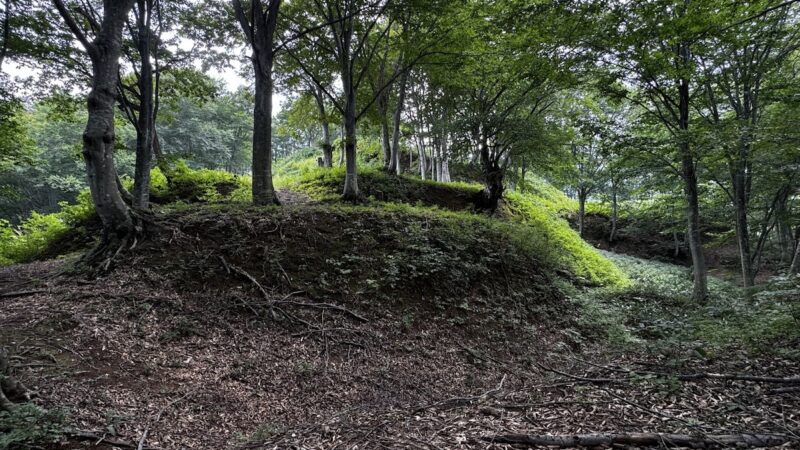
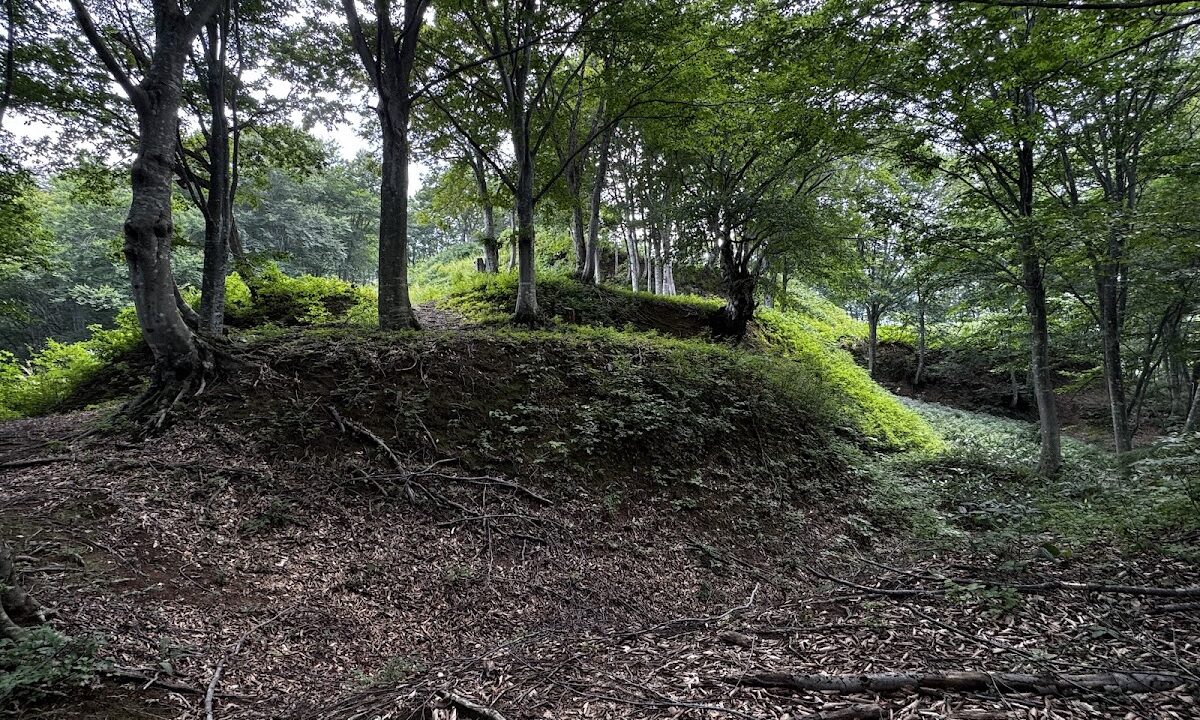
The greatest appeal of Arato Castle lies in its remarkably well-preserved state. Despite being abandoned more than 400 years ago, the remains of the castle, including earthworks, moats, and vertical trenches, remain almost exactly as they were when it was built.
Remarkably, despite being in a heavy snowfall area, the collapse of the remains has been minimized. This is because the winter snowfall actually protected the remains, and there was almost no human alteration.
Almost no grass grows on the castle site, and the steep castle walls are sometimes described as “almost as if they were from when the castle was built.” This excellent state of preservation provides extremely valuable material for the study of medieval mountain castles.
Major Remains
Earthworks
Earthworks surround each enclosure, centered around the main keep. These earthworks, constructed by piling up earth, served as fortifications to prevent enemy intrusion. The earthworks of Arato Castle retain their original height and width remarkably well, offering a glimpse into the civil engineering techniques of the Sengoku period.
Dry Moats
Dry moats separating enclosures, some reaching several meters in depth, functioned as obstacles that significantly restricted enemy movement. The cross-sectional shape and arrangement of the moats reveal the castle builder’s defensive strategy.
Cut-off Moats
Cut-off moats, dug to cut across ridges, were crucial defensive structures preventing attacks from the rear. Multiple cut-off moats have been identified at Arato Castle, each designed to counter attacks from different directions.
Vertical Moats
Vertical moats dug vertically along slopes prevented enemy soldiers from moving laterally. The vertical moats at Arato Castle are carved into steep slopes, demonstrating their high defensive effectiveness.
Outer Masugata
Outer masugata, located at the entrance to an enclosure, were designed to lure the enemy into a narrow space for attack. The outer masugata at Arato Castle is well-preserved, making it a valuable example for learning about castle construction techniques of the Sengoku period.
Points to Consider When Visiting Arato Castle
When visiting Arato Castle, paying attention to the following points will help you understand the castle’s charm more deeply.
Overall Layout
If possible, first observe the overall layout from a vantage point overlooking the entire castle. You will understand the concentric defensive structure centered on the main keep and the skillful use of the terrain.
Coordination of Defensive Structures
Note how defensive structures such as earthworks, moats, and vertical trenches work together to enhance defensive capabilities, rather than operating independently. You can see the concept of multi-layered defense, where even if one structure is breached, another obstacle awaits.
Sophistication of Construction Techniques
Despite being built in a short period, the design is efficient and rational. Try to find the ingenuity that maximized defensive effectiveness with limited labor and time.
Relative to the Mikuni Highway
By checking the castle’s position relative to the current National Route 17 (the old Mikuni Highway), you can appreciate that this castle was built in an optimal location for monitoring and blocking the highway.
Access
Access by Car
From the Kan-Etsu Expressway
- Approximately 10 minutes by car from the Kan-Etsu Expressway “Yuzawa IC”
- Proceed along National Route 17 towards Gunma (towards Mikuni Pass)
- Follow the signs before the Shibahara Tunnel
Parking
- Dedicated parking space for the castle ruins (limited number of spaces)
- Parking is possible near the entrance to the castle
Notes
- Access by car is difficult during winter (December to April) due to snow
- Studless tires are essential when the road is icy or snowy
- Be careful when parking or stopping near the Shibahara Tunnel due to heavy traffic
Access by Public Transportation
Using the JR Joetsu Line
- Get off at “Echigo-Yuzawa Station” on the JR Joetsu Line
- Approximately 7km from the station to the castle ruins
Using a Local Bus
- Take the Minami Echigo Kanko Bus “Mikuni Line” from Echigo-Yuzawa Station
- Get off at the “Shibahara” bus stop, then walk approximately 20-30 minutes to the castle entrance.
- Since the number of buses is limited, it is recommended to check the timetable in advance.
Taxi Access
- Approximately 15 minutes by taxi from Echigo-Yuzawa Station.
- It is recommended to arrange a taxi for your return trip in advance.
Castle Ascent Route
From the Castle Entrance to the Main Keep
- Approximately 15-20 minutes on foot from the castle entrance to the main keep.
- As it is a mountain path, comfortable walking shoes (trekking shoes recommended) are necessary.
- An elevation gain of approximately 100-150 meters.
- There are steep slopes, so those who are not confident in their physical fitness should be careful.
Condition of the Castle Ascent Route
- It is a mountain path, not a well-maintained walking trail.
- It can become slippery after rain, so be careful.
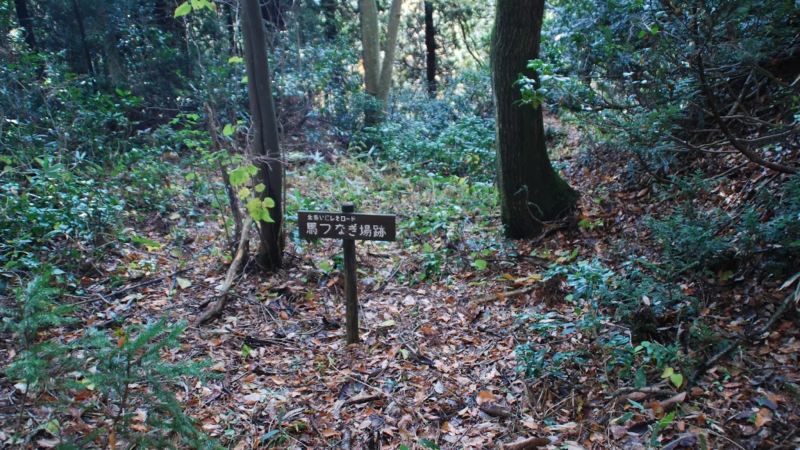
- There are guide signs, but there are places where it is easy to get lost, so it is recommended to use a map or GPS app.
Best Time to Visit
Best Season
- May to early November (snow-free period)
- The most beautiful times to visit are especially in May-June (when the leaves are fresh) and October-November (when the leaves change color).
Times to Avoid
- December-April: Heavy snowfall makes climbing difficult and dangerous.
- Mid-summer (July-August): Overgrown undergrowth can obscure the ruins.
- Rainy season: Poor footing and poor visibility.
Equipment and Precautions for Visiting
Essential Equipment
- Trekking shoes or hiking boots
- Drinking water
- Map or GPS app
- Mobile phone (for emergency contact)
Recommended Equipment
- Hat, sunscreen (summer)
- Warm clothing (spring/autumn)
- Rain gear
- Insect repellent (summer)
- Camera (for photographing the ruins)
- Binoculars (for viewing the scenery)
Safety Precautions
- Avoid climbing alone; visit with others if possible.
- Be aware of sudden weather changes (weather is unpredictable in mountainous areas).
- Be aware of bear sightings and carry a bear bell or similar device.
- Be careful of falls and slips as there are many steep areas.
- Check cell phone signal strength in advance.
Nearby Tourist Information
Tourist Spots in Yuzawa Town
Echigo Yuzawa Onsen
- A hot spring resort located about 10 minutes by car from Arato Castle.
- Ideal for relaxing after climbing the castle.
- Numerous day-trip bathing facilities are available.
Yuzawa Kogen Ski Resort & Alps no Sato
- Operates as an alpine botanical garden in summer.
- Take the ropeway to a plateau at an altitude of 1,000 meters.
- Offers magnificent views, including a panoramic view of Arato Castle’s location.
GALA Yuzawa Ski Resort
- Enjoy skiing in winter and trekking in summer.
- A rare ski resort directly connected to a Shinkansen station.
Ponshu-kan (Echigo Yuzawa Station)
- Facilities where you can sample sake from Niigata Prefecture
- Convenient for purchasing souvenirs
Nearby Castles
Asagai Yorii Castle
- A mountain castle located in Yuzawa Town, the same town as Arato Castle
- Many castle enthusiasts visit it along with Arato Castle
- Approximately 15 minutes by car
Sakado Castle (Minamiuonuma City)
- A mountain castle known as the residence of Uesugi Kagekatsu
- Approximately 40 minutes by car from Arato Castle
- A large mountain castle worth seeing
Kabasawa Castle (Minamiuonuma City)
- The residence of the Ueda Nagao clan
- Approximately 30 minutes by car from Arato Castle
Historical Facilities
Minamiuonuma Civic Hall (Library)
- You can view materials related to the Uesugi clan and the Otate Rebellion
- Detailed information about Arato Castle is also available
Undo-an Temple
- A temple where Uesugi Kagekatsu and Naoe Kanetsugu studied in their childhood
- Approximately 30 minutes by car from Arato Castle
- A Site Associated with the NHK Taiga Drama “Tenchijin”
Cultural Value of Arato Castle
Significance of Historic Site Designation
Arato Castle ruins were designated a Niigata Prefecture Historic Site on March 31, 1976. This designation is based on the following reasons:
Clearness of Construction Date While the construction dates of many medieval castles are unclear, historical records indicate that Arato Castle was specifically built on June 27, 1578. This clarity is extremely important for chronologically positioning castle construction techniques of the Sengoku period.
Completeness of Remains Because the castle has not undergone major alterations since its abandonment, the original layout remains almost completely intact. This gives it first-class historical value for studying the structure of medieval mountain castles.
Historical Significance
Arato Castle is a fortress directly related to the Otate Rebellion, a crucial turning point in the history of the Uesugi clan, and is an indispensable site for understanding the political and military history of the Sengoku period.
Academic Evaluation
Arato Castle is highly regarded among castle researchers for the following reasons:
Short-Term Construction Techniques
Despite being built in a hurry, its sophisticated layout, incorporating all the necessary defensive elements, demonstrates the high level of castle construction technology of the time.
Regional Characteristics
It strongly reflects the characteristics of mountain castle technology in the Echigo region, providing important evidence suggesting the existence of a group of castle builders under the Uesugi clan.
Standard for Comparative Research
Because its construction date is clear, it serves as a standard for comparative research with other castles whose construction dates are unknown.
Things to Know Before Visiting Arato Castle
Background Knowledge about the Otate Rebellion
To deeply understand Arato Castle, basic knowledge of the Otate Rebellion is essential.
The Course of the Rebellion
- March 13, 1578: Uesugi Kenshin dies suddenly
- A succession dispute erupts between Kagekatsu and Kagetora
- Kagekatsu secures the main keep of Kasugayama Castle, while Kagetora holes up in Otate Castle
- Hojo Ujimasa plans an invasion of Echigo to support his younger brother, Kagetora
- Kagekatsu builds Arato Castle on the Mikuni Road to block the Hojo army
- March 1579: Kagetora commits suicide, Kagekatsu wins
Historical Significance
As a result of the Otate Rebellion, Uesugi Kagekatsu inherited the Uesugi family and later became a powerful daimyo under the Toyotomi regime. If Kagetora had won, the Uesugi family would have come under the influence of the Hojo clan, and subsequent history may have been significantly different.
The Figure of Uesugi Kagekatsu
Uesugi Kagekatsu (1556-1623), who ordered the construction of Arato Castle, was born as the son of Sentoin, the sister of Uesugi Kenshin.
Main Career Highlights
- His childhood name was Umatsu, later changed to Akikage, and then Kagekatsu.
- He suppressed the Otate Rebellion and became the head of the Uesugi family.
- He pledged allegiance to Toyotomi Hideyoshi and became a daimyo with a domain of 1.2 million koku in Aizu.
- He sided with the Western Army in the Battle of Sekigahara, and after the war, his domain was reduced to 300,000 koku in Yonezawa.
- Together with his excellent advisor, Naoe Kanetsugu, he laid the foundation for the Yonezawa Domain.
Kagekatsu was known for his taciturn and cautious character, and there is an anecdote that “Lord Kagekatsu only smiled twice a year.”
History of the Mikuni Kaido
The Mikuni Kaido, which was monitored by Arato Castle, was developed during the Edo period as an important secondary road second only to the Five Highways.
Route
Takasaki (Gunma Prefecture) → Mikuni Pass → Echigo-Yuzawa → Muikamachi → Nagaoka → Niigata
Historical Role
- The shortest route connecting Kanto and Echigo
- A strategically important military route during the Sengoku period
- A route used for sankin-kotai (alternate attendance) and material transport during the Edo period
- The current National Route 17 follows almost the same route
Looking down at the Mikuni Kaido from Arato Castle, you can truly understand why this location was a strategic point.
Summary
Arato Castle is a valuable mountain castle ruin that conveys the turbulent history of the Sengoku period. Its strategic role in the important historical event of the Otate Rebellion, its intricate layout that seems impossible to have been built in such a short time, and the numerous remains that have been well preserved even after more than 400 years make it a must-see not only for castle enthusiasts but also for history lovers.
Located in a harsh natural environment of a heavy snowfall region, a visit requires careful preparation and careful timing, but the rewards of the experience and learning gained will undoubtedly be well worth the effort.
When visiting Echigo Yuzawa, in addition to the hot springs and skiing, be sure to visit Arato Castle, a witness to this history. As you climb the steep mountain path and look down on the Mikuni Kaido road from the summit, you will be able to feel the tension of the Sengoku period, where Uesugi Kagekatsu and Hojo Ujimasa confronted each other, transcending time.