Katsurao Castle, Hanishina District, Nagano Prefecture – The Complete Story of Murakami Yoshikiyo’s Residence and the Battles Against Takeda Shingen
Overview of Katsurao Castle
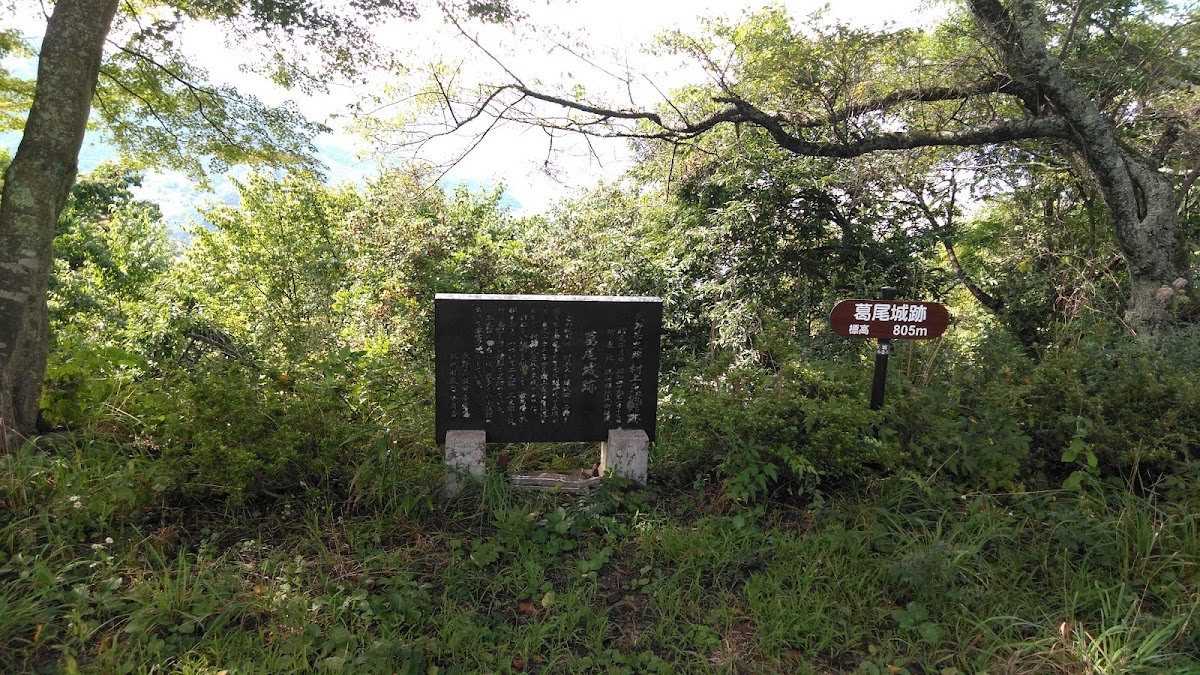
Katsurao Castle is a Sengoku period mountain castle located in Sakaki-machi, Hanishina District, Nagano Prefecture. Built on the summit of Mount Katsurao (elevation 805m) on the north bank of the Chikuma River, it boasts a relative height difference of approximately 400m from the base, making it known as a particularly strong fortress among Sengoku period mountain castles.
It was the base of the Murakami clan, the most powerful Shinano clan in northern Shinano, and is particularly renowned in history as a famous castle that repelled Takeda Harunobu (later Shingen), who invaded from Kai, on two occasions during the time of Murakami Yoshikiyo. Currently, it is protected as a Nagano Prefecture designated historical site, and remains such as earthworks and moats are well preserved.
Location and Geographical Importance of Katsuo Castle
Katsuo Castle is strategically located at a key point in the Chikuma River basin, controlling a vital transportation hub connecting northern Shinano, eastern Shinano, and Joshu (Gunma Prefecture). From Mount Katsuo, one could overlook the roads along the Chikuma River, providing a crucial surveillance function for detecting enemy movements early on.
As a mountain castle, its defensive capabilities were extremely high; its steep terrain and complex layout made it extremely difficult for attackers. This geographical advantage was one of the major factors that allowed Murakami Yoshikiyo to repel the Takeda army.
History of Katsuo Castle
Construction and the Rise of the Murakami Clan
There are various theories regarding the construction period of Katsuo Castle, but it is believed to have been built by the Murakami clan at the end of the Nanboku-cho period (late 14th century). The Murakami clan was a prestigious family descended from the Seiwa Genji clan and had long held power as a powerful samurai family in Shinano Province.
From the Muromachi period to the Sengoku period, the Murakami clan expanded their power throughout northern Shinano, using Katsuo Castle as their base, and grew into a regional daimyo controlling Hanishina, Sarashina, and Takai districts. They established a strong defensive network with numerous branch castles surrounding Katsuo Castle.
The Fierce Battle Between Murakami Yoshikiyo and Takeda Shingen
Katsuo Castle first appears on the historical stage during the time of Murakami Yoshikiyo. Yoshikiyo unified northern Shinano and, at his peak, boasted one of the greatest powers in Shinano.
The Battle of Uedahara (Tenbun 17, 1548)
In February of Tenbun 17 (1548), Takeda Harunobu (Shingen) invaded Murakami territory as part of his invasion of Shinano. The two armies clashed at Uedahara (present-day Ueda City), where Murakami Yoshikiyo defeated the Takeda army. In this battle, the Takeda forces suffered a crushing defeat, losing important retainers such as Itagaki Nobukata and Amari Torayasu, and Harunobu himself was wounded.
This was one of the few defeats Takeda Shingen experienced in his lifetime, and it served to demonstrate Murakami Yoshikiyo’s military prowess to the world.
Toishi Collapse (Tenbun 19, 1550)
In September of Tenbun 19 (1550), Takeda Harunobu again launched an invasion of Shinano Province, attacking Toishi Castle (present-day Ueda City), a subsidiary castle of the Murakami forces. However, due to Murakami Yoshikiyo’s skillful tactics, the Takeda army suffered a major defeat. In this battle, known as the “Toishi Collapse,” the Takeda forces also lost many soldiers.
With these two victories, Murakami Yoshikiyo established his unshakeable reputation as “the great general who defeated Shingen twice.”
Sanada Yukitaka’s Stratagem and the Fall of Katsuo Castle
However, Takeda Shingen abandoned a frontal assault and changed his strategy. He recruited Sanada Yukitaka (Yukitsuna) and attempted to weaken the Murakami clan through stratagem. Sanada Yukitaka, originally a subordinate of the Murakami clan, switched allegiance to the Takeda and became a master of stratagem.
Between 1551 and 1553, Sanada Yukitaka’s stratagems caused many of the Murakami’s subsidiary castles to defect to the Takeda. The capture of Toishi Castle, in particular, was a major blow.
In April 1553, Katsuo Castle was finally besieged by the Takeda army. Isolated due to the collapse of his network of subsidiary castles, Murakami Yoshikiyo was forced to abandon Katsuo Castle and flee to Echigo to the care of Nagao Kagetora (later Uesugi Kenshin).
Katsuo Castle under the Takeda Clan’s Rule
Takeda Shingen, who acquired Katsuo Castle, considered it a crucial base for his control of northern Shinano. He appointed a castle lord to govern it and it played a vital role in the Battle of Kawanakajima against Uesugi Kenshin.
Under the Takeda clan’s rule, Katsuo Castle underwent renovations, and its defensive capabilities are believed to have been further strengthened.
The Uesugi Era and the Castle’s Abandonment
In 1582, when the Takeda clan fell, northern Shinano came under the control of Uesugi Kagekatsu. Katsuo Castle also became an Uesugi castle, but by this time, the era of mountain castles was already coming to an end.
After the Battle of Sekigahara in 1600, when the Uesugi clan was transferred to Aizu, Katsuo Castle ceased to serve its purpose and was abandoned. From then on, the castle disappeared from the stage of history, leaving only its quiet remains in the mountains.
Layout and Remains of Katsuo Castle
Main Enclosure (Honmaru)
The main enclosure of Katsuo Castle is located on the summit of Mount Katsuo, at an altitude of 805m. It measures approximately 50m east-west and 30m north-south, and is surrounded by earthen ramparts. From the main enclosure, one can see the entire Chikuma River basin, providing excellent views and surveillance capabilities.
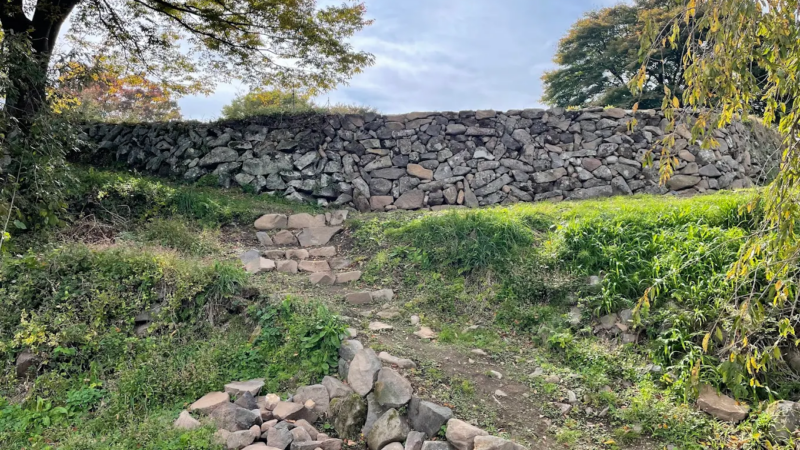
The traces of the earthen ramparts remain clearly visible today, making them valuable remains for understanding the structure of mountain castles from the Sengoku period.
Second and Third Enclosures
The second and third enclosures are arranged around the main enclosure, forming a stepped layout. Each enclosure is demarcated by moats and earthen ramparts, demonstrating various defensive measures.
Moats
The most distinctive feature of Katsuo Castle is the massive moat that cuts off the ridgeline. In particular, large trenches over 10 meters deep were constructed on the south and north sides of the main enclosure, forming a strong defensive line to prevent enemy intrusion.
These trenches remain remarkably well-preserved today, offering valuable historical remains that allow us to experience the defensive system of a mountain castle.
Vertical and Horizontal Moats
Numerous vertical moats were constructed on the slopes, a clever design to prevent flanking attacks. Horizontal moats can also be seen on the middle of the ridge, indicating the construction of a complex defensive line.
Earthworks
Earthworks were built around each enclosure, enhancing its defensive capabilities. The earthworks around the main enclosure, in particular, remain in sections over 2 meters high, demonstrating the advanced castle-building techniques of the time.
Murakami Clan Residence Site (Mansenji Temple)
At the foot of Katsuo Castle, in what is now Sakaki-machi, Sakaki, was the residence of the Murakami clan. During peacetime, the lord conducted administrative affairs at this residence, while in wartime, he would fortify himself at Katsuo Castle on the mountaintop.
Currently, part of the former residence site is within the grounds of Mansenji Temple, where traces of stone walls and earthworks remain. Mansenji Temple is known as a temple associated with the Murakami clan, and exhibits related to Murakami Yoshikiyo are displayed within its grounds.
Around the residence site, remnants of moats and earthworks are scattered, conveying the appearance of a medieval residence. Visiting this residence site in conjunction with a visit to Katsuo Castle will provide a deeper understanding of the Murakami clan’s system of rule.
The Kogai Ferry and the Chikuma River Defense Line
The Chikuma River is indispensable when discussing Katsuo Castle’s defense system. The Chikuma River, flowing south of the castle, functioned as a natural moat, serving as an important defensive line to prevent enemy approaches.
The “Kogai Ferry” was one of the important crossing points on the Chikuma River, and the Murakami clan strictly controlled this crossing. When the Takeda army invaded northern Shinano, securing this river crossing point was a crucial strategic objective.
Even today, a monument marking the site of the Kōgai ferry crossing stands along the Chikuma River, demonstrating its importance as a vital transportation hub at the time.
Guide to Visiting Katsuo Castle
Access
By Train
- Get off at Sakaki Station on the Shinano Railway, then walk approximately 20 minutes to the trailhead.
- You can also use the Sakaki Town Loop Bus from the station.
By Car
- Approximately 10 minutes from Sakaki Interchange on the Joshinetsu Expressway.
- Parking is available near the trailhead (free).
Climbing Route
There are several routes to climb Katsuo Castle, but the most common is the “Sakaki Shrine Course.”
- Sakaki Shrine Course (Estimated time: approx. 50 minutes)
- Standard route starting from Sakaki Shrine via a mountain trail
- Relatively well-maintained mountain trail
- Suitable for intermediate hikers
- Mansenji Temple Course (Estimated time: approx. 60 minutes)
- Route starting from Mansenji Temple, the site of the Murakami clan’s residence
- Allows you to follow a historical route
- Some sections are somewhat steep
Points to Note
- Estimated Time: Approximately 2-3 hours from ascent to descent
- Difficulty: Intermediate (Elevation difference 400m, includes steep mountain paths)
- Attire: Suitable hiking clothing, trekking shoes recommended
- Items to Bring: Drinking water, towel, insect repellent (summer)
- Best Season: April to November (winter is difficult due to snow)
Precautions for Visiting
- As it is a mountain castle, there are areas with unstable footing
- Beware of venomous snakes and wasps during the summer.
- Avoid solo climbing; climbing in groups is recommended.
- Refrain from climbing in bad weather.
- Always take your trash with you.
Related Historical Sites in the Surrounding Area
Sakaki Town Museum (Katsuo Castle Ruins Museum)
This museum exhibits detailed materials related to Katsuo Castle and the Murakami clan. Visiting before climbing the castle will allow you to understand the history more deeply.
- Address: 6313-2 Sakaki, Sakaki-machi, Hanishina-gun, Nagano Prefecture
- Opening Hours: 9:00 AM – 5:00 PM
- Closed: Mondays (or the following day if Monday is a public holiday)
Burial Site of Murakami Yoshikiyo
Sakaki Town has numerous historical sites associated with Murakami Yoshikiyo. There is also a place believed to be Yoshikiyo’s burial site, a must-see for history buffs.
Toishi Castle Ruins
Toishi Castle, the site of the “Toishi Collapse,” is located in Ueda City. Visiting it together with Katsuo Castle provides a more comprehensive understanding of the battle between Murakami Yoshikiyo and Takeda Shingen.
Cultural Property Designation of Katsuo Castle
Katsuo Castle Ruins were designated a Nagano Prefecture Historic Site in 1973. It is valued as a valuable example of well-preserved remains of a mountain castle from the Sengoku period.
In recent years, Sakaki Town has been focusing on the preservation and utilization of Katsuo Castle Ruins, carrying out regular grass cutting and the maintenance of information boards. Local volunteer guides also provide guided tours, allowing visitors to hear more detailed explanations during their visit.
Katsuo Castle and Shinano Province in the Sengoku Period
The history of Katsuo Castle symbolizes the complex situation in Shinano Province during the Sengoku period. It is deeply connected to important events in Japanese history, such as Takeda Shingen’s invasion of Shinano, the Battle of Kawanakajima against Uesugi Kenshin, and the rise of the Sanada clan.
The fact that Murakami Yoshikiyo defeated Takeda Shingen twice demonstrates that the Takeda army’s strength was not absolute. His defensive tactics, utilizing the terrain to his advantage, his governing with local support, and his qualities as a superior military commander all contributed to his victories.
However, ultimately, Katsuo Castle fell through another means: stratagem. This sequence of events illustrates that battles in the Sengoku period were not merely about military strength, but a competition of comprehensive power, including diplomacy, stratagem, and economic strength.
Present State and Preservation Efforts of Katsuo Castle
Currently, the Katsuo Castle ruins are carefully preserved as a valuable historical heritage site of the region. The Sakaki Town Board of Education is leading efforts to preserve and utilize the remains, including the maintenance of hiking trails and the installation of information boards.
Every year, local history enthusiasts and castle fans visit, experiencing the atmosphere of the Sengoku period. Furthermore, events such as the “Katsuo Castle Festival” are held in spring and autumn, serving as a hub for disseminating local history and culture.
Due to the recent castle boom, many history enthusiasts from all over Japan now visit, and it is attracting attention as a tourist resource for Sakaki Town.
Summary
Katsuo Castle in Sakaki Town, Hanishina District, Nagano Prefecture, occupies an important position in the history of Japanese castles as a masterpiece of mountain castles from the Sengoku period and as the residence of the famous general Murakami Yoshikiyo. Its glorious battle record, having repelled Takeda Shingen twice, and its dramatic history of ultimately falling through stratagem, continues to fascinate many history fans.
The remains of moats and earthworks on the mountaintop at an altitude of 805m convey the high level of castle construction technology of the time, allowing visitors to experience the tension of the Sengoku period. With its spectacular view overlooking the Chikuma River, Katsuo Castle, where you can feel the romance of history, is an indispensable historical site for learning about the Sengoku history of Shinano.
Katsuo Castle is an attractive destination not only for castle enthusiasts but also for those who enjoy mountain climbing and hiking. When you visit Nagano Prefecture, be sure to visit this historic mountain castle.