
Akizuki Castle (Awa City, Tokushima Prefecture) Complete Guide: History and Remains from the Hosokawa Clan’s Residence to its Abandonment
What is Akizuki Castle?
Akizuki Castle is a flatland castle from the Muromachi period, located in Akizuki, Donari-cho, Awa City, Tokushima Prefecture. Built in 1336 by Hosokawa Kazuuji, who entered Awa Province as its governor, it served as the political and military center of Awa Province for three generations of the Hosokawa clan. Currently, it is preserved as a designated historical site of Awa City, a valuable historical heritage site that conveys the atmosphere of its former glory.
Basic Information on Akizuki Castle
- Location: Akizuki, Donari-cho, Awa City, Tokushima Prefecture
- Castle Structure: Flatland Castle
- Year of Construction: Kenmu 3rd year / En’en 1st year (1336)
- Builder: Hosokawa Kazuuji
- Main Lords: Hosokawa Kazuuji, Hosokawa Yoriharu, Hosokawa Yoriyuki, Akizuki Nakatsukasa Daisuke (Mori Hida-no-kami)
- Year of Abandonment: Tensho 7th year (1579)
- Designated Cultural Property: Awa City Designated Historic Site
History of Akizuki Castle
Background of Construction and the Entry of the Hosokawa Clan
The history of Akizuki Castle is closely related to the political situation in Awa Province during the Kenmu Restoration. Replacing the Ogasawara clan (later the Miyoshi clan), who had previously served as the governor of Awa Province, Hosokawa Kazuuji, who enjoyed the deep trust of Ashikaga Takauji, was newly appointed as the governor of Awa Province.
In 1336, during the Kenmu era, when Ashikaga Takauji was defeated in battle in Kyoto and fleeing to Kyushu, Hosokawa Kazuuji, who had been appointed Governor of Awa Province, along with his younger brother Hosokawa Yoriharu and Hosokawa Akiuji, crossed to Shikoku to recruit troops. At this time, Kazuuji was taken in by the local powerful Awa Akizuki clan (said to be descendants of the Awa no Kuni no Miyatsuko), and established a residence in Akizuki.
The Awa Akizuki clan ceded their castle to Hosokawa Kazuuji, who is said to have used it as a basis to construct Akizuki Castle as a full-fledged fortress. Therefore, Akizuki Castle has the characteristic of being “a castle rebuilt by Hosokawa Kazuuji from the castle of the Awa Akizuki clan.”
The Era of the Hosokawa Clan’s Three Generations as Shugo Residences
After its construction by Hosokawa Kazuuji, Akizuki Castle functioned as the residence of the three generations of the Hosokawa clan as Shugo (military governor) of Awa Province.
First Generation: Hosokawa Kazuuji
Hosokawa Kazuuji served as a trusted confidant of Ashikaga Takauji and worked to expand the Ashikaga’s influence in Shikoku, based in Awa Province. He established the governing system of Awa Province from Akizuki Castle and contributed to the improvement of the Hosokawa clan’s status within the Muromachi Shogunate.
Second Generation: Hosokawa Yoriharu
Hosokawa Yoriharu, Kazuuji’s younger brother, inherited Akizuki Castle. Yoriharu, along with his brother, supported Ashikaga Takauji and played a crucial role during the turbulent Nanboku-cho period. Akizuki Castle continued to function as the political and military center of Awa Province.
Third Generation: Hosokawa Yoriyuki
Akizuki Castle reached its peak during the reign of Hosokawa Yoriyuki, Yoriharu’s son. Yoriyuki, at a young age, became the governor of Awa, Sanuki, and Tosa Provinces, and solidified the Hosokawa clan’s power in Shikoku from Akizuki Castle.
Relocation of the Headquarters to Shōzui Castle
When Hosokawa Yoriyuki went to Kyoto as the Kanrei (Shogun’s assistant) of the Muromachi Shogunate, a major change occurred in the governance system of Awa Province. Yoriyuki’s younger brother, Hosokawa Akiharu (possibly Yoriyuki’s adopted son), who became the founder of the Awa Hosokawa family, built a new castle, Shōzui Castle (Shōzui-kan), in Shōzui (present-day Aizumi-cho), which had better transportation access and was more economically developed, and relocated the Hosokawa clan’s headquarters there.
This relocation caused Akizuki Castle to lose its status as the shugo’s (provincial governor’s) residence, but it was not completely abandoned. Afterward, Akizuki Chūji no Daisuke (possibly Mori Hida no Kami) became the lord of the castle, and it continued to exist as an important branch castle of the Hosokawa clan.
Attack and Fall of Chōsokabe Motochika
In 1579 (Tenshō 7), the forces of Chōsokabe Motochika, a Sengoku daimyo from Tosa aiming to unify Shikoku, invaded Awa Province. At this time, Akizuki Castle also became a target of the Chosokabe army’s attack.
At that time, Akizuki Castle was in a situation where it could not secure sufficient defensive forces due to the decline of the Hosokawa clan’s power. Faced with Chosokabe Motochika’s organized attack, Akizuki Castle fell without a trace.
With this fall, Akizuki Castle’s history of over 240 years came to an end and it was abandoned. The Chosokabe clan did not reuse Akizuki Castle, instead establishing another base for their control of Awa Province. Therefore, Akizuki Castle disappeared from the stage of history with the end of the Sengoku period.
Structure and Layout of Akizuki Castle
Location and Topographical Characteristics
Akizuki Castle is a flatland castle built on a hill in Akizuki, Donari-cho, Awa City. The castle ruins remain on the northern hill, approximately 850 meters east of the intersection at the entrance to Kirihata-ji Temple (Pilgrimage Site No. 10) on Prefectural Road 139.
A small river flowed to the west of the castle, serving as a natural moat. While the surrounding area was relatively flat, the castle was built on a slightly elevated area, providing a vantage point for overlooking the surroundings.
Components of the Castle
The following traces of Akizuki Castle remain today:
Gohara Spring
A spring believed to have been used as a water source for daily life within the castle, water still flows from it. Securing a water source was extremely important for medieval castles, and this spring was a crucial infrastructure facility for Akizuki Castle.
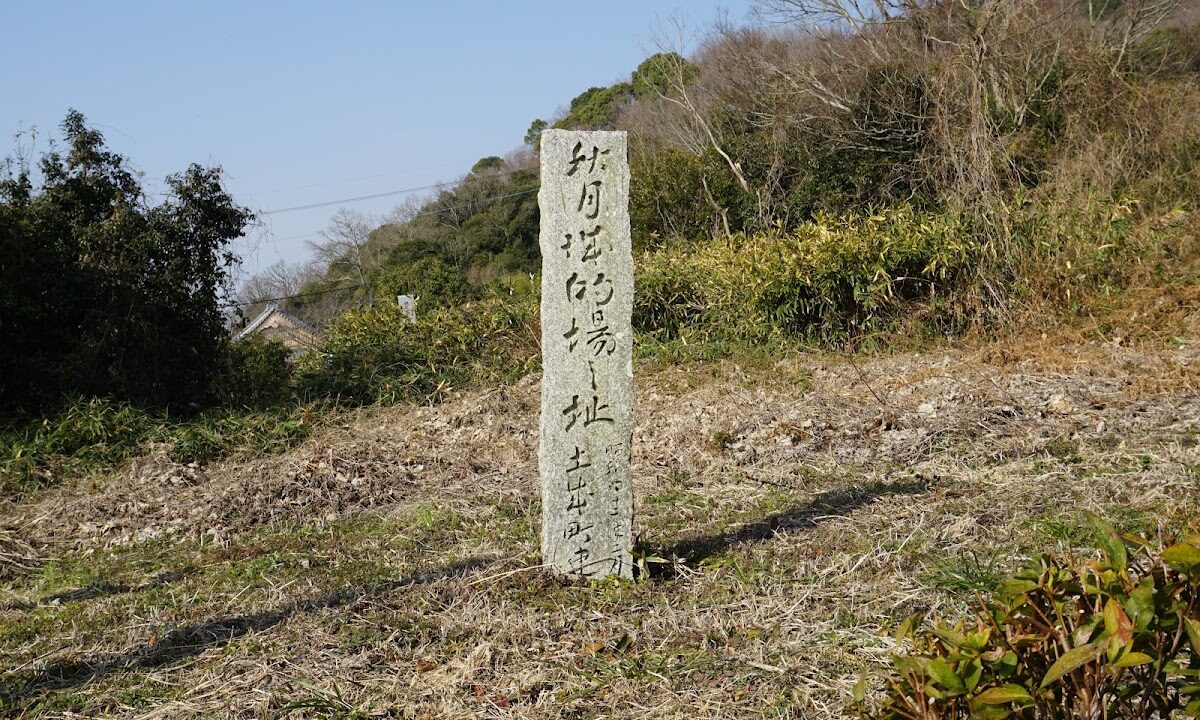
Archery Range
This is believed to be the place where samurai practiced archery. Archery was an important martial art in medieval samurai society, and the presence of a training facility within the castle indicates that Akizuki Castle functioned not merely as a residence, but as a military base.
Hearth Site
This is the remains of a cooking area within the castle. The remains of a large hearth indicate that many people were stationed there permanently.
Current Status of the Castle Ruins
Part of the Akizuki Castle ruins is used as a cemetery, making complete preservation of the remains difficult. However, a stone monument marking the castle site has been erected, recognizing its historical importance.
Although protected as a designated historical site by Awa City, large-scale excavations and development have not been carried out, and the detailed layout and placement of buildings remain subjects for future research.
Access and Visiting Information for Akizuki Castle
Location and Transportation Access
Location
771-1506 Akizuki, Donari-cho, Awa City, Tokushima Prefecture
Access by Public Transportation
- Approximately 15 minutes by car from JR Tokushima Line “Kamojima Station”
- Bus services are limited, so using a taxi is recommended.
Access by Car
- Approximately 10 minutes from Tokushima Expressway “Donari IC”
- Approximately 850 meters east from the intersection of Prefectural Road 139, the entrance to the 10th temple, Kirihata-ji, on the northern hillside
- There is no parking available, so please be considerate of the surrounding area when visiting.
Precautions When Visiting
Part of the Akizuki Castle ruins is used as a cemetery, so please note the following points when visiting.
- Enter the cemetery carefully and be considerate of visitors.
- Take care not to damage the remains.
- Always take your trash with you.
- As private property may be included, please obey any signs indicating “No Entry.”
Nearby Tourist Attractions
Kirihata-ji Temple (Temple No. 10)
This is the tenth temple of the Shikoku 88 Temple Pilgrimage, located near Akizuki Castle. It is an ancient temple associated with Kobo Daishi and is visited by many pilgrims. Visiting it in conjunction with a visit to Akizuki Castle is recommended.
Gosho Onsen
This hot spring facility is located upstream of the Miyagawauchi Valley River, within the Okumiyagawauchi Prefectural Natural Park. It is ideal for relaxing after visiting the castle ruins.
Tarai Udon
A specialty dish of Awa City, characterized by its style of serving warm udon noodles in a large tub, shared among several people. Several restaurants in the area serve “Tarai Udon.”
Tourist Grape Farm
From summer to autumn, you can enjoy grape picking in the Miyagawauchi area. Combine this with a historical exploration of Akizuki Castle and savor the seasonal flavors.
Cultural Significance of Awa City and Akizuki Castle
Position in the History of Awa Province
Akizuki Castle played a crucial role as the political center of Awa Province from the early Muromachi period to the Sengoku period. The period when the Hosokawa clan was based at Akizuki Castle coincides with the time when Awa Province functioned as the most important base for the Ashikaga clan in Shikoku.
The three generations of the Hosokawa clan—Kazuuji, Yoriharu, and Yoriyuki—exerted influence throughout Shikoku from their base at Akizuki Castle and were deeply involved in the central government of the Muromachi Shogunate. In particular, Hosokawa Yoriyuki, as Kanrei (deputy shogun), wielded real power in the Muromachi Shogunate, boasting such power that he was called the “regent who governed the realm.”
Thus, Akizuki Castle was not merely a local castle, but an important base that influenced nationwide political trends.
Importance in Local History
For the Akizuki district of Donari-cho, Awa City, the Akizuki Castle ruins are a crucial historical heritage site that shapes the region’s identity. Its history as the center of Awa Province during the Muromachi period is a source of pride for the local residents.
Present-day Awa City has developed as a region where the rich nature of the Yoshino River basin harmonizes with its history and culture, but the foundation of its history lies in the prosperity of the Middle Ages centered around Akizuki Castle.
Value and Challenges as a Cultural Property
While the Akizuki Castle ruins are protected as a designated historical site of Awa City, their national recognition is not necessarily high. However, considering its historical importance as the residence of the Hosokawa clan, a prestigious samurai family that played a central role in the Muromachi Shogunate, more proactive preservation and utilization are desirable.
The following points are among the challenges for the future:
- Clarification of the castle structure through detailed archaeological excavations
- Appropriate preservation and maintenance of the remains
- Enhancement of information provision through the installation of information boards and explanatory signs
- Utilization for local history education
- Examination of methods for utilization as a tourist resource
The relationship between Akizuki Castle and the Hosokawa clan
The Hosokawa clan’s base of operations in Shikoku
The Hosokawa clan, as a branch of the Ashikaga clan, was a samurai family that held the most important position in the Muromachi Shogunate. Akizuki Castle was the first location chosen by the Hosokawa clan as their base of operations in Shikoku.
Hosokawa Kazuyuki held the positions of governor of Awa, Sanuki, and Tosa, wielding influence throughout Shikoku. Akizuki Castle functioned as the command center for this Shikoku administration and played a crucial role in the expansion of the Hosokawa clan’s power.
Hosokawa Yoriyuki and Akizuki Castle
Hosokawa Yoriyuki is said to have been born and raised in Akizuki Castle, and for the young Yoriyuki, Akizuki Castle was the place where he learned the fundamentals of politics and military affairs. Yoriyuki later seized real power in the Muromachi Shogunate as Kanrei (deputy shogun), becoming such a powerful figure that he was called the “regent of the realm.” However, the foundation of his power was laid during his time at Akizuki Castle.
Even after Yoriyuki’s arrival in Kyoto, the Awa Hosokawa family continued to maintain Akizuki Castle as an important base. Even after relocating their main base to Shōzui Castle, Akizuki Castle was not completely abandoned, continuing to play a vital role in the Hosokawa clan’s network of branch castles.
The Establishment of the Awa Hosokawa Family and Akizuki Castle
Yoriyuki’s younger brother, Akiharu (or Yoriyuki’s adopted son), became the founder of the Awa Hosokawa family, inheriting the rule of Awa Province from Shōzui Castle. This Awa Hosokawa family later produced the Miyoshi clan, which would become a major force in the Kinai region during the Sengoku period.
Akizuki Castle can be considered the “birthplace” of the Awa Hosokawa family, and its historical significance is immense.
Akizuki Castle and Shikoku in the Sengoku Period
Chosokabe Motochika’s Unification of Shikoku and Akizuki Castle
The fall of Akizuki Castle in 1579 (Tensho 7) occurred as part of Chosokabe Motochika’s unification of Shikoku. During this period, the power of the Hosokawa clan was declining, and the Miyoshi clan was also weakened by pressure from Oda Nobunaga.
Chosokabe Motochika seized this opportunity to invade Awa Province, capturing castles one after another. Akizuki Castle became a target, and in stark contrast to its former glory, it fell surprisingly quickly.
Historical Significance of the Fall of Akizuki Castle
The fall of Akizuki Castle has meaning beyond simply the loss of one castle. It symbolized the end of the Hosokawa clan’s rule over Awa Province, which had continued since the Muromachi period.
The Chosokabe clan’s unification of Shikoku led to Toyotomi Hideyoshi’s conquest of Shikoku, and further to the Hachisuka clan’s rule of Awa Province during the Edo period. The fall of Akizuki Castle is positioned as one of these major turning points in history.
Current Status and Future Prospects of Akizuki Castle Ruins
Preservation Status and Challenges
Currently, part of the Akizuki Castle ruins is used as a cemetery, so the preservation of the remains is not necessarily good. However, important remains such as “Mihara Spring,” “Archery Range,” and “Hearth Site” remain, and with appropriate preservation measures, they could become valuable resources for understanding the reality of medieval castles.
While it is protected as a designated historical site of Awa City, future challenges include upgrading it to a national or prefectural historical site, and conducting detailed academic research.
Potential as a Tourism Resource
With proper maintenance and information dissemination, the Akizuki Castle ruins have the potential to become an attractive tourist spot for history enthusiasts and castle fans.
In recent years, interest in “castle tours” and “historical exploration” has been growing nationwide, attracting attention not only to famous castles but also to medieval castles in rural areas. Akizuki Castle holds historical significance as the residence of the prominent samurai family, the Hosokawa clan, and with appropriate PR, it could attract many history enthusiasts.
Contribution to Regional Development
Promoting historical tourism centered around the Akizuki Castle ruins has the potential to contribute to the regional development of the Akizuki area in Donari-cho, Awa City. Existing tourist resources such as Kirihata-ji Temple, Gosho Onsen hot springs, and tarai udon restaurants exist in the surrounding area, and the development of tourist routes combining these with the Akizuki Castle ruins is conceivable.
Developing tourist content such as an “Akizuki Historical Road” that combines history, nature, and food culture could lead to the revitalization of the entire region.
Summary
Akizuki Castle is a flatland castle from the Muromachi period located in Akizuki, Donari-cho, Awa City, Tokushima Prefecture, built in 1336 by Hosokawa Kazushi. Akizuki Castle served as the political and military center of Awa Province, serving as the residence of three generations of Hosokawa clan governors: Kazuuji, Yoriharu, and Yoriyuki. It was a crucial castle deeply involved with the central government of the Muromachi Shogunate.
Even after the Hosokawa clan moved their base to Shōzui Castle, it continued to exist as a subsidiary castle. However, in 1579, it fell to an attack by Chōsokabe Motochika, ending its approximately 240-year history.
Currently, it is preserved as a designated historical site of Awa City, with remnants such as the “Mihara Spring,” “Archery Range,” and “Hearth Site.” While complete preservation is difficult due to partial use as a cemetery, it is a valuable historical legacy of a medieval castle, and further research, preservation, and utilization are anticipated.
Visiting the Akizuki Castle ruins allows one to experience firsthand the history of Awa Province during the Muromachi period, the Hosokawa clan’s rule over Shikoku, and the turmoil of the Sengoku period. It is a historical site worth visiting not only for history enthusiasts but for anyone interested in local history.


