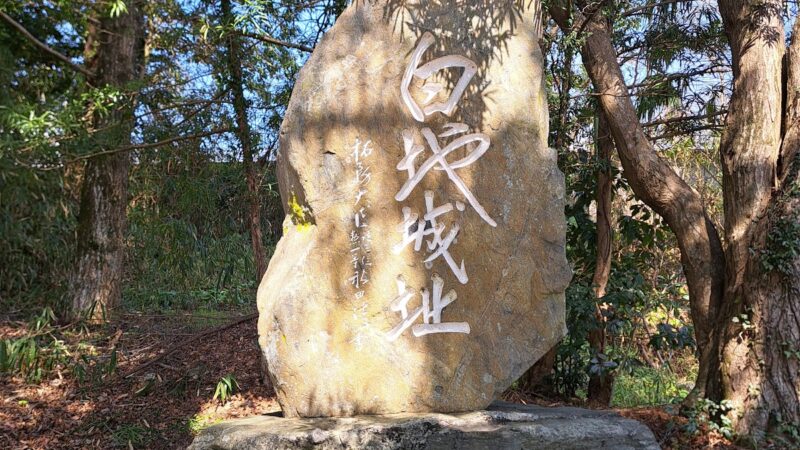
Tao Castle (Miyoshi City, Tokushima Prefecture) Complete Guide: Fortress Ruins and Highlights from the Sengoku Period
What is Tao Castle?
Tao Castle (Tao-jo) is a Japanese castle ruin located in Iwato, Yamashiro-cho, Miyoshi City, Tokushima Prefecture. Also known as Tao Castle or Shirojiyama Castle, it is currently protected as a Miyoshi City designated historical site. Built on a mountaintop approximately 462 meters above sea level, it was a full-fledged mountain castle, utilizing the rugged terrain with a relative elevation difference of approximately 310 meters from the base.
During the Sengoku period, this area functioned as an important strategic base in Awa Province, and the castle is particularly known for playing a crucial role in Chosokabe Motochika’s invasion of Awa by Tosa. Even today, the remains of earthworks, baileys, and moats are well-preserved, making it a valuable historical site that conveys the appearance of the mountain castle at that time.
History of Tao Castle
Construction and Early History
While there are no clear records regarding the exact construction date of Tao Castle, it is believed to have existed during the Sengoku period (Warring States period). This castle functioned as an important military base in western Awa Province, built in a strategic location overlooking the Yoshino River basin.
Initially, it is presumed to have been managed by local lords and powerful families, but its rulers changed hands numerous times amidst the turmoil of the Sengoku period. It was also under the influence of the Miyoshi clan at one point, reflecting the complex political situation of Awa Province.
Chosokabe Motochika’s Invasion of Awa and Tao Castle
The most important event in the history of Tao Castle is Chosokabe Motochika’s invasion of Awa Province during the Tensho era (1573-1592). Having unified Tosa Province, Motochika began his invasion of Awa Province with the aim of unifying Shikoku.
Around 1582, the Chosokabe army advanced into western Awa Province, utilizing Tao Castle as a crucial base. Motochika developed this castle as a forward base, using it as a foothold for further invasions into Awa Province. The castle’s lord at the time was known as Onishi Kakuyo, a senior retainer of the Chosokabe clan who defended Tao Castle.
Onishi Kakuyo played a vital role in the Chosokabe clan’s administration of Awa Province, solidifying their control over the surrounding region from Tao Castle. During this period, Tao Castle is believed to have functioned not only as a military base but also as an administrative center.
Toyotomi Hideyoshi’s Conquest of Shikoku and the End of Tao Castle
In 1585, when Toyotomi Hideyoshi conquered Shikoku, Chosokabe Motochika surrendered and was granted control of only Tosa Province. As a result, Awa Province became the territory of Hachisuka Iemasa, and Tao Castle also came under his control.
Under the rule of the Hachisuka clan, Tao Castle gradually lost its military importance. In the Edo period, influenced by the Tokugawa shogunate’s “One Castle Per Province” decree, it is believed that Tao Castle was abandoned. Afterward, the castle was abandoned and returned to nature, but the remains of its sturdy stone walls and earthworks have survived to this day.
Structure and Remains of Tao Castle
Overall Structure of the Castle
Tao Castle is a mountain castle built on a long, narrow ridge running north-south. The castle area is broadly divided into the North Castle and the South Castle, each with its own independent defensive function. These two castles together formed a defensive system covering a wide area.
Centered around the main enclosure at the mountaintop, multiple enclosures (kuruwa) are arranged in a stepped pattern, designed to prevent enemy incursions in stages. This castle possesses the typical characteristics of a Sengoku period mountain castle, making maximum use of its steep terrain and combining natural fortifications with artificial defensive structures.
Remains of the North Castle
The North Castle was the central part of Tao Castle and its most important defensive stronghold. The main enclosure is a relatively large, flat area, and it is presumed that the lord’s residence and important facilities were located here. Earthen ramparts surrounded the main enclosure, and some parts can still be clearly seen today.
The North Castle had multiple terraced enclosures, each functioning as a defensive line. Moats were constructed between the enclosures, demonstrating ingenuity in preventing enemy advances. In particular, large moats remain along the northern ridge, indicating strong vigilance against invasions from the north.
Remains of the South Castle
The South Castle was located south of the North Castle, connected to the ridge, and played a complementary role in the North Castle’s defenses. The South Castle also had multiple enclosures, each arranged in a terraced fashion. The southern castle enclosure is slightly smaller than the northern castle enclosure, but the defensive design utilizing the steep slope is similar.
There is a saddle between the southern and northern castles, and a moat was also constructed here. This moat not only separated the two castle enclosures but also served as a final line of defense to prevent intrusion into the northern castle in the event of the southern castle’s fall.
Characteristics of Earthworks and Moats
The most noteworthy features of the remains of Tao Castle are the well-preserved earthworks and moats. The earthworks around the main enclosure are about 1-2 meters high, and traces of stonework can be seen in some areas. These earthworks protected the castle from enemy arrows and firearms, and also served to clearly define the castle’s boundaries.
The moats were dug to cut off the ridgeline, and several moats with depths of 3-5 meters can be identified. These moats are not mere ditches, but full-fledged defensive structures dug in V-shapes and U-shapes, demonstrating the high level of castle construction technology of the time.
Entrances and Passages
Several entrances to the castle, known as “koguchi,” can be observed. These entrances are not simple openings; the earthworks are curved to prevent direct enemy advances. Furthermore, the passages connecting the baileys are strategically placed for defense, designed to hinder attackers’ progress.
Related Historical Sites Around Tao Castle
Relationship with Yatsuishi Castle
Yatsuishi Castle is located near Tao Castle, and the two castles were closely related. Yatsuishi Castle also functioned as an important base during Chosokabe Motochika’s invasion of Awa Province, forming a military network that supported the control of western Awa together with Tao Castle.
The two castles were visible to each other, allowing for communication using signal fires and other means. This enabled rapid transmission of enemy movements and coordinated defense. Yatsuishi Castle is now preserved as a historical site, and visiting it along with Tao Castle provides a deeper understanding of the defense system of the time.
Ikeda Castle and Shiroji Castle
There are other important castle ruins remaining in Miyoshi City. Ikeda Castle is known as the base of the Awa Miyoshi clan and played a central role in Awa Province during the Sengoku period. Shiroji Castle was also a powerful mountain castle in the region, and the history woven by these castles is indispensable for understanding the Sengoku history of Miyoshi City.
By visiting these castle ruins, you can gain a three-dimensional understanding of the complex power dynamics in western Awa Province during the Sengoku period and the roles played by each castle. Among them, Tao Castle occupies a particularly important position in the historical phase of the Chosokabe clan’s invasion of Awa.
Access and Visiting Information for Tao Castle
Access Method
Access to Tao Castle starts from the Iwato area of Yamashiro-cho, Miyoshi City, Tokushima Prefecture. If using public transportation, the nearest station is Awa-Kawaguchi Station on the JR Dosan Line, but since it is quite a distance from there to the castle ruins, using a private car or taxi is more practical.
If traveling by car, take the Ikawa-Ikeda Interchange on the Tokushima Expressway, then take National Route 32 and a prefectural road towards Yamashiro-cho. Head towards the Tao settlement, and from there, take the hiking trail to the castle ruins. There is some parking space near the trailhead, but it is limited, so please be careful.
Precautions for Climbing
Tao Castle is a full-fledged mountain castle with an elevation difference of approximately 310 meters, and climbing it requires appropriate physical fitness and equipment. The hiking trail is well-maintained, but there are many steep sections, and it takes about 1 to 1.5 hours to reach the summit.
When visiting, we recommend wearing non-slip shoes such as trekking shoes, comfortable clothing, plenty of drinking water, and appropriate warm clothing and rain gear for the season. Also, since there is a possibility of encountering wild animals such as bears and bees, it is safer to carry something that makes noise, such as a bell or radio.
Best Time to Visit
While it is possible to visit Tao Castle throughout the year, there are limited times when it is most comfortable to visit. Spring (April-May) and autumn (October-November) are the most suitable times, as the weather is mild and ideal for mountain hiking. Autumn, in particular, offers beautiful autumn foliage, allowing you to enjoy both historical exploration and nature appreciation.
Summer (June-September) is hot and humid, increasing the risk of heatstroke during hiking. Also, overgrown vegetation can make observing the ruins difficult. Winter (December-March) offers relatively good visibility, but snow and ice can make the trails dangerous.
Estimated Visit Time
You should allow at least 3-4 hours for a visit to Tao Castle, including hiking time. A standard schedule is approximately 1-1.5 hours for the ascent, 1 hour for sightseeing at the castle ruins, and 1 hour for the descent. If you want to carefully observe the ruins or enjoy taking photographs, it is recommended to allow more time.
Designation and Preservation Status of Tao Castle
Value as a Miyoshi City Designated Historic Site
Tao Castle is officially designated as a Miyoshi City Historic Site and is protected as an important cultural property of the region. This designation recognizes the historical value of Tao Castle, particularly its role in Chosokabe Motochika’s invasion of Awa Province, and the academic value of its well-preserved remains.
The designation as a city-designated historic site protects the castle ruins from uncontrolled development and destruction, and ensures their transmission to future generations. Furthermore, improvements to the viewing environment, such as regular grass cutting and the installation of information boards, are being made.
Preservation Status of the Remains
Despite more than 400 years having passed since the castle was abandoned, the remains of Tao Castle are preserved in relatively good condition. This is mainly because the castle was located in a remote mountainous area, making it less susceptible to the effects of later development.
The earthworks, moats, and the shape of the baileys are clearly visible, making it a valuable example for learning about the structure of mountain castles during the Sengoku period. However, natural weathering and the effects of vegetation are unavoidable, and continuous management is necessary for long-term preservation.
Significance of Visiting Tao Castle
Experiencing a Sengoku Period Mountain Castle
The greatest significance of visiting Tao Castle is the opportunity to actually experience a Sengoku period mountain castle. You can truly understand the ruggedness of the castle’s location, the ingenuity of its defenses, and the hardships faced by the people of that time—things that cannot be fully grasped through books and documents alone—by climbing and seeing it with your own eyes.
The experience of climbing a 300-meter elevation difference provides a firsthand understanding of the immense difficulties faced by soldiers of that time. Furthermore, the view from the summit offers clues to understanding why the castle was built in this location and which directions were being guarded.
Following in the Footsteps of Chosokabe Motochika
For those interested in the history of Chosokabe Motochika, who aimed to unify Shikoku, Tao Castle is an important historical site. Visiting this castle, which served as a forward base during Motochika’s invasion of Awa Province, will provide a deeper understanding of his strategy for unifying Shikoku.
The fact that a senior retainer, Onishi Kakuyo, defended this castle and used it as a base for managing Awa Province is evidence of the Chosokabe clan’s organized territorial management. Tao Castle was not merely a military facility, but also an administrative center for governing newly acquired territories.
Learning about Local History and Culture
A visit to Tao Castle is an excellent opportunity to learn about the history and culture of Miyoshi City and western Tokushima Prefecture. This region has long flourished as a transportation hub and has been the stage for many historical events. Tao Castle is an important legacy that marks a page in that history.
Visiting this historical site, which has been carefully preserved by the local people, will also allow you to touch upon the region’s historical awareness and cultural identity. Through the castle ruins, you can feel the continuity of history connecting the past, present, and future.
How to Enjoy Your Visit to Tao Castle
Points to Observe the Ruins
When visiting Tao Castle, first carefully observe the earthworks around the main enclosure. You can discern defensive ingenuity from the height, thickness, and curved arrangement of the earthworks. The depth and shape of the moats are also important points to observe. The deeply dug V-shaped moats not only physically hindered enemy intrusion but also likely instilled a sense of psychological intimidation.
Pay attention to the arrangement of the enclosures. The terraced arrangement of the enclosures reflects the idea of multi-layered defense, where each functioned as an independent defensive unit, and even if one enclosure fell, the next would continue the defense. The location and shape of the gate are also important for understanding the castle’s defensive system.
Enjoying the View
The view from the mountaintop is another major attraction of Tao Castle. On a clear day, you can enjoy a panoramic view of the vast Yoshino River basin, making it immediately clear why this area was strategically important. Other castle ruins are scattered throughout the surrounding mountains, and observing them allows you to appreciate the network of castles from that era.
In particular, to the south, you can see the route towards Tosa, allowing you to imagine the invasion route of the Chosokabe army. To the north, the interior of Awa Province stretches out, revealing that this castle was ideally located as a front-line base for the invasion of Awa.
Photography Tips
Tao Castle is also a great spot for photography. The remains such as earthworks and moats have a striking three-dimensional effect depending on how the light hits them, allowing you to take impressive photographs. The oblique light in the morning and evening, in particular, emphasizes the contours of the remains, resulting in dramatic images.
A panoramic photo from the mountaintop is also a memorable keepsake. Using a wide-angle lens, you can capture a magnificent landscape in a single shot. Furthermore, photographs of the remains against the backdrop of autumn foliage or spring greenery will be beautiful works that express the harmony of history and nature.
Sightseeing at Tao Castle and Miyoshi City
Nearby Tourist Attractions
We recommend visiting other tourist spots in Miyoshi City in conjunction with your visit to Tao Castle. The Iya Vine Bridge is famous as one of Japan’s three most unusual bridges, offering a thrilling experience. The beauty of the Oboke and Koboke gorges is also not to be missed. The landscape created by the rapids of the Yoshino River is breathtaking.
There are also plenty of roadside stations and hot spring facilities where you can relax after your hike. Enjoying local specialties and regional cuisine will also be a great part of your trip. Miyoshi City is a fascinating region where nature and history harmonize.
Local History Museums
Miyoshi City has local history museums and historical and folk museums where you can learn in detail about the history of the region, including Tao Castle. The exhibited materials and explanatory panels are perfect for preparation before visiting the castle ruins or reviewing after your visit. You may also have the opportunity to hear directly from curators who are well-versed in the region’s history.
These facilities sometimes display historical documents, maps, and excavated artifacts related to Tao Castle, helping to deepen your understanding of the castle’s history. It is recommended to check opening hours in advance before visiting.
Summary: The Historical Value and Future Prospects of Tao Castle
Tao Castle is an important historical heritage site that Miyoshi City, Tokushima Prefecture, is proud of. Functioning as a frontline base during the crucial historical period of Chosokabe Motochika’s invasion of Awa Province, this castle is a valuable witness to the political and military situation of the time.
The well-preserved remains have high academic value in the study of Sengoku period mountain castles, and also serve as excellent teaching material for general history enthusiasts to learn about the castle construction techniques and strategies of the time. The feeling gained from climbing the steep mountain paths and actually standing on the castle ruins is an irreplaceable experience.
In the future, it is hoped that Tao Castle will become more widely known and visited, increasing its value as a regional historical and cultural resource. At the same time, it is crucial to pass on this valuable historical site to future generations by promoting proper preservation, management, and the development of a suitable viewing environment.
Tao Castle is a place worth visiting at least once for anyone interested in the history of Japan’s Sengoku period, especially the history of Shikoku. Standing on the stage of history and feeling the presence of the people of that time will surely create unforgettable memories.