A Complete Guide to the History, Remains, and Access of Azono Castle (Kochi City, Kochi Prefecture) | Exploring Mountain Castles of Tosa
Azono Castle, located in Azono, Kochi City, Kochi Prefecture, is one of the important mountain castles of Tosa Province during the Sengoku period. It has a history associated with the Motoyama and Chosokabe clans, two of Tosa’s leading daimyo (feudal lords) of the Sengoku period, and even today, valuable remains such as earthworks, moats, and double vertical trenches remain in excellent condition. This article thoroughly explains this little-known mountain castle of Tosa, from its historical background to its castle structure, highlights, and access methods.
Basic Information on Azono Castle
Azono Castle is a mountain castle located at an altitude of approximately 120 meters in Kiyosakudani-yama, Azono, Kochi City. Its relative height is approximately 110 meters, and it possesses the typical characteristics of a medieval mountain castle. Classified as a mountain castle in Tosa Province, the remains of this castle are currently located in a forest northeast of Kochi Seifu Cemetery.
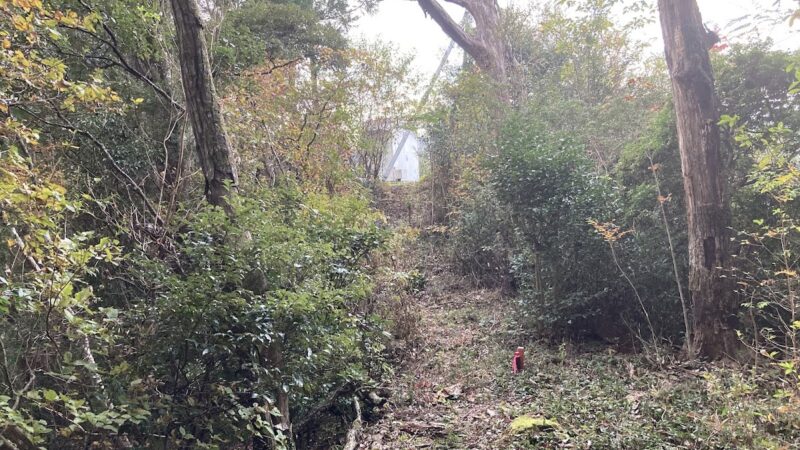
Since the castle site includes private land, consideration for local residents is necessary when visiting. While the site is only partially maintained, this is precisely why it is a valuable historical site that preserves the appearance of a Sengoku period mountain castle.
History of Azamino Castle
Azamino Castle during the Motoyama Clan Era
Azamino Castle was originally built as the residence of Motoyama Ukyo, a vassal of the Motoyama clan, whose base was Motoyama Castle (Motoyama-cho, Nagaoka-gun). The Motoyama clan was a powerful Sengoku daimyo (feudal lord) centered in Nagaoka-gun in northern Tosa Province, and at its peak, it was one of the seven powerful local lords of Tosa.
Motoyama Ukyo, as a member or senior retainer of the Motoyama clan, ruled this area located in the northern part of the Kochi Plain. Azamino Castle was located at the southern edge of the Motoyama clan’s sphere of influence and is thought to have served as a defensive base against southern forces.
Conquest by the Chosokabe Clan
In the late 16th century, as Chosokabe Motochika expanded his power aiming to unify Tosa Province, the Motoyama clan became his target. Fierce battles ensued between the Chosokabe and Motoyama clans, and ultimately, the Motoyama clan was destroyed by Chosokabe Motochika.
It is believed that Azamino Castle also came under the control of the Chosokabe clan during this process. Records show that Motoyama Ukyo subsequently served Chosokabe Motochika and his son, Chosokabe Morichika. This was a common example of the Sengoku period, where the defeated became subordinate to the victors.
Edo Period and Beyond
After the Battle of Sekigahara, Tosa Province was given to Yamauchi Kazutoyo, and early modern castles centered around Kochi Castle were constructed. During this period, it is presumed that Azamino Castle, a medieval-style mountain castle, ceased its military role and was abandoned. Afterward, it disappeared from the forefront of history and quietly aged in the mountains.
Layout and Structure of Azamino Castle
Castle Arrangement
Azamino Castle is a mountain castle of the “renkutsu” (連環) type, with multiple enclosures (kuruwa) arranged along the ridge, centered on the mountaintop. With the main enclosure at its center, multiple enclosures are arranged in a stepped fashion along the ridge extending east and west.
The basic defensive system of the mountain castle consists of a combination of natural fortifications that skillfully utilize the terrain and artificially constructed earthworks and trenches. The castle is of medium size, which is standard for a residence of a vassal of the Motoyama clan.
Major Remains
Earthworks
Earthworks remain in each enclosure within the castle. These earthworks are important defensive structures that prevent enemy intrusion and serve as the foundation for constructing fences and walls. The earthworks of Azamino Castle remain in good condition in some areas, making them valuable resources for understanding the castle construction techniques of the time.
The height of the earthworks varies depending on the location, but relatively high earthworks can be seen around the main enclosure. Although there is some collapse due to age, the clearly defined mounds are still visible.
Moats
Moats are the key to Azamino Castle’s defense. Moats are trenches dug to cut across ridges, serving as important defensive structures to prevent enemy intrusion. Multiple moats have been identified at Azamino Castle, particularly positioned to prepare for attacks from the rear (mountain side) of the castle.
Some moats are several meters deep, conveying the scale of the large-scale civil engineering work of the time. The V-shaped moats can still be clearly seen today.
Double Vertical Moats
One of the greatest highlights of Azamino Castle is the double vertical moats. A vertical moat is a moat dug vertically along a slope, serving to prevent enemies from climbing the slope. A double vertical moat is a double vertical moat dug in parallel, providing a stronger defense.
The double vertical moat at Azamino Castle is well-preserved and is valued as a valuable relic demonstrating the construction techniques of mountain castles during the Sengoku period. The two ditches descending the slope are still clearly visible today, making it a must-see for castle enthusiasts.
Enclosures (Kuruwa)
The castle grounds consist of multiple enclosures. The main enclosure is located at the highest point and is thought to have housed the lord’s residence and command post. The second and third enclosures are located around it, each used as a garrison for soldiers and a storage area for supplies.
The flat areas of the enclosures are still visible today, providing clues to the size and structure of the castle at the time. However, due to years of weathering and overgrown vegetation, some areas lack clear boundaries.
Highlights of Azamino Castle
Observation Points for the Remains
The main highlight of Azamino Castle is undoubtedly the well-preserved remains of this medieval mountain castle. Paying attention to the following points, in particular, will allow you to understand the castle’s charm more deeply.
Observation of the Moat: The moat located behind the castle is one of the most clearly preserved remains. Standing at the bottom of the moat and looking up at the cliffs on both sides, you can truly appreciate the high level of defense at the time.
Confirmation of the Double Vertical Moat: The double vertical moat descending the slope clearly shows two parallel ditches when viewed from above. Walking between the moats allows you to experience firsthand how difficult the situation was for attackers.
Shape of the Earthworks: The earthworks around the main enclosure retain their original form relatively well. Observing the cross-section of the earthworks may reveal traces of construction techniques such as rammed earth.
Surrounding Scenery
From Azamino Castle, you can overlook the Kochi Plain. This view is an important element in understanding the strategic importance of the castle’s location. On clear days, you can even see as far as the Pacific Ocean.
The tranquil atmosphere unique to mountain castles is also one of its charms. In the undeveloped, natural forest, you can reflect on the history of the Sengoku period.
Access Information
Location
781-0015 Azamino, Seisakudani-yama, Kochi City, Kochi Prefecture
Access by Car
Approximately 15 minutes by car from the center of Kochi City. Head north on Prefectural Road 16 towards Higashi-Shinzenji. After passing under the Kochi Expressway, continue for a short distance until you reach the road towards Azamino Kitamachi. Immediately after turning onto this road, you will find “Kochi Seifu Cemetery,” and the entrance to the castle ruins is in its northeast corner.
Since there is no designated parking area, you will need to park in a place that does not obstruct traffic around the cemetery, or park a short distance away and approach on foot.
Access by Public Transportation
Access by public transportation is not easy. It is a considerable distance from the nearest bus stop, so visiting by car is recommended.
Ascent Route
From the northeast corner of Kochi Seifu Cemetery, enter the forest and proceed east along the ridge to reach the moat behind. From there, you can proceed towards the main enclosure. The ascent takes approximately 15-20 minutes one way, but since the path is not well-maintained, appropriate hiking attire and shoes are essential.
Precautions for Visiting
Equipment and Preparation
- Clothing: Wear long-sleeved shirts, long pants, and sturdy hiking boots. Insect repellent is also essential during the summer.
- Items to Bring: Bring drinking water, a towel, a map or GPS device, and a mobile phone (for emergencies).
- Season: Winter to early spring is the best time to visit. In summer, the vegetation becomes overgrown, making it difficult to see the remains.
Manners and Safety
- The area around the castle ruins includes private property, so please do not enter areas marked as off-limits.
- Please do not damage the remains or take away any soil or sand.
- Avoid visiting alone; it is recommended to visit in groups whenever possible.
- On bad weather days or after rain, the ground can be slippery, so please refrain from attempting to climb the castle if necessary.
- Please take all your trash with you and help protect the natural environment.
Nearby Tourist Attractions
Kochi Castle
Located about 20 minutes by car from Azamino Castle, Kochi Castle is one of Japan’s famous castles with an existing keep. Built by Yamauchi Kazutoyo, it is a modern castle and is known as the only castle in Japan with its main enclosure buildings completely intact. While Azamino Castle is a medieval mountain castle, Kochi Castle is a modern flatland castle. Comparing the two allows us to understand the development process of castles.
Kochi Prefectural Museum of History and Folklore
This facility allows you to learn about the history and culture of Kochi Prefecture. It also has exhibits on the Sengoku period in Tosa, allowing you to deepen your understanding of Azamino Castle, the Motoyama clan, and the Chosokabe clan.
Motoyama Castle (Motoyama-cho, Nagaoka-gun)
This was the base of the Motoyama clan, whom Motoyama Ukyo, the lord of Azamino Castle, served. Although it is a distance from Kochi City, it is an important historical site for understanding the history of the Motoyama clan.
Historical Value of Azamino Castle
Position in the History of Tosa’s Sengoku Period
Azamino Castle is an important historical site that tells the story of the shifts in power during the Sengoku period in Tosa Province. As a site that concretely shows the process of unifying Tosa from the Motoyama clan to the Chosokabe clan, it has high historical value.
Significance in Castle Research
Azamino Castle holds significant importance in castle research due to its well-preserved, typical structure of a medieval mountain castle. In particular, the remains of double vertical moats are invaluable resources for understanding the castle-building techniques of the Sengoku period (Warring States period).
Its undeveloped, “raw mountain castle” status makes it easier to imagine its original appearance, which is also academically valued. Because it hasn’t been excessively developed, there is still room for further academic research, such as archaeological excavations.
Significance of Visiting Azamino Castle
Azamino Castle is not a famous tourist destination, but that’s precisely why it’s worth visiting. The time spent contemplating Sengoku period history in a quiet mountain forest, something you can’t experience at developed tourist spots, will be an invaluable experience for history enthusiasts.
For castle fans, it’s a valuable opportunity to observe well-preserved remains such as moats and double vertical moats up close. You can also deepen your own castle research through photography and creating layout maps.
Azamino Castle is not a famous tourist spot, but that’s precisely why it’s worth visiting. The quiet mountain forest setting, where you can confront the history of the Sengoku period, offers an invaluable experience for history buffs. Furthermore, visiting Azamino Castle in conjunction with Kochi Castle, a famous early modern castle, allows for a systematic understanding of the development of castles from the medieval to the early modern period. Learning about the changes in the role and structure of castles over time through actual remains leads to a deeper understanding that cannot be obtained from textbooks.
Summary
Azamino Castle, located in Azamino, Kochi City, Kochi Prefecture, is a mountain castle from the Sengoku period (Warring States period) and an important historical site that tells the story of the historical changes in Tosa Province, from the Motoyama clan to the Chosokabe clan. The remains, such as earthworks, moats, and double vertical moats, are well-preserved, making it a valuable resource for learning about the structure of medieval mountain castles.
Access is somewhat difficult, and maintenance is limited, but this is precisely what makes it so appealing, as it preserves the appearance of a Sengoku period mountain castle. Appropriate equipment and preparation are necessary for a visit, but as a little-known but excellent castle where you can enjoy history and nature simultaneously, it is especially recommended for castle enthusiasts.
When you visit Kochi, why not also visit Azamino Castle along with Kochi Castle and experience the profound depth of Tosa’s castle culture?