Shishiku Castle Complete Guide | History, Highlights, and Access Information for this Mountain Castle in Hokuto City, Yamanashi Prefecture
Shishiku Castle is a medieval mountain castle located in Egusa, Sutama-cho, Hokuto City, Yamanashi Prefecture. Also known as Egusa Castle, Egusa Hut, and Ura Castle, it is famous for being the residence of the Egusa clan, a branch of the Takeda clan. Built on a mountaintop at an altitude of 788 meters, this castle was a formidable fortress that utilized the steep terrain with a relative height of approximately 120 meters. Even today, remnants such as stone walls and moats remain in excellent condition.
This article comprehensively introduces essential information for mountain castle enthusiasts, from the historical background of Shishiku Castle to detailed information on its structure, highlights for visitors, and access methods.
History of Shishiku Castle
The Origins of the Egusa Clan and Shishiku Castle
Shishiku Castle was built as the residence of the Egusa clan, a branch of the Kai Takeda clan. The Egusa clan is said to be descended from Takeda Nobuyoshi and was an important family protecting a strategic point in northern Kai Province. The castle is located on a mountaintop at the confluence of the Shiokawa and Yudonosawa rivers, strategically situated to control the old Obi Road leading from Kai to Shinshu Pass towards Nobeyama.
The Egusa clan ruled this area for generations, playing a vital role in the Takeda family’s northern defense. The castle’s name, “Shishiku,” is a Buddhist term meaning the Buddha’s sermon, and as this brave name suggests, it functioned as an impregnable fortress.
Takeda Nobutora’s Unification of Kai Province and Shishiku Castle
Shishiku Castle first appears on the historical stage during the early Sengoku period, in the process of Takeda Nobutora’s unification of Kai Province. While Nobutora successively subjugated the local lords within Kai, the Egusa clan is known as one of the forces that resisted to the very end.
At that time, Kai Province was divided among several forces, including the Takeda clan. Nobutora inherited the unification project that had been carried out by his father, Nobunawa, and energetically proceeded with pacifying the province from the Daiei to Kyoroku eras. The Egusa clan, based in a rugged mountainous region, used its natural fortifications to resist the main Takeda family, but ultimately surrendered to Nobutora’s army.
Following this unification process, the Egusa clan was incorporated into the Takeda vassal group and continued to be responsible for the defense of the northern region.
Shishiku Castle After the Fall of the Takeda Clan
In 1582, the Takeda clan was destroyed when Takeda Katsuyori committed suicide during an invasion by the combined forces of Oda and Tokugawa. Afterward, Kai Province was ruled by vassals of Oda Nobunaga, and following the Honnoji Incident, it became the stage for the Tensho-Jingo War, a conflict between Tokugawa Ieyasu, Hojo Ujimasa, and Uesugi Kagekatsu over control of the region.
Shishiku Castle is believed to have played a crucial role during this period of turmoil. During the Tensho-Jingo War, fierce battles raged among the castles within Kai Province, with each side divided between the Tokugawa, Hojo, and Uesugi factions. Ultimately, Tokugawa Ieyasu seized control of Kai, and some of the former Takeda vassals, including the Egusa clan, came to serve the Tokugawa family.
From the Edo Period Onward
In the Edo period, Shishiku Castle was abandoned and ceased to serve its military purpose. Some members of the Egusa clan served Tokugawa Ieyasu and were appointed as hatamoto (direct retainers) of the Edo shogunate as the Iga-gumi. The Iga-gumi was an elite unit formed by Tokugawa Ieyasu, primarily composed of former Takeda retainers, and the Egusa clan contributed to the shogunate as part of this unit.
The castle ruins were neglected for a long time, but in recent years, local residents and castle enthusiasts have undertaken maintenance and preservation activities, maintaining it as an easily accessible historical site.
Layout and Structure of Shishiku Castle
Location and Topography
Shishiku Castle is built on a mountaintop at an altitude of 788 meters, with a relative height of approximately 120 meters from the foot of the mountain. The mountain on which the castle is located is steep, characterized by a rugged terrain with exposed rock faces. The castle’s layout makes maximum use of this natural fortification.
Below the castle lies the confluence of the Shiokawa and Yudonosawa rivers, making it a suitable location for securing water sources and monitoring transportation routes. Furthermore, it was a strategically important location overlooking the road connecting Kai and Shinano provinces, and functioned as a monitoring base against invasions from the north.
Structure of the Main Enclosure (Honmaru)
The main enclosure at the mountaintop is an irregularly shaped oval-shaped flat area, approximately 20 meters east-west and 30 meters north-south. While not particularly large, it provides sufficient space for a mountain castle, suggesting the presence of residential facilities and a command post.
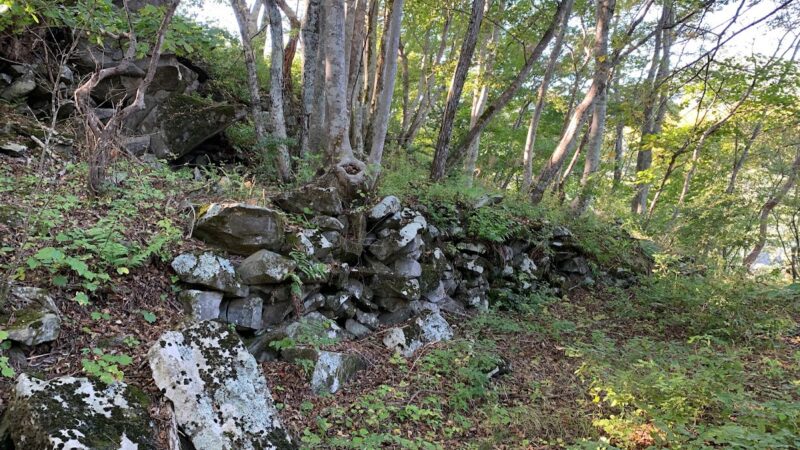
An earthen rampart was built on the east side of the main enclosure, enhancing its defensive capabilities. The northeast side opens in a gate-like manner, leading to a flat area constructed of stonework. This stonework is one of the most distinctive features of Shishiku Castle, showcasing a rugged yet dynamic structure that skillfully utilizes natural rocks.
Layout of the Belt Enclosure and Baileys
A belt enclosure (obiguruma) surrounds the main enclosure. The belt enclosure is a long, narrow enclosure surrounding the main enclosure, functioning as the first line of defense. This structure is designed to intercept the enemy at this outer bailey before they reach the main keep.
Within the castle, multiple baileys are arranged in a stepped pattern, each separated by moats and trenches. This multi-layered defensive structure is designed to gradually prevent enemy incursions.
Stonework and Stone Walls
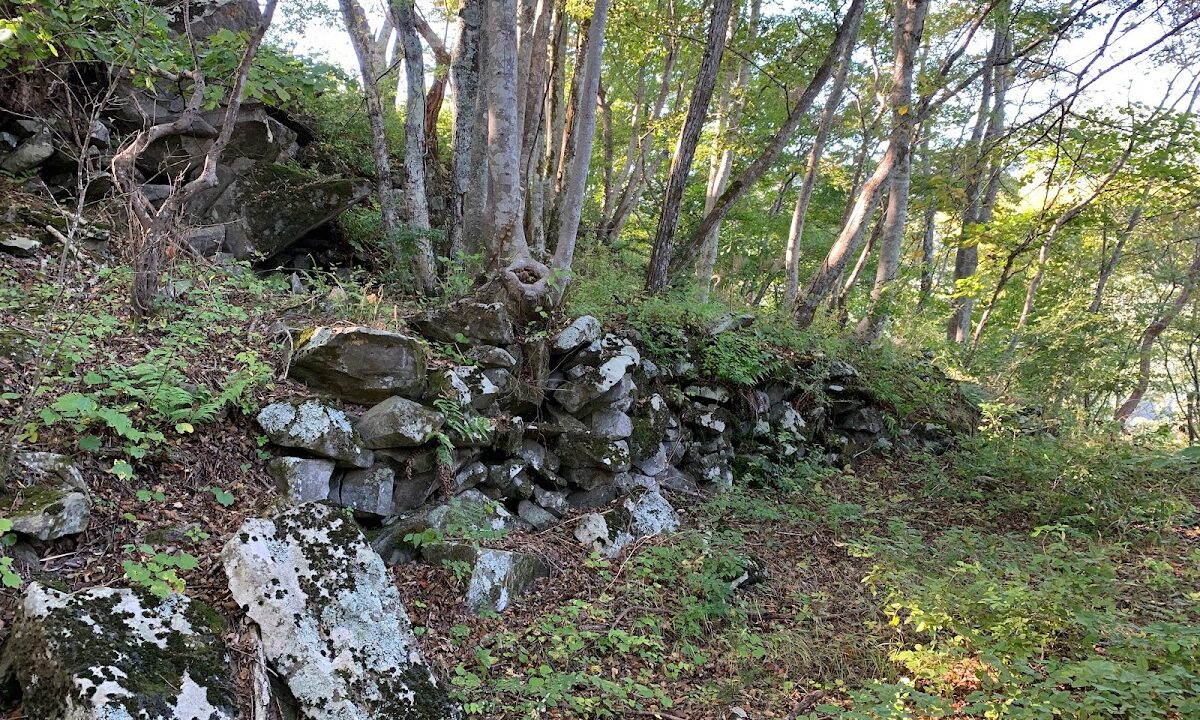
The greatest highlight of Shishiku Castle is the stonework found throughout. These utilize natural rocks in their raw state, giving them a rustic appearance that differs from processed stone walls. The stonework around the main keep, in particular, is large in scale, likely enhancing the castle’s defenses and creating a visually intimidating effect.
The stonework technique differs from the sophisticated stone walls seen in later, early modern castles; it’s a simple construction using natural stones, but this is precisely what makes it characteristic of medieval mountain castles. The use of local stone and the flexible placement of the stones to suit the terrain speaks to the high level of castle-building technology of the time.
Moats and Vertical Moats
Moats and vertical moats are effectively positioned as defensive structures of the castle. Moats are dry moats dug to cut across ridges, serving to block enemy incursions. At Shishiku Castle, multiple moats were constructed to demarcate the main enclosure from other baileys.
Vertical moats are moats dug vertically along slopes, preventing enemies from climbing the slopes and restricting lateral movement. Combined with the steep terrain of Shishiku Castle, vertical moats functioned as powerful defensive structures.
Some horizontal moats have also been identified, serving to demarcate baileys horizontally. The combination of these moats made Shishiku Castle an impregnable fortress.
Entrance/Exit
The entrance/exit to the castle, the koguchi (gateway), is the most important defensive structure. The koguchi of Shishiku Castle is located on the northeast side of the main enclosure, accompanied by a stone wall. The area around the main gate is meticulously designed to repel enemies, with narrow passages and winding paths to restrict the movement of intruders.
The stonework around the main gate is thought to have served not only as decoration but also to enhance structural strength and exert psychological pressure on the enemy.
Highlights of Shishiku Castle
Dynamic Stonework Remains
The greatest highlight of a visit to Shishiku Castle is undoubtedly the stonework remains surrounding the main enclosure. These stonework structures, skillfully utilizing natural rocks, convey the ruggedness and strength characteristic of medieval mountain castles.
The stonework on the east and northeast sides of the main enclosure is particularly large in scale and well-preserved. Walking among the stonework allows you to feel firsthand the hard work and ingenuity of the castle’s builders. It’s also a popular photography spot, attracting many castle enthusiasts.
View from the Main Enclosure
From the main enclosure, at an altitude of 788 meters, you can enjoy a panoramic view of the mountains of Hokuto City and the Kai basin. On clear days, you can even see the Yatsugatake mountain range and the Southern Alps, making it a renowned scenic spot.
This view is not only beautiful, but also important for understanding the strategic importance of Shishiku Castle. From the castle, you can see a wide area of surrounding roads and settlements, giving you a real sense of its function as a military base.
Well-Preserved Moats and Vertical Ditches
The moats and vertical ditches of Shishiku Castle are still clearly visible even after several hundred years. The moats around the main enclosure, in particular, are deep, giving a real sense of the scale of the defensive facilities at the time.
The vertical ditches extend long along the slope, providing clues to understanding how the castle’s defensive lines were constructed. By observing these remains, you can learn about the construction techniques and defensive philosophies of medieval mountain castles.
Local Maintenance and Information Boards
Shishiku Castle is designated as a historical site of Hokuto City and is carefully maintained and managed by local residents. The path to the castle is relatively easy to walk, and information boards are installed at key points.
The information boards contain explanations about the castle’s history and structure, making them easy to understand even for first-time visitors. Thanks to the love and efforts of the local people for the castle, this valuable cultural asset is being passed down to future generations.
Surrounding Historical Environment
At the foot of Shishiku Castle is Negoya Daimyojin Shrine, and the historical environment related to the castle remains. Negoya refers to the residence or castle town built at the foot of a mountain castle during peacetime, and it is believed that the residence of the Egusa clan was located at the foot of Shishiku Castle.
Exploring the surrounding area allows you to imagine not only the castle but also the entire living space of the time, leading to a deeper understanding of history.
Access Information
Access by Car
Shishiku Castle is easily accessible by car. The castle entrance can be reached in about 15 minutes from the Sutama Interchange on the Chuo Expressway. A road leads almost to the summit, and there are houses nearby, making it a relatively easily accessible mountain castle.
Travel time from major cities:
- From Tokyo: Approximately 2 hours 30 minutes via the Chuo Expressway
- From Kofu City: Approximately 40 minutes via National Routes 20 and 141
- From Nagano Prefecture: Approximately 1 hour 30 minutes via National Route 141
Parking Information
There is some space near the castle entrance where a few cars can park. However, this is not an official parking lot, so consideration should be given to avoiding inconveniencing local residents. If parking on the street, choose a location that does not obstruct traffic and avoid parking for extended periods.
During peak seasons and on weekends, parking spaces may be limited, so it is recommended to allow ample time for your visit.
Access by Public Transportation
If using public transportation, the nearest stations are Nirasaki Station or Nagasaka Station on the JR Chuo Main Line. However, the castle is some distance from the stations, and bus services are limited, so taking a taxi is more practical.
Distance from nearest station:
- Approximately 10 km from JR Nagasaka Station (approximately 20 minutes by taxi)
- Approximately 15 km from JR Nirasaki Station (approximately 30 minutes by taxi)
If planning a visit by public transportation, it is recommended to contact a taxi company in advance for a smoother experience.
Time Required for Climbing the Castle
You can reach near the castle entrance by car, and the climb to the main keep takes approximately 20-30 minutes one way. Since the path is a steep mountain trail, a certain level of physical fitness and appropriate hiking equipment are necessary.
If you plan to thoroughly explore the castle, allow 1 hour 30 minutes to 2 hours, including round trip and sightseeing time. If you plan to take photographs or closely examine the remains, it is recommended to allow even more time.
Important Points for Visiting
Clothing and Equipment:
- Hiking boots or trekking shoes are recommended.
- Shoes with good grip are important as there are slippery areas.
- Dress appropriately for the season (insect repellent in summer, warm clothing in winter).
- Bring drinking water with you.
Safety Considerations:
- Be careful of your footing as there are steep slopes and rocky areas.
- Avoid visiting during or after rain, as the ground becomes slippery.
- Visiting in a group is safer than visiting alone.
- Check your cell phone signal strength beforehand.
Manners:
- Respect the historical site and be careful not to damage the remains.
- Always take your trash with you.
- Be considerate of local residents and observe quietly.
- Do not trespass on private property.
Nearby Tourist Attractions
Wakagami Castle
Located approximately 8.7 kilometers from Shishiku Castle, Wakagami Castle played a crucial role in the Tensho-Jingo War. It was the frontline castle during the confrontation between Tokugawa Ieyasu and Hojo Ujimasa, and its remains, such as earthworks and moats, are still well-preserved. Visiting both Shishiku Castle and Wakagami Castle will provide a deeper understanding of the Sengoku period history of this region.
Shinpu Castle
Shinpu Castle, the last full-fledged castle built by Takeda Katsuyori, is located about 30 minutes by car from Shishiku Castle. A tragic castle that marked the downfall of the Takeda clan, its vast grounds and remains, such as the circular outworks, are highlights. It is designated a national historic site and is well-maintained.
Yato Castle
Yato Castle, located within Hokuto City, is approximately 9.7 kilometers from Shishiku Castle. This castle, believed to be the residence of Takeda Nobushige, the younger brother of Takeda Shingen, is a flatland castle. It has been developed into a park, making it an easily accessible historical site.
Furumiya Castle
Located approximately 4.4 kilometers from Shishiku Castle, Furumiya Castle is another medieval castle in this region. Although small in scale, it retains interesting remains that offer insight into the region’s history.
Fukakusa Manor
Located approximately 9.8 kilometers away, Fukakusa Manor is the site of a residence built on flat land. As a peaceful samurai residence, distinct from mountain castles, it offers a unique contrast and is worth visiting.
Tourist Facilities in Hokuto City
Besides castle tours, Hokuto City boasts numerous attractive tourist facilities. These include hiking trails where you can enjoy the nature of the Yatsugatake Mountains, tourist facilities in the Kiyosato Highlands, and hot spring resorts, allowing you to create a combined sightseeing plan with castle visits.
Cultural Property Designation and Preservation Activities of Shishiku Castle
Shishiku Castle is designated as a historical site of Hokuto City and is protected as an important cultural property of the region. In recent years, a preservation society has been formed by local residents, and they regularly mow the grass, maintain the approach to the castle, and install information boards.
Thanks to these community-wide preservation activities, Shishiku Castle is easy to visit, and the remains are well-preserved. As castle enthusiasts, we should appreciate these local efforts and be mindful of proper etiquette during our visit.
How to Enjoy Visiting Shishiku Castle
Learning History
Learning about the history of Shishiku Castle, the Egusa clan, and the Takeda clan before your visit will deepen your understanding at the site. In particular, knowing about Takeda Nobutora’s unification of Kai Province and the Tensho-Jingo War will allow you to better appreciate the castle’s strategic importance and historical background.
Observing the Remains
By carefully observing the remains such as stone walls, moats, vertical trenches, and earthworks, you can learn about the construction techniques and defensive philosophies of medieval mountain castles. Bringing a camera to record impressive remains is also recommended.
Enjoying the View
The view from the main enclosure offers not only beautiful scenery but also clues to understanding the importance of the castle’s location. Observe the surroundings from a strategic perspective, noting what kind of terrain stretches out in which direction and which roads are visible.
Comparison with Surrounding Castles
If time permits, visiting surrounding castles such as Wakagami Castle and Shinpu Castle and comparing their characteristics would be interesting. You can experience the unique features of mountain castles, hill castles, and flatland castles, as well as the changes in construction techniques over time.
Summary
Shishiku Castle is a valuable medieval mountain castle remains located in Hokuto City, Yamanashi Prefecture. This castle, once the residence of the Egusa clan, a branch of the Takeda family, and a site of last-ditch resistance during Takeda Nobutora’s unification of Kai Province, boasts numerous historical features, including dynamic stonework and well-preserved moats and trenches.
Despite being a steep mountain castle with a relative elevation of 120 meters, it’s relatively easy to visit as it’s accessible by car almost to the summit. Thanks to careful maintenance and preservation efforts by local residents, a safe environment for visitors is ensured.
This castle is a must-visit for anyone interested in the Sengoku period history of Kai Province, those who want to see the remains of a medieval mountain castle firsthand, or those who want to enjoy historical sightseeing in Yamanashi Prefecture. Other important castles such as Wakagami Castle and Shinpu Castle are scattered throughout the surrounding area, making it a good idea to plan a castle tour as part of a larger itinerary.
We hope that a visit to Shishiku Castle will allow you to experience the true nature of a fortress built by Sengoku period warlords and feel the romance of history.