Takahata Castle (Takahata Town): A Complete Guide to its History and Highlights | Remains of Kanegajo Castle and Access Information
Located in Takahata Town, Higashiokitama District, Yamagata Prefecture, Takahata Castle is a historical castle site that played an important role for approximately 660 years, from the late Heian period to the late Edo period. Also known as “Kanegajo Castle,” its unique shape and rich history have led to its designation as a cultural property of Yamagata Prefecture. This article comprehensively introduces the detailed history, highlights, existing remains, and access information of Takahata Castle—all the information you need to know when visiting this valuable historical site.
Overview and Basic Information of Takahata Castle
Takahata Castle was a flatland castle located in the center of Takahata Town, Yamagata Prefecture, around the current Takahata Elementary School. It was affectionately known as “Kanegajo Castle” because its shape resembled a temple bell. It is also sometimes called “Yashirojo Castle” in some regions.
Location and Designation Information
- Location: Around 1064 Takahata, Takahata-machi, Higashiokitama-gun, Yamagata Prefecture
- Designation Category: Yamagata Prefecture Designated Historic Site
- Date of Designation: March 14, 1983
- Castle Classification: Flatland Castle
- Construction Period: Jōan era (1171-1174)
- Year of Abandonment: Tenpō era (around 1830)
History of Takahata Castle
The history of Takahata Castle tells the story of its transformation as an important base in the Okitama region, spanning from the late Heian period to the late Edo period.
Late Heian Period: Castle Construction and the Fujiwara Clan Era
The construction of Takahata Castle dates back to the Jōan era (1171-1174). It is said that Takahata Castle was built by Hizume Goro Suehira, a cousin of Fujiwara no Hidehira of Hiraizumi in Oshu. At that time, the Oshu Fujiwara clan wielded great power in the Tohoku region, and Takahata Castle functioned as an important base under their control.
It is believed that Hizume, as a member of the Hiraizumi Fujiwara clan, was entrusted with the governance of the Okitama region. While castles of this period were not as large as those of later periods, they functioned as centers of regional control.
Kamakura Period to Sengoku Period: Rule of the Date Clan
After the Fujiwara clan was destroyed in the Oshu War (1189) led by Minamoto no Yoritomo, the Okitama region came under the control of the Kamakura Shogunate. Subsequently, the Date clan expanded their power in the Okitama region, and Takahata Castle became an important residence for the Date clan’s rule over Okitama.
The Date clan governed the Okitama region from their base in Yonezawa, and Takahata Castle was one of the important bases in their governing system. Throughout the Sengoku period, the Date clan engaged in conflicts with the Uesugi and Mogami clans, and it is believed that Takahata Castle played a strategic role.
Azuchi-Momoyama Period: The Era of the Gamo and Uesugi Clans
In 1590, following Toyotomi Hideyoshi’s pacification of Oshu, Date Masamune was transferred from Yonezawa to Iwadeyama (present-day Miyagi Prefecture). He then came under the control of Gamo Ujisato, who was appointed to Aizu. Later, in 1598, Uesugi Kagekatsu became the daimyo of Aizu with a domain of 1.2 million koku, and the Okitama region also became Uesugi territory.
During this period, Takahata Castle functioned as an important base for the Uesugi clan’s control of Okitama, and also as a branch castle of Yonezawa Castle. Although the Uesugi clan’s domain was reduced to 300,000 koku (later 150,000 koku) after the Battle of Sekigahara, they continued to consider Takahata Castle important.
Edo Period: Shogunate-Controlled Territory and Oda Clan’s Jinya (Fortified Residence)
With the arrival of the Edo period, the status of Takahata Castle changed significantly. In 1622 (Genna 8), a portion of the area, including Takahata, became a shogunate-controlled territory (tenryo) from Uesugi territory, and various daimyo were entrusted with its management as yasado (administrative offices).
In 1799 (Kansei 11), Oda Nobuchika, a descendant of Oda Nobunaga, was transferred to Takahata with a stipend of 10,000 koku. The Oda clan used Takahata Castle as their fortified residence, developing it into the “Takahata Jinya.” During this period, although the castle’s military function was lost, it played an important role as an administrative center for governing the territory.
The Oda clan’s rule continued until the end of the Edo period, and Takahata Castle remained the center of the region for approximately 660 years until it was officially abandoned around 1830 (Tenpo era).
Layout and Structure of Takahata Castle
Takahata Castle was built as a flatland castle and, due to its unique shape, is also known as “Kanegajo” (Bell Castle). While the castle’s layout changed over time, its basic structure has been maintained since its construction at the end of the Heian period.
Castle Shape and Scale
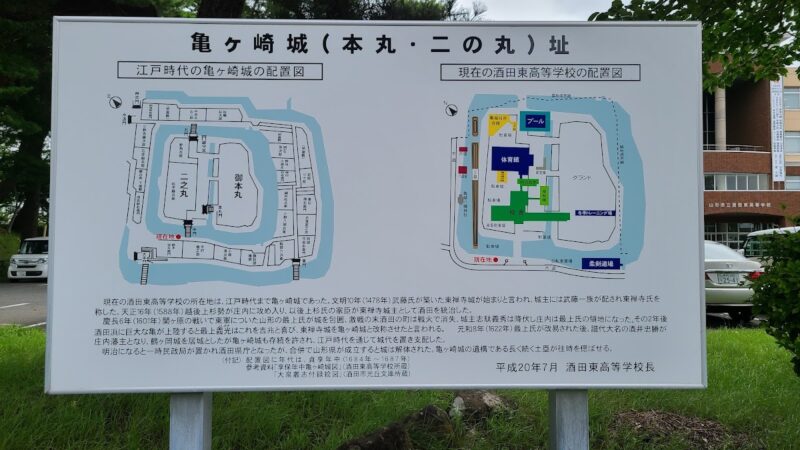
The most distinctive feature of Takahata Castle is its bell-like shape when viewed from above. This unique shape is the origin of its nickname, “Kanegajo” (Bell Castle). The castle grounds are thought to have extended from the current Takahata Elementary School to the surrounding urban area.
The castle’s scale consisted of a main keep (Honmaru), surrounded by the second and third baileys (Ninmaru and Sannomaru), protected by multiple moats and earthworks. It was a relatively large structure for a flatland castle, and its size was sufficient to function as an important base in the Okitama region.
Moats and Earthworks
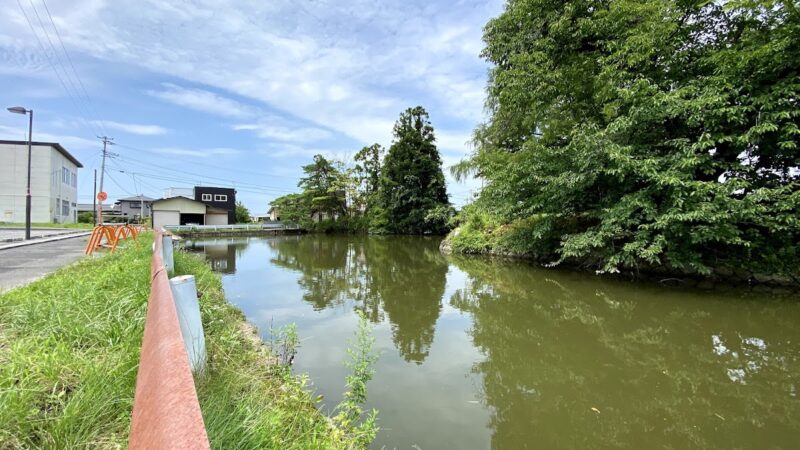
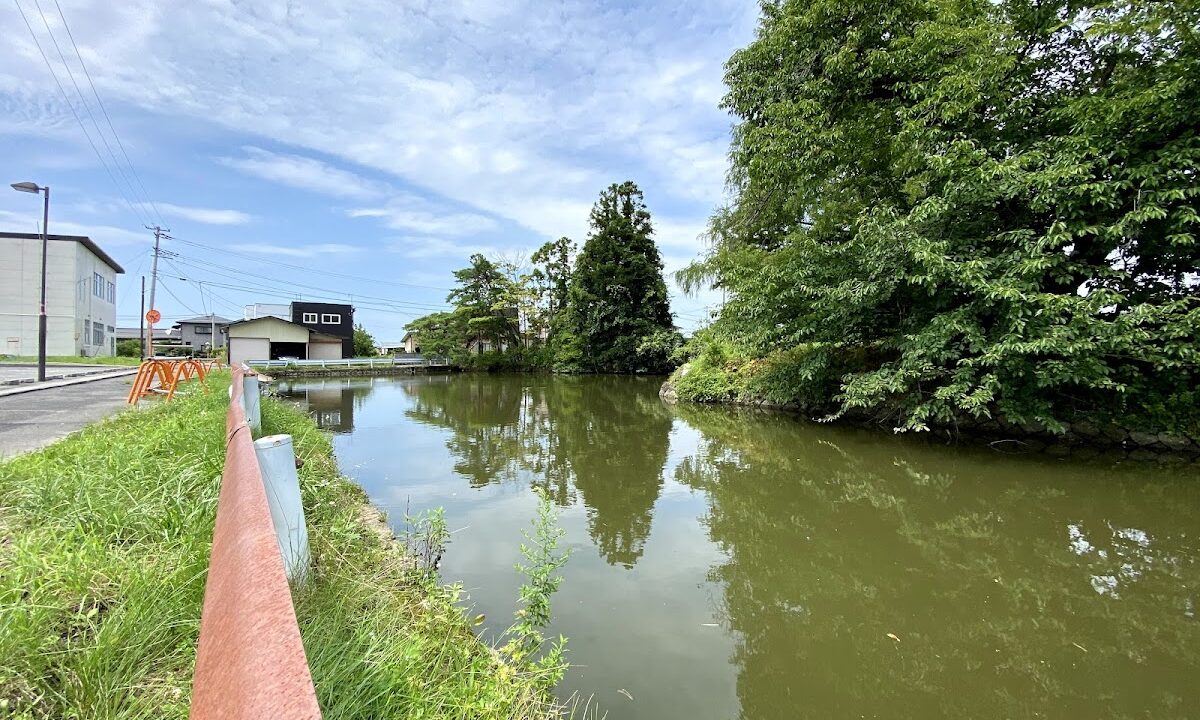
Takahata Castle was surrounded by multiple moats as defensive structures. The moats that remain today are believed to be the remains of the former inner moat. This moat is thought to have been located near the main gate and is still preserved with water in it today.
Partial traces of the outer moat remain around Takahata Elementary School, indicating the former size of the castle grounds. Small remnants of the earthworks can also be seen, giving a glimpse into the castle’s former appearance.
Main Enclosure and Major Facilities
The main enclosure (Honmaru) is believed to have been located where Takahata Elementary School currently stands. The lord’s residence and major buildings were situated here. During the Oda clan’s era, a fortified residence (Jinya) was located here, functioning as the center of the domain’s administration.
The second and third enclosures (Ninokuruwa and Sanokuruwa) housed the residences of retainers and warehouses, functioning as a castle town. The main gate (Otemon) was an important facility as the castle’s main entrance, and inside it were spaces for ceremonies and administrative activities.
Existing Remains and Points of Interest
Although nearly 200 years have passed since Takahata Castle was abandoned, several remains can still be seen today.
Inner Moat Remains (Main Highlights)
The inner moat remains are the best-preserved and easiest to visit. A moat still holds water at what is believed to be the location of the inner moat of the main gate. This moat is protected as a Yamagata Prefecture designated cultural property and is a valuable historical relic that conveys the history of Takahata Castle.
The area around the moat is well-maintained, allowing visitors to imagine the castle’s appearance in its heyday while strolling around. The surrounding scenery reflected on the water’s surface is beautiful in every season, and many tourists visit, especially during cherry blossom season and autumn foliage season.
Earthwork Remains
Slight traces of earthworks remain around Takahata Elementary School. These played an important role as defensive structures of the castle, and although some areas are now residential areas or part of roads, careful observation allows one to imagine their former appearance.
Traces of the Outer Moat
While most of the outer moat has been filled in, its former location can be inferred from the topography and road layout. Walking around the area near Takahata Elementary School, you can sense the remnants of the castle in the subtle elevation changes and curves of the roads.
Surrounding Historical Buildings
Around the Takahata Castle ruins, there are numerous historical buildings and temples that evoke the atmosphere of the castle town. Visiting these sites allows you to experience the history of the town’s development centered around Takahata Castle.
Access Information to Takahata Castle
Takahata Castle ruins are located in the center of Takahata Town, Yamagata Prefecture, and are accessible by both public transport and private car.
Access Information to Takahata Castle
Takahata Castle ruins are located in the center of Takahata Town, Yamagata Prefecture, and are accessible by both public transport and private car. ### Access by Public Transportation
By Train
- Approximately 15-20 minutes on foot from JR Ou Main Line “Takahata Station”
- Takahata Station is not a stop on the Yamagata Shinkansen, but it is about 15 minutes away from Yonezawa Station by local train.
- If using the Yamagata Shinkansen, get off at Yonezawa Station and transfer to the JR Ou Main Line.
By Bus
- Takahata Town operates a bus service, but the number of buses is limited, so it is necessary to check the timetable in advance.
- For details, please contact Takahata Town Hall (TEL: 0238-52-1111)
Access by Private Car
By Expressway
- Approximately 8 minutes (approx. 5km) from Tohoku Chuo Expressway “Nanyo Takahata IC”
- Approximately 50 minutes via National Route 13 from Tohoku Expressway “Fukushima Iizaka IC”
Parking Information
- There is no large, dedicated parking lot around the castle ruins, but you can use the parking lots of nearby public and commercial facilities.
- If your visit is short, there are some places where you can park on the street, but please be considerate of the local residents.
Address and Map Information
- Address: Around 1064 Takahata, Takahata-machi, Higashiokitama-gun, Yamagata Prefecture 992-0351
- When searching with a car navigation system, it is easiest to aim for “Takahata Elementary School”.
How to Enjoy Visiting Takahata Castle
Here are some points to help you feel the history more deeply when visiting Takahata Castle ruins.
Estimated Visit Time
If you only want to see the main remains of the castle, 30 minutes to 1 hour is sufficient. However, if you also want to visit nearby historical buildings and tourist spots in Takahata-machi, it is recommended to allocate about half a day.
Photo Spots
The inner moat remains are a spot where you can take beautiful photos throughout the four seasons. The following times are especially recommended:
- Spring (Early to Mid-April): Cherry blossoms bloom, and their reflection on the moat’s surface is beautiful.
- Summer (July to August): The fresh greenery is vibrant, and the reflection on the water is impressive.
- Autumn (Late October to Early November): Autumn leaves color the moat, creating a picturesque landscape.
- Winter (January to February): The snow-covered moat remains possess a serene beauty.
Historical Walking Course
- Observation of the Inner Moat Remains (15 minutes): First, visit the inner moat remains, which are the best-preserved.
- Stroll Around Takabatake Elementary School (20 minutes): Walk around the area believed to be the site of the main keep, and look for traces of the earthworks and outer moat.
- Visiting Nearby Temples and Shrines (30 minutes): Visit temples and shrines that evoke the atmosphere of the castle town.
Other Tourist Attractions in Takahata Town
When visiting Takahata Castle Ruins, we recommend also visiting other attractive tourist spots in Takahata Town.
Former Takahata Station (Taiyokan)
This Western-style station building, built during the Taisho era, is now used as a tourist information center. Its retro atmosphere is popular, and cherry blossoms are illuminated at night in spring.
Inu-no-Miya & Neko-no-Miya
This shrine, dedicated to pet deities, is rare nationwide. People from all over Japan visit to pray for the health and repose of their pets.
Takahata Winery
Takahata Town is one of the leading wine-producing areas in Yamagata Prefecture. At Takahata Winery, you can enjoy tours and wine tastings.
Mahoroba-no-Sato
This facility allows you to experience the rich nature and agricultural culture of Takahata Town. Local agricultural products and specialty goods can also be purchased.
History and Culture of Takahata Town
Takahata Town is a historic town that has developed around Takahata Castle.
A Town of Organic Agriculture
Takahata Town is known as a region where organic agriculture thrives. In particular, it boasts the highest production volume of Delaware grapes in Japan, which are used as raw materials for high-quality wine. Town development is progressing in harmony with agriculture and industry, where a rich natural environment and modern industries coexist.
Cultural Properties and Historical Heritage
Besides the Takahata Castle ruins, Takahata Town has numerous cultural properties. From Jomon period ruins to modern buildings, you can experience the history of various eras.
Annual Events and Festivals
Takahata Town holds various events throughout the year. You can enjoy the charm of each season, such as the spring cherry blossom festival, summer fireworks display, and autumn harvest festival. Event information can be found at the Takahata Town Tourism Association (TEL: 0238-57-3844).
Precautions for Visitors
When visiting Takahata Castle Ruins, please note the following:
Request for Protection of Historical Remains
- Do not directly touch or climb on the earthworks or moat remains.
- Do not collect or damage plants around the historical remains.
- Please take all your trash with you to maintain the beauty of the historical site.
Safety Precautions
- The area around the moat can be slippery. Particular caution is needed during rainy weather and winter.
- In summer, remember to take precautions against insects and sunburn.
- In winter, be aware of snow and ice, and wear appropriate clothing and shoes.
Photography Etiquette
- As the surrounding area is a residential area, please be considerate of residents’ privacy when taking photographs.
- Entry to the grounds of Takahata Elementary School is prohibited in principle. Please limit photography to outside areas.
Nearby Accommodations and Restaurants
There are various accommodations and restaurants in Takahata Town and the surrounding area.
Accommodation
Takahata Town has many inns and business hotels where you can enjoy a relaxing stay. There are also many accommodations in the neighboring cities of Yonezawa and Nanyo, including plenty of inns where you can enjoy hot springs.
Restaurants
Takahata Town is a region where agriculture thrives, so there are many restaurants serving dishes made with fresh local ingredients. Restaurants that offer pairings of wine made from locally grown grapes with the food are especially recommended.
Summary: The Charm of Takahata Castle
Takahata Castle (Kanegajo) is a historical castle site that functioned as an important base in the Okitama region for approximately 660 years, from the late Heian period to the late Edo period. It has a rich history, having been associated with famous daimyo who shaped the history of the Tohoku region, such as the Fujiwara, Date, Uesugi, and Oda clans.
Currently, the remains, centered around the inner moat, remain and are protected as a Yamagata Prefecture designated cultural property. Even amidst increasing urbanization, the water-filled moat remains evoke the town’s former glory, allowing visitors to feel a sense of historical romance.
Takahata Town boasts not only the ruins of Takahata Castle, but also numerous other attractive tourist spots, including the former Takahata Station, the Inu-no-Miya and Neko-no-Miya shrines, and Takahata Winery. As a town where organic farming thrives, visitors can enjoy abundant nature and delicious food.
When visiting Yamagata Prefecture, we highly recommend visiting Takahata Town and experiencing the history of Takahata Castle. With the opening of the Tohoku Chuo Expressway making access even more convenient, enjoy a trip to Takahata Town where you can savor history, nature, and gourmet delights.
Contact Information
Takahata Town Hall
- Address: 436 Takahata, Takahata-machi, Higashiokitama-gun, Yamagata Prefecture 992-0392
- Phone: 0238-52-1111
- Opening Hours: Monday-Friday 8:30-17:15
Takahata Town Tourism Association (Mahoroba no Sato Takahata)
- Address: 200-1 Yamazaki, Takahata-machi, Yamagata Prefecture 999-2173
- Phone: 0238-57-3844
- Official Website: You can check detailed tourist information and obtain event information.
When planning a visit to Takahata Castle Ruins, we recommend checking the latest information at the contact information above. They can also provide detailed information on seasonal events and surrounding tourist spots.