
Fujishima Castle (Tsuruoka City, Yamagata Prefecture): History and Highlights | A Complete Overview of a Flatland Castle that Survived from the Nanboku-cho Period to the Sengoku Period
Overview of Fujishima Castle
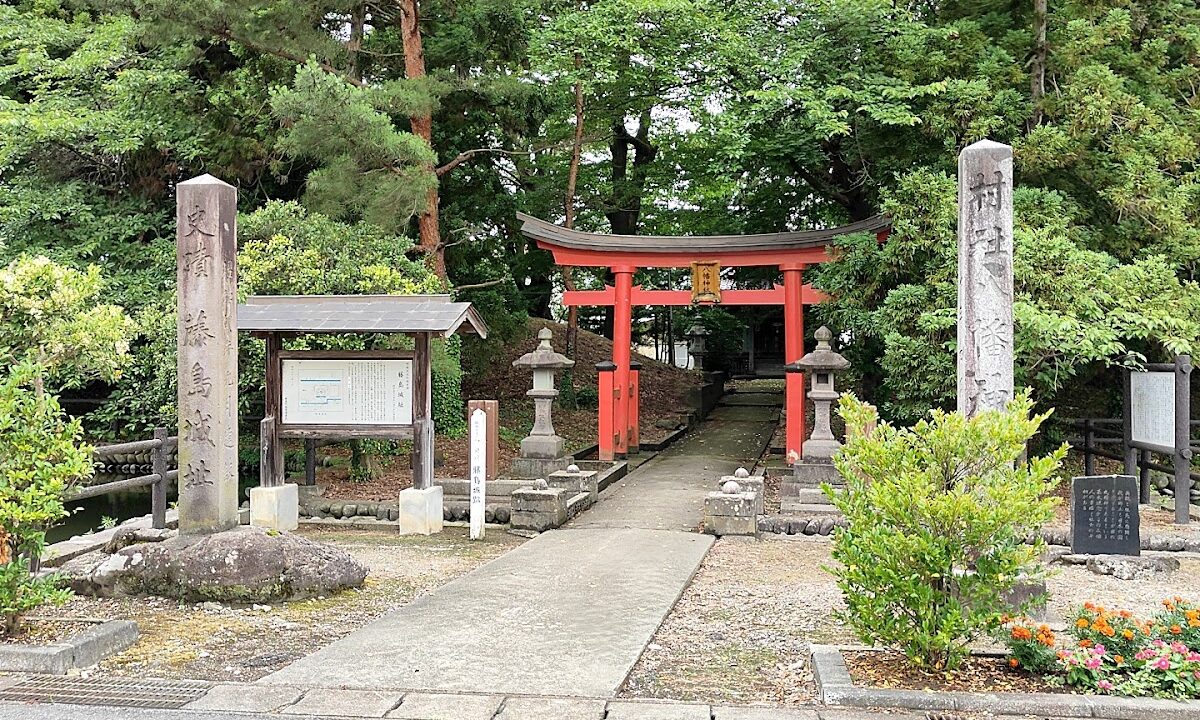
Fujishima Castle was a Japanese castle located in Fujishima, Tsuruoka City, Yamagata Prefecture. Built as a flatland castle without a keep, it featured an inner moat surrounding the main enclosure and the Fujishima River, a natural river, as its outer moat. Currently, it is protected as a city-designated historical site, with the Hachiman Shrine grounds and the Shonai Agricultural High School site occupying the central part of the castle ruins.
Basic Information
Location: 108 Furutateato, Fujishima, Tsuruoka City, Yamagata Prefecture (around Hachiman Shrine)
Year of Construction: Believed to be during the Wado era (708-714)
Builder: Unknown (there is a theory that it was a facility related to the Dewa Provincial Government)
Major Lords: Hamuro clan, Kuga clan, Horikawa clan, Kitabatake clan, Tosabayashi clan, Maruoka clan, Kurita clan, Kido clan, Niiseki clan
Year of Abandonment: Genna 1 (1615)
Remains: Enclosures, earthworks, moats, and part of a water moat
Designated Cultural Property: Tsuruoka City Designated Historic Site (Fujishima Castle Ruins)
Classification/Structure: Flatland Castle
Keep Structure: None
Former Province: Dewa Province
Common Name/Alternate Name: Furutate (Ancient Shield)
History of Fujishima Castle
From Ancient Times to the Early Middle Ages
The origins of Fujishima Castle are believed to date back to the Wado era (708-714). During this period, when the Dewa Provincial Office was established in Taira (Hiragata, near present-day Sakata City), it is thought to have been built as a facility attached to the provincial office. It is highly probable that it functioned as one of the administrative centers of Dewa Province under the ancient Ritsuryo system, and was an important base in the Shonai region.
Fujishima Castle during the Nanboku-cho Period
Fujishima Castle appears on the historical stage during the Nanboku-cho period. From the Kenmu Restoration to the Yoshino Court period, it is recorded as the site where the Southern Court forces, including Dewa no Kami Hamuro Mitsuaki and his son, as well as Nakain Tomonobu and Kitabatake Akinobu, frequently raised arms in August of Genko 3 (1333).
In particular, Kitabatake Akinobu accompanied Prince Yoshinaga (later Emperor Go-Murakami), a son of Emperor Go-Daigo, to Oshu, where he sought to expand the influence of the Southern Court. Fujishima Castle functioned as an important military base for the Southern Court, and fierce battles were fought there against the Northern Court. During this period, it is believed that samurai from noble families, such as the Hamuro, Kuga, Horikawa, and Kitabatake clans, served as lords of the castle.
Fujishima Castle and the Tosabayashi Clan in the Sengoku Period
With the arrival of the Sengoku period, Fujishima Castle came under the control of the Daiboji clan, a powerful force in the Shonai region. The Tosabayashi clan, a senior retainer of the Daiboji clan, became the lords of the castle, and it played an important role as a strategic point in the Shonai Plain. The Tosabayashi clan used this castle as their residence for generations and governed the region.
The Uesugi Clan’s Rule over Shonai and the Fujishima Rebellion
In 1590, following Toyotomi Hideyoshi’s pacification of Oshu, the Shonai region became the territory of Uesugi Kagekatsu. The land survey conducted at this time sparked strong opposition from the farmers, leading to a large-scale uprising. This event is known as the “Fujishima Rebellion.”
The rebels holed up in Fujishima Castle, and Naoe Kanetsugu, a senior retainer of the Uesugi family, went to suppress them. However, due to the castle’s strong defenses and the rebels’ resistance, Kanetsugu could not easily capture the castle. This incident is recorded as demonstrating the high defensive strength of Fujishima Castle and the strong unity of the farmers in the Shonai region. Although the rebellion was eventually suppressed, it was one of the few battles in which Naoe Kanetsugu faced considerable difficulty.
The Mogami Clan Era and the Castle’s Abandonment
After the Battle of Sekigahara in 1600, the Shonai region came under the control of Mogami Yoshiaki. Fujishima Castle became a branch castle of the Mogami clan, and his retainer, Niizeki Inaba-no-kami Hisamasa, was appointed as its lord. The Niizeki clan was responsible for the castle’s maintenance and local administration, but their rule did not last long.
In 1615, when the Edo Shogunate issued the “One Castle Per Province” decree, Fujishima Castle was abandoned. The castle’s history of approximately 900 years came to an end, and the site was subsequently used for farmland and shrine grounds.
Structure and Remains of Fujishima Castle
Castle Layout and Structure
Fujishima Castle was built as a typical flatland castle, located on the flat land of the Shonai Plain. The area around the current Shonai Agricultural High School and Hachiman Shrine corresponds to the castle grounds, with multiple baileys arranged around the main keep.
The main enclosure (Honmaru) is located within the grounds of the Hachiman Shrine and was surrounded by an inner moat. The outer moat cleverly utilized the natural Fujishima River, creating a strong defensive system despite being a flatland castle. This is believed to be one of the reasons why even Naoe Kanetsugu could not easily capture it.
Existing Remains
Currently, the following remains are preserved at the Fujishima Castle site:
Earthworks: An L-shaped earthwork remains in good condition, extending from the north to the east side of the Hachiman Shrine grounds. It is approximately 2-3 meters high, conveying the appearance of the defensive facilities at the time.
Water Moat: A portion of the water moat remains on the east side of the main enclosure, allowing us to imagine its former appearance.
Horizontal Moat: Traces of horizontal moats have been confirmed around the castle grounds.
Enclosures: Multiple enclosure remains are preserved as topographical features, indicating the large scale of the castle.
Archaeological Excavation Results
The Yamagata Prefectural Buried Cultural Properties Center conducted an archaeological excavation (Research Report 232) covering an area of 237.6 square meters within the outer enclosure of Fujishima Castle. This excavation uncovered two large structures believed to be well remains. Numerous postholes were also detected, but they could not be definitively identified as the remains of post-supported buildings.
These excavation results provide valuable data for understanding the lifestyle and building layout within the castle. Further investigations are expected to reveal more detailed information about the castle’s structure.
Highlights of Fujishima Castle
Hachiman Shrine (Main Enclosure Site)
Hachiman Shrine, located on the site of Fujishima Castle’s main enclosure, is a central point for exploring the castle ruins. The earthworks within the shrine grounds are well-preserved, allowing for close observation of the castle remains. It is a valuable spot where one can imagine the former appearance of the castle amidst the tranquil atmosphere of the shrine.
Earthworks and Moat
The moat remaining east of Hachiman Shrine and the L-shaped earthworks extending from the north to the east are the most important remains of Fujishima Castle. Walking along the top of the earthworks allows you to experience the castle’s defensive lines. The combination with the moat, in particular, is very helpful in understanding the ingenuity of defensive systems in flatland castles.
Extent of the Castle Grounds
Walking through the vast castle grounds, including the site of Shonai Agricultural High School, allows you to truly appreciate how large Fujishima Castle was. Although it is now farmland and school facilities, the topography and the arrangement of waterways allow you to infer the original layout.
Access and Visiting Information
Location
108 Furutateato, Fujishima, Tsuruoka City, Yamagata Prefecture 999-7601 (Hachiman Shrine)
Access Methods
Train: Approximately 15 minutes on foot from JR Uetsu Main Line “Fujishima Station”
Car: Approximately 20 minutes from Yamagata Expressway “Tsuruoka IC”. It’s easy to find if you aim for Shonai Agricultural High School or Hachiman Shrine.
Visiting Information
Visiting Hours: Open year-round (Hachiman Shrine grounds are always open)
Admission Fee: Free
Parking: Limited parking available at Hachiman Shrine
Inquiries: Tsuruoka City Fujishima Office General Affairs and Planning Division (TEL: 0235-64-2111)
Points to Note During Your Visit
- Hachiman Shrine is still a place of worship, so please observe proper etiquette.
- Do not enter the grounds of Shonai Agricultural High School without permission.
- The earthworks and moat remains are valuable cultural assets, so please be careful not to damage them.
- There are few information boards or explanatory signs, so researching the history and structure of the castle beforehand will deepen your understanding.
Nearby Attractions
Castles of the Shonai Region
When visiting Fujishima Castle, visiting the surrounding castle ruins will give you a deeper understanding of the castle history of the Shonai region.
Tsurugaoka Castle (Tsuruoka Castle): The main castle of the Shonai Domain. Located in the city of Tsuruoka, its moats and stone walls are well-preserved.
Daihoji Castle: The main castle of the Daihoji clan. This castle served as the residence of the lord of the Tosabayashi clan, who were the lords of Fujishima Castle.
Historical and Cultural Facilities
Chido Museum: A museum where you can learn about the history and culture of the Shonai region. It also houses materials related to Fujishima Castle.
Fujishima Historical Park: A facility introducing the history of the Fujishima area. You can also learn about the history of flood control in the region.
The History of Shonai as Told by Fujishima Castle
Fujishima Castle is not merely a military facility, but an important historical site that embodies the history of the Shonai region. Starting from facilities related to the ancient Dewa Provincial Government, it has witnessed approximately 900 years of historical changes, from the turmoil of the Northern and Southern Courts period, regional rule during the Sengoku period, to the transition to the shogunate system of the early modern period.
This castle has always played a crucial role at turning points in history, particularly as a base of operations for the Kitabatake clan during the Nanboku-cho period, as the residence of the Tosa-Hayashi clan during the Sengoku period, and as the stage for the Fujishima Rebellion.
The fact that even Naoe Kanetsugu, one of the most renowned generals of the Sengoku period, could not easily capture it speaks to the castle’s formidable defenses and the strong will of those who held it. Despite being a flatland castle, its layout, which cleverly utilizes rivers, and its robust earthworks and moat system, are valuable examples of the development of castle construction techniques from the medieval to the early modern period.
Currently, the Fujishima Castle ruins stand quietly in a peaceful rural area. However, by walking through the remaining earthworks, moats, and the vast castle grounds, one can feel the drama of history that once unfolded here.
Preservation and Utilization of Fujishima Castle
While the Fujishima Castle ruins are protected as a Tsuruoka City designated historical site, parts of it are used for farmland and school facilities, making it difficult to grasp the overall picture of the castle remains. However, the earthworks and moats within the grounds of Hachiman Shrine are well-preserved, and their future preservation and utilization are anticipated.
In recent years, preservation activities for the castle ruins have been promoted by local residents and history enthusiasts, including the installation of information boards and cleaning activities. Furthermore, archaeological excavations are being conducted continuously, and it is hoped that new discoveries will further shed light on the castle’s true nature.
Fujishima Castle is an important cultural heritage site that tells the history of the Shonai region. It is a quiet historical site with few visitors, but that is precisely why it is a precious place to slowly reflect on history. When you visit Yamagata Prefecture, be sure to visit this little-known but magnificent castle.
Summary
Fujishima Castle (Tsuruoka City, Yamagata Prefecture) is a flatland castle with a history of approximately 900 years, originating in the Wado era and ending in its abandonment in Genna 1 (1615). During the Nanboku-cho period, it played an important role as a base for the Southern Court, including the Kitabatake clan, and during the Sengoku period, it served as the residence of the Tosabayashi clan, a senior retainer of the Daiboji clan.
Known as a formidable fortress that even Naoe Kanetsugu could not easily capture during the Fujishima Rebellion of 1590, it is now protected as a city-designated historical site, with well-preserved remains such as earthworks and moats within the grounds of the Hachiman Shrine.
It is an important historical site indispensable for understanding the history of the Shonai region, and is a place worth visiting not only for castle enthusiasts but also for history lovers. Why not reflect on the long history of this castle ruin nestled in a quiet rural area?


