Takahata Castle (Yamagata Prefecture) Complete Guide: The History and Highlights of Kanegajo Castle, Dating Back to the Jōan Era
Located in Takahata Town, Higashiokitama District, Yamagata Prefecture, Takahata Castle is a historical fortress that functioned as the political and military center of the Okitama region for approximately 500 years, from the late Heian period to the Edo period. Also known as “Kanegajo Castle,” its unique layout and moat continue to fascinate visitors.
Basic Information on Takahata Castle
Takahata Castle is a flatland castle built in Okitama District, Dewa Province (present-day Kojōnouchi, Takahata Town, Higashiokitama District, Yamagata Prefecture). Currently, the castle ruins remain around Takahata Elementary School, and a portion of the moat is preserved as a Takahata Town designated historical site.
Alternative Names and Titles
Takahata Castle has several alternative names:
- Kanegajo (鐘ヶ城): An alternative name given because the castle’s shape resembles a temple bell.
- Yashirojo (屋代城): The name used during the rule of the Date clan.
- Takahata Castle: While both “Takahata” and “Takahata” are used, the current place name is “Takahata-machi”.
Location and Access
Address: Takahata, Takahata-machi, Higashiokitama-gun, Yamagata Prefecture
Access Method:
- Approximately 15 minutes by car from JR Takahata Station
- Approximately 10 minutes by car from Takahata IC on the Tohoku Chuo Expressway
- Within walking distance of the center of Takahata-machi
Visiting Information:
- Admission Fee: Free
- Visiting Hours: Open (Consideration is required on elementary school grounds)
- Parking: Use nearby public parking lots
History of Takahata Castle: From Construction to Abandonment
Late Heian Period: Construction by Hizume Suehira
The construction of Takahata Castle dates back to the Jōan era (1171-1174). It is said to have been built by Hizume Gorō Suehira, a cousin of Fujiwara Hidehira of Hiraizumi in Ōshū.
The Hizume clan was a powerful samurai family in Ōshū, a branch of the Hiraizumi Fujiwara clan. At that time, the Okitama region was within the sphere of influence of the Ōshū Fujiwara clan, and Takahata Castle is thought to have played an important role as a southern defensive base. As a castle influenced by Hiraizumi culture, it is a valuable example in the history of castles in the Tohoku region.
Nanboku-chō Period: The Date Clan’s Advance
In Tenju 6 (1380), Date Muneto attacked and captured Takahata Castle from Nagai Hirofusa, and Takahata Castle came under the control of the Date clan. From this time, the castle came to be known as Yashiro Castle.
For the Date clan, Takahata Castle was extremely important as a base for controlling the Okitama region. For approximately 150 years thereafter, it functioned as the Date clan’s residence and became the political and economic center of Okitama County. It is presumed that during this period, the castle underwent expansion and renovation, taking on the characteristics of a Sengoku period castle.
Sengoku Period: 212 Years of Date Clan Rule
From the Nanboku-cho period to the Sengoku period, Takahata Castle served as an important base for the Date clan, governed for 212 years. This long period of rule demonstrates the stable power base of the Date clan in the Okitama region.
The Date clan established their governing system for the Okitama region centered around Takahata Castle and coordinated with surrounding castles. It is thought to have formed a southern defense line of the Date territory, alongside Yonezawa Castle and Nagai Castle.
Azuchi-Momoyama Period: The Gamo and Uesugi Clan Era
After Toyotomi Hideyoshi’s pacification of Oshu, a reorganization of the territory centered on Aizu took place. Takahata Castle also came under new rule. When Gamo Ujisato was appointed to Aizu, Takahata Castle also came under Gamo’s control. Later, when Uesugi Kagekatsu became the lord of Aizu with a 1.2 million koku domain, Takahata Castle began to function as a branch castle of the Yonezawa Domain.
After the Battle of Sekigahara, the Uesugi clan’s domain was reduced to 300,000 koku, but Takahata Castle continued to be maintained as an important base for the Yonezawa Domain.
Edo Period: Shogunate-Controlled Territory and Takahata Jinya
With the arrival of the Edo period, the status of Takahata Castle changed significantly.
From 1689 (Genroku 2) onward, Takahata experienced complex forms of control, sometimes becoming a shogunate-controlled territory (tenryo) and sometimes a territory entrusted to the Uesugi clan. During this period, its military function as a castle was lost, and its character as an administrative facility became stronger.
Later, when Oda Nobuchika was transferred to Takahata, the Takahata Jinya (fortified residence) was established on the site of Takahata Castle. The Oda clan, descended from Nobunaga’s second son Nobuo, ruled the area as the Takahata Oda clan until the end of the Edo period. The Jinya functioned as a magistrate’s office, overseeing the administration of the territory.
With the Meiji Restoration, the castle was abandoned, and its fortifications were gradually dismantled.
Takahata Castle’s Layout and Structure
Overall Castle Structure
Takahata Castle was built as a hilltop castle and was centered around the present-day Takahata Elementary School.
Main Enclosure Structure:
- Honmaru: Near Takahata Elementary School grounds
- Ninokuruwa: West of Honmaru
- Sannomaru: South of Honmaru
- Otemon: Located on the west side
The castle’s overall shape resembles a temple bell, giving rise to its alternative name, “Kanegajo” (Bell Castle). This unique shape is thought to be the result of a layout that skillfully utilizes the terrain.
Arrangement of Moats and Earthworks
Takahata Castle’s defensive system consisted of multiple moats and earthworks.
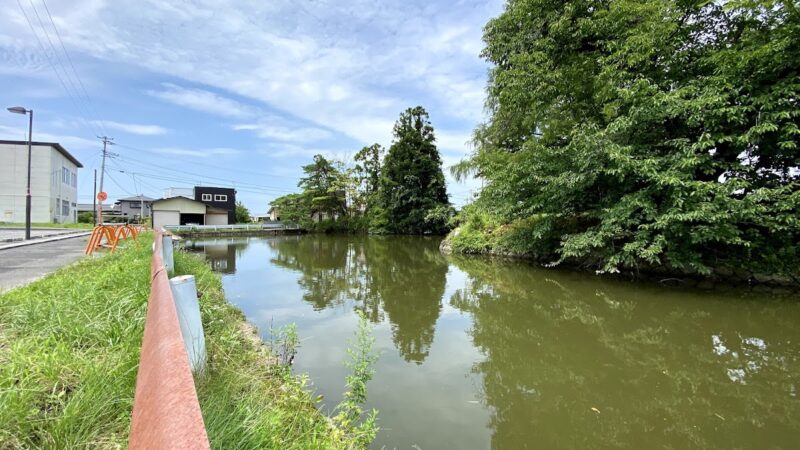
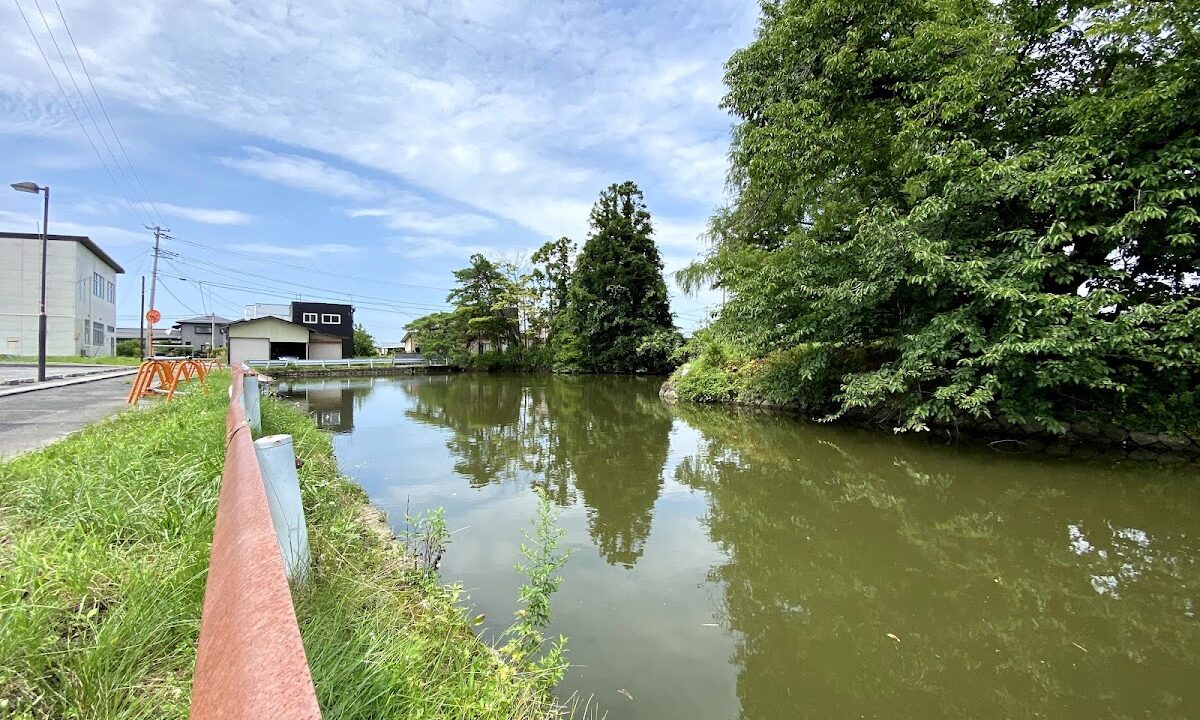
Inner Moat: The main defensive line surrounding Honmaru, which still remains filled with water today. This inner moat is protected as a town-designated historical site and is a valuable relic that evokes the castle’s former appearance.
Outer Moat: The outer defensive line surrounding the entire castle area. Although mostly filled in today, some traces can be seen.
Earthworks: A few traces of earthworks can be seen scattered around Takahata Elementary School. By combining it with a moat, an effective defensive system was constructed.
Features of the Water Moat
The most distinctive feature of Takahata Castle is the water moat that still remains today.
There are few examples of well-preserved water moats among castle ruins in Yamagata Prefecture, and the water moat of Takahata Castle is valued as a precious cultural asset. The water in the moat is drawn from the surrounding water system, maintaining a constant water level.
The moat is approximately 10 meters wide and still several meters deep, allowing us to imagine its function as a defensive structure in the past. The surrounding scenery reflected on the water’s surface is beautiful in every season, delighting visitors.
Existing Remains and Highlights
Takahata Town Designated Historic Site: Water Moat
The most important highlight at Takahata Castle ruins is the water moat, which is a town-designated historic site.
Located west of Takahata Elementary School, this water moat is thought to be the remains of the inner moat of the main gate. It still holds water today and is preserved as a valuable relic that conveys its former appearance.
The area around the moat is well-maintained and can be observed up close. Especially during the cherry blossom season in spring and the autumn foliage season, the reflections on the water are beautiful, making it a popular photography spot.
Exploring the Remains of Earthworks
Careful observation near Takabatake Elementary School reveals faint traces of earthworks.
The subtle differences in elevation and unnatural mounds of earth remaining in the current terrain are remnants of the former earthworks. While not completely intact, they provide clues to inferring the scale and layout of the castle.
Traces of the Outer Moat
Some traces of the outer moat, which surrounded the outside of the castle grounds, also remain.
Although much has been lost due to residential development and road construction, there are places where the location of the former outer moat can be inferred from depressions in the terrain and waterways. Walking while comparing old maps with the current terrain provides a clearer overall picture of the castle.
Main Enclosure Site (Takahata Elementary School)
The area near the Takahata Elementary School grounds is considered to be the main enclosure site.
While free access is restricted due to it being school grounds, you can feel the atmosphere of the castle ruins from the perimeter. The main enclosure was the center of the castle, where the lord’s residence and important facilities were located.
Takahata Castle and the History of the Okitama Region
The Role of Takahata Castle in the Okitama Region
The Okitama region is located in the southern part of Yamagata Prefecture and is a fertile area centered around the Yonezawa Basin. It has long been considered an important transportation hub, and many castles were built there.
Takahata Castle was located in the eastern part of the Okitama region and served the following roles:
- Military Base: A defensive line against invasions from the east
- Administrative Center: A governing center for the surrounding region
- Economic Center: Management of the collection and distribution of goods
- Cultural Center: A starting point for the spread of the lord’s culture throughout the region
Relationship with Surrounding Castles
Takahata Castle did not exist in isolation, but formed a network with surrounding castles.
Yonezawa Castle: A central castle in the Okitama region. As the base of the Uesugi clan, it oversaw the group of branch castles, including Takahata Castle.
Nagai Castle: A strategic point in the western part of the Okitama region. It was responsible for regional defense in cooperation with Takahata Castle.
Kameoka Castle: Located north of Takahata Castle, it was responsible for the defense of the northern part of the Okitama region.
These castles cooperated with each other to form a comprehensive defense system for the entire Okitama region. It is believed that a system of information transmission using beacons and swift horses was also in place.
Regional Development and the Castle of Takahata
The existence of Takahata Castle greatly contributed to the development of the town of Takahata.
As a castle town, Takahata developed with samurai residences, merchant districts, and temples and shrines. The urban planning centered around the castle still influences the current layout of Takahata town.
In the Edo period, with the establishment of the Takahata Jinya (administrative office), its function as an administrative and economic center was further strengthened. A market opened, commerce flourished, and it prospered as one of the leading towns in the Okitama region.
Cultural Value of Takahata Castle
Historical Value
Takahata Castle possesses high historical value in the following respects:
- Influence of the Hiraizumi Fujiwara Clan: As a castle within the sphere of influence of the Oshu Fujiwara clan, it reflects the political situation in the Tohoku region at the end of the Heian period.
- Long-Term Rule of the Date Clan: The 212-year rule of the Date clan is important for studying the territorial management of Sengoku daimyo.
- Changes in Rulers: Its history of functioning under diverse rulers—the Date clan, Gamo clan, Uesugi clan, the Shogunate, and the Oda clan—reflects the changes in Japan’s feudal system.
- Conversion to a Jinya (fortified residence): An example showing the transition process from a Sengoku period castle to an Edo period Jinya.
Archaeological Value
There is a possibility of discovering artifacts from various periods at the Takahata Castle site.
Past investigations and accidental discoveries have unearthed ceramics, roof tiles, and metal products from the medieval to early modern periods. These artifacts provide clues to life in the castle and the trade relations of the time.
Further detailed excavations are expected to clarify the layout and structure of the buildings, as well as the castle’s transformation process.
Value as a Landscape
The Takahata Castle ruins, with their remaining moat, are valuable as a historical landscape.
As urbanization progresses, landscapes that retain the atmosphere of castle ruins are decreasing. The Takahata Castle ruins, with their harmonious blend of moat and surrounding natural environment, support the region’s cultural identity as a space where one can feel the atmosphere of the castle in its heyday.
Points to Note When Visiting Takahata Castle
Best Season for Visiting
The Takahata Castle ruins can be visited throughout the year, but each season offers different charms.
Spring (April-May): Cherry blossom season. The cherry blossoms around the moat are beautiful, and the reflection of the blossoms on the water’s surface is a spectacular sight.
Summer (June-August): The season when the greenery is lush and the aquatic plants in the moat are abundant. Enjoy the beauty of the fresh green leaves.
Autumn (October-November): The season of autumn leaves. The reflection of the leaves in the moat is magnificent, making it ideal for photography.
Winter (December-March): The castle ruins are covered in snow. You can reflect on history in a tranquil atmosphere.
Nearby Tourist Attractions
When visiting Takahata Castle Ruins, we recommend also visiting the nearby tourist attractions.
Takahata Winery: A leading winery in Yamagata Prefecture. You can enjoy wine tasting and tours.
Hamada Hirosuke Memorial Museum: A facility introducing the life and works of children’s author Hamada Hirosuke.
Inu-no-Miya/Neko-no-Miya: A rare shrine where people pray for the health of their pets. Visitors come from all over Japan.
Mahoroba Ancient Village Historical Park: A park that has been developed from Jomon period to Kofun period ruins.
Akutsu Hachiman Shrine: An ancient shrine with a three-story pagoda designated as a National Important Cultural Property.
Local Food and Specialty Products
Takahata Town is a thriving agricultural area with a wealth of specialty products.
Takahata Wine: Wine made from locally grown grapes. White wine made from Delaware grapes is particularly famous.
Cherries: A representative fruit of Yamagata Prefecture. They are in season in early summer.
Grapes: Cultivated not only for winemaking but also for fresh consumption. A popular autumn delicacy.
Rice: High-quality rice from the Okitama region. Brand-name rice varieties such as Tsuyahime and Haenuki.
Buckwheat Noodles: Numerous restaurants serve handmade buckwheat noodles made with locally produced buckwheat flour.
Points to Note When Visiting
When visiting the Takahata Castle Ruins, please note the following:
- Consideration for School Facilities: The main keep site is within the grounds of an elementary school. Please refrain from entering during class hours and view from the perimeter.
- Protection of Historical Remains: The moats and earthworks are valuable cultural assets. Please do not enter restricted areas and be careful not to damage the remains.
- Safety Measures: Some areas around the moats can be slippery. Particular caution is needed during rainy weather and winter.
- Parking: There is no dedicated parking lot. Please use the parking lots of nearby public facilities and tourist attractions, and avoid parking on the street.
- Take Your Trash Home: To preserve the environment around the castle ruins, please be sure to take your trash home with you.
Current Status and Challenges of Takahata Castle Research
Historical Documents and Folklore
Historical documents concerning Takahata Castle are limited.
Much of the information regarding the construction period and builder is based on local folklore, and reliable historical evidence is needed to support it. In particular, the folklore that the castle was built by Hizume Suehira during the Jōan era is expected to be further clarified through future research.
Regarding the period after the Date clan era, fragmentary descriptions can be found in Date family documents and Uesugi family records. Careful interpretation of these historical materials will clarify the castle’s function and role.
Need for Archaeological Investigation
Full-scale archaeological excavations have not yet been sufficiently conducted at the Takahata Castle site.
Future planned excavations are expected to yield the following results:
- Clarification of building layout and structure
- Understanding the castle’s transformation process
- Dating based on excavated artifacts
- Reconstruction of daily life
However, large-scale excavations are difficult because the main keep site is currently used as an elementary school. Investigations in the surrounding areas and a series of small-scale trench surveys would be a more realistic approach.
Efforts for Preservation and Utilization
Takahata Town is working on the preservation and utilization of the Takahata Castle site.
Currently, the moat is protected as a town-designated historical site, but the following initiatives are being considered for the future:
- Development of a comprehensive preservation plan: A preservation plan that considers not only the moat but the entire castle site.
- Enhancement of explanatory signs: Installation of detailed explanatory signs to deepen understanding on site.
- Utilization of digital technology: Recreation of the castle in its heyday using AR (augmented reality) and VR (virtual reality).
- Development of educational programs: Providing opportunities for local children to learn about local history.
- Utilization as a tourist resource: Development of routes in cooperation with surrounding tourist spots.
Takahata Castle and the History of Japanese Castles
Characteristics of Castles in the Tohoku Region
Takahata Castle clearly demonstrates the characteristics of castles in the Tohoku region.
Castles in the Tohoku region have the following characteristics:
- Influence of Hiraizumi Culture: Cultural influence of the Oshu Fujiwara clan at the end of the Heian period
- Castles of Local Powers: Castles built by samurai groups rooted in the region
- Adapted to Snowy Regions: Structures and ingenuity unique to heavy snowfall areas
- Water Utilization: Development of moats utilizing abundant water resources
Takahata Castle is a typical Tohoku castle possessing these characteristics.
Takahata Castle as a Hilltop Castle
Takahata Castle is classified as a hilltop castle.
Hilltop castles are castles built at the boundary between plains and hills, and have the following advantages:
- Allows for defense from higher ground against attacks from plains
- Easier to secure larger baileys compared to mountain castles
- Favorable for the development of castle towns
- Relatively easy to secure water
Takahata Castle functioned for a long period of time by utilizing these advantages.
Conversion to a Jinya (Fortified Residence)
The transformation of Takahata Castle, which became the Takahata Jinya during the Edo period, is an important example in the history of Japanese castles.
The conversion from a military facility of the Sengoku period to an administrative facility of the peaceful era was seen in many castles. In the case of Takahata Castle, it is unique in that it continued to function as the Oda clan’s Jinya until the end of the Edo period.
Further research is needed regarding the building layout and functions during the Jinya period.
Summary: The Charm and Future Prospects of Takahata Castle
Takahata Castle is a castle with a history spanning approximately 700 years, from the late Heian period to the Meiji Restoration. Beginning with the legend of its construction by Hizume Suehira, it embodies the major currents of Japanese history, from the 212 years of rule by the Date clan to its conversion to a Jinya during the Edo period.
The remaining moat is a valuable historical relic that conveys the appearance of the past, evoking a sense of historical romance for visitors. As its alternative name, Kanegajo, suggests, it is a castle with a unique shape and occupies an important position in the history of the Okitama region. Takahata Town is a charming region blessed with abundant nature, history, and delicious food. Visiting the Takahata Castle ruins allows you to experience the region’s rich history and culture.
It is hoped that the preservation and utilization of the Takahata Castle ruins will further progress, making it a place where more people can visit, learn, and enjoy themselves. Passing on the Takahata Castle ruins, a treasure of the region, to future generations is our important responsibility.
When visiting Yamagata Prefecture, be sure to stop by Takahata Town and reflect on its long history amidst the tranquil atmosphere of the Takahata Castle ruins. The seasonal scenery reflected in the moat will surely create lasting memories.