Complete Guide to Sawayama Castle (Shiga Prefecture): A Thorough Explanation from Ishida Mitsunari’s Residence to the Climbing Route
What is Sawayama Castle?: A Famous Castle Built at a Strategic Point in Omi Province
Sawayama Castle is a mountain castle built on Mt. Sawayama (elevation 232.5m, relative height approximately 134m) in Hikone City, Shiga Prefecture. Currently, only the castle ruins remain. From the Sengoku period to the early Edo period, it played a crucial role as a transportation hub connecting the Kinai region and eastern Japan.
Located near Sekigahara, where the Fuwa Barrier was located, it was a strategic base controlling the Higashiyama Road (Nakasendo, present-day National Route 8), and was a castle highly valued by powerful figures such as Oda Nobunaga, Toyotomi Hideyoshi, and Tokugawa Ieyasu. It is particularly known as the residence of Ishida Mitsunari, and was such a famous castle that it was praised with the saying, “There are two things that surpass Jibu-sho: Shima Sakon and Sawayama Castle.”
From the site of the main keep at the summit, you can enjoy a panoramic view of Hikone city and Lake Biwa, making it a popular spot even today, attracting many history buffs and hiking enthusiasts.
History of Sawayama Castle: From the Kamakura Period to the Battle of Sekigahara
Kamakura Period: The Origins of Sawayama Castle
The history of Sawayama Castle dates back to the early Kamakura period. It is said to have begun when Saho Tokitsuna (later of the Sasaki clan), the sixth son of Sasaki Sadatsuna of the Omi Genji clan, built a residence there. It was built by the Sasaki clan, who served as the governor of Omi Province, and subsequently developed into an important base in Omi Province.
Sengoku Period: The Era of Nobunaga and Hideyoshi
With the arrival of the Sengoku period, Sawayama Castle became even more important as a castle protecting a strategic point in Omi Province.
During the era of Oda Nobunaga, Nobunaga himself used Sawayama Castle as a base for conquering Omi Province. The castle was made a crucial military base for the expansion from the Kinai region to the eastern provinces, with the senior retainer Niwa Nagahide appointed as its lord. Niwa Nagahide was a warrior who distinguished himself under the Oda-Toyotomi regime, further enhancing the strategic value of Sawayama Castle.
Even during the era of Toyotomi Hideyoshi, the emphasis on Sawayama Castle remained unchanged. Powerful warriors such as Hori Hidemasa and Horio Yoshiharu successively became lords of the castle, and improvements were made to it.
The Era of Ishida Mitsunari: The Golden Age of Sawayama Castle
In 1590 (Tensho 18), when Ishida Mitsunari (1560-1600), the head of the Five Commissioners of the Toyotomi regime, became the lord of Sawayama Castle, the castle underwent extensive renovations.
Mitsunari constructed a five-story keep and developed it into a magnificent castle with Toriimoto as the main gate. By constructing inner and outer moats, building a comprehensive fortification including the castle town, and developing areas for merchants, samurai residences, and blacksmiths, the castle was transformed into a fortified city with an urban structure.
At this time, Sawayama Castle was highly regarded as a magnificent castle far beyond the means of Mitsunari’s status, as evidenced by the saying, “There are two things that are too good for Jibu-sho: Shima Sakon and Sawayama Castle.” Shima Sakon (Shima Kiyooki) was a renowned general whom Mitsunari had hired with exceptional treatment, and together with Sawayama Castle, he symbolized Mitsunari’s power.
The Battle of Sekigahara and the Fall of Sawayama Castle
On September 15, 1600 (Keicho 5), the Western Army, led by Ishida Mitsunari, was defeated by the Eastern Army, led by Tokugawa Ieyasu, at the Battle of Sekigahara.
On the day of the battle, Ishida Masatsugu, Mitsunari’s father, and his brother, Ishida Masazumi, were guarding Sawayama Castle. Upon receiving news of the defeat at Sekigahara, Tokugawa Ieyasu launched a full-scale attack on Sawayama Castle on September 18th, with Kobayakawa Hideaki leading the vanguard and approximately 15,000 troops.
The castle defenders put up a desperate resistance, but the overwhelming difference in numbers led to its fall. This battle is known as the “Battle of Sawayama Castle.” The Ishida family committed suicide, and Sawayama Castle was burned down.
Ii Naomasa’s Entry and Abandonment of the Castle
After the Battle of Sekigahara, Ii Naomasa, one of the Four Heavenly Kings of Tokugawa, entered Sawayama Castle. However, Naomasa chose to build a new castle rather than rebuild the war-torn Sawayama Castle.
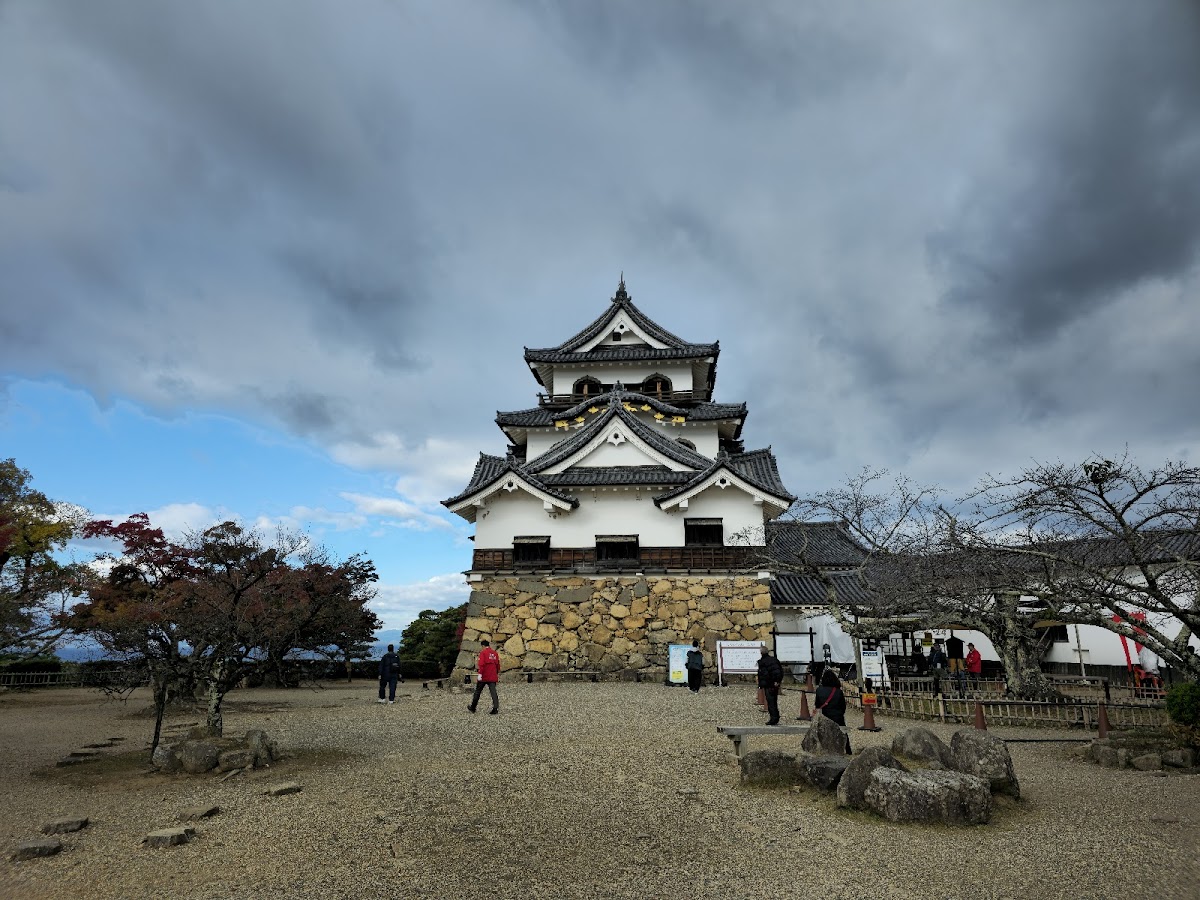
Construction of a new castle (Hikone Castle) began on Mount Hikone in 1603 (Keicho 8), and much of the building materials and stonework from Sawayama Castle were repurposed for the construction of Hikone Castle. Thus, Sawayama Castle was abandoned, and its history came to an end.
Structure and Layout of Sawayama Castle
Overall Structure
Sawayama Castle was a typical mountain castle, with the main keep at the summit and multiple baileys (kuruwa) arranged on the slopes. During the time of Ishida Mitsunari, a five-story keep was built in the main keep, and a comprehensive fortification including the castle town was developed.
Main Components:
- Honmaru (Mountaintop, Elevation 232.5m)
- Ninomaru (Second Bailey)
- Sannomaru (Third Bailey)
- Taikomaru (Drum Bailey)
- Senkan-ido (Thousand-Kan Well)
- Otemon (Main Gate, Toriimoto Side)
- Inner and Outer Moats
- Castle Town (Townhouses, Samurai Residences, Blacksmiths’ Area)
Ascent Route and Defensive Structures
The main gate was located at the eastern foot of the mountain, and the route ascending from Toriimoto was the official route. At the eastern foot, there is a space surrounded by earthworks, and the opening in the earthworks, believed to be the site of the main gate, can still be seen today.
The ascent route from here continues to Taikomaru and then to the Honmaru. Defensive structures utilizing the steep terrain were strategically placed throughout, giving the castle a significant advantage to attackers.
Stone Walls and Remains
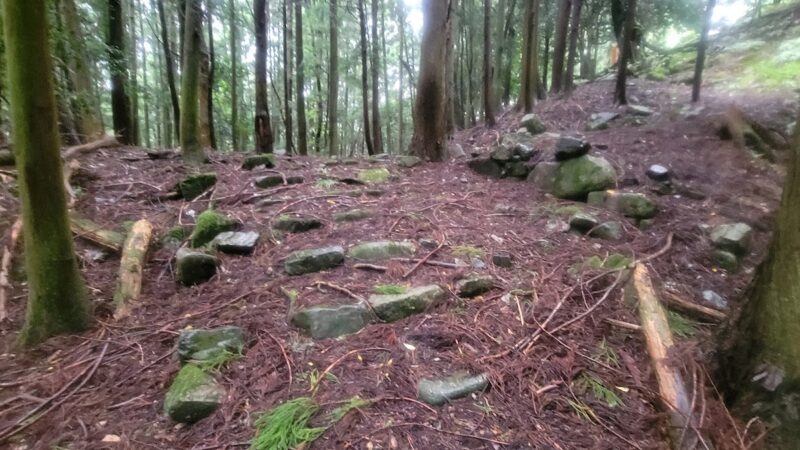
Currently, some of the stone walls remain at the Sawayama Castle site. Especially around the Honmaru, remains demonstrating the stonework techniques of the time can be observed. However, many of the stone walls were reused during the construction of Hikone Castle, so they do not retain their original appearance completely.
At the site of the main keep on the mountaintop, remnants of foundation stones and earthworks from the time of Ishida Mitsunari remain, and a sign indicating the location where the five-story keep once stood is also installed.
Highlights of Sawayama Castle Ruins
View from the Main Keep Site
The greatest highlight of Sawayama Castle is the spectacular view from the main keep site on the mountaintop. You can see the city of Hikone, Lake Biwa, Hikone Castle, and, on a clear day, even the Hira Mountains.
Ishida Mitsunari must have gazed upon this view while harboring his ambition to conquer Japan. The view is especially magnificent on a clear day, making you forget the fatigue of the climb.
Senkan-ido Well
To the north of the main keep is the site of a well called “Senkan-ido” (Thousand-Kan Well). This well was an extremely important water source for the mountain castle, and it was given this name because it was considered to be worth a thousand kan during a siege. The well is approximately 10 meters deep and still holds water. The technology to dig a well on the mountaintop demonstrates the advanced civil engineering techniques of the time.
Stone Walls and Enclosure Remains
Parts of the original stone walls remain along the path to the castle and around the mountaintop. These walls, built using the Nozura-zumi (rough-stone masonry) technique, are valuable relics that convey the castle-building techniques of the Sengoku period.
Explanatory boards are installed at each enclosure site, allowing visitors to explore while understanding the former castle structure.
Taiko-maru
Taiko-maru is an enclosure located in front of the main keep, where a drum used to announce the time is believed to have been placed. From here, one can overlook the city of Hikone, and it played an important role in the castle’s defense.
Otemon Gate Remains
At the Otemon Gate site on the eastern foot of the mountain, the opening in the earthen rampart remains clearly visible. This was the official entrance to the castle, and it is believed that a magnificent turret gate stood here during the time of Ishida Mitsunari.
Routes to Sawayama Castle Ruins
Ryotanji Temple Route (West Side – Recommended)
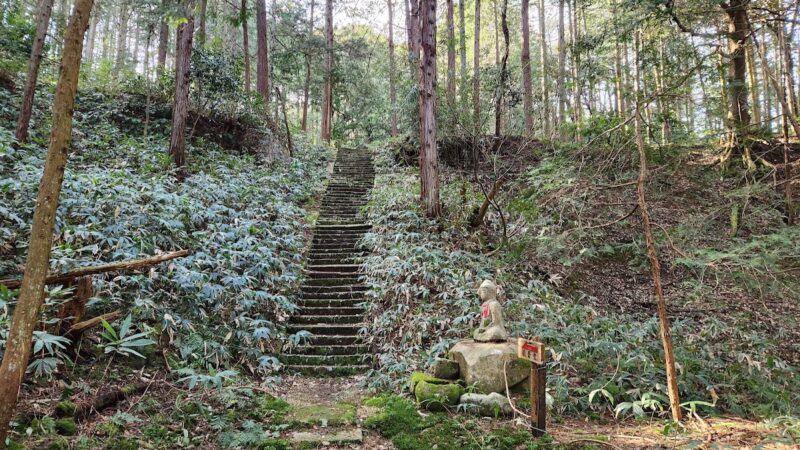
The most well-maintained and common route is the hiking trail from Ryotanji Temple.
Features:
- Time Required: Approximately 30-40 minutes one way
- Difficulty: Intermediate (The trail is well-maintained, but there are steep sections)
- Parking: Free parking available at Ryotanji Temple (approximately 20 cars)
- Toilets: Available at Ryotanji Temple
Ryotanji Temple is a temple associated with the Ii family and houses the tomb of Ii Naomasa. Visiting the temple before hiking is recommended. The hiking trail is relatively well-maintained, and signposts are installed.
Toriimoto Route (East Side – Main Road)
This route follows the historical main road.
Features:
- Time Required: Approximately 40-50 minutes one way
- Difficulty: Intermediate to Advanced (Some sections of the path are difficult to follow)
- Parking: Paid parking available near Toriimoto
You can experience the official route used to ascend the castle during the time of Ishida Mitsunari, but some sections of the path are unclear, making it suitable for experienced hikers.
Access from Hikone Station
From JR Hikone Station to Ryōtanji Temple is approximately 20-25 minutes on foot, or about 5 minutes by taxi. Bus service is limited, so it is recommended to check the timetable in advance.
Precautions When Climbing to Sawayama Castle Ruins
Clothing and Equipment
- Hiking boots or trekking shoes: There are slippery sections on the mountain trails.
- Comfortable clothing: Long sleeves and long pants are recommended (to prevent insect bites).
- Drinking water: Bring plenty of water, especially in summer.
- Hat and sunscreen: Essential during periods of strong sunlight.
- Rain gear: Weather can change quickly.
- Gloves: Useful on sections with chains and steep slopes.
Precautions When Climbing
- During winter (December to February), there is a possibility of snow and ice, making climbing dangerous.
- Always descend before sunset (There are no lighting facilities).
- Avoid climbing alone; climb in groups whenever possible.
- Carrying a bear bell is recommended (for protection against wild animals).
- Always take your trash with you.
- Please be careful not to damage the historical site.
Opening Hours
While Sawayama Castle Ruins are generally accessible 24 hours a day, Ryotanji Temple’s opening hours are 9:00 AM to 4:00 PM (until 3:30 PM in winter). If using the Ryotanji Temple route, it is recommended to begin your ascent during opening hours and descend before closing time.
Nearby Tourist Attractions
Hikone Castle
Hikone Castle, a national treasure built using repurposed stone walls and building materials from Sawayama Castle, is approximately a 10-minute drive or 30-minute walk from Sawayama Castle Ruins. It is a valuable castle with an existing keep, and visiting both Sawayama Castle and Hikone Castle allows you to experience the continuity of castle history.
Ryotanji Temple
Ryotanji Temple, the family temple of the Ii clan, is a base for climbing Sawayama Castle and a renowned temple with a beautiful garden. This site contains the tombs of successive heads of the Ii family, including Ii Naomasa, making it a must-see spot for history buffs.
Sawayama Castle Ruins Monument
A stone monument marking the Sawayama Castle ruins stands at the foot of the mountain, making it a popular photo spot.
Toriimoto-juku
Toriimoto-juku, which flourished as a post town on the old Nakasendo road, retains its historical streetscape. It was also the site of the main gate of Sawayama Castle, and a stroll through the area allows you to feel the atmosphere of that time.
Utilizing the Hikone Tourist Information Center
Hikone Tourist Information Center
The Hikone Tourist Information Center, located within JR Hikone Station, provides detailed information about the Sawayama Castle ruins.
Services Offered:
- Distribution of climbing maps for Sawayama Castle Ruins
- Detailed explanations of climbing routes
- Information on the latest climbing trail conditions
- Information on nearby tourist spots
- Introduction to accommodations
Opening Hours: 9:00 AM – 5:00 PM (Open year-round)
Hikone Tourist Center
The Hikone Tourist Center, located near Hikone Castle, also provides information about Sawayama Castle.
Services Offered:
- Distribution of tourist brochures
- Information on sightseeing in Hikone City
- Souvenir sales
- Rest area
Hikone Tourism Association
The Hikone Tourism Association’s official website, “Hikone Tourist Guide,” is regularly updated with the latest information on Sawayama Castle Ruins and important notes regarding climbing. We recommend checking it before your climb.
The Charm and Historical Value of Sawayama Castle
A Place to Learn About Ishida Mitsunari
Sawayama Castle is an essential place for understanding the character of Ishida Mitsunari. Mitsunari was a man of exceptional administrative skills as a “magistrate,” but he also possessed outstanding qualities as a military commander.
Although he was said to be “too much for a civil affairs official,” he is also said to have valued frugality and practicality over the appearance of the castle. Visiting the ruins of Sawayama Castle allows you to experience Mitsunari’s character and values.
A Prelude to the Battle of Sekigahara
The Battle of Sawayama Castle was the de facto final chapter of the Battle of Sekigahara. The last resistance of the Ishida forces, defeated in the main battle, unfolded at this castle. Standing at the castle ruins, you can feel the weight of history symbolizing the end of the Sengoku period.
Value in Castle Research
Sawayama Castle is an important historical site that shows the changes in castle architecture during the transition period from the Sengoku period to the early Edo period. The outer fortifications and the development of the castle town during Ishida Mitsunari’s time convey the appearance of a transitional period to early modern castles, making it a valuable resource for castle research.
Model Itinerary for Visiting Sawayama Castle
Half-Day Course (Approx. 4 Hours)
- JR Hikone Station (9:00) – Gather information at the tourist information center
- Ryotanji Temple (9:30) – Visit the temple and the Ii family cemetery (30 minutes)
- Climb to Sawayama Castle Ruins (10:00-12:00) – Round trip approximately 2 hours
- Lunch (12:30) – Around Hikone Station or Toriimoto-juku
- Hikone Castle (13:30-) – Visit if time permits
Full-Day Course (Approx. 8 Hours)
- JR Hikone Station (9:00)
- Ryotanji Temple (9:30-10:00)
- Climb to Sawayama Castle Ruins (10:00-12:30) – Leisurely Stroll
- Lunch (13:00) – Enjoy Hikone’s local specialties
- Hikone Castle (14:00-16:30) – Visit the castle tower and gardens
- Stroll through the Castle Town (16:30-17:30) – Yumekyobashi Castle Road, etc.
- Dinner (18:00-) – Omi beef, etc.
Access Information
Access by Train
- Get off at JR Tokaido Main Line “Hikone Station”
- From Osaka: Approximately 1 hour 10 minutes by Special Rapid Service
- From Kyoto: Approximately 50 minutes by Special Rapid Service
- From Nagoya: Approximately 50 minutes by Special Rapid Service
Access by Car
- Approximately 10 minutes from Meishin Expressway “Hikone IC”
- Free parking available at Ryotanji Temple (approximately 20 cars)
- Numerous paid parking lots around Hikone Castle
Taxi
- From Hikone Station to Ryōtanji Temple: Approximately 5 minutes, fare approximately 1,000 yen
Summary: Sawayama Castle Ruins are a magnificent castle site overflowing with historical romance
Sawayama Castle was the residence of Ishida Mitsunari, a leading warlord of the Sengoku period, and was deeply involved in the Battle of Sekigahara, a turning point in Japanese history. Although it is now a ruined castle with no remaining structures, the view from the mountaintop, the remaining stone walls, and the weight of history deeply move visitors.
The climb is of moderate difficulty, allowing you to combine a historical stroll with a hike enjoying nature. Visiting it in conjunction with Hikone Castle will allow you to experience the transformation of castles from the Sengoku period to the Edo period.
When visiting Shiga Prefecture, be sure to visit Sawayama Castle Ruins. You’ll be able to spend a luxurious time reflecting on the romance of the Sengoku period while gazing at the view that Ishida Mitsunari saw.