Complete Guide to Kanaōyōgaiyama Castle (Saitama Prefecture): History and Highlights of a Strategic Fortress Protecting Hachigata Castle
What is Kanaōyōgaiyama Castle?
Kanaōyōgaiyama Castle is a medieval mountain castle located in Kanaō, Yorii-machi, Ōsato-gun, Saitama Prefecture. Built on Kanaōyama (also known as Tsutsujiyama), a 229-meter-high mountain overlooking the Arakawa River, it functioned as an important subsidiary castle protecting the western side of Hachigata Castle during the Sengoku period. Currently, it is maintained as Kanaōyama Park, with an observation deck at the summit, preserving the atmosphere of the Sengoku period along with the changing seasons.
The castle ruins are located on the tip of a mountain ridge approximately 100 meters above sea level, and were a strategically important location for monitoring and defending the “Tonokura no Watashi” crossing point on the Arakawa River. Although it was abandoned on June 14, 1590 (Tensho 18) with the fall of Hachigata Castle, some remains such as earthworks, vertical moats, and barbicans still exist, making it a valuable historical site for understanding the structure of medieval mountain castles.
History of Kanao Yogaiyama Castle
Construction History and the Fujita Clan Era
Regarding the construction period of Kanao Yogaiyama Castle, the prevailing theory is that it was built around 1532 (Tenbun 1) as a subsidiary castle when Fujita Saemon-no-suke Shigetoshi built Tenjin-yama Castle (present-day Hanazono Castle). This date is also recorded on the local information board.
Fujita Shigetoshi was a warlord who held power in northern Musashi Province and had close ties with the forces based at Hachigata Castle, which is said to have been built in 1476 (Bunmei 8) by Nagao Kageharu. Kanaoyama Castle was built incorporating the mountain pass leading from Hachigata Castle to Tenjinyama Castle, playing a crucial role in controlling a strategic transportation hub.
The Hojo Clan Era and Kanaoyama Yahei
As the power of the Later Hojo clan expanded into Musashi Province, Kanaoyama Castle came under the control of Hojo Ujikuni (lord of Hachigata Castle). After the Fujita clan’s departure, Kanaoyama Yahei, a former retainer of the Fujita clan, was appointed as the castle lord. It is believed that Kanaoyama Yahei established his residence near Denzoin Temple at the foot of the mountain, using the summit of Kanaoyama as a fortified stronghold (an emergency refuge and defensive base).
Records indicate that Iwata Hikojiro managed Kanaoyama in 1582, and that Iwata Genba-no-kami later took over. This suggests that Kanaoyama Castle was a base where important warriors within the Hojo clan’s vassal group were stationed.
The Siege of Odawara and the Abandonment of the Castle
In 1590, when Toyotomi Hideyoshi began his siege of Odawara, Hachigata Castle was besieged by the large army of Maeda Toshiie and Uesugi Kagekatsu. Kanaoyōgaiyama Castle, as a subsidiary castle of Hachigata Castle, was also targeted by the Toyotomi army, but it is believed to have surrendered without a fight due to the overwhelming difference in military strength.
When Hachigata Castle surrendered on June 14th, Kanaoyōgaiyama Castle shared the same fate and was abandoned. Since then, the castle has not been used militarily, and over many years it has transformed into its current form.
Castle Structure and Layout
Characteristics of the Main Enclosure (Honkuruwa)
The main enclosure of Kanaoyōgaiyama Castle is located near the tip of the mountain ridge, where Atago Shrine is situated. It is a long, narrow shape, approximately 15 meters east-west and 70 meters north-south, and offers an open view towards the Arakawa River.
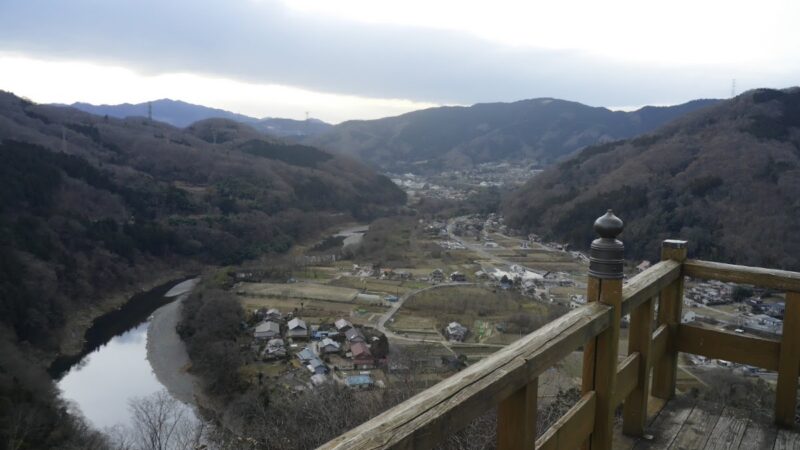
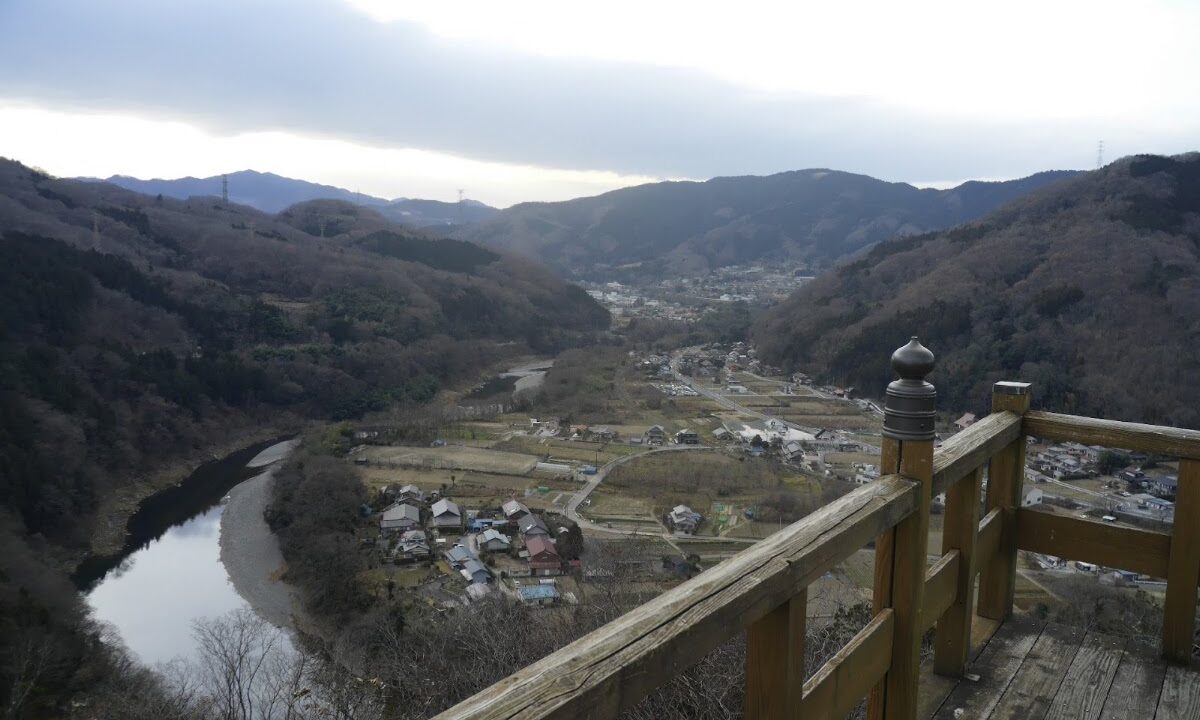
Behind the main enclosure (to the north) is a watchtower base approximately 5 meters high, marking the highest point of the castle. Currently, an observation deck has been installed, offering views towards Hachigata Castle and the Chichibu area. The view from the observation deck is excellent, offering a panoramic view of the Arakawa River and the surrounding mountains, demonstrating the castle’s emphasis on surveillance and defense.
Second Enclosure and Atago Shrine
Below the main enclosure is a flat area believed to be the second enclosure, where Atago Shrine is located. Atago Shrine is revered as the god of fire prevention, and its presence at castle ruins is common throughout Japan. This flat area also offers excellent views, suggesting its strategic importance as a defensive point.
Current Status of Remains
The following remains can be identified today:
Earthworks: Defensive structures built by piling up earth around and behind the enclosures. Some parts remain clearly visible. Vertical Moat (Vertical Moat): A moat dug vertically along the slope. It served to hinder enemy lateral movement and make attacks difficult.
Horse Outpost: A defensive structure built in front of the castle gate. It prevented direct enemy attacks and also functioned as a base for friendly attacks.
Stone Wall: Traces of stone walls can be seen in some areas, but later modifications are possible.
However, due to years of weathering and development accompanying the creation of a park, many of the remains are unclear. When visiting the castle, paying attention to the topography and the presence of cliffs (artificial cliffs) will make it easier to understand the castle’s structure.
Residence Site/Denzoin Temple
Denzoin Temple, located at the foot of the mountain, is said to be the site of the residence of Kanae Yahei. In medieval mountain castles, it was common practice to live in a residence at the foot of the mountain during peacetime and to take refuge in the fortified castle on the mountaintop during wartime. Observing the topography around Denzoin Temple, it’s clear that flat land stretches out, making it a suitable location for a residence.
Highlights of Kanaoyōgaiyama Castle
Spectacular Views from the Observation Deck
The observation deck located in the main enclosure is the greatest highlight of Kanaoyōgaiyama Castle. From here, you can enjoy a panoramic view of the Arakawa River, the direction of Hachigata Castle, the Chichibu Mountains, and the Kanto Plain. On clear days, you can even see the mountains of Jōshū (Gunma Prefecture) in the distance, giving you a real sense of how strategically important this castle was for monitoring a wide area.
During the Sengoku period, the castle lord and defenders must have gazed upon this view while keeping a watchful eye on enemy movements. While we can enjoy this view in peaceful times, imagining the tension of that era evokes a different kind of emotion.
Famous for Azaleas
Kanaoyama Mountain is also known as “Azalea Mountain,” and azaleas bloom profusely from April to May. During this season, the entire mountain is dyed in vibrant reds and pinks, attracting many tourists. It’s a rare spot where you can enjoy exploring castle ruins and admiring the flowers at the same time.
During the azalea blooming season, local residents maintain and manage the area, making the walking paths easy to navigate. The ability to combine historical exploration with nature appreciation is a major attraction of Kanaojiroyama Castle.
Visiting Atago Shrine
Atago Shrine, located in the second enclosure, is a shrine that attracts the faith of the local community. There are many examples of castle ruins being preserved without destruction when shrines are built on them, and it can be said that the existence of Atago Shrine has contributed to the preservation of the Kanaojiroyama Castle ruins.
When visiting the shrine, pay attention to the topography around it. You can discern the castle’s structure from the flat, leveled enclosures and the differences in elevation with the surrounding area.
The Arakawa River and the Tonokura Ferry Crossing
Understanding the strategic value of Kanaoyōgaiyama Castle hinges on the presence of the Arakawa River. The Arakawa River, flowing below the castle, was a vital transportation route connecting Musashi Province and Kōzuke Province (Gunma Prefecture), and there was a river crossing point known as the “Tonokura Ferry Crossing.”
Monitoring and defending this river crossing point was a crucial role of Kanaoyōgaiyama Castle, and it played a vital part in the western defense line of Hachigata Castle. Walking along the Arakawa River and imagining the transportation routes and defense lines of the time helps to appreciate the castle’s ingenious location.
Access and Visiting Guide
Access by Public Transportation
By Train
- Get off at Hakure Station on the Chichibu Railway, approximately 15 minutes on foot.
- Cross the Yorii Bridge from the station and proceed towards Chichibu; you will see signs for Kanaoyama Park.
- Accessible on foot from Yorii Station on the JR Hachiko Line, Tobu Tojo Line, and Chichibu Railway (approximately 25 minutes).
Access by Car
Via Kan-Etsu Expressway
- Approximately 10 minutes from Hanazono Interchange.
- Proceed along National Route 140 towards Chichibu, and follow the signs for Kanaoyama Park near Yorii Bridge.
Parking
- Dedicated parking lot for Kanaoyama Park (free).
- The parking lot is located to the left of the park entrance and can accommodate approximately 10 cars.
Climbing Time and Estimated Time Required
Climbing Time
- From the parking lot or foot of the mountain to the main enclosure (observation deck): Approximately 10 minutes on foot.
- A relatively gentle walking path is maintained, making it easy for beginners to climb.
Estimated Visiting Time
- Round trip to the observation deck only: Approximately 30 minutes
- If you want to carefully observe the ruins: Approximately 1 hour
- If you also visit the nearby Hachigata Castle and Hanazono Castle: Half a day to a full day
Points to Note When Visiting
Clothing and Equipment
- Comfortable walking shoes (sneakers or light hiking boots) are recommended
- In summer, bring insect repellent, a hat, and drinking water
- In winter, prepare warm clothing (the mountaintop is windy)
Visiting Manners
- Be careful not to damage the ruins
- Always take your trash with you
- Visit Atago Shrine quietly
- Do not trespass on private property
Best Season
- Azalea blooming season (late April to mid-May): You can enjoy both flower viewing and castle exploration
- Autumn (October to November): The autumn leaves are beautiful, and the weather is mild
- Winter: The leaves have fallen from the trees, making it easier to observe the ruins and topography.
Related Historical Sites in the Surrounding Area
Hachigata Castle Ruins
If you visit Kanaoyōgaiyama Castle, you should definitely also visit the ruins of Hachigata Castle, the main castle. Hachigata Castle is a large flatland castle built on a plateau between the Arakawa and Fukasawa rivers, and is a nationally designated historical site. At the Hachigata Castle History Museum, you can learn in detail about the history of Hōjō Ujikuni and Hachigata Castle.
The distance from Kanaoyōgaiyama Castle to Hachigata Castle Ruins is about 10 minutes by car, or about 30 minutes on foot. Visiting both castles will give you a deeper understanding of the relationship between the subsidiary castle and the main castle.
Hanazono Castle (Tenjin-yama Castle)
Tenjin-yama Castle (present-day Hanazono Castle), built by Fujita Shigetoshi, is also a castle closely related to Kanaoyōgaiyama Castle. Kanaoyōgaiyama Castle is said to have been built as a subsidiary castle of Hanazono Castle, and a mountain pass connecting the two castles passed through Kanaoyōgaiyama Castle.
Hanazono Castle is a mountain castle with a relative elevation of approximately 150 meters, and it retains slightly more substantial mountain castle remains than Kanaōyōgaiyama Castle. If you have time, it would be interesting to visit Hanazono Castle and compare them.
Other Castles in Yorii Town
Several other castle ruins exist in Yorii Town:
- Yorii Yōgaiyama Castle: A subsidiary castle protecting the east of Hachigata Castle
- Hanazono Mitake Castle: A subsidiary castle of Hanazono Castle
By visiting these castles, you can see the overall picture of the castle network centered around Hachigata Castle.
Historical Significance of Kanaōyōgaiyama Castle
Part of the Hachigata Castle Defense System
The greatest historical significance of Kanaōyōgaiyama Castle lies in its role as an important subsidiary castle forming the western defense line of Hachigata Castle. Hachigata Castle was a strong castle protected by the natural moats of the Arakawa and Fukasawa rivers, but several subsidiary castles were positioned to monitor and defend surrounding transportation routes and river crossing points.
Kanaoyōgaiyama Castle, in particular, played a crucial role in guarding against enemy incursions from the Chichibu area and controlling the Tonokura ferry crossing point on the Arakawa River. This strategic placement allowed Hachigata Castle to establish a wide-area defense system encompassing the surrounding region.
A Typical Example of a Medieval Mountain Castle
Kanaoyōgaiyama Castle possesses typical characteristics of a medieval mountain castle from the Sengoku period. With its main enclosure located on the mountaintop, fortified defenses built with earthworks and moats, and emphasis on surveillance due to its advantageous location with excellent views—this structure is common to medieval mountain castles throughout Japan.
Although not large in scale, this makes it easier to understand the basic structure of a medieval mountain castle, making it a suitable site for beginners to learn about mountain castle architecture.
Importance in Regional History
The history of Kanaoyōgaiyama Castle provides important clues to understanding the Sengoku period history of northern Musashi Province. The transition of rulers from the Fujita clan to the Hojo clan, the reality of the Hojo clan’s territorial control centered around Hachigata Castle, and the end of the Sengoku period with Toyotomi Hideyoshi’s siege of Odawara—these historical events are etched into this small mountain castle.
When discussing the history of the region, it’s crucial not to overlook the existence of smaller branch castles like Kanaōyōgaiyama Castle, in addition to the larger castles. By carefully deciphering the role each castle played, the true picture of regional society during the Sengoku period emerges.
Points to Enjoy Kanaōyōgaiyama Castle
Recommended Prior Study
Before visiting Kanaōyōgaiyama Castle, acquiring basic knowledge about Hachigata Castle, Hojo Ujikuni, and the siege of Odawara will deepen your understanding at the site. It would be helpful to research the following information:
- The history and structure of Hachigata Castle
- The career of Hojo Ujikuni and his rule over Hachigata Castle
- The course of Toyotomi Hideyoshi’s Odawara campaign
- Basic structure and terminology of medieval mountain castles
The joy of reading the topography
One of the joys of exploring castles is interpreting the topography. At Kanaoyōgaiyama Castle, pay attention to the following points:
- The difference in elevation between the main enclosure and the second enclosure
- The presence of cut slopes (artificial cliffs)
- The arrangement and height of earthworks
- Traces of moats
- The relationship with the Arakawa River
From these topographical features, you can decipher the castle’s defensive structure and strategic intentions.
Photography Tips
Kanaoyōgaiyama Castle is a great spot for photography:
- Views from the observation deck (especially beautiful at sunset)
- Panoramic view during the azalea blooming season
- Combination of Atago Shrine and castle ruins
- Distant view showing the relative positions of the Arakawa River and the castle mountain
- Details of the ruins such as earthworks and moats
Seasonal Charms
Kanaoyōgaiyama Castle has different charms in each of the four seasons:
Spring: The most vibrant season with azaleas in full bloom. It’s bustling with many tourists.
Summer: Beautiful fresh greenery and cool shade. However, insect repellent is essential.
Autumn: Beautiful autumn foliage and mild weather. The perfect season for exploring the castle.
Winter: The leaves have fallen, making it easier to observe the ruins and topography. The air is clear and the views are excellent.
Summary: The Value of Kanaōyōgaiyama Castle
Kanaōyōgaiyama Castle, though not large in scale, is an important historical site for understanding the regional defense system of the Sengoku period. It functioned as a subsidiary castle protecting the western side of Hachigata Castle and had a clear role in monitoring the Arakawa River crossing point.
Currently, it is a park, a tourist spot where visitors can enjoy the view from the observation deck and the azalea blossoms, but behind it lies the tense history of the Sengoku period. Although only partial remains exist, careful observation of the topography allows for an understanding of the structure of a medieval mountain castle.
Visiting it along with surrounding castles such as Hachigata Castle and Hanazono Castle will provide a deeper understanding of the Hōjō clan’s rule and the regional history of the Sengoku period. It is an attractive spot recommended not only for history enthusiasts but also for those who enjoy hiking and nature appreciation.
When visiting Yorii Town in Saitama Prefecture, be sure to visit Kanaōyōgaiyama Castle and experience the atmosphere of the Sengoku period. By superimposing the world that the castle lords and garrisons once saw onto the view from the observation deck, you’ll feel a closer connection to history.