Hio Castle (Saitama Prefecture) Complete Guide: A Thorough Explanation of the Mountain Castle Remains of Nagao Kageharu and the Suwabe Clan
What is Hio Castle?
Hio Castle is a Sengoku period mountain castle located in Hio, Ogano-machi, Chichibu-gun, Saitama Prefecture. Built on a mountaintop at an altitude of 551m, extending northwest from Kannon-yama, it boasts a rugged location with a relative elevation difference of approximately 160-210m from the base. Protected as a Saitama Prefecture designated important historical site and an Ogano-machi designated historical site, the castle remains, which functioned as an important military base in western Musashi Province, are well-preserved.
The greatest feature of Hio Castle lies in its mountain castle structure, which skillfully utilizes the natural terrain. The two mountaintops and the groups of baileys positioned between them, the deep moats, and the natural cut-through of Ushikubi Pass all convey the ingenuity of Sengoku period castle construction techniques and terrain utilization.
History of Hio Castle
The Legend of Nagao Kageharu’s Siege
The most dramatic episode in the history of Hio Castle is the siege of Nagao Kageharu in 1478. Nagao Kageharu, the chief retainer of the Yamanouchi Uesugi family, the Kanto Kanrei (governor of the Kanto region), rebelled against the Uesugi clan over a succession dispute, using Hachigata Castle as his base. However, after being attacked by Ota Dokan and driven out of Hachigata Castle, Kageharu is said to have temporarily fled to Hio Castle.
Nagao Kageharu’s rebellion became a large-scale conflict that engulfed the entire Kanto region, and Hio Castle was also caught in the maelstrom of the Sengoku period (Warring States period). Located in a rugged mountainous area, Hio Castle is thought to have been an ideal refuge for the cornered Kageharu.
The Period as the Residence of the Suwabe Clan
From the mid-Sengoku period onward, Hio Castle became the residence of Suwabe Tōtōmi-no-kami Sadakatsu, a senior retainer of Hojo Ujikuni. The Suwabe clan was a prominent family that served as the chief retainer of Hojo Ujikuni, playing a crucial role in the Hojo Ujikuni’s rule of the territory, which was based at Hachigata Castle.
Hio Castle was positioned as a subsidiary castle of Hachigata Castle and functioned particularly as a defensive base to prepare for invasions by Takeda Shingen. During the intensifying power struggle between the Takeda and Hojo clans from the Eiroku to Tensho periods, Hio Castle’s strategic value in the defense of the Chichibu region was extremely high.
The Legend of Repelling Yamagata Masakage
The most famous legend associated with Hio Castle is the story of its repelling of Yamagata Masakage, one of Takeda’s four most famous retainers. During the Takeda army’s invasion, the castle lord, Suwabe Sadakatsu, was intoxicated, so his wife took command and bravely repelled the Takeda army. While the historical accuracy of this anecdote is debated, it is passed down as an episode demonstrating the strength of Hio Castle and the spirit of the castle lord’s family.
Abandonment and Aftermath
In 1590, following Toyotomi Hideyoshi’s siege of Odawara, the Hojo clan was destroyed, and Hio Castle was abandoned. From then on, the castle was never used as a military base and lay quietly dormant in the forest. Currently, the remains are well-preserved, making it a valuable historical site that conveys the appearance of a mountain castle from the Sengoku period.
Structure and Layout of Hio Castle
Overall Structure
Hio Castle is a multi-bailey mountain castle built on a ridge extending northwest from Kannonyama. It utilizes the two mountain peaks at an altitude of 551m as the main baileys, with multiple baileys arranged in the saddle and along the ridge between them. The castle area extends approximately 300m east-west and 200m north-south, making it a medium-sized mountain castle. The castle’s greatest defensive feature is a natural cut called Ushikubi Pass. This pass is a sheer rock face, functioning as a natural moat. While there is debate as to whether it was an artificial moat or a natural formation, it undoubtedly served as a powerful barrier against enemy intrusion.
Main Enclosure and Enclosure Layout
The main enclosure is located on the eastern mountaintop, providing a relatively flat space. The main enclosure measures approximately 30m east-west and 20m north-south, a standard size for a mountain castle. Traces of earthworks are found around the main enclosure, indicating its defensive capabilities.
A secondary enclosure is located to the west of the main enclosure, and another enclosure is situated on the western mountaintop. These enclosures are arranged along the ridge, limiting enemy intrusion routes and providing an effective defensive structure. Small elevation changes and steep slopes are incorporated between each enclosure, demonstrating various ingenious measures to hinder enemy advances.
Moats and Defensive Structures
A clear moat can be seen on the ridge north of the main enclosure. This moat is approximately 5 meters wide and 3 meters deep, and was excavated to completely cut off the ridge. The moat not only prevented enemy intrusion but also served to prevent the spread of fire within the castle.
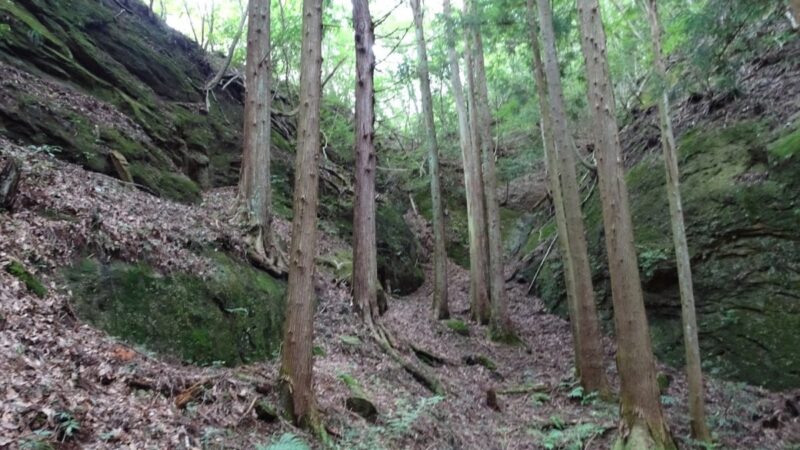
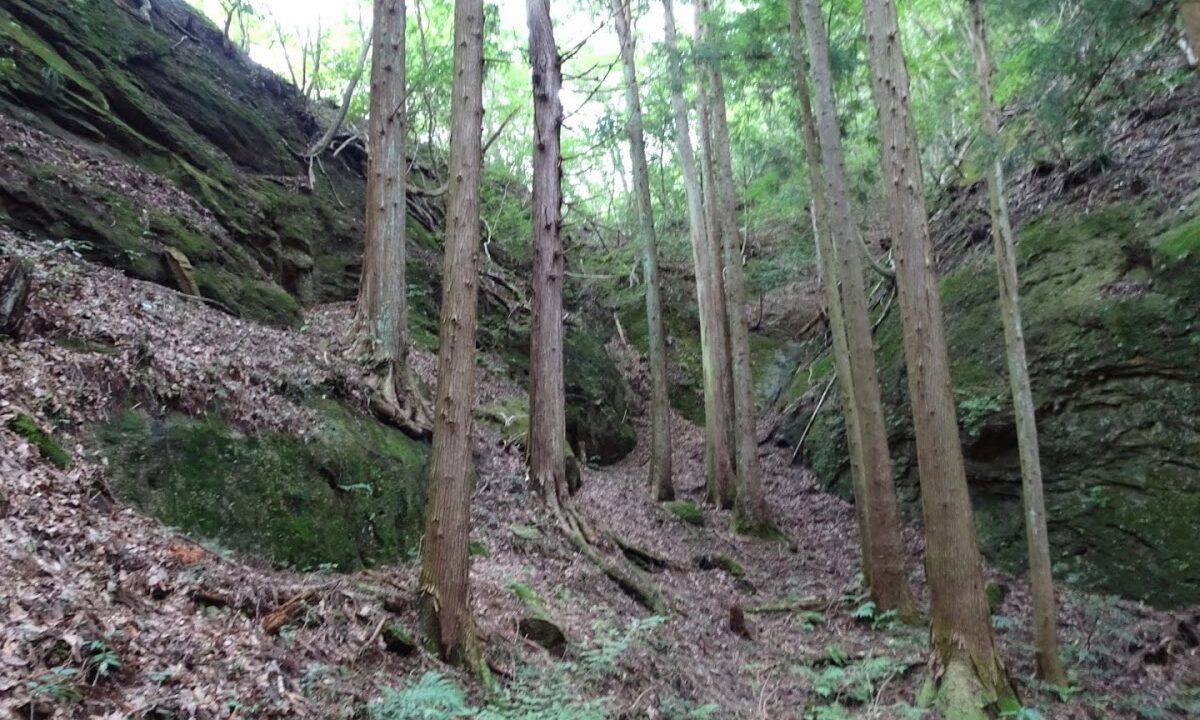
The cut-through section of Ushikubi Pass is the largest defensive line, utilizing the natural terrain. Both sides are sheer rock walls, making it extremely difficult to penetrate. It is presumed that defensive structures such as gates and fences were built at this pass during the Sengoku period.
Earthworks can be seen around the main enclosure and in some of the baileys, with a height of approximately 1-2 meters. No stone walls were used; it was built purely as an earthen castle. This is a common characteristic of mountain castles in the Chichibu region, reflecting the difficulty of obtaining stone materials in this area.
Ascent Route and Entrance
The main ascent route to the castle is thought to have been from the Kannon-in temple at the foot of the mountain towards the summit. The current hiking trail largely follows this route, requiring a climb up a steep mountain path. While no clear remains of the castle’s entrance (koguchi) exist, slight topographical alterations can be observed at the entrances to the baileys.
Highlights of the Remains
Layout of the Baileys
The greatest highlight of Hio Castle is its skillfully arranged baileys, utilizing the terrain. The layout, connecting the main bailey to the secondary bailey and then to the bailey on the western mountaintop, is a typical example of a Sengoku period mountain castle that emphasized ridge defense. Clear elevation changes mark the boundaries of each bailey, allowing visitors to experience the original layout.
The main bailey, in particular, is relatively flat and spacious, suggesting the presence of the lord’s residence and troop garrisons. Walking through the baileys, one can almost picture the lives and battle preparations of the castle’s soldiers during the Sengoku period.
Remaining Earthworks
The earthworks remaining around the main enclosure, though only 1-2 meters high, clearly show traces of earthwork. Walking along the top of the earthworks, one can appreciate their function as defensive structures and their role in clearly defining the boundaries of the enclosures. The fact that these earthworks have withstood approximately 450 years of wind and rain speaks to the high level of castle-building technology of the time.
The Impressive Moat
The moat on the north side of the main enclosure is a particularly impressive remnant among the defensive structures of Hio Castle. The deep ditch, completely cutting off the ridge, functioned as a powerful barrier to prevent enemy intrusion. Standing at the bottom of the moat, one can truly appreciate the height and steepness of the cliffs on both sides, and is amazed by the skillful castle-building techniques of the Sengoku period.
The Natural Fortress of Ushikubi Pass
Ushikubi Pass is an indispensable geographical feature when discussing Hio Castle. The sheer cliffs divide the castle grounds like a natural moat, and the structure is such that the central part of the castle cannot be reached without passing through this pass. The view from the mountain pass is spectacular, and it’s easy to imagine its function as a lookout post in those days.
Views and Location
The view from the mountaintop is another of Hio Castle’s attractions. You can see the Chichibu Basin and the surrounding mountains, truly appreciating its excellent military location. On a clear day, you can even see Mount Bukō and Mount Ryōgami in the distance, and it’s a moving thought to imagine that the castle’s soldiers during the Sengoku period saw the same view.
Access to Hio Castle
Access by Public Transportation
By Train and Bus
- Get off at Seibu Chichibu Station on the Seibu Chichibu Line or Chichibu Station on the Chichibu Railway.
- Take a Seibu Kanko Bus bound for Ogano Bus Depot or Kurio.
- Get off at the Kannon-in Entrance bus stop (approximately 40 minutes).
- Walk approximately 5 minutes from the bus stop to Kannon-in Temple, then hike approximately 40-60 minutes from Kannon-in Temple to the castle ruins.
Since bus services are limited, it is recommended to check the timetable in advance. Especially on holidays, the number of services is limited, so be sure to carefully check the round-trip times before visiting the castle.
Access by Car
Using the Kan-Etsu Expressway
- Approximately 50km from Hanazono IC via National Route 140 (Chichibu Highway), approximately 1 hour 20 minutes.
- From Ogano town center, take the prefectural road to Kannon-in Temple.
Using the Chuo Expressway
- Approximately 60km from Katsunuma IC via National Route 140 (via Karisaka Tunnel), approximately 1 hour 30 minutes.
Parking Information
You can use the parking lot for visitors to Kannon-in Temple (Washikutsuyama Kannon-in, Chichibu Pilgrimage Site No. 31). Parking is free and can accommodate about 10 regular cars. However, please be mindful of proper etiquette as this is a parking lot for temple visitors. We recommend visiting Kannon-in Temple before hiking.
The trailhead is a short walk from the parking lot, and there are signs, so you won’t get lost.
Ascent Route and Estimated Time
Standard Route (Kannon-in Course)
The most common ascent route is the one that starts from beside Kannon-in Temple.
Detailed Ascent Route
- Kannon-in Temple Parking Lot (Elevation approx. 390m)
- Pass through the Kannon-in Temple grounds to the trailhead (5 minutes)
- Climb the steep mountain path (30-40 minutes)
- Arrive at Ushikubi Pass (Elevation approx. 500m)
- From the pass to the main enclosure (10-15 minutes)
- Arrive at the main enclosure (Elevation 551m)
Estimated Time
- Ascent: 40-60 minutes
- Exploring the castle grounds: 30-60 minutes
- Descent: 30-40 minutes
- Total: Approx. 2-3 hours
Precautions for Hiking
Hiking to Hio Castle is a serious mountain climb. Please pay attention to the following points.
Equipment
- Trekking shoes or hiking boots are mandatory.
- Comfortable clothing (long sleeves and long pants recommended).
- Drinking water (at least 500ml).
- Towel, hat.
- Work gloves (useful for gripping rocks).
- Bear bell (for protection against wild animals).
Dangerous Areas
- Many sections of the trail are steep.
- Be careful of rocky areas and exposed tree roots.
- Be especially careful during and after rain, as it can be slippery.
- The rocky areas at Ushikubi Pass have unstable footing.
- Snow and ice are possible in winter.
Other Precautions
- Avoid solo climbing; climbing in groups is recommended.
- Cell phone reception is unreliable.
- Use the toilet at Kannon-in Temple (there are no toilets at the castle ruins).
- Be aware of wild animals such as bears and wild boars.
- Always take your trash with you.
Best Time to Climb
The best seasons for climbing Hio Castle are spring (April-May) and autumn (October-November). It’s best to avoid visiting in the summer due to the heat and insects. In winter, there’s a possibility of snow and ice, so it’s advisable to avoid it unless you’re an experienced hiker.
Especially during the fresh green season and the autumn foliage season, the scenery from the hiking trail is beautiful, making for a pleasant climb to the castle.
Nearby Attractions
Washikutsuyama Kannon-in Temple (Chichibu Pilgrimage Site No. 31)
Kannon-in Temple, the starting point for the climb to Hio Castle, is the 31st temple of the Chichibu Thirty-Four Kannon Pilgrimage. The Kannon Hall, built on a cliff face, is impressive and worth visiting in conjunction with the castle ruins. The view from the temple grounds is also magnificent, offering a panoramic view of the Chichibu Basin.
Hachigata Castle Ruins (Yorii Town)
Hachigata Castle, the main castle of Hio Castle, is about an hour’s drive away. Known as the residence of Hojo Ujikuni, it is a nationally designated historical site. Visiting it together with Hio Castle will give you a better understanding of the Hojo clan’s control over the Chichibu region. The Hachigata Castle History Museum is also located on the premises, offering detailed exhibits.
Ogano Town Local History Museum
This facility introduces the history and culture of Ogano Town and displays materials related to Hio Castle. Visiting before visiting the castle ruins will provide a deeper understanding. It also has a wealth of materials on the Suwabe clan and the Sengoku period history of the Chichibu region.
Mount Bukō
Mount Bukō, a symbolic landmark of Chichibu, can be seen from Hio Castle. At an elevation of 1,304m, it’s a great place for climbing and hiking. Combining a visit to Hio Castle with a tour of Chichibu’s mountain castles and mountains is highly recommended.
Chichibu Thirty-Four Kannon Pilgrimage Sites
The Chichibu pilgrimage, including Kannon-in Temple, is a representative tourist route in the Chichibu region. Combining a visit to Hio Castle with the pilgrimage site tour will allow for a more fulfilling Chichibu sightseeing experience.
Cultural Property Designation of Hio Castle
The Hio Castle ruins have been designated as a cultural property under the following designations.
- Saitama Prefecture Designated Important Historic Site (Prefectural Designation)
- Ogano Town Designated Historic Site (Town Designation)
These designations ensure the protection and preservation of the remains. When visiting the castle ruins, please be careful not to damage the remains or collapse the earthworks.
Research and Investigation of Hio Castle
Research on Hio Castle has been conducted by Saitama Prefecture and Ogano Town. In recent years, the creation of layout maps and detailed surveys of the remains have been carried out, gradually revealing the castle’s structure.
However, due to limited excavation and a small number of unearthed artifacts, many aspects of the castle’s detailed history and period of use remain unclear. It is one of the castle ruins where further research is expected.
Best Season to Visit Hio Castle
The best time to visit Hio Castle is as follows:
Spring (April-May)
- Beautiful fresh greenery and temperatures suitable for hiking
- Enjoy cherry blossoms and wildflowers
- May be crowded during Golden Week
Autumn (October-November)
- Beautiful autumn foliage, the most popular season
- Comfortable temperatures and fewer insects
- Generally stable weather
Summer (June-September)
- Not highly recommended due to heat and numerous insects
- Relatively comfortable if climbing early in the morning
- Families are often seen during summer vacation
Winter (December-March)
- Possibility of snow and ice, suitable for advanced hikers
- Clear air and superb views
- The winter landscape also has its own charm
Points for Enjoying Hio Castle
Preparation
To fully enjoy Hio Castle, preparation is essential.
- Preparation for History: Gain basic knowledge about the Nagao Kageharu Rebellion and the Hojo clan’s rule over Chichibu.
- Prepare Maps: Bring topographic maps from the Geospatial Information Authority of Japan or castle layout maps from castle-related books.
- Check the Weather: Always check the weather forecast for the day of the climb.
- Check Your Physical Fitness: This climb involves an elevation gain of over 160m, so do not push yourself if you are not confident in your physical fitness.
How to Enjoy the Site
- Observe the Remains: Carefully observe the remains such as baileys, earthworks, and moats.
- Photography: Take photos to record the remains and views (posting on social media is also fun!).
- Use Your Imagination: Stroll while imagining what the castle was like during the Sengoku period.
- Observe Nature: Enjoy the nature unique to mountain castles, such as plants and wild birds.
Keep a Record
Keeping a record of your castle visit will increase the enjoyment of looking back on it later.
- Post your visit record on castle websites such as Kojodan
- Share your impressions on blogs and social media
- Organize castle stamps (if any) and photos in an album
- Note down the date and time of visit, weather, and duration
Hio Castle and Chichibu in the Sengoku Period
To understand Hio Castle, it is important to know the historical background of the Chichibu region during the Sengoku period.
The Chichibu region was located at the western edge of Musashi Province, bordering Kai Province (Yamanashi Prefecture). Therefore, it became the front line between the two major powers, the Hojo clan of Kanto and the Takeda clan of Kai, and the stage for their power struggle.
Hojo Ujikuni controlled the Chichibu region from his base at Hachigata Castle and built several branch castles to prepare for Takeda invasions. Hio Castle was one of these important branch castles, forming a defensive line for the Chichibu region.
The Suwabe clan, as Hojo Ujikuni’s chief retainer, was entrusted with the defense of this front line. The rugged terrain of Hio Castle is believed to have functioned as a natural fortress, repelling the Takeda army’s invasion and playing a crucial role in protecting the peace of Chichibu.
Summary
Hio Castle is a valuable Sengoku period mountain castle remaining in the Chichibu region of Saitama Prefecture. The castle ruins, which served as the stage for the dramatic Sengoku period events—including the legend of Nagao Kageharu’s siege, its history as the residence of the Suwabe clan, and its battles against the Takeda clan—still stand quietly in the mountains.
The remains of the castle, such as baileys, earthworks, and moats, at the 551m-high summit, convey the ingenuity of Sengoku period castle construction techniques and terrain utilization. The climb is not easy, but the views from the summit and the impressive remains will more than reward the effort.
As part of your Chichibu sightseeing or castle tour, be sure to visit Hio Castle. It will be a wonderful experience, allowing you to feel the spirit of the Sengoku period and immerse yourself in the romance of history.
When you visit, please take sufficient precautions for your safety and be mindful of protecting the historical remains, while fully enjoying the charm of Hio Castle.