Complete Guide to Oana Castle (Sakado City, Saitama Prefecture): Unraveling the Mysteries of Honda Hidegen’s Encampment and a Medieval Castle
What is Oana Castle?
Oana Castle is a flatland castle located in Higashi-Sakado 1-chome, Sakado City, Saitama Prefecture. Currently, a portion of its remains is preserved as the “Oana Castle Ruins Plaza” within the Higashi-Sakado housing complex. Also known as “Oana-kan,” “Oana-yama-kan,” “Gotan-yama,” and “Goten-yama,” it is a castle built on a gentle river terrace.
This castle is known as the site where Honda Kyuzo Hidegen, a hatamoto (direct retainer) of the Tokugawa clan, established his encampment in the early Edo period. However, it is actually believed to have utilized the remains of a castle built during the Muromachi period. However, there are no clear historical records regarding the castle’s lord or construction period during the medieval period, making it a historical site shrouded in mystery.
History of Ōana Castle
Ōana Castle as a Medieval Castle
Many aspects of Ōana Castle remain unclear, including its exact construction date and the identity of its lord at the time. However, based on the state of the remains and the historical context of the surrounding area, it is presumed to have been a castle built during the Muromachi period.
Seven castles from the Muromachi period, known as the “Shimohiroya Castle Group,” exist in the vicinity of Sakado City, and Ōana Castle is thought to have had some connection to these. This region was a strategic point in the Kanto region, a battleground where various forces fought fiercely, and Ōana Castle may have functioned as a base for regional control.
Honda Hidegen and the Ōana Jinya (Fortified Residence)
The only clearly recorded event in the history of Ōana Castle is the establishment of a fortified residence by Honda Kyūzō Hidegen in the early Edo period. Honda Hidegen was a member of the family of Honda Tadakatsu, known as one of the Four Heavenly Kings of Tokugawa, and his uncle was Honda Sakuzemon Shigetsugu, known by the nickname “Oni Sakuzemon” (Demon Sakuzemon).
In 1590 (Tensho 18), after Toyotomi Hideyoshi’s siege of Odawara, Tokugawa Ieyasu was transferred to the Kanto region, and Honda Hidegen followed him there. At this time, Hidegen was granted 150 koku and established a fortified residence in Oana. It is believed that Hidegen repurposed the remains of an existing medieval castle to construct the residence, thus allowing Oana Castle to survive until the early Edo period.
Honda Hidegen’s residence functioned as a residence for a hatamoto (direct retainer of the shogun) and served as a governing center for the surrounding area. However, detailed historical records and the exact time of its abandonment are unclear.
Structure and Remains of Oana Castle
Castle Location
Oana Castle was built on a river terrace formed by a tributary of the Koma River. This gently sloping terrace was slightly higher than the surrounding area, making it a suitable location for a defensive base utilizing the natural terrain. Although it was a flatland castle, it is believed that the use of this slightly elevated area ensured a certain level of defensibility.
Existing Remains
Unfortunately, the remains of Oana Castle are not in good condition. Approximately half of the castle grounds were lost due to the construction of the Higashi-Sakado housing complex during the Showa period. Furthermore, the remaining portion has also been affected by housing development, and only limited remains retain their original form.
The main remains that can be confirmed at present are as follows:
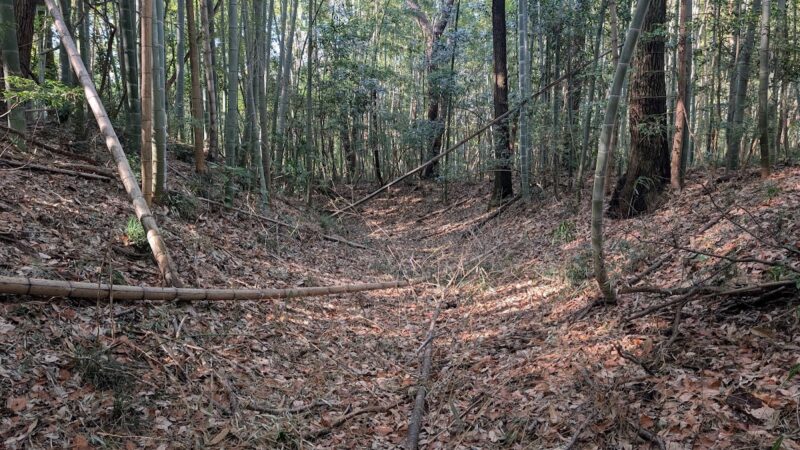
Earthworks: Slight traces of earthworks can be seen around the castle ruins plaza. Although their height and size have decreased significantly from their original state, remnants of earthworks that functioned as defensive structures for the castle can be confirmed.
Enclosures (Kuruwa): Surveys conducted before the construction of the housing complex confirmed the existence of multiple enclosures. While the clear outlines have been lost due to changes in the terrain, it can be inferred that the castle was once divided into multiple sections.
Traces of Dry Moats: Some records mention the existence of dry moats, but confirmation at the site is difficult.
Scale of the Castle Grounds
The exact extent of the castle grounds is unknown, but judging from the remaining remains and topography, it is thought to have been a relatively small castle. The fact that it was used as a samurai residence suggests that it was more of a residential area for local governance than a large military base.
Highlights of Oana Castle
Oana Castle Ruins Plaza
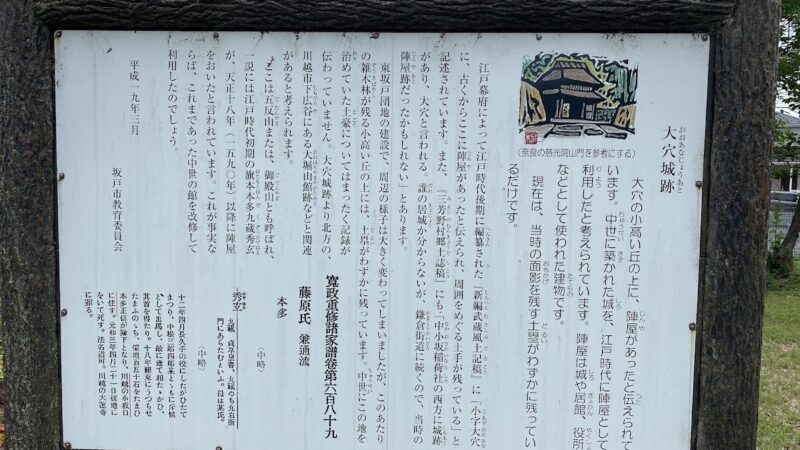
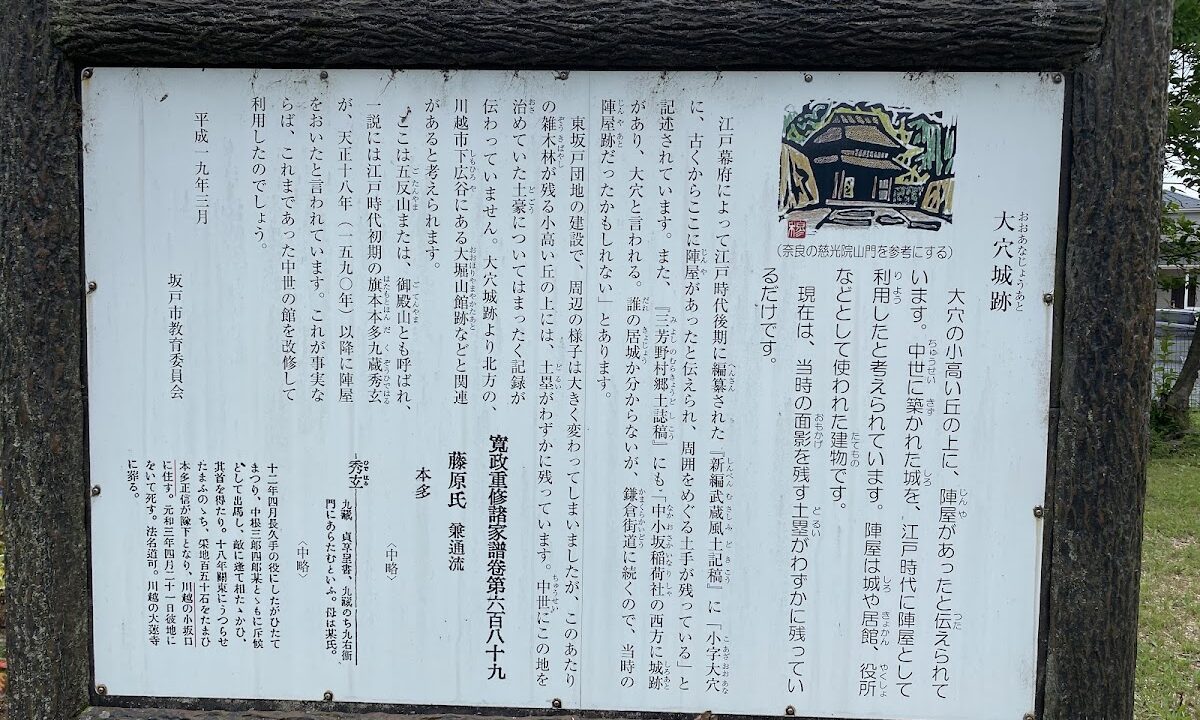
Currently, the remains of Oana Castle are maintained as the “Oana Castle Ruins Plaza” within the Higashi Sakado housing complex. Information boards are installed in the plaza, allowing visitors to learn about the castle’s history and overview. Although small in scale, it is preserved as a valuable historical site that conveys the history of the region.
The plaza also functions as a place of relaxation for the residents of the housing complex, making it an interesting place where historical value and modern living spaces coexist.
Traces of Earthworks
The traces of earthworks remaining around the castle ruins plaza are the most important highlight of Oana Castle. Although small in scale, it allows visitors to actually see the defensive facilities of a castle from the medieval to early Edo period. The arrangement and shape of the earthworks allow us to imagine the layout of the castle at the time.
Imagining the Historical Landscape
Although the Oana Castle ruins are now surrounded by housing complexes and residential areas, they were once located in a rural area with fields and farmlands. By observing the information on the signboards and the surrounding topography, we can imagine the landscape and appearance of the castle in its heyday.
Access Information
Access by Train and Bus
Nearest Station: Tobu Tojo Line “Wakaba Station”
Bus:
- Take the Sakado City Loop Bus or Tobu Bus from Wakaba Station
- Get off at the “Higashi Sakado Danchi Iriguchi” bus stop and it’s a short walk (approximately 1 minute)
While it is possible to access the site on foot from Wakaba Station, it takes about 20-25 minutes. Using the bus is more convenient.
Access by Car
Kan-Etsu Expressway:
- Approximately 15 minutes from “Tsurugashima IC”
- Approximately 10 minutes from “Sakado-Nishi Smart IC”
Since there is limited parking space around Higashi-Sakado housing complex, we recommend using public transportation.
Estimated Visiting Time
Approximately 15-20 minutes is sufficient for visiting the Oana Castle Ruins. Because the ruins are small, you can complete your visit in a short time. Combining a visit with other nearby historical sites is also a good idea.
Visitor Guide
Points to Note When Visiting
- Free Visit: The Oana Castle Ruins Plaza is always open and you can visit freely.
- Admission Fee: Free
- Facilities: Please use the public facilities within the housing complex for toilets and rest areas.
- Photography: Photography is permitted, but please be considerate of the privacy of the residents.
- Weather: Be careful as the ground may be slippery in rainy weather.
Recommended Time to Visit
Oana Castle Ruins can be visited year-round, but the following times are especially recommended:
- Spring (March-May): The weather is mild and suitable for strolling.
- Autumn (October-November): A cool and pleasant season.
- Weekday Mornings: You can visit in peace and quiet.
In summer, take precautions against the heat; in winter, take precautions against the cold.
Castle Visit Tips
Since the remains of Oana Castle are limited, learning about its historical background before visiting will allow you to enjoy it more deeply. By carefully reading the information board and observing the surrounding terrain, try to imagine what the castle looked like in its heyday.
When taking photographs, it’s a good idea to focus on recording the remaining earthworks and the information board. The contrast with the housing complex also makes for an interesting subject, highlighting the unique characteristics of the castle ruins that remain today.
Surrounding Castles and Historical Sites
Saitama Prefecture has many castle historical sites, and visiting them along with Ōana Castle will allow you to gain a deeper understanding of the history of castles in the Kanto region.
Japan’s Top 100 Castles / Continued Top 100 Castles
Kawagoe Castle (Japan’s Top 100 Castles):
- Approximately 10km from Oana Castle
- A valuable historical site with the main keep still standing
- Kawagoe-kan (Continued Top 100 Castles) is also located nearby
Hachigata Castle (Japan’s Top 100 Castles):
- Approximately 25km from Oana Castle
- A large-scale castle that flourished as an important base for the Hojo clan
- A natural fortress built at the confluence of the Arakawa and Fukasawa rivers
Oshi Castle (Continued Top 100 Castles):
- Approximately 20km from Oana Castle
- A water castle famous from “Nobou no Shiro” (The Floating Castle)
- A strong castle that withstood Ishida Mitsunari’s water siege
Sugaya-kan (Continued Top 100 Castles):
- Approximately 15km from Oana Castle
- Site of Hatakeyama Shigetada’s residence
- Earthworks and moats remain in good condition.
Sugiyama Castle (Continued Top 100 Japanese Castles):
- Approximately 8km from Oana Castle
- A technically sophisticated layout, described as a “textbook of castle construction”
- A valuable historical site where you can learn about castle construction techniques of the Sengoku period.
Other Surrounding Castles
Asaba Castle: A medieval castle located in Sakado City.
Tawame Castle: One of the castle complexes in Sakado City.
Mifukuji Jinjo: Site of a fortified encampment in Sakado City.
These castles, like Oana Castle, may have been part of the Shimohiroya castle complex or a network of medieval castles around Sakado City. Visiting them together will provide a more comprehensive understanding of the region’s history.
Historical Significance of Oana Castle
Medieval Kanto Castle Culture
Oana Castle, as one of the many medieval castles remaining in the Kanto region, is an important historical site that shows the nature of regional governance at the time. Unlike large mountain castles or hilltop castles, Ōana Castle, built as a relatively small flatland castle, is thought to have functioned as a residence for local lords and powerful families.
The Kantō region during the Muromachi period was in a complex political situation, marked by conflicts between the Kamakura Shogun and the Kantō Kanrei (deputy shogun of the Kantō region), and the establishment of the Koga Shogunate. During this time, local lords built castles and residences like this to protect their territories. Ōana Castle can be considered one such castle built within this historical context.
Tokugawa Retainers and Hatamoto Jinya (Fortified Residences)
In the early Edo period, following Tokugawa Ieyasu’s transfer to the Kantō region, many of his retainers were granted fiefs throughout the Kantō region and established jinya (fortified residences). Honda Hidegen’s Ōana Jinya is one example.
While not as large as the castles of daimyo (feudal lords), hatamoto jinya played an important role as centers of regional governance. Utilizing existing medieval castles to establish jinya was a common practice at the time, and Ōana Castle falls into this category.
Honda Hideharu’s lineage, being related to Honda Sakuzemon Shigetsugu as his uncle, held a certain status within the Tokugawa vassal group. While his stipend of 150 koku was not particularly large, the Ōana Jinya (fortified residence) functioned as a crucial element of the Tokugawa’s control over the Kanto region.
Urbanization and Historical Site Preservation
The current state of Ōana Castle symbolizes the challenges faced by many castle historical sites in Japan. The loss of more than half of the castle grounds due to urban development during the period of rapid economic growth demonstrates the difficult balance between preserving historical heritage and development.
On the other hand, the development of the remaining area as the “Ōana Castle Ruins Plaza,” with its installed information boards, is a testament to efforts to pass on the region’s history to future generations. The preservation of a historical site within a modern living space like a housing complex is an interesting example of the coexistence of past and present.
The Significance of Visiting Oana Castle
Compared to large-scale castles like Kawagoe Castle or Hachigata Castle, Oana Castle may seem less impressive in terms of the scale and state of preservation of its remains. However, this small castle site possesses its own unique value.
Firstly, it is a valuable historical site that tells the story of the region’s history from the medieval to the early modern period. The social structure and regional governance of the time were formed not only by large-scale castles but also by smaller castles like this one. Visiting Oana Castle provides an opportunity to reflect not only on the grand currents of history but also on the lives of people at the local level.
Secondly, it allows one to experience firsthand the current state of historical heritage being lost amidst urbanization. The challenges of balancing development and preservation, and how to pass on limited remains to future generations, are issues faced not only by Oana Castle but by many historical sites throughout Japan.
Thirdly, it helps in understanding the castle network within Saitama Prefecture. By starting at Oana Castle and visiting nearby castles such as Sugiyama Castle, Kawagoe Castle, and Sugaya-kan, one can gain a more comprehensive understanding of the history of castles in the Kanto region. ## Current Status and Challenges of Oana Castle Research
Historical materials concerning Oana Castle are limited, leaving many mysteries unresolved. Even basic information, such as the construction period in the medieval era, the castle lord, and the castle’s function, remains unclear. This is a challenge common to small-scale castles and fortifications in rural areas, not just Oana Castle.
Future research topics include:
- Excavation of Documentary Materials: Discovering new information about Oana Castle from local historical documents and temple/shrine records.
- Archaeological Investigation: Detailed surveying of remaining remains and, if possible, empirical research through excavation.
- Clarification of Relationships with Surrounding Castles and Fortifications: Clarification of the relationship with the Shimohiroya Castle Group and the overall picture of the regional castle network.
- Research on Honda Hidegen: Detailed investigation into its actual function as a fortified residence during the Edo period and the activities of the Honda clan.
Diligent research by local historians and researchers will be key to solving these mysteries.
Summary
Oana Castle is a small but historically significant castle site located in Sakado City, Saitama Prefecture. It possesses a unique charm as a place where the history of two eras intersects: a medieval castle believed to have been built during the Muromachi period, and its use as a military camp by Honda Hidegen in the early Edo period.
Currently, it is preserved as the “Oana Castle Ruins Plaza” within the Higashi-Sakado housing complex, where small remains such as earthworks can be seen. Although small in scale and requiring only about 15 minutes to visit, it is a valuable historical site for learning about the history of medieval castles in the Kanto region and the military camp culture of the Tokugawa retainers.
Saitama Prefecture is home to numerous famous castles, including Kawagoe Castle, Hachigata Castle, Oshi Castle, Sugaya-kan, and Sugiyama Castle, which have been selected as among Japan’s Top 100 Castles and the Continued Top 100 Castles. Visiting Oana Castle in conjunction with these castles will allow for a deeper and more multifaceted understanding of the history of castles in the Kanto region.
Although much of the Ōana Castle’s remains have been lost amidst urbanization, the surviving parts are expected to be preserved as a valuable site that conveys the region’s history to the present day. Castle enthusiasts should definitely visit this small historical site and imagine what it was like in its heyday.