Yasudo Castle (Saitama Prefecture) Complete Guide: A Thorough Explanation of the Mountain Castle and Historical Value of the Tan-to Okawara Clan
Yasudo Castle, located in Higashichichibu Village, Chichibu District, Saitama Prefecture, is a medieval mountain castle built by the Tan-to Okawara clan, one of the seven clans of Musashi Province. While Saitama Prefecture boasts other famous castles such as Hachigata Castle, Kawagoe Castle, and Oshi Castle, Yasudo Castle is a crucial historical site indispensable to understanding the region’s medieval history, attracting attention from castle researchers and history enthusiasts.
This article will comprehensively cover the charm of this mountain castle, from its historical background and structure to the remains that can be seen on-site and access methods.
History of Yasudo Castle: From the Tan-to Okawara Clan to the Ueda Clan
The Tan-to Okawara Clan and the Construction of Yasudo Castle
Yasudo Castle was built by the Okawara clan, who belonged to the Tan-to clan, one of the seven clans of Musashi Province. The Musashi Seven Clans are a collective term for samurai groups that held power in Musashi Province (present-day Saitama, Tokyo, and parts of Kanagawa prefectures) from the late Heian period to the Kamakura period.
The Tan clan was based in the Chichibu region, and the Okawara clan was a particularly powerful family within it. The upper reaches of the Tsuki River in Higashi-Chichibu Village is a strategically important area surrounded by rugged mountains, and it is believed that the Okawara clan utilized this terrain to build Yasudo Castle.
The Uesugi Zenshu Rebellion and the Decline of the Okawara Clan
The most important turning point in the history of Yasudo Castle was the “Uesugi Zenshu Rebellion,” which broke out in 1416 (Oei 23). This rebellion was a large-scale conflict that engulfed the entire Kanto region, initiated by Uesugi Ujinori (Zenshu), the Kanto Kanrei (governor of the Kanto region), against the Muromachi Shogunate.
During this rebellion, the Nakamura clan, the lords of the Tan clan, sided with the Uesugi Zen sect, and consequently declined significantly after the rebellion was suppressed. The Okawara clan also lost power as a result of their involvement in the rebellion, and Yasuto Castle fell out of their control.
Under the control of the Ueda clan, lords of Matsuyama Castle
After the decline of the Okawara clan, Yasuto Castle became part of the territory of the Ueda clan, lords of Matsuyama Castle (present-day Yoshimi-machi, Hiki-gun, Saitama Prefecture). The Ueda clan was a powerful samurai group in Musashi Province, and controlled the surrounding area from their base at Matsuyama Castle.
There is a theory that Higashichichibu Village was the Ueda clan’s ancestral home (place of origin), suggesting that the area around Yasuto Castle was an important territory for the Ueda clan. Under the control of the Ueda clan, Yasuto Castle is presumed to have functioned as a branch castle of Matsuyama Castle.
Yasudo Castle After the Sengoku Period
During the Sengoku period (Warring States period), the Kanto region became a fierce battleground where the Later Hojo clan, the Uesugi clan, and the Takeda clan vied for supremacy. Castles within Saitama Prefecture were also caught up in these power struggles.
While there are no clear records of when Yasudo Castle was abandoned, it is believed that it had already lost its function as a military facility by the end of the Sengoku period. This is likely due to its mountainous location, which made it unsuitable for large-scale battles of the Sengoku period.
Structure and Layout of Yasudo Castle
Location and Utilization of Topography as a Mountain Castle
Yasudo Castle is a typical medieval mountain castle, built on a mountaintop approximately 300 meters above sea level. Its layout, skillfully utilizing the steep terrain facing a tributary of the Tsuki River, clearly demonstrates the characteristics of a medieval castle.
The castle’s location maximized its geographical advantages in the mountainous area of Higashichichibu Village. Surrounded by deep valleys, it functioned as a natural stronghold. This type of location is a common characteristic of mountain castles in the Kanto region, and shares similarities with famous castles such as Sugiyama Castle and Hachigata Castle.
Main Enclosure Site and Remains
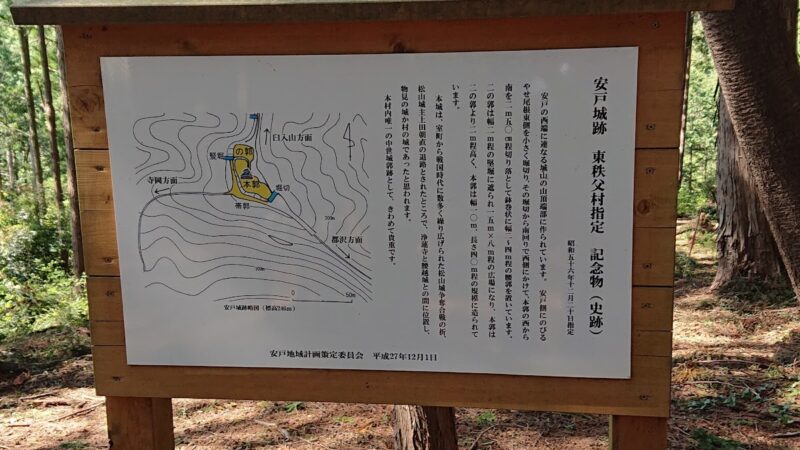
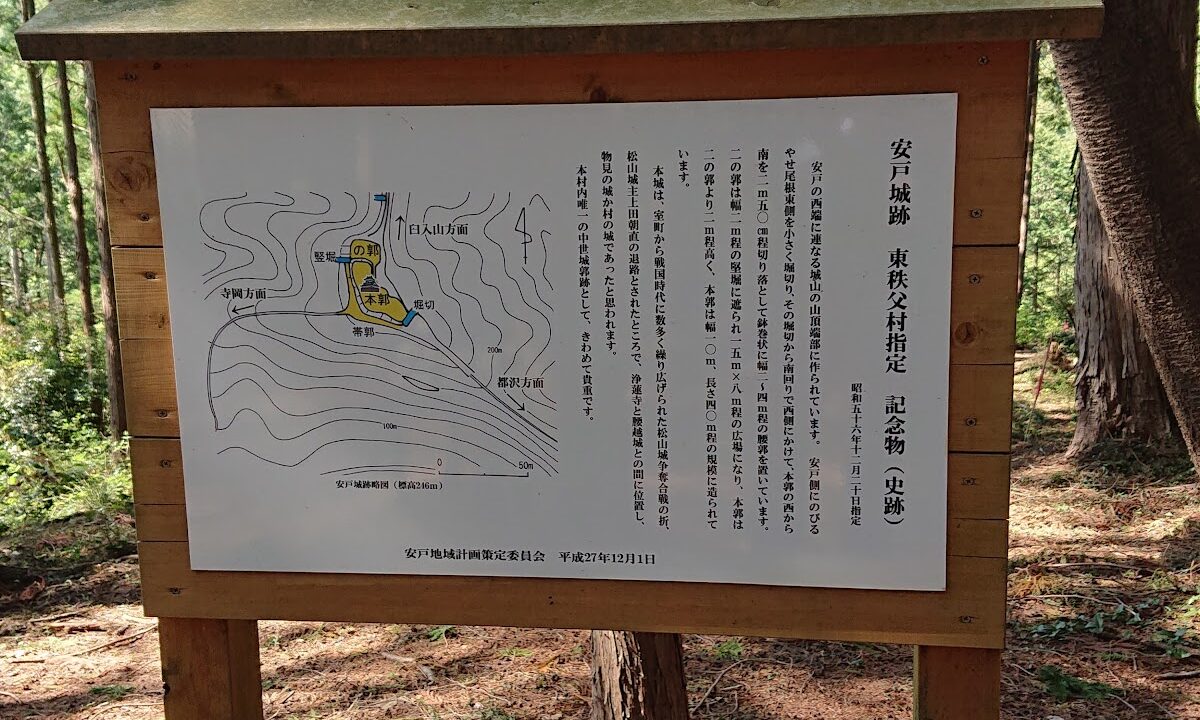
Currently, a marker post and information board have been installed at the site of the main enclosure of Yasudo Castle, allowing visitors to confirm that it is a castle site. The main enclosure site is a relatively flat area, and it is presumed that major buildings once stood there.
Remnants of a lower enclosure can also be seen around the main enclosure, suggesting that it functioned as a defensive structure. However, due to later development and natural erosion, it does not completely retain its original form.
Characteristics of the Vertical Moat
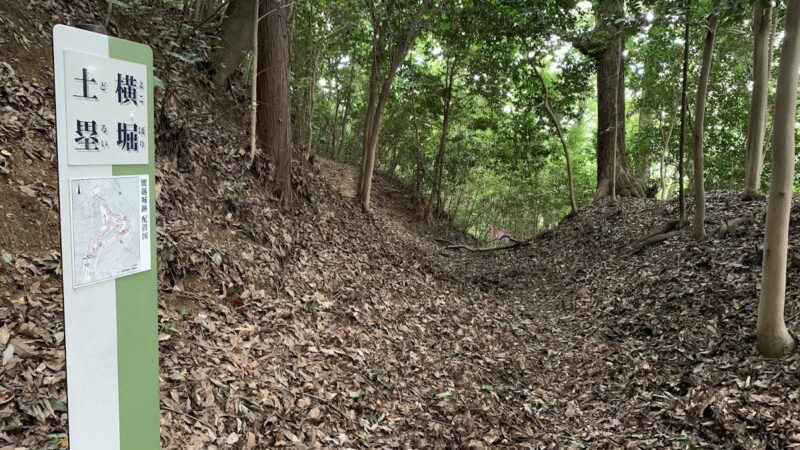
The most noteworthy remains of Yasudo Castle are the vertical moats. A vertical moat is a moat dug vertically along the slope of a mountain, serving to prevent flanking attacks by enemies and to stop enemies invading along the mountain ridge.
The vertical moats of Yasudo Castle can still be clearly seen today, making them valuable remains for understanding the defensive system of medieval mountain castles. The scale and arrangement of the vertical moats indicate that Yasudo Castle functioned not merely as a residence, but as a full-fledged military facility.
Moats and Defensive Lines
Yasudo Castle is also believed to have had moats, which played a crucial role in the defense of mountain castles. Moats are dug to cut across ridges and are one of the most effective defensive structures for preventing enemy advances.
Currently, it is difficult to grasp the full extent of the moats due to overgrown trees and accumulated sediment, but observations of the terrain suggest the possibility of multiple moats existing.
Highlights and Notes on Yasudo Castle
Observation Points for Vertical Moats
The biggest highlight when visiting Yasudo Castle is undoubtedly the vertical moats. As you descend the slope from the main keep site, you can see multiple vertical moats. By observing the depth, width, and arrangement of the vertical moats, you can understand the castle construction techniques and defensive philosophies of the time.
In particular, pay attention to how the vertical moats utilize the mountain slope. This is a valuable opportunity to experience firsthand the characteristics of a medieval mountain castle, where natural terrain and artificial defensive structures are integrated.
View from the Main Enclosure
From the main enclosure, you can enjoy a panoramic view of the mountainous area of Higashichichibu Village. The former lords of the castle must have also surveyed their territory from this spot. The landscape created by the surrounding mountains and the flow of the Tsuki River makes you realize that this was a strategically important location.
Marker Posts and Information Boards
The marker posts and information boards installed at the main enclosure are important sources of information for understanding the history of Yasudo Castle. The information boards contain basic information about the castle’s history and structure, allowing even first-time visitors to understand the overview of the castle ruins.
Surrounding Natural Environment
Yasudo Castle ruins are surrounded by the rich nature of Higashichichibu Village. The fresh greenery in spring and the autumn foliage are beautiful, allowing you to enjoy nature observation along with exploring the castle ruins. However, as it is a mountain castle, appropriate clothing and equipment are necessary when visiting.
Access and Visiting Guide
Access by Public Transportation
Access to Yasudo Castle by public transportation is somewhat inconvenient. The nearest station is Ogawamachi Station on the Tobu Tojo Line, from where you will need to take a local bus such as the Eagle Bus.
Access from Ogawamachi Station on the Tobu Tojo Line:
- Approximately 30 minutes by bus from Ogawamachi Station, get off at the “Ogawara” bus stop.
- Approximately 20-30 minutes on foot from the bus stop to the castle ruins.
Since the number of buses is limited, it is recommended to check the timetable in advance. Also, since you will be walking along a mountain path from the bus stop to the castle ruins, you should plan accordingly and allow ample time.
Access by Car
If traveling by car, the nearest interchanges are the Arashiyama-Ogawa IC or Hanazono IC on the Kan-Etsu Expressway.
Access from the Kan-Etsu Expressway:
- Approximately 30 minutes from Arashiyama-Ogawa Interchange via National Route 254
- Approximately 40 minutes from Hanazono Interchange via Prefectural Road
Higashichichibu Village is located in a mountainous area, so the roads are narrow and winding in many places. Please drive with caution. Also, there is no dedicated parking lot around the castle ruins, so if you park on the street, please be considerate of local residents.
Points to Note When Visiting
Clothing and Equipment:
- As it is a mountain castle, wear appropriate footwear for hiking (such as trekking shoes).
- Wear long sleeves and long pants (to prevent insect bites and injuries from vegetation).
- Carry drinking water.
- Use insect repellent in summer and warm clothing in winter.
Safety:
- Avoid visiting alone; visit with multiple people whenever possible.
- Refrain from visiting on days with bad weather.
- Check cell phone signal strength in advance.
- Plan your visit with ample time to descend before sunset.
Manners:
- Do not damage the ruins.
- Always take your trash with you.
- Do not trespass on private property.
- Be considerate of local residents.
Higashichichibu Village and the Village of Washi Paper
History and Culture of Higashichichibu Village
Higashichichibu Village, where Yasudo Castle is located, is the only village in Saitama Prefecture and is a region where rich nature and traditional culture remain. Located in a mountain village at the uppermost reaches of the Tsuki River, this area has long been a center of forestry and washi (Japanese paper) production.
Besides Yasuto Castle, the village contains numerous medieval ruins, including the Okawara Clan Residence and the Yamada Residence, suggesting the region held considerable political and military importance during the Middle Ages.
The Tradition of Hosokawa Paper
Higashichichibu Village is known as a production center for “Hosokawa paper.” Hosokawa paper is a handmade washi made from mulberry (kozo) fibers, and its techniques were registered as part of the UNESCO Intangible Cultural Heritage “Washi: Traditional Japanese Handmade Paper Techniques” in 2014.
When visiting Yasuto Castle, we recommend visiting the facilities developed as a washi village and experiencing traditional washi making. You can enjoy both the medieval castle ruins and the traditional crafts of Higashichichibu Village at the same time.
Nearby Castles and Tourist Spots
Major Castles in Saitama Prefecture
For castle enthusiasts visiting Yasudo Castle, we recommend also visiting other castles in Saitama Prefecture.
Hachigata Castle (Yorii Town):
One of Japan’s 100 Famous Castles, an important branch castle of the Later Hojo clan. A large-scale castle built on a cliff between the Arakawa and Fukasawa rivers, it retains magnificent earthworks and dry moats.
Kawagoe Castle (Kawagoe City):
A valuable castle with an existing Edo-period main keep. It functioned as the administrative center of the Kawagoe Domain and is now designated as a National Important Cultural Property.
Oshi Castle (Gyoda City):
A castle famous for being featured in the movie “Nobou no Shiro” (The Floating Castle). Known as a strong fortress that withstood Ishida Mitsunari’s water siege.
Sugiyama Castle (Ranzan Town):
One of Japan’s Continued 100 Famous Castles, a mountain castle with a highly refined layout, sometimes called a “textbook of castle construction.” This is an important historical site for the study of medieval castles.
Matsuyama Castle Ruins
Matsuyama Castle Ruins (Yoshimi Town), which has deep historical ties to Yasudo Castle, is another castle worth visiting. As the base of the Ueda clan and the site of a battle between the Later Hojo and Uesugi clans, it is an important castle in the history of the Kanto region during the Sengoku period.
Tourism in the Chichibu Region
Around Higashichichibu Village, there are numerous tourist spots where you can enjoy the rich nature and culture of the Chichibu region.
- Chichibu Pilgrimage: A pilgrimage to the 34 Kannon temples of Chichibu
- Mitsumine Shrine: One of the leading power spots in the Kanto region
- Nagatoro Gorge: A scenic spot famous for its river rafting and rock formations
- Chichibu Night Festival: One of Japan’s three major float festivals
Current Status and Challenges of Yasudo Castle Research
Limitations of Documentary Sources
Documentary sources concerning Yasudo Castle are extremely limited, making it difficult to unravel the detailed history of the castle. Historical materials concerning the Okawara and Ueda clans are also fragmentary, and much of the information regarding the castle’s construction date, abandonment period, and changes in its lords remains speculative.
The Need for Archaeological Investigation
No full-scale archaeological excavations have been conducted at the Yasudo Castle site. If archaeological investigations are conducted in the future, the analysis of excavated artifacts and remains may reveal more about the castle’s true nature.
In particular, the detailed structure of defensive facilities such as vertical moats and trenches, the scale and arrangement of the main keep and lower enclosures, and the presence or absence of post holes and foundation stones indicating the existence of buildings will be important themes for investigation.
Challenges of Preservation and Development
Currently, the Yasudo Castle ruins have not undergone full-scale development, and the state of preservation of the remains is not necessarily good. Some areas are difficult to see due to overgrown trees, and parts of the remains are being lost due to natural erosion.
As a valuable cultural asset of the region, appropriate preservation and development are desired, but securing budget and personnel is a challenge due to its location in a small village in a mountainous area.
Summary: The Historical Value of Yasudo Castle
Although not large in scale, Yasudo Castle is an important site for understanding the medieval history of Musashi Province, especially the history of the Musashi Seven Clans. The process of the castle lord changing from the Tan clan’s Okawara clan to the Ueda clan reflects the political changes in the Kanto region from the medieval period to the Sengoku period.
The remains of the castle, such as the vertical moats and the site of the main keep, are valuable learning materials for studying the structure of medieval mountain castles, making it a worthwhile castle site to visit for castle researchers and history enthusiasts.
Furthermore, Yasudo Castle, located in the rich natural environment of Higashichichibu Village, is a spot where you can enjoy both historical exploration and nature walks simultaneously. Along with the traditional culture of the area as a center for washi paper making, you can experience the unique charm of this region.
While Saitama Prefecture boasts more famous castles such as Hachigata Castle (one of Japan’s Top 100 Castles) and Sugiyama Castle (one of the Continued Top 100 Castles), smaller, local mountain castles like Yasudo Castle also possess their own unique history and value. By visiting these locally rooted castle sites, not just the famous ones, you can truly appreciate the diversity and depth of Japanese castle culture.
When visiting castle sites, please be sure to respectfully preserve the remains, be considerate of local residents, and enjoy your visit safely. We hope that Yasudo Castle will be a valuable experience for you, allowing you to feel the history of medieval Musashi Province.