Kumakura Castle (Saitama Prefecture) Complete Guide | Nagao Kageharu’s Mountain Castle Remains and Everything You Need to Know About Visiting
What is Kumakura Castle?
Kumakura Castle is a Sengoku period mountain castle built on Shiroyama (elevation 648m) in Arakawa Hino, Chichibu City, Saitama Prefecture. Also known as Hino Castle or Shiroyama, it functioned as an important military base in Chichibu County, Musashi Province.
The castle is located on a ridge extending north from Kumakura Mountain (elevation 1,426.5m), and with a relative height of over 300m from the foot of the mountain, it is a full-fledged mountain castle that makes maximum use of its natural fortifications. Currently designated as a Saitama Prefecture Selected Important Historical Site, it is a valuable historical site that preserves the remains of a Sengoku period mountain castle in excellent condition.
Basic Information on Kumakura Castle
- Location: Arakawa Hino, Chichibu City, Saitama Prefecture (formerly Hino Village, Chichibu District, Musashi Province)
- Other Names: Hino Castle, Shiroyama, Shinken Castle
- Castle Structure: Mountain Castle
- Builder: Nagao Kageharu
- Year of Construction: Around Bunmei 8 (1476)
- Main Lords: Nagao Kageharu, Nagao Clan
- Elevation: 648m (approximately 300m above the foot of the mountain)
- Remains: Enclosures, earthworks, moats, horizontal moats (dry moats), vertical moats
- Designated Cultural Property: Saitama Prefecture Selected Important Historic Site (Kumakura Castle Ruins)
History of Kumakura Castle
The Nagao Kageharu Rebellion and the Background of Kumakura Castle’s Construction
Kumakura Castle is believed to have been built in connection with the Nagao Kageharu Rebellion, which broke out in 1476 (Bunmei 8). This rebellion was a significant political turning point in the Kanto region during the late Muromachi period.
Nagao Kageharu was from the prestigious Shirai Nagao clan, which served as the chief retainer (steward) of the Yamanouchi Uesugi clan. However, after the death of his father, Nagao Kagenobu, he became dissatisfied when the chief retainer position was inherited not by Kageharu but by a relative, Nagao Kagetada (of the Soja Nagao clan), and rebelled against his lord, the Yamanouchi Uesugi clan.
Kumakura Castle as a Strategic Point
In launching his rebellion, Kageharu needed to secure bases throughout the Kanto region. Kumakura Castle, leveraging its geographical characteristics in the Chichibu region, held the following strategic significance:
- Mountain Fortress: A defensive base utilizing the rugged terrain of Chichibu
- Securing Supply Routes: A communication route to Kai Province (present-day Yamanashi Prefecture)
- Containment of the Kanto Plain: A forward base maintaining influence over the plains
Kageharu used Kumakura Castle, as well as Hachigata Castle (Yorii-machi, Osato-gun, Saitama Prefecture), and other bases to wage fierce battles against the Yamanouchi Uesugi clan and Ota Dokan.
The Course of the Nagao Kageharu Rebellion
The Kageharu Rebellion, which began in 1476, initially saw Kageharu’s side gaining the upper hand. Kageharu allied himself with Ashikaga Shigeuji, the Koga Shogun, and expanded his power by gaining the support of local lords throughout the Kanto region.
However, through the skillful military maneuvers of Ota Dokan, a senior retainer of the Yamanouchi Uesugi clan, Kageharu’s strongholds were gradually captured. In particular, Dokan, using Edo Castle as his base, successively captured castles belonging to Kageharu’s faction.
While there are no clear records of when and how Kumakura Castle fell, considering that Hachigata Castle, Kageharu’s main stronghold, was captured around 1478, it is highly likely that Kumakura Castle also lost its function around this time.
The Aftermath of Kumakura Castle
After the end of Nagao Kageharu’s rebellion, historical records are scarce, and details about how Kumakura Castle was used are unknown. While it may have been temporarily used by local powerful families throughout the Sengoku period, it is believed to have lost its role as a major military base.
From the Edo period onward, it became a ruined castle, and although it was recognized locally as “Shiroyama” (Castle Mountain), it gradually became overgrown with forest. In recent years, advancements in castle research have led to a re-evaluation of its historical value, resulting in its designation as a Saitama Prefecture Important Historic Site for protection.
Layout and Structure of Kumakura Castle
Characteristics of the Overall Structure
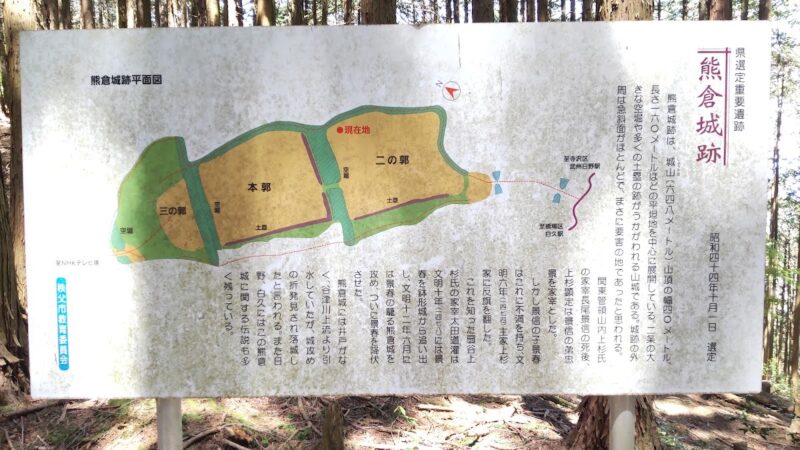
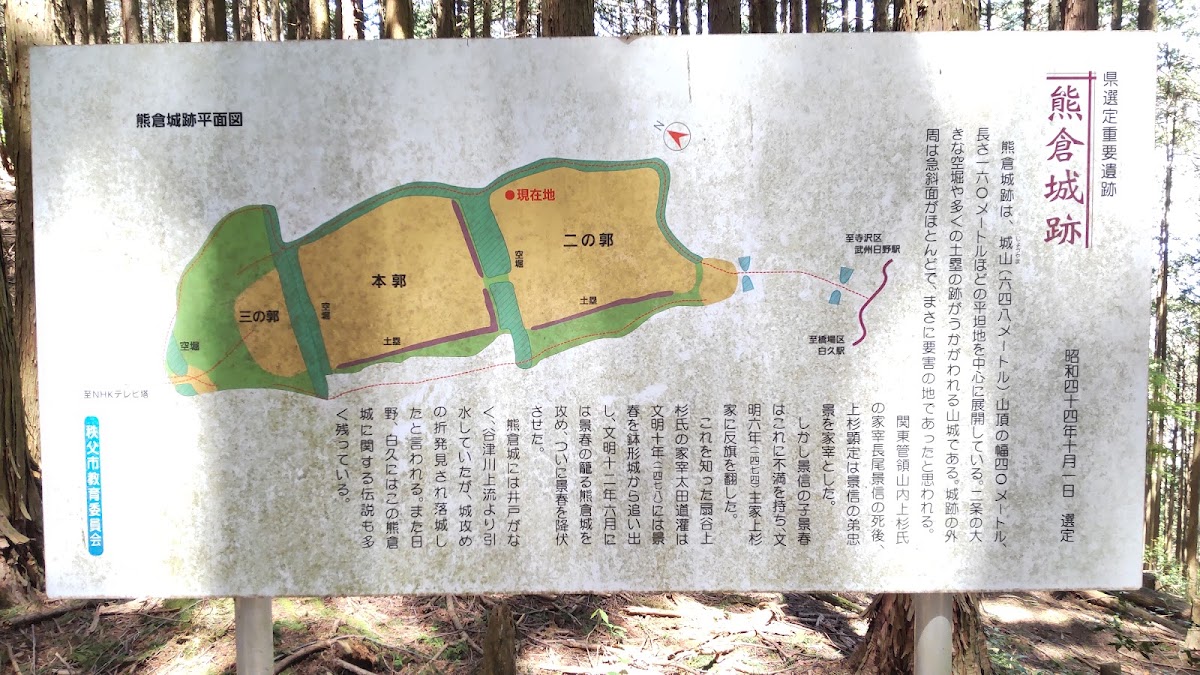
Kumakura Castle is a multi-bailey mountain castle built on a ridge extending north from Mount Kumakura. Centered around the main bailey, multiple baileys are arranged along the ridge, with defenses reinforced by trenches and vertical moats.
The castle’s most distinctive feature is its relatively large bailey area for a mountain castle. This indicates a design intended to accommodate a certain size of army, suggesting it functioned not merely as a lookout post or emergency shelter, but as a full-fledged military base.
Main Bailey (Honmaru)
Located at the summit of the castle mountain, the main bailey forms the core of Kumakura Castle. It has a relatively flat surface, and traces of earthworks can be seen around it. From the main bailey, one can see a panoramic view of the Chichibu Basin, suggesting it served a monitoring and command function.
The main enclosure is of medium size for a mountain castle, and it is presumed to have housed the lord’s residence and command post. Even today, the outline of the flat area can be confirmed by observing the ground surface.
Arrangement of the Enclosures
Several enclosures are arranged in a stepped pattern around the main enclosure. These enclosures are thought to have had the following functions:
- Soldier garrison space: A place to station soldiers responsible for defense
- Supply storage: Storage of supplies such as weapons and food
- Reserve defense line: A defensive position to delay attacks on the main enclosure
The enclosures are separated by steep slopes (artificially constructed slopes), a design intended to make it difficult for attackers to advance.
Moats
The moats are particularly important defensive features of Kumakura Castle. Moats are dry moats dug to cut across the ridge, serving to prevent enemy incursions.
Multiple dry moats have been identified at Kumakura Castle, and the moat behind the main enclosure (south side) is particularly large and clearly preserved. This moat functioned as a defensive line against attacks from the direction of Mount Kumakura.
The depth of the moats varies depending on the location, but in some places it reaches several meters, demonstrating the advanced castle-building techniques of the time.
Vertical and Horizontal Moats
Vertical moats are positioned on the slopes. Vertical moats are dry moats dug vertically into the slope, effectively preventing enemy soldiers from climbing the slope and restricting their movement laterally.
Horizontal moats (dry moats) have also been identified in some areas, positioned around the perimeter of the enclosures. These moats functioned not only as physical obstacles but also as positions from which defending soldiers could conceal themselves and launch attacks.
Earthworks
Earthworks were constructed along the edges of the enclosures. Earthen ramparts are defensive structures built with earth, serving to protect against enemy arrows and stones, while also obscuring the view of the castle from the outside.
Although the earthen ramparts of Kumakura Castle have not retained their original form due to years of weathering, they can still be observed as part of the terrain’s undulations.
Access Route
The exact location of the access route (main road) to the castle is unclear, but it is highly likely that it was a different route from the current hiking trail. It is presumed that the access route was intentionally winding and included checkpoints for defensive purposes.
Highlights of Kumakura Castle (Castle Notes)
Well-Preserved Moat Remains
The biggest highlight when visiting Kumakura Castle is the clearly preserved moats. In particular, the large moat behind the main enclosure is a valuable relic that allows you to experience the defensive system of a mountain castle from the Sengoku period. You can observe the depth and width of the moat, the angle of the cliffs, and other aspects of the castle construction techniques of the time up close.
Spacious Enclosures
One of the distinguishing features of Kumakura Castle, despite being a mountain castle, is its relatively large enclosures. The flat areas of each enclosure, including the main enclosure, suggest that Nagao Kageharu intended to station a considerable army there.
Views
From the summit of the castle mountain (near the main enclosure), you can enjoy views of the Chichibu Basin. On a clear day, you can see the surrounding mountains and the city, giving you a real sense of the castle’s strategic importance. Perhaps Nagao Kageharu once gazed upon the same view from this spot, formulating his strategies.
Harmony with Nature
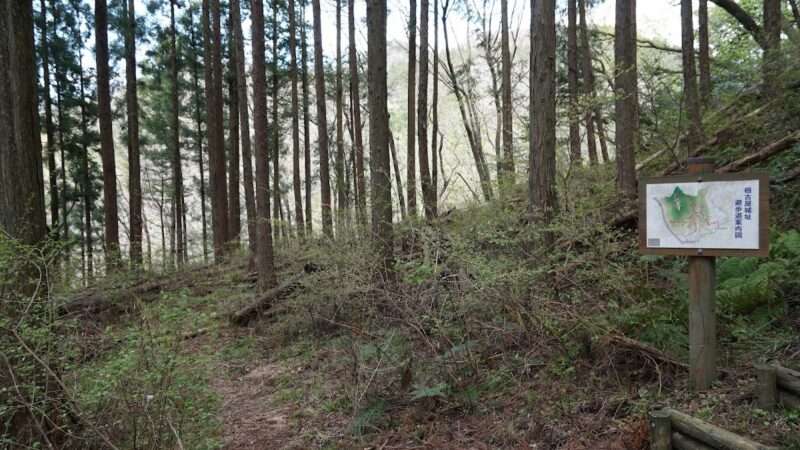
The current Kumakura Castle ruins are covered in forest, creating a beautiful landscape where nature and the ruins harmonize. You can also enjoy the changing vegetation throughout the seasons, and especially during the fresh green season and the autumn foliage season, you can enjoy historical walks and hiking simultaneously.
Value of the Saitama Prefecture-Designated Important Historic Site
The Kumakura Castle Ruins, designated as an Important Historic Site by Saitama Prefecture, are of high academic value as a mountain castle ruin from the Sengoku period and are an important cultural property that conveys the history of the region. While information boards are limited, this only adds to the enjoyment of imagining its former appearance.
Access Information
Access by Public Transportation
Using the Chichibu Railway:
- Get off at “Shiraku Station” on the Chichibu Railway
- Approximately 60 minutes or more on foot from the station to the castle entrance
- Approximately 90 to 120 minutes on foot from the station to the summit of the castle mountain
Access by public transportation takes time, so plan accordingly, allowing ample time and physical stamina.
Access by Private Car
From the Kan-Etsu Expressway:
- From Hanazono IC, take National Route 140 (towards Chichibu)
- Via Chichibu city center towards Arakawa Hino
- Estimated time: Approximately 60 minutes from Hanazono IC
To the Castle Entrance:
- There is some parking space near the Shiroyama trailhead (approximately 2-3 cars)
- The forest road may be closed depending on its condition, so prior confirmation is recommended.
- Car navigation setting: Search for “Chichibu City Arakawa Hino” and follow the local signs.
Parking Information
There is limited parking space near the Shiroyama trailhead. While there are a few spaces, you will be parking on the shoulder of the road, so please be careful not to obstruct other vehicles.
Parking spaces may be full on weekends and during peak climbing season, so early arrival is recommended. Also, many hikers visit this location in conjunction with climbing Kumakura-yama, so please be considerate of others.
Ascent Route
From the Shiroyama Trailhead:
- From the trailhead to the summit of Shiroyama (main enclosure): Approximately 30-40 minutes on foot
- The trail is well-maintained, but hiking boots or trekking shoes are recommended as it is a mountain trail
- A reasonable level of physical fitness is required as you will be climbing approximately 300m in elevation.
Traverse from Kumakurayama:
- There is also a route that descends to Shiroyama via Kumakurayama from the Kumakurayama trailhead
- This route is a serious mountain climb, so sufficient equipment and experience are necessary.
Precautions for Visiting
Clothing and Equipment
- Hiking boots or trekking shoes: Non-slip soles are recommended
- Long-sleeved shirt and long pants: To prevent insect bites and cuts from branches
- Hat: To protect your head from the sun and branches
- Gloves: Useful for gripping rocks and trees
- Drinking water: Bring a sufficient amount (especially in summer)
- Map and Compass: Essential for avoiding getting lost
Seasonal Precautions
Spring (March-May):
- While the fresh greenery is beautiful, be aware of remaining snow and ice.
- Those with hay fever should take precautions.
Summer (June-August):
- Insect repellent is essential due to the abundance of insects.
- Stay well-hydrated to prevent heatstroke.
- Take early action as thunderstorms are possible in the afternoon.
Autumn (September-November):
- The autumn foliage is beautiful, making it the best season to visit.
- Sunset is earlier, so manage your time carefully.
Winter (December-February):
- Hiking trails may become dangerous due to snow and ice.
- It is best to avoid winter hiking if you have no experience.
Safety Precautions
- Avoid solo hiking: Visit in groups if possible.
- Check the weather: Check the weather forecast in advance.
- Cell phone signal: Please be aware that there may be areas in the mountains where cell phone signals do not reach.
- Wild animals: Be aware of the possibility of bears and wild boars appearing, and make noise with bells or other means.
- Protection of historical remains: Please take care not to damage the earthworks or trenches.
Forest road closure information
The forest road leading to the castle entrance may be closed due to typhoons, heavy rain, landslides, etc. We recommend checking the latest information with the Chichibu City Hall or the local tourism association before visiting.
Nearby Tourist Attractions
Nearby Castles
Hachigata Castle (Yorii-machi, Osato-gun, Saitama Prefecture):
- One of the castles used as a base by Nagao Kageharu
- A nationally designated historical site, currently undergoing restoration and maintenance
- Approximately 60 minutes by car from Kumakura Castle
Sugiyama Castle (Ranzan-machi, Hiki-gun, Saitama Prefecture):
- A technically sophisticated mountain castle, often referred to as a “textbook example of castle construction”
- A nationally designated historical site
- Approximately 70 minutes by car from Kumakura Castle
Sugaya-kan (Ranzan-machi, Hiki-gun, Saitama Prefecture):
- Site of Hatakeyama Shigetada’s residence
- A nationally designated historical site, adjacent to the Saitama Prefectural Ranzan Historical Site Museum
- Approximately 70 minutes by car from Kumakura Castle
Chichibu Tourist Attractions
Chichibu Shrine:
- One of the three major shrines of Chichibu, the main shrine of the Chichibu region
- A magnificent shrine rebuilt by Tokugawa Ieyasu
- Approximately 30 minutes by car from Kumakura Castle
Mitsumine Shrine:
- One of the leading power spots in the Kanto region, situated on a mountaintop at an altitude of 1,100m
- Approximately 50 minutes by car from Kumakura Castle
Chichibu Pilgrimage:
- The Chichibu Thirty-Four Kannon Pilgrimage is one of the 100 Kannon Pilgrimages in Japan
- Enjoy historical temple architecture at each pilgrimage site
Nagatoro Gorge:
- A nationally designated scenic spot and natural monument, the rock formations
- River rafting is popular
- Approximately 40 minutes by car from Kumakura Castle
Hot Spring Facilities
Chichibu Onsen:
- Several day-trip hot spring facilities are located in the city center
- Ideal for relaxing after climbing the castle
Bukō Onsen:
- A hot spring facility at the foot of Mt. Bukō
- Approximately 40 minutes by car from Kumakura Castle
Learn more about Kumakura Castle and Nagao Kageharu
The Figure of Nagao Kageharu
Nagao Kageharu was a samurai warrior of the late Muromachi period, from the Shirai Nagao clan. His father, Nagao Kagenobu, wielded great power as the chief retainer of the Yamanouchi Uesugi clan. However, after Kagenobu’s death, the position of chief retainer was not inherited by Kageharu, which directly led to the rebellion.
Kageharu’s rebellion was not merely driven by personal vendetta; against the backdrop of the complex political situation in the Kanto region at the time, he allied himself with Ashikaga Shigeuji, the Koga Shogun, to oppose the Yamanouchi Uesugi clan. This rebellion was suppressed by the outstanding warrior Ota Dokan, but it marked a significant shift in the political landscape of Kanto.
The Struggle with Ota Dokan
In the Nagao Kageharu Rebellion, Ota Dokan was Kageharu’s greatest rival. Based in Edo Castle, Dokan, with his superior military talent and strategic vision, successively captured castles belonging to Kageharu’s side.
The conflict between the two was not merely a clash of arms, but also a battle of wits, utilizing stratagems and diplomacy. Although the battle ultimately ended in Dokan’s victory, Kageharu was a powerful warrior who, at one point, controlled a wide area of the Kanto region.
The Role of Mountain Castles in the Sengoku Period
Mountain castles like Kumakura Castle were important military facilities during the Sengoku period. They functioned as bases for governing territories in peacetime and as defensive strongholds in wartime.
The location of mountain castles was selected considering the following factors:
- Defensiveness: Terrain that is difficult to attack and easy to defend
- Visibility: A panoramic view of the surrounding area
- Supply Routes: Access to water sources and food supplies
- Transportational Hub: Monitoring of major roads and rivers
Kumakura Castle was built in an excellent location that met these conditions.
Sample Itinerary for Visiting Kumakura Castle
Half-Day Course (Shiroyama Mountain Only)
Duration: Approximately 3-4 hours
- 09:00 Arrive at the castle entrance, prepare
- 09:15 Begin ascent
- 09:45 Arrive at the summit of Shiroyama Mountain (main enclosure), view the ruins
- 10:30 View surrounding enclosures and moats
- 11:00 Begin descent
- 11:30 Return to the castle entrance
- 12:00 Lunch in Chichibu city, hot springs, etc.
Full-Day Course (Kumakura Mountain Traverse)
Duration: Approximately 6-8 hours
- 08:00 Depart from Kumakura Mountain trailhead
- 10:30 Arrive at the summit of Kumakura Mountain
- 11:00 Begin traverse towards Shiroyama Mountain (Kumakura Castle)
- 12:00 Arrived at Shiroyama, lunch and sightseeing of the ruins
- 13:30 Start of descent
- 15:00 Descent completed
- 15:30 Relax in the hot springs
This course is a serious mountain climb, so sufficient experience and equipment are necessary.
Research and Preservation of Kumakura Castle
Academic Value
Kumakura Castle, as a mountain castle from the early Sengoku period, is a valuable resource for studying the castle construction techniques and tactics of the time. Its historical context is particularly important as a castle associated with a specific individual, Nagao Kageharu.
Recent castle research has progressed with the creation of layout maps and surveying, and the structure of Kumakura Castle is being elucidated in more detail.
Preservation Challenges
Preserving the remains of the mountain castle presents the following challenges:
- Natural Erosion: Collapse of earthworks and moats due to wind and rain
- Vegetation Overgrowth: Destruction of remains by tree roots
- Human Damage: Trampling on remains due to inappropriate entry
- Wildlife Damage: Digging up by wild animals, etc.
To address these challenges, local governments, researchers, and volunteers are cooperating in preservation activities.
Request to Visitors
When visiting Kumakura Castle, please cooperate with the following:
- Do not damage the remains: Do not climb on or dig in the earthworks or moats
- Take your trash with you: To protect the natural environment and the ruins
- Walk on designated routes: To protect the remains, do not trespass unnecessarily
- No Open Fires: To prevent forest fires
The consideration of each of us will help pass on this valuable historical heritage to future generations.
Summary
Kumakura Castle (Chichibu City, Saitama Prefecture) is a historical site of high historical value, as it is a mountain castle associated with the Nagao Kageharu Rebellion, a significant historical event of the Sengoku period. The remains of the castle, including baileys, moats, and earthworks, located on a 648m-high mountain, convey the castle-building techniques and strategies of the time.
While access requires a certain level of physical fitness and preparation, it is a valuable place where you can feel the spirit of the Sengoku period amidst the rich nature of Chichibu. The surrounding area also boasts many related historical sites such as Hachigata Castle and other Chichibu tourist attractions, making it an area where you can fully enjoy history and nature.
It is a recommended spot not only for castle enthusiasts but also for those interested in history and those who enjoy hiking. When visiting, please be mindful of safety and cooperate in protecting the remains while experiencing the charm of Kumakura Castle.
Kumakura Castle ruins, protected as a Saitama Prefecture designated important historical site, are our precious historical heritage. In order to pass on this history to future generations, it is important that each individual visits with an awareness of cultural property preservation.