Complete Guide to Kojiro Castle (Tsurukame Castle) | A Thorough Explanation of its History and Highlights in Unzen City, Nagasaki Prefecture
What is Kojiro Castle? | A Medieval Mountain Castle Remaining in Unzen City, Nagasaki Prefecture
Kojiro Castle (Kojiro-jo) is a flatland castle located in Kojiro, Kunimi-cho, Unzen City, Nagasaki Prefecture, that existed from the medieval period to the early modern period. Also known as Tsurukame Castle, it was built on a small hill approximately 21 meters above sea level and 16 meters above ground level.
It began as the residence of the Kojiro clan and later became the residence of the Kojiro Nabeshima family, a branch of the Saga Domain, making it a historically important castle. Currently, parts of the castle ruins remain, and the surrounding area, Kojiro-koji, designated as a National Important Preservation District for Groups of Traditional Buildings, spreads out, conveying the atmosphere of the samurai town of yesteryear.
Basic Information on Kamishiro Castle
- Location: Kamishiro, Kunimi-cho, Unzen City, Nagasaki Prefecture (Shirokami)
- Alternate Name: Tsurukame Castle
- Castle Structure: Hilltop Castle
- Elevation: 21 meters
- Relative Height: 16 meters
- Construction Period: Medieval period (details unknown)
- Builder: Kamishiro clan
- Main Lords: Kamishiro clan, Kamishiro Nabeshima clan
- Year of Abandonment: 1637 (after the Shimabara Rebellion)
- Remains: Enclosures, earthworks, watchtower bases, gate, dry moats
- Designated Cultural Property: None (however, the surrounding Kamishiro-koji area is a designated Important Preservation District for Groups of Traditional Buildings)
History of Kamishiro Castle | From the Kamishiro Clan to the Nabeshima Clan
The Era of the Kamishiro Clan
The exact construction date of Kamishiro Castle is unclear, but it is believed to have been built by the Kamishiro clan, who ruled the area as local administrators during the medieval period. The Kamishiro clan were local lords based in Kamishiro, Takaki District, Hizen Province, and held considerable power as vassals of the Arima clan.
The Kamishiro clan ruled this area for generations, using Kamishiro Castle as their residence. However, the turmoil of the Sengoku period drastically altered the balance of power, first with the Ryuzoji clan, and later with Toyotomi Hideyoshi’s conquest of Kyushu.
The Rule of the Nabeshima Clan and the Establishment of a Fortified Residence
After the Battle of Sekigahara, a branch of the Nabeshima clan, who became the lords of the Saga Domain, was granted the Kamishiro territory. In 1607 (Keicho 12), Nabeshima Shigemori, the second son of Nabeshima Naoshige, was granted the Kamishiro territory of 20,000 koku, establishing the Kamishiro Nabeshima family.
In the late 17th century, during the time of Nabeshima Takashinari, the fourth head of the Kōdai Nabeshima family, a samurai residential area was developed east of Kōdai Castle, and a fortified residence (jinya) was built in its northwestern corner. This is the origin of the present-day Kōdai-kōji.
The Shimabara Rebellion and the Abandonment of the Castle
The Shimabara Rebellion, which broke out in 1637 (Kanei 14), had a significant impact on the history of Kōdai Castle. After the rebellion was suppressed, it is believed that Kōdai Castle was abandoned due to the shogunate’s strict enforcement of the “One Castle Per Province” decree. Subsequently, the Kōdai Nabeshima family continued to rule the Kōdai territory from their fortified residence until the Meiji Restoration.
Modern Era
With the abolition of the feudal domains and establishment of prefectures in 1871 (Meiji 4), the Kōdai territory ceased to exist, and the rule of the Kōdai Nabeshima family ended. Since then, Kōdai-kōji has been maintained as a quiet residential area, preserving the landscape of a samurai town from the early modern period to this day.
Structure and Layout of Kamishiro Castle
Castle Layout
Although small in scale, Kamishiro Castle retains many characteristics of a flatland castle from the medieval to early modern period. It features a main enclosure at the top of a hill, surrounded by multiple baileys.
Major Remains:
- Main Enclosure: The central part of the castle, located at the highest point.
- Baileys: Multiple flat areas arranged in a stepped fashion around the main enclosure.
- Earthworks: Defensive structures built on the edges of the baileys.
- Watchtower Base: A raised area where a watchtower is thought to have stood.
- Gate Entrance: The remains of a fortified gate serving as an entrance to the castle.
- Dry Moat: A moat used to demarcate the baileys and prevent enemy intrusion.
Defensive Features
As a flatland castle, Kamishiro Castle is characterized by its defensive design that skillfully utilizes the natural terrain. Despite being a low hill with a relative elevation of only 16 meters, the castle’s defenses were enhanced by a dry moat surrounding it and the presence of a fortified entrance.
The earthworks are not stone walls but rather mounds of earth, strongly retaining the characteristics of medieval castles. This is thought to be because Kōdai Castle was abandoned before it could be remodeled into a full-fledged early modern castle.
Highlights of Kōdai Castle | Remains that can be seen on site
Enclosures and Earthworks
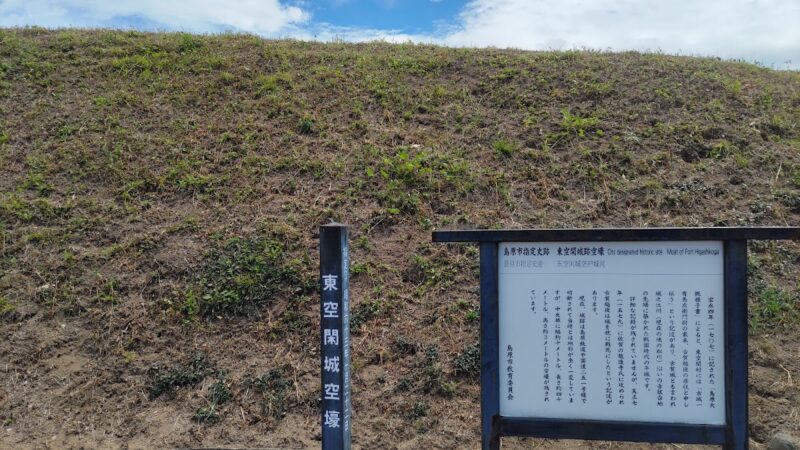
Upon visiting the Kōdai Castle ruins, the first thing that catches the eye are the terraced enclosures. Clearly defined flat areas remain within the mixed forest, giving a sense of the castle’s former scale. Partially remaining earthworks can be seen along the edges of the enclosures, with mounds of earth approximately 1-2 meters high.
Dry Moats
Traces of dry moats remain around the castle ruins. Although some parts are buried, they can be clearly seen as depressions in the terrain, indicating their role in demarcating the enclosures.
Remains of a Watchtower Base
In one corner of the main enclosure, there is a raised area believed to be the base of a watchtower. From here, one could overlook the surrounding terrain, suggesting it served as a lookout post.
Entrance Gate
The remains of the entrance gate (koguchi) to the castle are also present. This passage, created by cutting into the earthen rampart, demonstrates a fortified defensive structure.
View
From the castle ruins, you can enjoy views of the Ariake Sea and the Shimabara Peninsula. Although the elevation is low, its location overlooking the surrounding plains highlights its strategic military importance.
Jindai-koji | Important Preservation District for Groups of Traditional Buildings
Overview of Jindai-koji
When visiting Jindai Castle, be sure to also explore the adjacent Jindai-koji. Jindai-koji is a samurai town formed around the Jindai Nabeshima family’s residence, and was designated a National Important Preservation District for Groups of Traditional Buildings on July 8, 2015.
The preservation area covers approximately 11.3 hectares and beautifully preserves the landscape of a samurai town from the Edo period to the modern era. Stone walls, hedges, and waterways convey the appearance of the past, creating a quiet and peaceful atmosphere.
Kunimi Jindai-koji Historical and Cultural Park Nabeshima Residence
The central facility of Jindai-koji is the Kunimi Jindai-koji Historical and Cultural Park Nabeshima Residence. This residence, built on the site of the Jindai Nabeshima family’s encampment, is a valuable building exhibiting characteristics of modern Japanese-style architecture.
The residence is open to the public, allowing visitors to see the living spaces of a samurai residence. The garden is also beautifully maintained, offering enjoyment of the scenery throughout the seasons.
Highlights of the Nabeshima Residence:
- The main building is a modern Japanese-style building.
- A beautiful Japanese garden.
- Exhibits showcasing the life of a samurai family.
- Seasonal events and special exhibitions.
Samurai Residence Landscape
Walking along Jindai-koji Street, you’ll encounter a landscape of samurai residences surrounded by stone walls. A distinctive feature is the hedges planted on top of the stone walls, which continue along the street, creating a unique atmosphere.
The roads are straight and well-maintained, indicating that this was a planned samurai town. Waterways are also maintained, suggesting a history of their use as a source of water for daily life.
Access Information | How to Get to Kōdai Castle
Access by Public Transportation
Using the Shimabara Railway:
- Get off at Kōdai Station on the Shimabara Railway, approximately 10 minutes on foot.
- From Kōdai Station, proceed to the Kōdai Castle Ruins via the Kōdai-koji Traditional Buildings Preservation District.
Access from Nagasaki Airport:
- Approximately 30 minutes by car from Nagasaki Airport.
- If using a bus, transfer to the Shimabara Railway via Isahaya Station.
Access by Car
From Nagasaki City:
- Approximately 30 minutes via National Route 57 from Isahaya IC on the Nagasaki Expressway.
From Kumamoto:
- Take a ferry from Shimabara Port to Kumamoto Port (approximately 30 minutes).
- From Kumamoto Port, proceed via National Route 57.
From Fukuoka:
- Approximately 1 hour 30 minutes via Isahaya IC on the Nagasaki Expressway.
Parking Information
There is no dedicated parking lot for the Kamishiro Castle Ruins, but you can use the parking lot of the Unzen City Kamishiro-koji Traditional Buildings Preservation District. A free parking lot is available near the Nabeshima Residence, and you can access the Kamishiro Castle Ruins on foot from there.
- Parking Location: Kamishiro, Kunimi-cho, Unzen City (near the Nabeshima Residence)
- Fee: Free
- Capacity: Approximately 20 cars
- Operating Hours: No specific restrictions
Estimated Visit Time and Notes
Estimated Visit Time
- Kamishiro Castle Ruins Only: Approximately 20-30 minutes
- Including a Stroll Through Kamishiro-koji: Approximately 1-2 hours
- Including a Visit to the Nabeshima Residence: Approximately 2-3 hours
Notes for Visitors
- Clothing: The castle ruins are located in a wooded area, and some areas have uneven ground. Comfortable walking shoes and clothing are recommended.
- Season: In summer, vegetation grows thick, making it difficult to see the ruins. Spring and autumn are ideal times to visit.
- Insect Repellent: Due to the rich natural environment, it’s a good idea to bring insect repellent spray.
- Information Boards: There are few detailed information boards at the castle ruins, so researching information beforehand will deepen your understanding.
- Private Property: Kamishiro-koji is still used as a residential area. When visiting, please be considerate of the residents’ privacy and stroll quietly.
Nearby Tourist Attractions
Unzen Onsen
Unzen Onsen, located about 30 minutes by car from Kamishiro Castle, is a hot spring resort situated on the slopes of Mount Unzen, which was designated as Japan’s first national park. You can enjoy the sulfurous smell of the “hells” and high-quality hot springs.
Shimabara Castle
Shimabara Castle, a representative castle of the Shimabara Peninsula, is located about 40 minutes by car from Kamishiro Castle. The five-story castle tower has been restored, and there are also extensive exhibits related to the Shimabara Rebellion.
Obama Onsen
Located in Obama-cho, Unzen City, Obama Onsen is a scenic hot spring resort with a town spread along the coast. Known for its beautiful sunsets, it boasts “Hot Foot 105,” Japan’s longest footbath.
Gamadasu Dome (Unzen Volcano Disaster Memorial Museum)
Gamadasu Dome, which conveys the memory of the 1991 eruption of Mount Unzen-Fugen, is an interactive museum where visitors can learn about volcanoes and disaster prevention.
Model Itinerary for Visiting Kamishiro Castle
Half-Day Course (Approx. 3 Hours)
- Arrive at Kamishiro-koji Parking Lot (9:00)
- Visit the Nabeshima Residence (9:00-10:00)
- Stroll through Kamishiro-koji (10:00-10:45)
- Visit the Kamishiro Castle Ruins (10:45-11:30)
- Lunch in the surrounding area (11:30-12:30)
Full-Day Course (Enjoy Unzen City to the Fullest)
- Visit the Kamishiro Castle Ruins and Kamishiro-koji (Morning)
- Lunch and Footbath at Obama Onsen (Noon-2:00)
- Unzen Onsen Hell Tour (2:30-4:00)
- Bathing at Unzen Onsen (16:00-17:30)
Evaluation and Visitor Feedback of Kōdai Castle
Evaluation as a Castle
According to data from Kojōdan (a castle-building website), the average rating for Kōdai Castle is ★★☆☆☆ (2.17), and the average visit time is about 20 minutes. With approximately 90 visitors, it’s not particularly well-known, but it’s valued as a hidden gem where you can quietly admire the remains of a medieval castle.
Visitor Impressions
- “Although small in scale, the baileys and earthworks are well-preserved, giving a sense of the atmosphere of a medieval castle.”
- “Visiting it together with Kōdai-kōji allows for a more comprehensive understanding of the history of the samurai town.”
- “Its simple atmosphere, unspoiled by tourism, is appealing.”
- “There is little information available, so prior research is necessary.”
Historical Significance of Kōdai Castle
Position in Hizen Province
Kōdai Castle is an important castle in Hizen Province (present-day Saga and Nagasaki Prefectures) that represents the transition from the medieval to the early modern period. It is valuable as a historical site that tells the story of the transition from the rule of the Kōdai clan, a local lord, to the rule of an early modern daimyo.
Role as a Branch Castle of the Saga Domain
As the residence of the Kōdai Nabeshima family, it played a role in supporting the branch domain system of the Saga Domain. Although a small domain with a scale of 20,000 koku, it demonstrated the influence of the Saga Domain on the Shimabara Peninsula.
Preservation of the Samurai District
Although Kōdai Castle itself was abandoned, the preservation of the samurai district centered around the castle’s headquarters, known as Kōdai-kōji, to this day is a valuable example in the study of Japanese castle towns.
Materials and Research on Kōdai Castle
Main References
For those who wish to learn more about Kōdai Castle, the following materials are helpful.
- *Comprehensive Survey of Japanese Castles*, Volume 17 (Nagasaki/Saga)
- *History of Nagasaki Prefecture* (Yamakawa Publishing)
- Various pamphlets issued by the Unzen City Board of Education
- *Jindai-koji, Important Preservation District for Groups of Traditional Buildings* (Survey Report)
Related Historical Sites
- Hara Castle Ruins: Castle ruins that were the stage of the Shimabara Rebellion (World Cultural Heritage Site)
- Hinoe Castle Ruins: Residence of the Arima clan
- Shimabara Castle: Residence of the Matsukura and Takariki clans
Summary | The Charm and Value of Visiting Jindai Castle
Jindai Castle is a simple castle ruin that has not been extensively developed for tourism, but for that reason it is a valuable spot where you can quietly enjoy the atmosphere of a medieval castle. Basic remains such as baileys, earthworks, and dry moats are well-preserved, making it a historical site worth seeing for castle enthusiasts.
In particular, visiting Jindai Castle in combination with the adjacent Jindai-koji allows for a three-dimensional understanding of the relationship between the castle and the castle town, which is a major attraction. The landscape of the samurai town, protected as an Important Preservation District for Groups of Traditional Buildings, is a valuable cultural heritage that conveys the appearance of local samurai society during the Edo period.
When visiting Unzen City, be sure to visit not only the hot springs and natural scenery, but also the historical sights of Kōdai Castle and Kōdai-koji. It’s a hidden gem recommended for experiencing the diverse history and culture of Nagasaki Prefecture.
Best Season to Visit
- Spring (March-May): Beautiful fresh greenery and mild weather, perfect for strolling.
- Autumn (October-November): Autumn foliage and crisp air make it easy to observe the ruins.
- Winter (December-February): The vegetation withers, making the ruins easier to see, but warm clothing is necessary.
Kōdai Castle is an important historical site for understanding the reality of small and medium-sized local castles in the history of Japanese castles. While not flashy, it’s a place where you can feel the depth of history, making it a worthwhile historical site for castle enthusiasts and history buffs.
-680x450.png)