
A Complete Guide to the History and Highlights of Sengoku Castle (Osaki City, Miyagi Prefecture) | The Endo Clan’s Residence, Now Preserved as a Main Enclosure Park
Located in Matsuyama Sengoku, Osaki City, Miyagi Prefecture, Sengoku Castle was a mountain castle that played an important role as a strategic point in Mutsu Province from the medieval to the early modern period. Currently, it is maintained as a main enclosure park, with well-preserved remains such as earthworks and baileys. This article provides a detailed explanation of Sengoku Castle’s history from its construction to its abandonment, its castle structure, highlights, and access methods.
Basic Information on Sengoku Castle
Location: Honmaru, Sengoku, Matsuyama, Osaki City, Miyagi Prefecture (Gohonmaru Park)
Other Names: Sengoku-kan, Matsuyama Castle, Matsuyama-kan, Bungaku-kan
Former Province: Rikuzen Province (Mutsu Province)
Castle Classification: Mountain Castle
Builder: Endo Moritsugu
Year of Construction: Oei 8 (1401)
Main Lords: Endo clan, Ishikawa Akimitsu, Furuta Shigenori, Moniwa Yoshimoto
Existing Remains: Enclosures, lower enclosures, earthworks, moats
Designated Cultural Property: None (City Historic Site)
History of Sengoku Castle
The Castle’s Construction and the Endo Clan’s Era
There are various theories regarding the construction date of Sengoku Castle, but it is generally believed that it was first built in 1401 (Oei 8) by Endo Moritsugu, who was appointed as the local magistrate by order of Ashikaga Mitsukane, the Kamakura Shogun. One theory suggests its origins date back to the Kamakura period, indicating the possibility that some kind of residence existed in this area from the early stages of the Endo clan’s power.
The Endo clan, as lords of Matsuyama-sho, used Sengoku Castle as their residence. Matsuyama-sho refers to the area of present-day Matsuyama district in Osaki City, a strategically important location due to its strategic location. Sengoku Castle was a mountain castle that skillfully utilized the hilly terrain, functioning as a base for monitoring and governing the surrounding area.
The Battle of Osaki and the Involvement of the Date Clan
Sengoku Castle first clearly appears in history during the Battle of Osaki in 1588 (Tensho 16). At this time, the lord of Sengoku Castle was Endo Takayasu. The Battle of Osaki was a series of battles fought between Date Masamune and the Osaki clan during his process of establishing hegemony over Oshu.
Sengoku Castle, located on the border between the territories of the Osaki and Date clans, held an extremely important strategic position. Because of its strategic location overlooking the territories of the Date, Osaki, and Kasai clans, it is said that over 10,000 Date troops gathered at this castle, and a war council was held there to plan the attack on Nakashinda Castle, the Osaki clan’s stronghold.
During the Battle of Osaki, Sengoku Castle functioned as a forward base for the Date forces and became the center of the Date clan’s military operations in the region.
The Kasai-Osaki Rebellion and the Date Clan’s Encampment
After Toyotomi Hideyoshi’s pacification of Oshu in 1590, the former territories of the Osaki and Kasai clans were confiscated. However, the following year, 1591, the Kasai-Osaki Rebellion occurred. During the suppression of this rebellion, Sengoku Castle was used as a base camp for the Date forces.
After suppressing the rebellion, Date Masamune established his control over the region, and Sengoku Castle came under the control of the Date clan.
Lords of the Castle in the Early Modern Period
In the Edo period, several lords were successively appointed to Sengoku Castle.
Ishikawa Akimitsu: He was appointed to Sengoku Castle as a senior retainer of the Date clan. The Ishikawa clan was a powerful family within the Date clan and was entrusted with governing this region.
Furuta Shigenori: He succeeded Ishikawa as lord of Sengoku Castle. The Furuta clan, as vassals of the Date family, was responsible for governing the Matsuyama region.
Moniwa Yoshimoto: The Moniwa clan was known as a senior retainer of the Date family and governed the Matsuyama region from Sengoku Castle. It is believed that development of the castle town progressed during the Moniwa clan’s time.
However, from the mid-Edo period onward, Sengoku Castle gradually lost its function as a military base and eventually became a ruined castle.
Structure and Layout of Sengoku Castle
Location and Utilization of Topography
Sengoku Castle was built on a hill extending northward, a mountain castle that skillfully utilized the natural terrain. Located on a hill east of Prefectural Road 242, it was built on high ground overlooking the surrounding plains. This location allowed for early detection of enemy movements and provided advantageous defensive conditions.
Arrangement of Enclosures
Sengoku Castle has a linear layout, with the main enclosure (Honmaru) at the southern summit extending northward to the second and third enclosures (Ninokuruwa).
Honmaru: Located at the highest point of the castle, it is believed to have housed the lord’s residence and command post. Traces of the earthworks remain clearly visible today, allowing us to feel the remnants of the former castle.
Ninomaru: Located north of the main enclosure (Honmaru), this was an important defensive enclosure. It is presumed to have contained the residences of retainers and barracks for soldiers.
Sannomaru: Located on the northernmost side, this area is now a parking lot. It served as the castle entrance and played a role in preventing intrusion from the outside.
Defensive Structures
Sengoku Castle had multiple defensive structures.
Earthworks: Earthworks surrounded the main enclosure, and traces of them can still be seen today. These earthworks prevented enemy intrusion and also clearly defined the castle’s boundaries.
Moat: Moats dug to cut through the hillside served as important defensive structures to hinder enemy advances.
Koshikuruwa: Koshikuruwa, positioned around the main enclosures, served as part of a multi-layered defense and also functioned as watchtowers.
These remains are still well-preserved and are valuable resources for understanding the structure of medieval mountain castles.
Current Status as Honmaru Park
Park Development Status
The Sengoku Castle ruins are currently developed as Honmaru Park, serving as a place of relaxation for local residents. Information boards are installed within the park, allowing visitors to learn about the castle’s history and structure.
A stage has been set up in the former San-no-maru (third bailey), which is used for local events. A map of the entire Honmaru Park is also installed, making it easy for first-time visitors to grasp the overall layout of the castle ruins.
Points of Interest
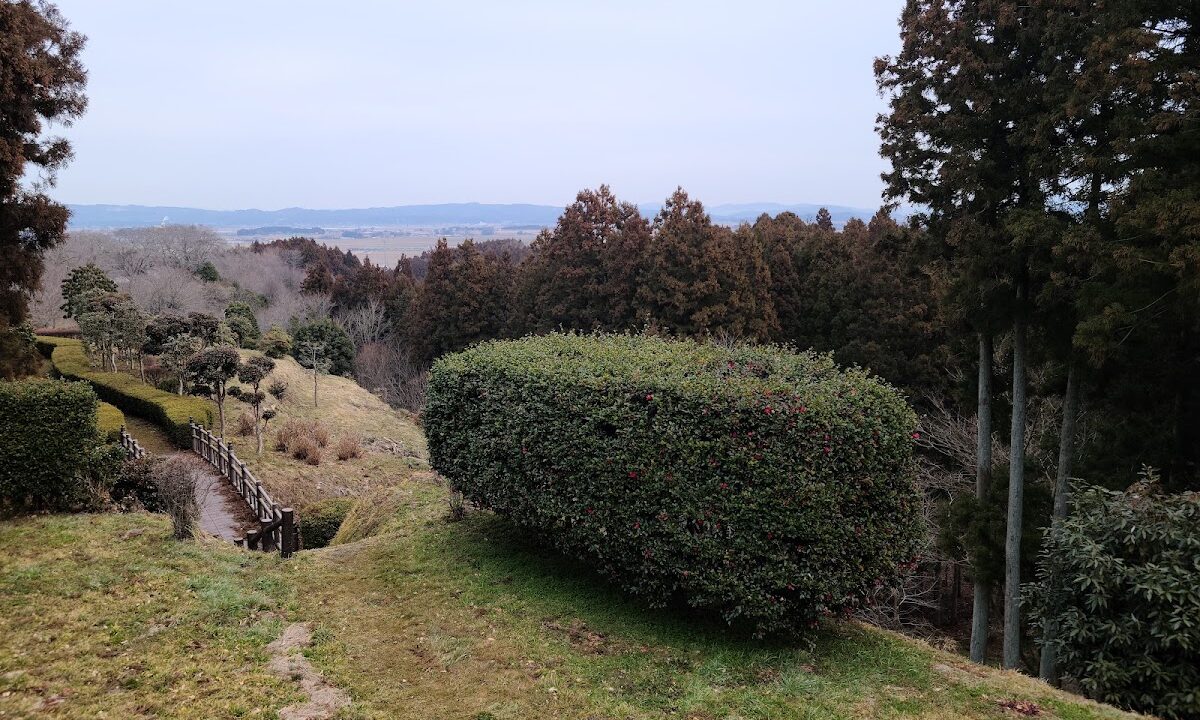
Earthworks and Baileys: The earthworks remaining around the Honmaru (main bailey) are the main highlight of Sengoku Castle. These are valuable remains that allow you to experience the defensive system of a medieval mountain castle.
View: From the castle ruins, you can enjoy a panoramic view of the Matsuyama townscape and the surrounding rural landscape. The former lords of the castle likely governed their territory while gazing at this view.
Bailey Layout: Walking from the Honmaru to the San-no-maru (third bailey) allows you to experience the interconnected layout of the castle. The elevation differences and layout of each enclosure reveal the castle’s defensive design.
Estimated Visiting Time
A visit to the Sengoku Castle ruins takes approximately 30 minutes. If you wish to carefully observe the remains and enjoy taking photographs, allow about an hour.
Access Information
Access by Car
Tohoku Expressway: Approximately 20 minutes from Yamato IC, or approximately 15 minutes from Sanbongi Smart IC.
Parking: The site of the third enclosure has been developed as a parking lot and is free to use. Approximately 10 regular-sized cars can be parked there.
Access by Public Transportation
JR Tohoku Main Line: Approximately 25 minutes on foot from Matsuyama-cho Station, or approximately 5 minutes by taxi.
Bus: Get off at the “Matsuyama Sengoku” bus stop on the Osaki City Bus, then approximately 5 minutes on foot.
Public transportation services are limited, so it is recommended to check the timetable in advance.
Address and Map
Address: 6 Honmaru, Sengoku, Matsuyama, Osaki City, Miyagi Prefecture 987-1304
Searching for “Gohonmaru Park” or “Sengoku Castle Ruins” on your car navigation system or smartphone map app will display the exact location.
Nearby Attractions
Matsuyama Sake Museum
Located about a 5-minute drive from Sengoku Castle, the Matsuyama Sake Museum is a facility where you can learn about the history of sake brewing in Miyagi Prefecture. There is also a tasting corner where you can enjoy local sake.
Cherry Blossoms at Matsuyama Gohonmaru Park
In spring, Gohonmaru Park, the site of Sengoku Castle, becomes a famous cherry blossom viewing spot. Approximately 100 cherry trees bloom, attracting many visitors. The contrast between the castle ruins and the cherry blossoms makes it a popular photo spot.
Kajo-numa Pond
Located about a 15-minute drive from Sengoku Castle, Kajo-numa Pond is a Ramsar Convention registered wetland and is known as a stopover point for migratory birds. You can enjoy nature observation and bird photography.
Sengoku Castle Visitor Ratings and Reviews
Rating on Kojodan
On Kojodan, a community site for castle enthusiasts, Sengoku Castle has an average rating of ★★★☆☆ (3.25), with 41 visitors recorded to date (data is subject to change).
Visitors have given positive feedback such as “The remains are well-preserved,” “It’s well-maintained as a park and easy to visit,” and “The view is wonderful.” However, some have commented that “It would be good if the information boards were more comprehensive” and “It’s difficult to visit in winter due to snow.”
Recommended Time to Visit
Spring (Early April – Early May): The cherry blossoms are in bloom, offering the most beautiful scenery.
Autumn (October – November): The autumn leaves are beautiful, and the weather is mild, making it ideal for visiting.
Summer: The greenery is dense, making the outlines of the remains somewhat difficult to see, but you can rest in the cool shade of the trees. Winter: Snow accumulation can make footing difficult, so caution is advised when visiting.
Historical Significance of Sengoku Castle
Position in the Medieval History of the Osaki Region
Sengoku Castle is an important historical site that tells the history of the Osaki region from the medieval to the early modern period. Its history, from being the base of a local lord, the Endo clan, to becoming a stage for the expansion of the Date clan’s power, clearly demonstrates the changes in the political situation of the region.
The fact that it served as the site of Date Masamune’s military council during the Battle of Osaki indicates that Sengoku Castle was not merely a small provincial castle, but played a crucial role in the larger historical unification of Oshu.
Value in Mountain Castle Research
Sengoku Castle possesses a typical structure of a medieval mountain castle, yet it was used until the early modern period. Therefore, it is a valuable case study for researching the changes in castles during the transition from the medieval to the early modern period.
Because the remains of earthworks and moats are well-preserved, archaeological excavations and surveys may reveal more detailed information about the castle’s structure.
Notes on Visiting Sengoku Castle
Clothing and Equipment
While Sengoku Castle ruins are maintained as a park, some areas are sloped or have uneven footing. The following equipment is recommended for your visit:
- Comfortable walking shoes (sneakers or trekking shoes)
- Comfortable clothing
- Insect repellent (in summer)
- Hat and sunscreen (some areas have little shade)
- Drinking water
Manners and Rules
- Be careful not to damage the remains
- Take all your trash with you
- No open flames
- Do not trespass on private property
- Respect the information boards and explanatory signs
Photography
Photography is permitted at Sengoku Castle ruins, but please be considerate of other visitors. Drone aerial photography requires prior permission from Osaki City.
Summary
Sengoku Castle in Osaki City, Miyagi Prefecture, is a mountain castle built in 1401 by Endo Moritsugu. It played a crucial role as a historical strategic point during the Battle of Osaki, where Date Masamune’s forces gathered. Currently, it is maintained as the Honmaru Park, with well-preserved remains such as earthworks and baileys.
The visit takes approximately 30 minutes, and with ample parking, access is relatively easy. The scenery is particularly beautiful during the cherry blossom season in spring. Sengoku Castle, where you can learn about the structure of a medieval mountain castle and reflect on the history of Date Masamune’s unification of Oshu, is a historical site worth visiting for anyone interested in Miyagi Prefecture’s history.
It’s a recommended spot not only for castle enthusiasts, but also for history buffs and those who enjoy nature walks. When you visit Osaki City, be sure to stop by the Sengoku Castle ruins.


--765x450.png)