Kiyama Castle (Kamimashiki District, Kumamoto Prefecture): A Complete Guide to its History and Highlights | The Fortress Ruins of the Aso Clan
What is Kiyama Castle?
Kiyama Castle is a medieval mountain castle located in Terasako, Mashiki Town, Kamimashiki District, Kumamoto Prefecture. It is known as the castle that served as the base of the Kiyama clan, a branch of the Aso clan, a powerful local family in Higo Province. Currently, it is maintained as Kiyama Castle Ruins Park and preserved as a regional historical heritage site.
Mashiki Town, located in central Kumamoto Prefecture, is adjacent to the east of Kumamoto City and is a transportation hub close to Kumamoto Airport. Due to this geographical importance, Kiyama Castle played a crucial military and political role in the medieval period.
Basic Information on Kiyama Castle
Location: Terasako, Mashiki-machi, Kamimashiki-gun, Kumamoto Prefecture
Castle Type: Mountain Castle
Builder: Kiyama Clan
Main Lords: Kiyama Clan
Year of Abandonment: Unknown (Estimated to be late Sengoku period)
Remains: Enclosures, earthworks, moats
Current Status: Kiyama Castle Ruins Park
History of Kiyama Castle
Background of Construction and the Kiyama Clan
The exact construction date of Kiyama Castle is uncertain due to a lack of clear records, but it is believed to have been built in medieval Higo Province by the Kiyama clan, a branch of the Aso clan.
The Aso clan served as the chief priest of Aso Shrine and were powerful local lords in Higo Province. The Kiyama clan, a branch of the Aso clan, controlled this region as the Aso clan’s power expanded, maintaining their influence with Kiyama Castle as their base.
The Role of Kiyama Castle in the Medieval Period
Kiyama Castle functioned as a southern base for the Aso clan’s power in Higo Province. The Mashiki region is located in the eastern part of the Kumamoto Plain, a strategically important location controlling the transportation route from the Aso area to the Kumamoto Plain.
It is believed that the Kiyama clan governed the surrounding area from this castle, maintaining ties with the main Aso clan while being involved in the political situation of Higo Province. In the medieval period, Higo Province was divided among powerful local lords such as the Kikuchi, Aso, and Sagara clans, and Kiyama Castle played a crucial role in these power struggles.
Kiyama Castle in the Sengoku Period
With the arrival of the Sengoku period, Higo Province was embroiled in major political upheavals, including the Shimazu clan’s northward advance and Toyotomi Hideyoshi’s conquest of Kyushu. After Toyotomi Hideyoshi’s conquest of Kyushu in 1587, Higo Province was given to Sasa Narimasa, but Sasa’s misgovernment led to local uprisings. While detailed historical records are scarce and many aspects of Kiyama Castle’s history during this period remain unclear, it is presumed that, like many medieval castles, it was abandoned during the Higo provincial uprising and the subsequent rule of Higo by Kato Kiyomasa.
Kato Kiyomasa built Kumamoto Castle and promoted the consolidation of castles into early modern castles, thus ending the military role of medieval mountain castles like Kiyama Castle and fading from the historical stage.
Kiyama Castle Ruins from the Early Modern Period Onward
From the Edo period onward, the Kiyama Castle ruins were used as farmland and forest, but were preserved as a historical memory of the region. Even after the Meiji era, it was recognized as a “castle ruin” by locals, and development as a historical site progressed from the Showa to the Heisei period.
Currently, it is maintained as Kiyama Castle Ruins Park by Mashiki Town, serving as a place of relaxation for local residents and also as a site for historical learning.
Structure and Remains of Kiyama Castle
Castle Layout
Kiyama Castle exhibits the typical form of a medieval mountain castle, with a layout that skillfully utilizes the natural terrain. The main enclosure (honmaru) is located at the top of the hill, surrounded by multiple baileys.
The main enclosure measures approximately 50 meters east-west and 30 meters north-south, and traces of earthworks can be seen around it. From the main enclosure, one can see a panoramic view of the town of Mashiki and the Kumamoto Plain, indicating its military surveillance function.
Characteristics of Defensive Facilities
The following remains of defensive facilities at Kiyama Castle can still be seen today:
Earthworks: Traces of earthworks remain around the main enclosure and the second bailey. While currently about 1-2 meters high, it is estimated to have been higher at the time of construction.
Moat: A moat was constructed along the ridge, a measure taken to prevent enemy intrusion. It can still be seen today as a depression in the terrain.
Enclosures: Multiple enclosures are arranged in a stepped pattern around the main enclosure, creating a multi-layered defensive structure. Each enclosure is thought to have been used for troop garrisoning or storage of supplies.
Stone Walls and Structures
As Kiyama Castle is a medieval mountain castle, it does not have the full-fledged stone walls found in early modern castles. Defenses consisted mainly of earthworks and moats.
Regarding structures, while no clear remains such as foundation stones have been confirmed today, it is presumed that buildings such as a residence or watchtower existed in the main enclosure. Since medieval mountain castles were generally used with residents living in residences at the foot of the mountain during peacetime and taking refuge in the castle during wartime, it is highly likely that Kiyama Castle followed a similar pattern.
Relationship with the Shiro-no-moto Kofun Group
A group of burial mounds called the “Shiro-no-moto Kofun Group” exists around the Kiyama Castle ruins. These were constructed during the Kofun period (around the 6th-7th centuries), making them much older than the construction of Kiyama Castle.
Powerful figures have resided in this region since the Kofun period, and its geographical importance has been recognized since ancient times. The construction of a castle by the Kiyama clan in the medieval period is thought to be a continuation of the traditional strategic importance of the area from antiquity.
The main burial mounds of the castle are preserved as part of Kiyama Castle Ruins Park, making it a valuable historical site that allows for a continuous understanding of the region’s history from ancient to medieval times.
Current Status of Kiyama Castle Ruins Park
Park Development
Currently, the Kiyama Castle ruins are developed as “Kiyama Castle Ruins Park” by Mashiki Town. Walking paths are provided within the park, allowing visitors to explore the main enclosure and various baileys.
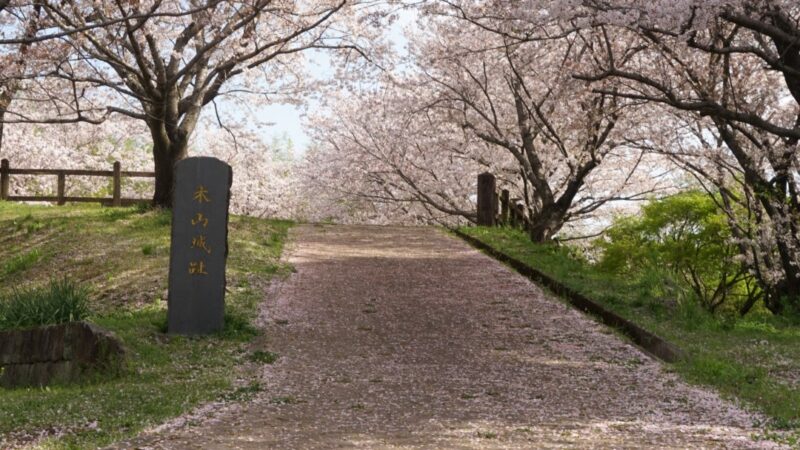
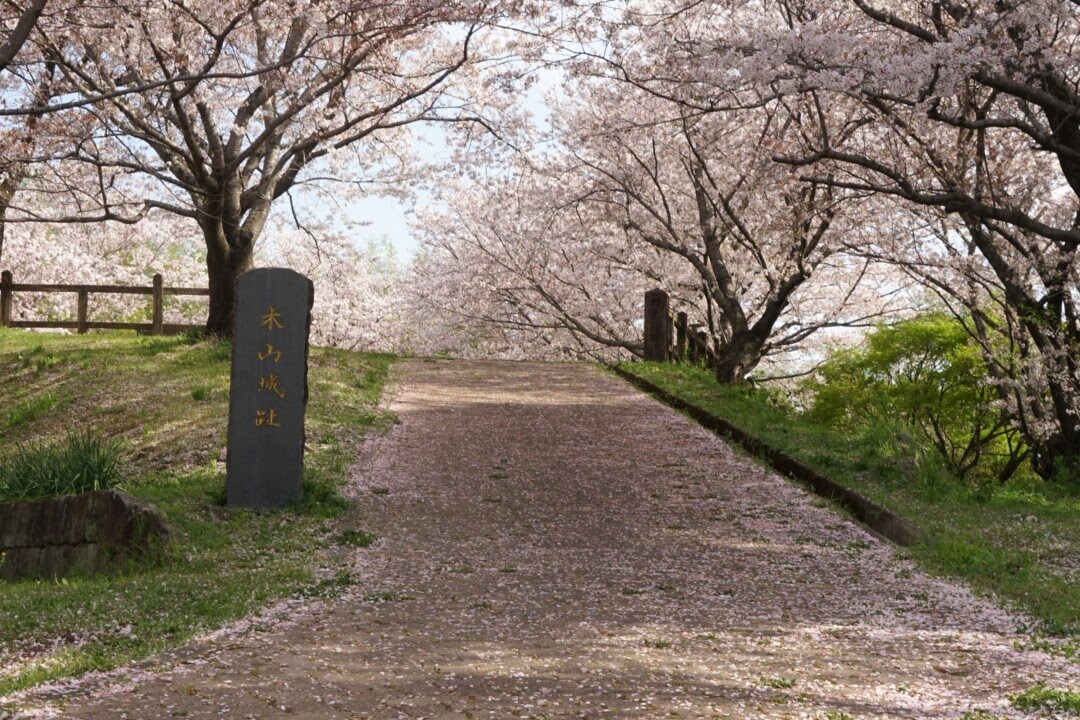
The park is equipped with facilities such as a free parking lot, restrooms, and rest areas, and is used not only for historical walks but also as a place of relaxation for local residents. In spring, cherry blossoms bloom, making it a popular spot for cherry blossom viewing.
Information Boards and Explanations
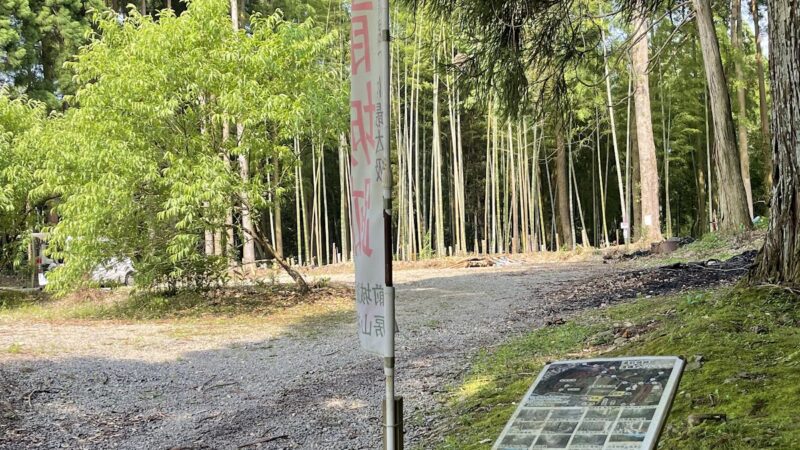
Information boards explaining the history and structure of Kiyama Castle are installed within the park. The castle ruins are clearly marked with points of interest and the locations of the remains, making it easy for first-time visitors to understand the site.
The view from the main enclosure is magnificent, offering panoramic views of Mashiki town, Kumamoto City, and Mount Aso, allowing visitors to appreciate the strategic importance of this castle’s location.
Impact and Recovery from the Kumamoto Earthquake
The Kumamoto Earthquake, which occurred in April 2016, caused extensive damage to Mashiki town. Kiyama Castle Ruins Park was also affected, with some walking paths and facilities suffering damage.
However, as part of Mashiki town’s reconstruction efforts, the park has been restored and is now fully operational. Kiyama Castle Ruins Park holds significant meaning for the community as a symbol of recovery from the earthquake.
Overview of Kamimashiki District and Mashiki Town
Geography and History of Kamimashiki District
Kamimashiki District is located in the central part of Kumamoto Prefecture. Currently, the area consists of four towns: Mashiki, Kashima, Kosa, and Yamato.
The name “Mashiki” has a long history, originating from Mashiki County in Higo Province. It developed as a transportation hub from ancient times, and in the Middle Ages, many castles, including Kiyama Castle, were built there.
The Kamimashiki region stretches from the eastern part of the Kumamoto Plain to the western foothills of the Aso caldera, and has developed as an industry centered on agriculture. Rice cultivation and livestock farming are particularly thriving, making it an important region supporting food production in Kumamoto Prefecture.
Characteristics of Mashiki Town
Mashiki Town is the central town of Kamimashiki County and a suburban town adjacent to Kumamoto City. With a population of approximately 30,000, and with Kumamoto Airport located within the town, it also plays a role as a gateway to Kumamoto Prefecture by air.
The Kiyama district, the town center, has flourished as a transportation hub since ancient times, and even today, it is home to a concentration of commercial and public facilities. The name of Kiyama Castle also originates from this Kiyama district.
Mashiki Town has developed as a commuter town for Kumamoto City, and while residential development is progressing, agriculture continues, making it a town that possesses both urban and rural characteristics.
Industries and Local Products
The main industry in the Kamimashiki region, especially Mashiki Town, is agriculture. Rice cultivation is central, but vegetables and fruit trees are also grown. Livestock farming is also thriving, with the production of fattening cattle.
Mashiki Town’s local specialties include fruits such as watermelons and melons, which are shipped both within and outside the prefecture as “Mashiki Watermelons” during the summer. In recent years, the development of processed products using locally produced agricultural products has also progressed.
Due to the location of Kumamoto Airport, logistics and tourism-related industries also play an important role, and industrial parks and commercial facilities are located around the airport.
Access and Visiting Information for Kiyama Castle
Access by Car
Kiyama Castle Ruins Park is easily accessible by car.
From the Kyushu Expressway:
- Approximately 15 minutes from Mashiki Kumamoto Airport IC
- Approximately 20 minutes from Mifune IC
From Kumamoto City Center:
- Approximately 30 minutes via National Route 443
The park has a free parking lot with space for approximately 20 regular cars.
Access by Public Transportation
Bus:
Take a Kumamoto Bus or Sanko Bus bound for Mashiki from Kumamoto City Center (Transportation Center), get off at the “Kiyama” bus stop, and walk for approximately 15 minutes.
JR:
The nearest station is “Haramizu Station” on the JR Hohi Main Line, but it is approximately 5 kilometers from the station to the Kiyama Castle Ruins, making it difficult to walk. Using a taxi or bus is recommended.
Estimated Visit Time and Notes
A leisurely visit to Kiyama Castle Ruins Park should take approximately one hour. The climb to the main enclosure is gentle, but we recommend wearing comfortable shoes.
Notes for Visitors:
- The park is open year-round, but please avoid visiting at night.
- Bringing insect repellent is recommended during the summer.
- Bringing drinking water in advance is convenient.
- Be careful as the ground can be slippery in rainy weather.
Nearby Tourist Attractions
When visiting Kiyama Castle Ruins, you can also visit nearby tourist attractions.
Mashiki Town Exchange Information Center Minaterasu: A facility introducing tourist information and local products of Mashiki Town. It is also a symbol of recovery from the earthquake.
Shioi Spring: A representative spring in Mashiki Town, selected as one of the “100 Famous Waters of the Heisei Era” by the Ministry of the Environment.
Kumamoto Airport: You can watch planes taking off and landing from the observation deck. The airport also has a wide selection of shops selling Kumamoto’s local products.
Aso Kumamoto Airport Hotel Eminence:
It also has a day-trip hot spring facility, where you can relax and unwind after sightseeing.
Cultural Value of Kiyama Castle Ruins
Historical Value
Kiyama Castle is an important historical site that shows the reality of regional governance in Higo Province during the Middle Ages. It functioned as a base for regional governance by the Aso clan and is a valuable example for understanding the political and military structure of Higo during the Middle Ages.
It retains the typical structure of a medieval mountain castle, and the remains such as earthworks and moats allow us to understand the castle-building techniques and defensive philosophies of the time.
Archaeological Value
Although no full-scale excavation surveys have been conducted at Kiyama Castle Ruins to date, the existence of castle remains can be confirmed from surface observation. Further detailed investigations may reveal more about the castle structure and daily life during the Middle Ages.
Its aspect as a complex site with the Shiromoto Kofun Group is also important, making it a valuable example showing the continuity of regional history from ancient to medieval times.
Value as a Local Cultural Site
Kiyama Castle Ruins are a core element of Mashiki Town’s historical identity. They are used as teaching materials for local history in local schools, providing a place for children to learn about the region’s history.
Even during the recovery process following the Kumamoto earthquake, Kiyama Castle Ruins Park functioned as a place to reaffirm community bonds, possessing cultural significance beyond mere historical site.
The Kiyama and Aso Clans
History of the Aso Clan
The Aso clan was a powerful local lord in the medieval period, based in Aso County, Higo Province. They held the hereditary position of chief priest of Aso Shrine, possessing a unique dual identity as both Shinto priests and samurai.
From the late Heian period to the Kamakura period, the Aso clan grew into a powerful samurai group in Higo Province, and during the Nanboku-cho period, they sided with the Southern Court. From the Muromachi period to the Sengoku period, they maintained their power, primarily in the Aso region, as one of the three major powers in Higo Province, alongside the Kikuchi and Sagara clans.
The Genealogy of the Kiyama Clan
The Kiyama clan was a branch of the Aso clan. Families that separated from the main Aso family established their own territories and formed their own independent power bases.
The Kiyama clan ruled the Mashiki region, controlling the surrounding area from Kiyama Castle. While maintaining relations with the main Aso family, they are thought to have maintained a degree of independence and acted as regional lords.
The Castle Network of the Aso Clan
The Aso clan and its branches built many castles in eastern Higo Province. Kiyama Castle was one of them, and an important base located at the western end of the Aso clan’s castle network.
Other Aso clan-related castles include Kojō (Aso City), the residence of the main Aso clan, and Yabe Castle (Yamato Town) of the Yabe clan. These castles worked together to form the Aso clan’s sphere of influence.
Medieval Castles of Higo Province and Kiyama Castle
Distribution of Castles in Higo Province
Numerous mountain castles were built in medieval Higo Province. Major examples include Kumabe-kan (Kumabe Manor) of the Kumabe clan, Kumafu Castle of the Kikuchi clan, Hitoyoshi Castle of the Sagara clan, and Kumamoto Castle (later Kumamoto Castle) of the Kato clan.
These castles functioned as bases for their respective local lords, reflecting the complex political situation of Higo Province. Kiyama Castle, too, was one of these castles in Higo Province, serving as a center of regional control.
Characteristics of Medieval Mountain Castles
Medieval mountain castles like Kiyama Castle possess characteristics that differ from early modern flatland castles and hill castles.
Location: Built on hills and mountains suitable for defense, making maximum use of the natural terrain.
Structure: Defensive facilities primarily consisting of earthworks and moats, rather than stone walls.
Usage: Served as a “fortified castle,” where the inhabitants lived in a residence at the foot of the mountain during peacetime and took refuge in the mountain castle during wartime.
Scale: Smaller in scale compared to early modern castles, a castle of the regional lord level.
These characteristics also apply to Kiyama Castle, which preserves the typical appearance of a medieval mountain castle.
Regional Positioning of Kiyama Castle
Kiyama Castle was located on a transportation route connecting the Aso region and the Kumamoto Plain, making it a strategically important location. It is believed to have served as a front-line base protecting the western edge of the Aso clan’s sphere of influence.
The Mashiki region was close to the Kumamoto Plain, the center of Higo Province, and was politically and economically important. Kiyama Castle contributed to the Aso clan’s maintenance of power by controlling this region.
Current Status and Challenges of Kiyama Castle Research
Status of Historical Materials
Historical materials concerning Kiyama Castle are limited, and many aspects of its construction date and detailed history remain unclear. As is common with medieval regional castles, the lack of detailed records is a research challenge.
While fragmentary information can be obtained from historical materials related to the Aso clan and military chronicles from the Sengoku period, historical materials focusing specifically on Kiyama Castle are scarce.
The Need for Archaeological Investigation
No full-scale archaeological excavations have been conducted at the Kiyama Castle site to date. Future archaeological investigations could potentially provide more detailed information regarding the castle’s structure, age, and artifacts used.
Excavation of the main enclosure and baileys, in particular, is crucial for clarifying the layout of buildings and the actual living conditions. Furthermore, dating of excavated artifacts could lead to the determination of the castle’s construction date and abandonment period.
Challenges of Preservation and Utilization
Kiyama Castle Ruins are currently preserved as a park, but preservation challenges exist, such as the deterioration of the remains over time and the overgrowth of vegetation. Appropriate maintenance and preservation work as needed are required.
On the other hand, utilization as a resource for local history education and tourism is also important. Efforts to convey the value of Kiyama Castle to more people, such as improving information boards and conducting guided tours, are expected.
Summary
Kiyama Castle is the site of a medieval mountain castle located in Mashiki-machi, Kamimashiki-gun, Kumamoto Prefecture. As the residence of the Kiyama clan, a branch of the Aso clan, it played an important role in the regional control of Higo Province during the medieval period.
Currently, it is maintained as Kiyama Castle Ruins Park, where remains such as earthworks and moats can be seen, and the main enclosure offers panoramic views of Mashiki-machi and the Kumamoto Plain. It also has value as a complex site with the Shiromoto Kofun Group, making it a valuable historical site for learning about the regional history from ancient to medieval times.
In Mashiki Town, which has recovered from the Kumamoto earthquake, the Kiyama Castle ruins will continue to be carefully preserved and utilized as a symbol of the region’s historical identity. When you visit Kumamoto Prefecture, why not take a trip to the Kiyama Castle ruins and reflect on the history of medieval Higo?