History and Remains of Wadanishi Castle (Tosa-cho, Tosa-gun) | A Thorough Explanation of Mountain Castles in Kochi Prefecture
Wadanishi Castle, located in Tosa-cho, Tosa-gun, Kochi Prefecture, is a medieval mountain castle situated in the central part of the Shikoku Mountains. Built on a mountaintop at an altitude of 732m, this castle played an important role as a base for the Wada clan’s rule over Tosa Province. This article provides a detailed explanation of Wadanishi Castle, including its historical background, the characteristics of its remains, and how to access it.
Basic Information on Wadanishi Castle
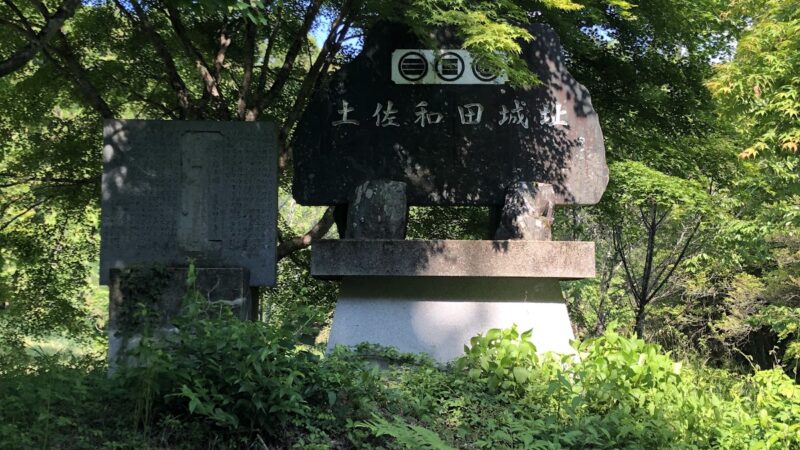
Wadanishi Castle is a mountain castle located in Nishikojodani, Wada, Tosa-cho, Tosa-gun, Kochi Prefecture. It is situated on the mountaintop behind Nishi Hachimangu Shrine, built at an altitude of 732m.
Castle Overview
- Location: Nishikojodani, Wada, Tosa-cho, Tosa-gun, Kochi Prefecture
- Alternate Name: Tosa Wada Nishi Castle
- Elevation: 732m
- Castle Type: Mountain Castle
- Main Remains: Earthworks, baileys, moats
- Builder: Wada clan
- Construction Period: Estimated to be the mid-Kamakura period
Wada Nishi Castle functioned as a paired castle with Wada Honjo Castle (Wada Higashi Kojo Castle), also located in the Wada district of Tosa-cho. While Wada Honjo Castle is situated on the eastern mountaintop at an elevation of 695m, Wada Nishi Castle is built on the higher western mountaintop at 732m.
Historical Background of Wada Nishi Castle
The Wada Clan and Tosa Province
The Wada clan was a samurai group that entered Tosa Province in the early Kamakura period. The castle complex in the Wada area, including Wada Nishi Castle, functioned as a military base for the Wada clan’s rule over Tosa Province.
It is said that Wada Yoshinao, considered the ancestor of the Wada clan, built Wada Honjo Castle in November 1223. During this period, as the Kamakura Shogunate’s system of rule was established, the control of territories by shogunate retainers was also progressing in Tosa Province. Wada Nishi Castle is thought to have played a role in defending the entire Wada area in conjunction with Wada Honjo Castle.
Political Situation in Medieval Tosa
From the Kamakura period to the Nanboku-cho period, Tosa Province maintained its own independent system of rule by local powerful families, while still being influenced by the central government. The Wada clan played a part in this, maintaining influence in central Tosa Province by controlling the strategically important upper reaches of the Yoshino River.
The area around Tosa Town, located in the central part of the Shikoku Mountains, was a region through which important transportation routes connecting Tosa Province, Iyo Province, and Awa Province passed. Mountain castles like Wada Nishi Castle were essential military facilities for monitoring these routes and defending the territory.
Tosa and the Wada Clan in the Sengoku Period
With the arrival of the Sengoku period (Warring States period), Tosa Province underwent significant transformation with the rise of the Chosokabe clan. During Chosokabe Motochika’s unification of Tosa, many local powerful families either came under the Chosokabe’s control or were destroyed.
While historical records regarding the detailed rise and fall of the Wada clan are limited, it is presumed that the castle complex in the Wada area, including Wada Nishi Castle, was incorporated into the Chosokabe’s sphere of influence during this period. It is thought that the castle was subsequently abandoned due to the “One Castle Per Province” decree of the Edo period.
Layout and Remains of Wada Nishi Castle
Characteristics of the Castle Structure
Wada Nishi Castle is a typical medieval mountain castle built around the summit of a mountain at an altitude of 732m. It features a highly defensible structure utilizing the steep terrain, and the following remains have been confirmed:
Main Enclosure (Honmaru)
The main enclosure is located at the summit. A relatively flat, leveled area has been formed, and it is presumed that the lord’s residence and command post were located there. Earthen ramparts surround the main enclosure, enhancing its defensive capabilities.
Arrangement of Enclosures (Kuruwa)
Several enclosures are arranged in a stepped pattern around the main enclosure. These enclosures are thought to have been used for garrisoning soldiers and storing supplies. Each enclosure is demarcated by earthen ramparts and steep slopes, designed to function as an independent defensive unit.
Earthen Rampant
A distinctive feature of Wada Nishi Castle is the well-preserved earthen rampart. The earthen ramparts surrounding the castle grounds served to prevent enemy intrusion and protect against projectiles such as arrows and stones. Some of these ramparts still retain a height of over 1 meter, making them valuable historical resources for understanding the castle construction techniques of the time.
Moats
Moats were constructed between the castle grounds or at points separating the castle area from the outside. The characteristic moats cut across ridges (horikiri) of mountain castles can also be observed, demonstrating ingenuity in limiting enemy access routes.
Relationship with Nishi Hachiman Shrine
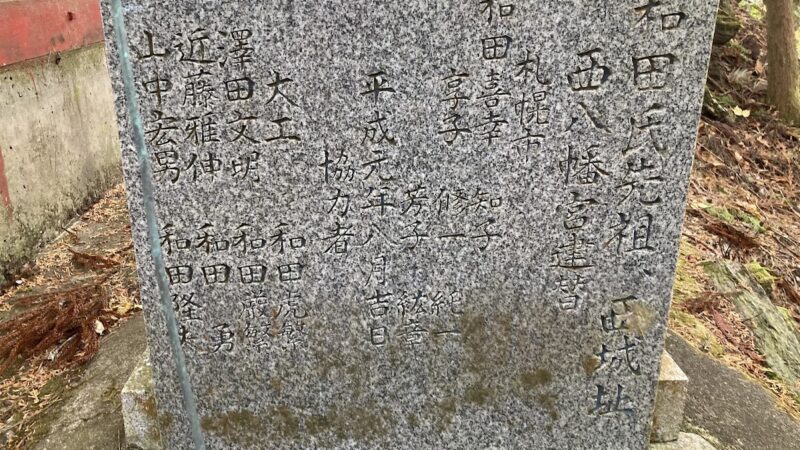
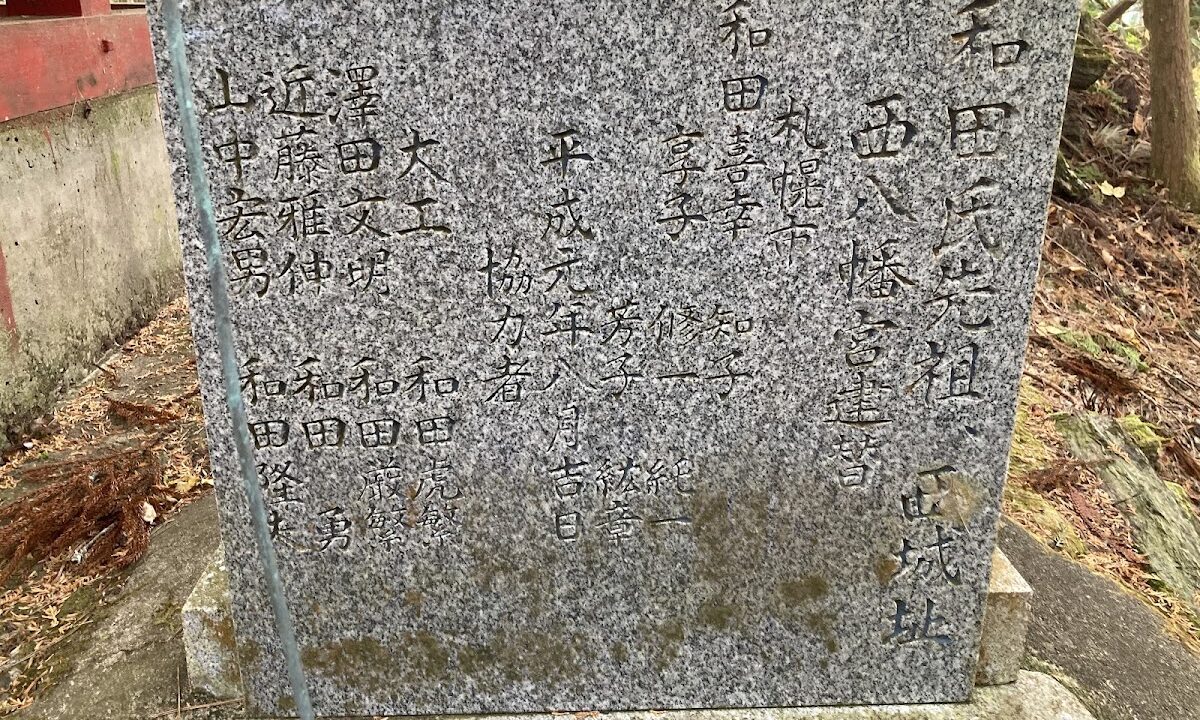
Nishi Hachiman Shrine is located at the foot of Wada Nishi Castle. This shrine is believed to have been revered as the castle’s guardian deity, indicating a close relationship between the castle and the shrine. In medieval mountain castles, shrines and temples played an important role as objects of worship for the castle lords and samurai, and Wada Nishi Castle is no exception.
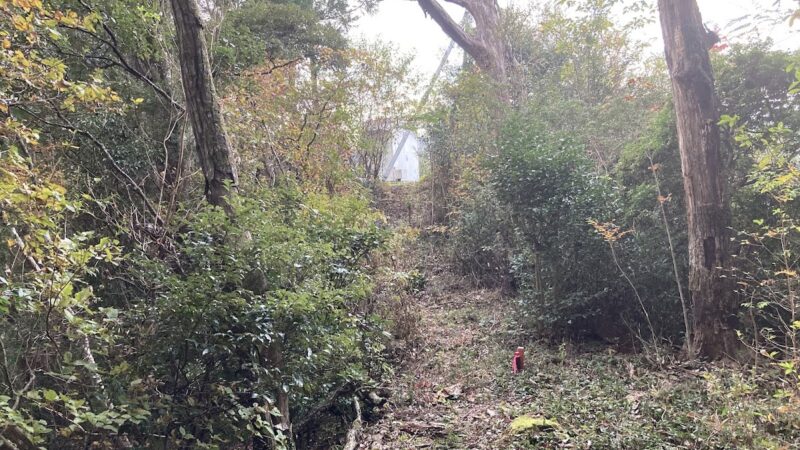
A hiking trail from Nishi Hachiman Shrine to the castle ruins is maintained and is still used as an access route to the castle site today.
Geographical Environment of Tosa District and Wada Area
Overview of Tosa District
Tosa District is located in the north-central part of Kochi Prefecture and currently consists of two towns and villages: Tosa Town and Okawa Village. It is situated in the heart of the Shikoku Mountains and has the geographical characteristic of being in the upper reaches of the Yoshino River.
Although its population is small, approximately 3,600 (2026 estimate), it is home to the Sameura Dam, known as the “water reservoir of Shikoku,” and plays a crucial role in the supply of water resources to the entire Shikoku region.
Characteristics of the Wada Area in Tosa Town
The Wada area in Tosa Town, where Wada Nishijo Castle is located, is a mountain settlement that developed along a tributary of the Yoshino River. It is a basin-shaped area surrounded by mountains reaching an altitude of 700m, and has functioned as a transportation hub since ancient times.
Currently, the Wada area has scattered houses, an elementary school, and shrines, creating a quiet rural landscape characteristic of mountainous regions. While some land was submerged under the reservoir created by the construction of the Sameura Dam, the mountaintop where Wada Nishijo Castle is located remained unaffected.
Location of Mountain Castles in the Shikoku Mountains
The Shikoku Mountains are a rugged mountainous region running east-west through the central part of Shikoku. This topography served as a border and boundary for territories from ancient to medieval times, leading to the construction of many mountain castles.
Wada Nishijo Castle, at an altitude of 732m, is relatively high among the mountain castles of Tosa Province. The reasons for building a castle at such a high altitude are thought to be the ability to monitor a wide area, its defensive advantages, and its symbolic significance as a symbol of control over the surrounding region.
Relationship between Wada Nishijo Castle and Wada Honjo Castle
Function as Twin Castles
Wada Nishijo Castle is thought to have been strategically positioned as a paired castle with Wada Honjo Castle (Wada Higashi Kojyo) to the east. The two castles are approximately 1 km apart in a straight line, and a system was in place for defending the entire Wada region while maintaining communication with each other.
Wada Honjo Castle is located at an altitude of 695m and is said to have been built in 1223 by Wada Yoshinao. On the other hand, the exact construction date of Wada Nishijo Castle is unclear, but it is estimated to have been built around the same time as Wada Honjo Castle, or slightly later.
Estimated Division of Roles
The following division of roles is assumed for the relationship between the two castles:
Wada Honjo Castle (Higashi Kojo Castle)
- Residential function as the headquarters of the Wada clan
- Political center with Higashi Hachimangu Shrine as its guardian deity
- Base for daily territorial management
Wada Nishijo Castle
- A military fortress located at higher elevation
- A defensive base against invasions from the west
- An emergency refuge
This type of defense system, combining multiple castles, is a common form seen in medieval mountain castles. It is believed that during peacetime, the territory was managed primarily from Wada Honjo Castle, while during wartime, the defensive capabilities of Wada Nishijo Castle were utilized.
Access and Visiting Information for Wada Nishijo Castle
Location and Transportation Access
Address: Nishikojodani, Wada, Tosa-cho, Tosa-gun, Kochi Prefecture
Access by Car
- From Kochi City, head north on National Route 32 for approximately 1 hour.
- From the center of Tosa-cho, take the prefectural road to the Wada area.
- Proceed towards Nishi Hachimangu Shrine.
- Parking is available near the shrine (a few cars).
Public Transportation
- Take a bus from JR Dosan Line Osugi Station towards Tosa-cho.
- However, since the number of buses is limited, visiting by car is recommended.
Ascent Route
To reach Wada Nishijo Castle, use the mountain trail from Nishi Hachimangu Shrine. The following points should be noted when ascending the castle.
- Mountaineering Equipment: Due to the elevation difference, hiking boots or trekking shoes are necessary.
- Estimated Time: Approximately 40-60 minutes on foot from Nishi Hachimangu Shrine to the summit.
- Trail Conditions: The mountain trail is poorly maintained and can be slippery in rainy weather.
- Season: Snow is possible in winter, and vegetation is lush in summer.
- Items to Bring: Drinking water, map, compass, mobile phone (reception may be unavailable).
Precautions for Visiting
- Private Property: The area around the castle ruins may include private property, so please observe proper etiquette while visiting.
- Protection of Remains: Care must be taken not to damage remains such as earthworks and baileys.
- Safety Assurance: Avoid climbing alone; visiting in groups is recommended.
- Weather Check: Check the weather forecast in advance and refrain from climbing in bad weather.
- Contact: It’s important to inform family and friends of your destination before visiting the castle.
Nearby Historical Sites and Tourist Spots
Wada Honjo Castle (Wada Higashi Kojō Castle)
When visiting Wada Nishijo Castle, we highly recommend also visiting Wada Honjo Castle. Located behind Higashi Hachimangu Shrine, it is an important castle site with a history as the base of the Wada clan.
Sameura Dam
Sameura Dam, a representative tourist spot in Tosa Town, is a multi-purpose dam completed in 1975. As the “water reservoir of Shikoku,” it is an important facility supporting the water resources of the four prefectures of Shikoku, and the area around the dam lake is also beautiful and a popular tourist destination.
Cultural Properties of Tosa Town
Besides Wada Nishijo Castle, many historical buildings and cultural properties remain in Tosa Town. Ancient temples such as Jizōji Temple and shrines remaining in each village offer a glimpse into the history of Tosa from the medieval to early modern periods.
Mountain Castle Culture of Kochi Prefecture
Characteristics of Castles in Tosa Province
Kochi Prefecture (formerly Tosa Province) has numerous mountain castles remaining. This is due to the following geographical and historical factors:
- Rugged Terrain: The complex topography of the Shikoku Mountains created natural strongholds.
- Rivalry of Small-Scale Local Clans: In the Middle Ages, many local clans held their own spheres of influence.
- Conflicts of the Sengoku Period: Many castles were built during the rise of the Chosokabe clan and the process of unifying Tosa.
Representative Mountain Castles of Tosa
Besides Wada Nishi Castle, Kochi Prefecture has the following notable mountain castles:
- Okatoyo Castle: The base of the Chosokabe clan (Nankoku City)
- Aki Castle: The residence of the Aki clan (Aki City)
- Sakawa Castle: The central castle of the Sakawa region (Sakawa Town)
- Nakamura Castle: The base of the Tosa Ichijo clan (Shimanto City)
By comparing these castles with Wadanishi Castle, we can understand the diversity and regional characteristics of mountain castles in Tosa Province.
Preservation of Wadanishi Castle and Future Challenges
Current State of Preservation
Fortunately, the remains of Wadanishi Castle have escaped large-scale development, and the topography, earthworks, and baileys from the time of construction remain relatively well preserved. However, the following challenges exist.
- Overgrown Vegetation: Trees and plants are growing densely, gradually covering the remains.
- Weathering and Erosion: Earthworks and other structures are gradually collapsing due to years of wind and rain.
- Low Awareness: Low recognition outside the local area limits preservation activities.
- Difficulty of Access: Hiking trails are not adequately maintained, limiting visitors.
Importance of Preservation Activities
Medieval mountain castles like Wada Nishijo Castle occupy an important position in the history of Japanese castles. Unlike early modern castles with stone walls and keeps, they are valuable resources for learning about defensive systems using civil engineering techniques such as earthworks and moats.
The following initiatives are expected in the future:
- Academic Survey: Detailed surveying and archaeological excavation by experts
- Remains Preservation: Development of hiking trails to ensure safe visits for visitors
- Information Dissemination: Provision of information through brochures and websites
- Collaboration with the Community: Preservation activities in cooperation with local residents and Tosa Town
Summary
Wada Nishi Castle is a mountain castle located at an altitude of 732m in Tosa Town, Tosa District, Kochi Prefecture. It was an important military base for the Wada clan in medieval Tosa. It functioned as a twin castle to Wada Honjo Castle, playing a role in protecting a strategic point in the upper reaches of the Yoshino River.
Even today, remains such as earthworks and baileys are well-preserved, making it a valuable historical site for learning about the structure of medieval mountain castles. Understanding its geographical environment in the central part of the Shikoku Mountains and the historical background of Tosa District, which includes the Sameura Dam, allows for a deeper understanding of the historical significance of Wada Nishi Castle.
While access requires hiking equipment, it is a castle site worth visiting for history enthusiasts and castle fans. While experiencing the rich nature and history of Tosa Town, you can have a valuable experience of encountering medieval mountain castle culture.
The mountain castles of Kochi Prefecture, including Wadanishi Castle, are important cultural heritage sites in the history of Japanese castles. In order to pass on these remains to future generations, it is necessary to cherish them as local historical resources while striking a balance between appropriate preservation and utilization.