Complete Guide to Sukumo Castle (Matsuda Castle) | A Thorough Explanation of its History and Highlights in Sukumo City, Kochi Prefecture
Located in the heart of Sukumo City, Kochi Prefecture, Sukumo Castle is a hilltop castle that played an important role as a strategic point in western Tosa from the Sengoku period to the early Edo period. Also known as “Matsuda Castle,” this castle was abandoned due to the “One Castle Per Province” decree, but the castle ruins, where the Ishizuchi Shrine now stands, are designated as a Sukumo City Historic Site. This article provides a thorough explanation of Sukumo Castle’s detailed history, changes in its lords, local highlights, and access methods.
Overview and Basic Information of Sukumo Castle
Sukumo Castle is a hilltop castle built on a small hill (approximately 40 meters above sea level, 20 meters relative height) on the west bank of the Matsuda River in the northeastern part of Sukumo City, Kochi Prefecture. Its highly defensible location, utilizing the natural terrain of the Matsuda River, made it a strategically important base in western Tosa.
Basic Data
- Location: 2-chome, Chuo, Sukumo City, Kochi Prefecture
- Alternate Name: Matsuda Castle
- Castle Structure: Hilltop Castle
- Construction Period: Unknown (Estimated to be before the Sengoku period)
- Year of Abandonment: Genna 1 (1615)
- Designated Cultural Property: Sukumo City Designated Historic Site
- Current Status: Within the grounds of Ishizuchi Shrine, some stone walls remain
History of Sukumo Castle and Changes in Lords
The history of Sukumo Castle tells of changes in rule by multiple forces. The construction period is unclear, but it already functioned as an important base during the Sengoku period.
Matsuda Clan Era (Early Sengoku Period)
Sukumo Castle was initially called “Matsuda Castle,” and Matsuda Hyogo resided there. The Matsuda clan held power as local lords in western Tosa, but they were replaced by other forces during the turbulent Sengoku period. ### The Ioka Clan Era
After the Matsuda clan, Ioka Hoki-no-kami became the lord of the castle. The Ioka clan was also a powerful local lord in western Tosa, but they eventually came under pressure from the rising Chosokabe clan.
The Chosokabe Clan Era (After 1575)
In 1575, during the campaign to unify Tosa, Chosokabe Motochika’s forces attacked the Tosa Ichijo clan, and Sukumo Castle was captured. After its fall, Chosokabe Uemon-no-taifu, a member of the Chosokabe clan, took control, and the castle functioned as a base in western Tosa. For the Chosokabe clan, Sukumo Castle was an important western base controlling the Shimanto River basin and the Hata region.
Later, Noda Jinzaemon served as the castle lord for a period, and Sukumo was governed under the Chosokabe clan’s rule.
The Yamauchi Clan Era and the Establishment of the Sukumo Yamauchi Clan (1601-1615)
In the Battle of Sekigahara in 1600, Yamauchi Kazutoyo, who sided with the Tokugawa, was granted the entire province of Tosa for his military achievements, and entered Tosa the following year, 1601. At this time, his nephew, Yamauchi Yoshiuji (who was granted the Yamauchi surname by Ando Yoshiuji), was granted Sukumo with a stipend of 6,000 koku (some sources say 6,800 koku) and entered Sukumo Castle.
Yamauchi Yoshiuji renovated the castle, strengthening its defenses by improving the stone walls and other structures. Yoshiuji became the first head of the Sukumo Yamauchi clan, and thereafter, Sukumo continued as a branch domain of the Yamauchi clan until the Meiji Restoration.
Abolition of the Castle under the One Castle Per Province Decree (1615)
In 1615, the Edo Shogunate issued the One Castle Per Province Decree, which meant that all castles in the Tosa Domain except Kochi Castle were to be abolished. Sukumo Castle was also demolished under this order, losing its function as a castle.
After its abolition, Yamauchi Yoshiuji and his descendants developed a residence (doi) at the foot of the hill and continued to govern Sukumo from there. This residence became known as “Sukumo Doi” and served as the residence of the Sukumo Yamauchi clan throughout the Edo period.
Layout and Structure of Sukumo Castle
Sukumo Castle was a flatland castle utilizing the hilly terrain on the west bank of the Matsuda River. While relatively small, it possessed a strategically important layout.
Topographical Features
The castle utilized the natural moat of the Matsuda River on its east side, and the defensive structure from the west to the north utilized the elevation difference of the hills. The location, at an elevation of approximately 40 meters and a relative height of approximately 20 meters, offered a balanced position between visibility from the plains and defensive capabilities.
Main Enclosure Structure
Honmaru: The mountaintop where Ishizuchi Shrine currently stands is the site of the Honmaru. Although a relatively small flat area, traces of a watchtower base can be seen. It is believed that the Honmaru offered panoramic views of Sukumo city and the Matsuda River basin.
Ninokuruwa and Sannomaru: It is presumed that multiple enclosures were arranged around the Honmaru, but due to changes in the terrain, many details are now unclear.
Stone Walls: Some of the stone walls, believed to have been constructed during renovations by Yamauchi Yoshishi, still remain. However, due to weathering and collapse, they do not completely retain their original form.
Access to the Castle
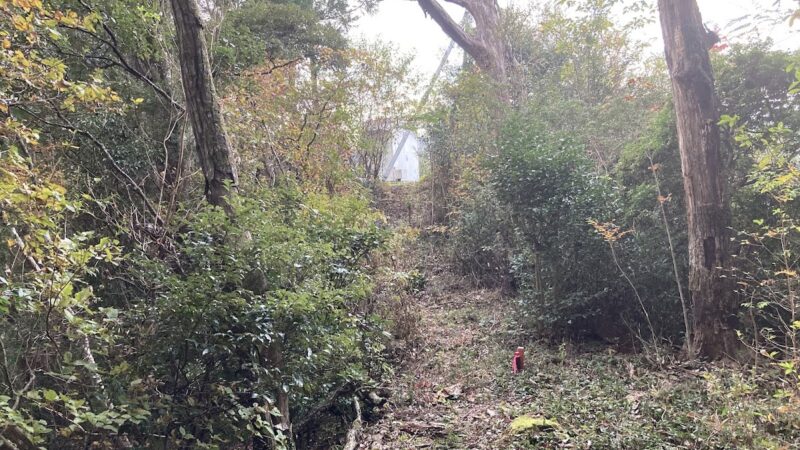
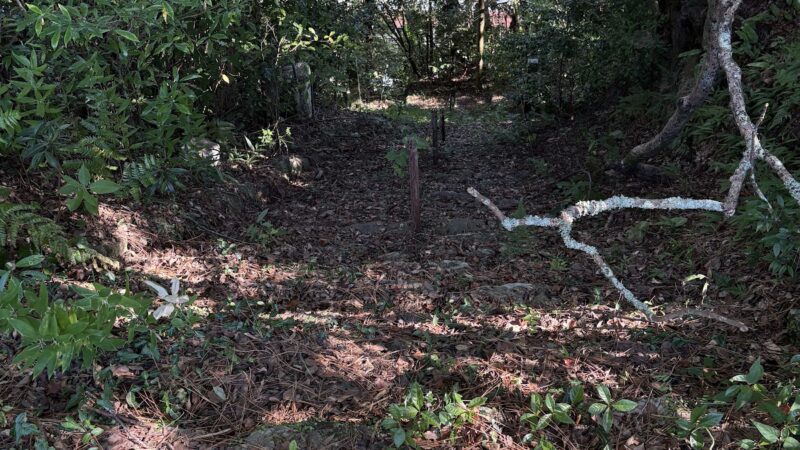
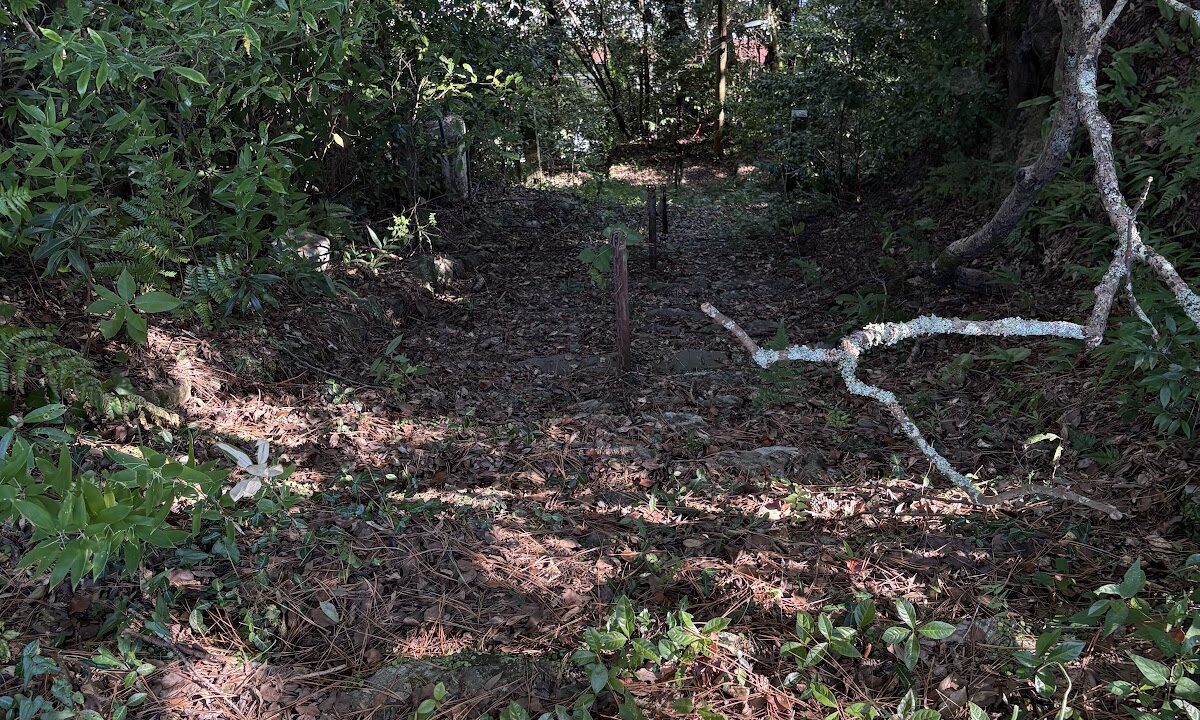
Currently, a stone staircase access route to the castle is maintained from the Matsuda River side. However, this staircase is quite steep and particularly slippery during rainy weather or when fallen leaves accumulate, so caution is advised.
Highlights of the Current Sukumo Castle Ruins
More than 400 years have passed since the castle was abandoned, and the Sukumo Castle ruins are now the grounds of Ishizuchi Shrine. However, remnants that evoke the castle’s former glory remain.
Ishizuchi Shrine
Ishizuchi Shrine is located on the site of the main keep. It is a shrine of the Ishizuchi faith, which worships Mount Ishizuchi in Ehime Prefecture, and is a center of local faith. However, in recent years, due to a decrease in visitors, maintenance of the grounds is insufficient in some areas, and the current situation is somewhat dilapidated.
Remaining Stone Walls
Parts of stone walls, presumably built during the Yamauchi clan era, remain at the castle ruins. Although not in their complete form, they are valuable relics that reveal the castle-building techniques of the time. The construction methods of the stone walls and the types of stones used reveal characteristics of early Edo period castle architecture.
Turret Base Remains
Traces of a turret base can be seen in the main enclosure. Though small, it is believed to have functioned as a lookout post, playing a role in monitoring the town of Sukumo and the surrounding area.
View
From the main enclosure, you can see the town of Sukumo, the flow of the Matsuda River, and, on a clear day, even Sukumo Bay. It’s clear that this view was crucial for military surveillance during the Sengoku period.
Atmosphere of the Castle Ruins
Rather than a well-maintained tourist spot, this place has a strong atmosphere of a historical site quietly preserving traces of history. While not many people visit, this makes it a place where you can quietly stroll while reflecting on the history from the Sengoku period to the early Edo period.
History of Sukumo City and the Role of Sukumo Castle
Sukumo Castle was not merely a military base; it also functioned as the political, economic, and cultural center of the Sukumo region.
Atmosphere of the Castle Ruins
Rather than a well-maintained tourist destination, it has a strong atmosphere of a historical site quietly preserving traces of history. ### A Key Point in Western Tosa
Sukumo is located at the westernmost tip of Tosa Province and was a crucial point for maritime traffic to Iyo (Ehime Prefecture) and Bungo (Oita Prefecture). Furthermore, it held a strategically important position for governing the entire Hata region, including the Shimanto River basin, and Sukumo Castle played a central role.
The Rule of the Sukumo Yamauchi Clan
Even after the “One Castle Per Province” decree, the Sukumo Yamauchi clan continued to rule Sukumo from their base at Sukumo Doi until the end of the Edo period. The Sukumo Yamauchi clan held significant influence as a branch of the Tosa Domain and produced many talented individuals during the late Edo period. In particular, Sukumo became known as a treasure trove of talent, producing figures such as the late Edo period patriot Kominami Gorouemon and the Meiji-era politician Hayashi Yuzo.
Transportation Access and Nearby Sightseeing
Access to Sukumo Castle Ruins
Access by Train:
- Approximately 15 minutes on foot from Sukumo Station on the Tosa Kuroshio Railway Sukumo Line
- Approximately 2 hours by limited express train from Kochi Station to Sukumo Station
Access by Car:
- Approximately 1 hour 30 minutes via National Route 56 from Shimanto-cho Chuo IC on the Kochi Expressway
- Approximately 5 minutes by car from Sukumo city center
- Parking: Limited space available near Ishizuchi Shrine (however, it is very small)
Notes:
- The stone steps leading to the castle are steep, so comfortable shoes are recommended.
- Be especially careful as it can be slippery during rainy weather or when there are many fallen leaves.
- The shrine grounds are somewhat dilapidated, so watch your step.
Nearby Sightseeing Spots
Sukumo City Sukumo History Museum: Exhibits materials related to the history of Sukumo, the Sukumo Yamauchi clan, and the patriots of the late Edo period. You can also learn about the history of Sukumo Castle in detail. It’s about a 10-minute walk from Sukumo Station.
Daruma Sunset: Sukumo Bay is known as a famous spot for “Daruma sunsets,” where, under the right conditions, the setting sun appears to resemble a Daruma doll.
Kanyo Island Park: A small island in Sukumo Bay with a well-maintained promenade where you can enjoy the ocean view.
Katashima Island: An uninhabited island in Sukumo Bay, offering beautiful coastlines and coral reefs.
Points to Note When Visiting Sukumo Castle
Estimated Visit Time
Visiting the castle ruins itself takes about 30 minutes to an hour. However, if you plan to visit nearby attractions such as the Sukumo City History Museum, it’s best to allow about half a day.
Best Time to Visit
While it’s possible to visit year-round, consider the following:
- Spring (March-May): Mild weather, ideal for strolling
- Autumn (October-November): Beautiful scenery with autumn foliage (but slippery due to fallen leaves)
- Summer (June-September): Heat and insect repellent are necessary
- Winter (December-February): Relatively mild, but early sunsets make early visits recommended
Photo Opportunities
- View of Sukumo town from the main keep
- Remaining stone walls
- The Ishizuchi Shrine and the atmosphere of the castle ruins
- The stone steps leading to the castle (historical atmosphere)
Recommended for History Fans
Sukumo Castle is not a large-scale castle, but it is an important historical site for understanding the history of western Tosa. You can enjoy this more deeply by paying particular attention to the following points:
- The Chosokabe Clan’s Process of Unifying Tosa: The capture of Sukumo Castle was part of the Chosokabe Clan’s westward expansion policy.
- The Yamauchi Clan’s System of Governing Tosa: The establishment and role of the Sukumo Yamauchi clan.
- The Impact of the One Castle Per Province Decree: The typical pattern of relocation to Doi after the castle’s abandonment.
- The Reality of Small Local Domains: The state of governance of small domains during the Edo period.
Historical Significance of Sukumo Castle
Sukumo Castle holds several important significances in the history of Tosa.
Center for Governing Western Tosa
From the Sengoku period to the early Edo period, Sukumo Castle was the political and military center of western Tosa. While the rulers changed from the Matsuda clan, the Yorioka clan, the Chosokabe clan, to the Yamauchi clan, it consistently functioned as a center of regional governance.
Evidence of the Chosokabe Clan’s Expansion of Power
The capture of Sukumo Castle in 1575 was a crucial step in Chosokabe Motochika’s unification of Tosa Province. This capture established the Chosokabe clan’s influence in the Hata region, laying the foundation for their eventual unification of all of Tosa.
Part of the Yamauchi Clan’s Tosa Governing System
Yamauchi Yoshiuji’s entry into Sukumo was part of Yamauchi Kazutoyo’s establishment of a Tosa governing system. Kazutoyo suppressed the former Chosokabe clan’s influence by strategically placing family members and hereditary retainers in key locations, establishing a new system of rule. The Sukumo Yamauchi clan is a prime example of this.
An Example of the “One Castle Per Province” Decree
The abolition of castles under the “One Castle Per Province” decree of 1615 is a concrete example of the Edo Shogunate’s policy of strengthening control. The abolition of Sukumo Castle and its subsequent relocation to Doi was one of several similar phenomena seen throughout the country, and is an important example for understanding the political system of the Edo period. ## Learning about the History and Culture of Sukumo City
When visiting the Sukumo Castle ruins, we recommend also experiencing the rich history and culture of Sukumo City.
Sukumo City Sukumo History Museum
At the Sukumo City Sukumo History Museum, you can learn about the history of Sukumo in chronological order. The museum boasts a comprehensive collection of exhibits, including a model of Sukumo Castle, related materials, the history of the Sukumo Yamauchi clan, and the activities of the patriots of the late Edo period. Visiting before or after your visit to Sukumo Castle will provide a deeper understanding.
Traces of the Patriots of the Late Edo Period
Sukumo produced many talented individuals during the late Edo period. In particular, Kominami Gorouemon had connections with Sakamoto Ryoma and was a prominent member of the Tosa Loyalist Party. Furthermore, Hayashi Yuzo was active as a politician during the Meiji era. Historical sites and monuments related to these great figures are scattered throughout Sukumo City.
The Culture of Sukumo
Sukumo was a cultural center in western Tosa and has fostered its own unique culture. The region retains strong regional characteristics, particularly in its food culture that utilizes the abundant seafood of Sukumo Bay and its agriculture that takes advantage of its warm climate.
Summary
Sukumo Castle (Matsuda Castle), located in Sukumo City, Kochi Prefecture, is a flatland castle that played an important role as a strategic point in western Tosa from the Sengoku period to the early Edo period. The castle changed hands several times, with the Matsuda, Yorioka, Chosokabe, and Yamauchi clans serving as the center of regional governance in each era.
Although it was abandoned in 1615 due to the “One Castle Per Province” decree, the castle ruins, where the Ishizuchi Shrine is located, are designated as a Sukumo City Historic Site. Remaining stone walls, turret bases, and views from the main keep evoke the past, making it a historical site worth visiting for history buffs.
Despite its convenient access (approximately a 15-minute walk from Sukumo Station), it is not a crowded place, allowing visitors to quietly reflect on history. Visiting nearby facilities such as the Sukumo City Sukumo History Museum will allow you to gain a deeper understanding of the history and culture of western Tosa.
When you visit Sukumo, be sure to stop by the Sukumo Castle ruins and experience the history of Tosa from the Sengoku period to the Edo period.