Complete Guide to the History and Highlights of Zoda Castle (Nakadado District, Kagawa Prefecture) | A Mountain Castle Hidden with the Tragedy of the Sengoku Period
What is Zoda Castle?
Zoda Castle is a Sengoku period mountain castle built on a 428.1m-high mountain located on the border between Zoda, Mannō-cho, Nakadado-gun, Kagawa Prefecture, and Nishibun, Ayagawa-cho, Ayauta-gun. Known as one of the important medieval mountain castles in Sanuki Province (present-day Kagawa Prefecture), it functioned as the residence of the Zoda clan, who were counted among the Hayuka Seven.
The castle ruins are located on a steep mountaintop towering on the border between present-day Mannō-cho and Ayagawa-cho, built on a strategically important site with a relative height difference of approximately 250m. It is located south of the Kubikiri Pass, through which Kagawa Prefectural Road 17 passes, and the name of this pass itself conveys the tragic history of the castle.
History of Zoda Castle
Origins and Establishment of the Zoda Clan
There are various theories regarding the origins of the Zoda clan, and due to a lack of clear historical sources, it is impossible to say anything definitively. The main theories are as follows:
Local Powerful Clan Theory: This theory suggests that a local powerful clan, deeply rooted in this region since ancient times, expanded their power and built the castle during the turbulent Sengoku period. The central Sanuki region of Sanuki Province was a strategically important transportation hub since ancient times, and it is quite plausible that powerful local clans existed there.
Central Power Theory: This theory suggests that a branch of a family that obtained the central government or the position of Sanuki’s governor entered this area and adopted the name Zoda. Similar cases can be seen in various regions during the Sengoku period.
In any case, the Zoda clan was established as a local lord with a certain degree of power in western Sanuki Province during the Sengoku period.
The Zoda Clan as one of the Hayuka Seven
The Zoda clan was counted as one of the “Hayaka Seven.” The Hayuka Seven were a coalition of local lords united around the Hayuka clan in the central Sanuki region. These local lords formed cooperative relationships to resist larger powers.
Zōda Bitchū-no-kami Munetoshi, known as the lord of Zōda Castle, is believed to have played a crucial role in the region’s political and military balance as a member of the Hayuka Seven.
The Tragedy of Tenshō 7
The most important event in the history of Zōda Castle was the attack by Chōsokabe Motochika on November 26, Tenshō 7 (1579).
Chōsokabe Motochika’s Invasion of Sanuki: Having unified Tosa Province (present-day Kochi Prefecture), Chōsokabe Motochika began his invasion of Sanuki Province with the aim of unifying Shikoku. By Tenshō 7, the Chōsokabe army was advancing towards western Sanuki Province.
The Siege of Zoda Castle: When the large Chosokabe army besieged Zoda Castle, the defenders, led by Zoda Bichu-no-kami Munetoshi, faced an overwhelming numerical disadvantage. According to historical records, almost all of the castle’s defenders were killed, and it is said that the lord, Zoda Bichu-no-kami Munetoshi, realizing his end was near, set fire to the castle and committed suicide.
The brutality of this battle is symbolized by the place name “Kubikiri-toge” (Head-Cutting Pass), which still exists today. It is said that this name was given because many of the fallen soldiers’ heads were severed at this pass.
Zoda Castle After its Fall
After the fall of Zoda Castle, this region came under the control of the Chosokabe clan, but their rule did not last long. In 1585, Toyotomi Hideyoshi’s conquest of Shikoku was completed, and Sanuki Province became the territory of the Ikoma clan. It is believed that Zoda Castle had already been abandoned by this time and never functioned as a castle again.
Layout and Structure of Zoda Castle
Location and Topography
Zoda Castle is a typical mountain castle built on the summit of Shiroyama Mountain, at an elevation of 428.1m. Its rugged location, with a relative elevation difference of approximately 250m, provided a natural stronghold against enemy attacks.
The castle’s location offered an excellent vantage point overlooking the Sanuki Plain, suggesting it also functioned as a military surveillance base. Furthermore, its location on the border between Mannō Town and Ayagawa Town suggests it may have also played a role in monitoring transportation routes connecting multiple regions.
Characteristics of the Remains
Currently, the following remains have been confirmed at the Zoda Castle site:
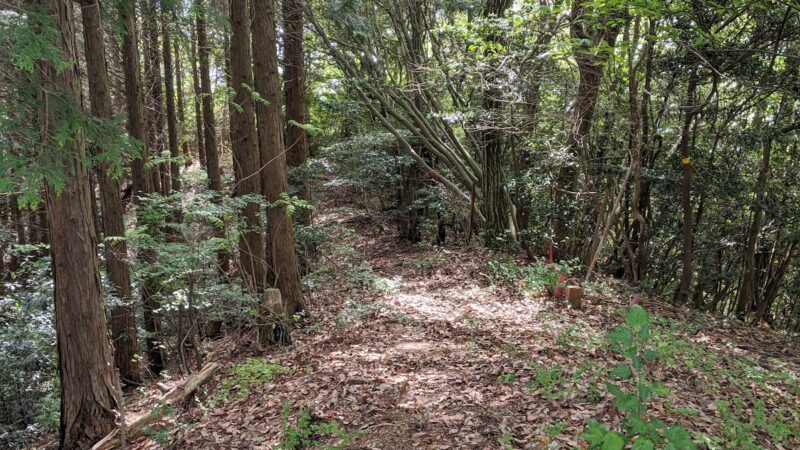
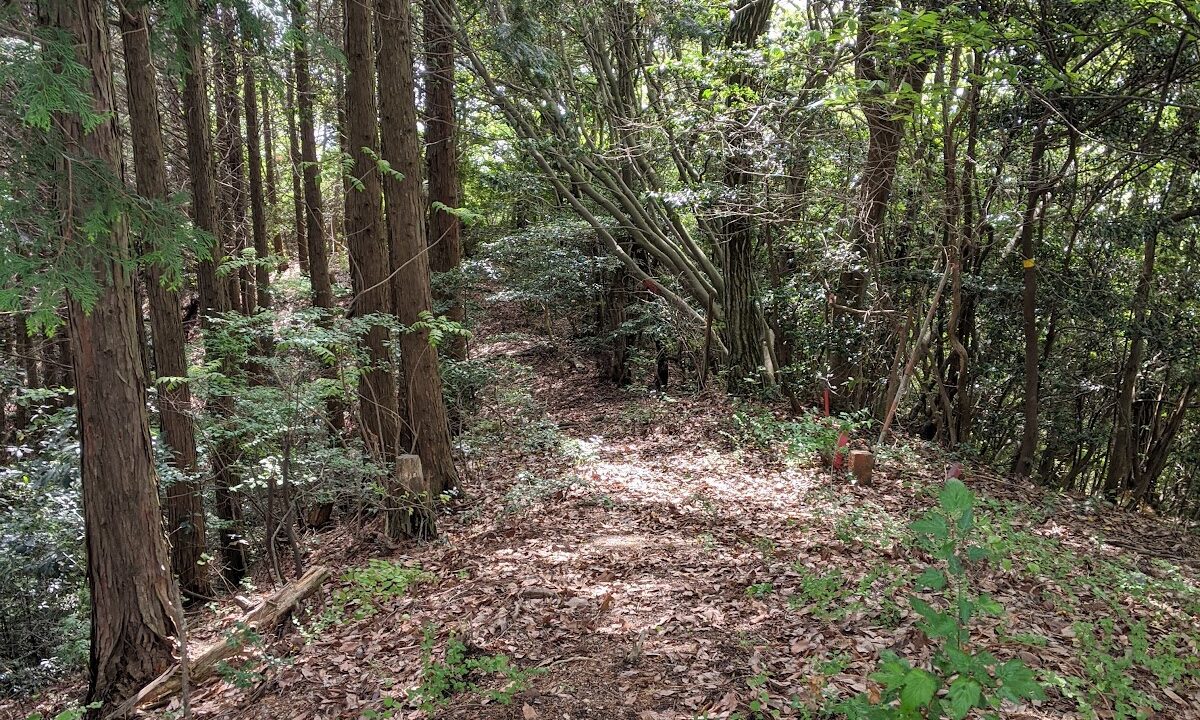
Kuruwa (Enclosures): Multiple enclosures, which are flat areas at the center of the castle, have been identified. It is presumed that multiple enclosures, arranged in a stepped pattern, extended from the mountaintop down the slope, centered around the main enclosure.
Earthworks: Traces of earthworks have been confirmed in some enclosures, indicating their function as defensive structures.
Cut Cliffs: Steep cut cliffs (artificially carved steep slopes), characteristic of mountain castles, are visible in various places, demonstrating a strategy to make enemy intrusion difficult.
While possessing the basic structure of a mountain castle, no large-scale stone walls have been confirmed, exhibiting a typical form of a medieval mountain castle primarily constructed of earth. This suggests that Zoda Castle was built using castle construction techniques from the early to mid-Sengoku period.
Kubikiri Pass and Related Historical Sites
Origin of Kubikiri Pass
Kubikiri Pass, through which Kagawa Prefectural Road 17 passes, is an important site that conveys the tragedy of Zoda Castle. It is said that many soldiers were killed in the battle of Tensho 7 (1579) at this pass, and that the heads of the fallen soldiers were cut off here.
Even today, a Jizo statue commemorating the fallen soldiers is enshrined at the pass and is carefully preserved by the local people. This Jizo statue is a valuable reminder of the fierce battles of the Sengoku period.
The Grave of Zoda Bichu-no-kami
At Kubikiri Pass, the grave of the castle lord, Zoda Bichu-no-kami Munetoshi, remains. It is believed to have been erected by later generations to mourn the castle lord who committed suicide.
The grave site is enshrined as “Zoda Daimyojin” and is considered the burial place of Zoda Bichu-no-kami Munetoshi. As an important historical site that conveys the history of the region, it continues to attract visitors.
Relationship with Bichu-ji Castle
Near Zoda Castle, there is another mountain castle called “Bichu-ji Castle.” Located in Bichu-ji, Zoda, Mannō-cho, Nakatado-gun, Kagawa Prefecture, it is a mountain castle at an altitude of 240m with a relative height difference of approximately 60m.
Remains such as earthworks and baileys have been confirmed at Bichu-ji Castle, suggesting the possibility that it was a subsidiary castle or related facility of Zoda Castle. The connection between the castle lord’s name, “Bichu-no-kami,” and the place name “Bichu-ji” is also an interesting point.
Access and Visiting Information for Zoda Castle
Location
- Address: Zoda, Mannō-chō, Nakatado-gun, Kagawa Prefecture (border with Nishibun, Ayagawa-chō, Ayauta-gun)
- Former Province: Sanuki Province
Access Methods
Access by Car:
- Approximately 15km from the Zentsuji IC on the Takamatsu Expressway, about 25 minutes by car
- The trailhead is near Kubikiri Pass on Kagawa Prefectural Road 17
Public Transportation:
- Approximately 20 minutes by taxi from Kotohira Station on the JR Dosan Line
- Access by public transportation is inconvenient, so using a car is recommended.
Precautions for Visiting the Castle
Zoda Castle is a full-fledged mountain castle, and the following preparations and precautions are necessary for visiting.
- Mountaineering Equipment: Since the climb is to an altitude of 428m with a relative elevation difference of 250m, hiking boots and comfortable clothing are essential.
- Estimated Time: Allow approximately 2-3 hours for the round trip.
- Season: In summer, vegetation is lush, and in winter, there is a possibility of snow. Spring and autumn are recommended for the climb.
- Hydration: There are no water sources on the mountain, so please bring plenty of drinking water.
- Avoid Solo Trips: It is recommended to climb in groups whenever possible.
Nearby Tourist Attractions
When visiting Zoda Castle, you can also visit nearby tourist attractions.
Mannō Town Highlights:
- Mannō Pond: One of Japan’s largest irrigation reservoirs, known for its renovation by Kōbō Daishi Kūkai.
- Sanuki Mannō National Park: A vast park where you can enjoy flowers throughout the seasons.
Kotohira, Marugame, and Sakaide Areas:
- Kotohira-gū Shrine: A famous shrine in Sanuki Province, affectionately known as “Konpira-san.”
- Marugame Castle: A famous castle with an existing keep.
- Zentsūji Temple: The birthplace of Kōbō Daishi Kūkai.
The Position of Zōda Castle in Sanuki Province’s Castle Culture
Characteristics of Mountain Castles in Kagawa Prefecture
Kagawa Prefecture (formerly Sanuki Province) has a relatively flat topography, but there are also many mountain castles. Sengoku period mountain castles are scattered throughout various regions such as Takamatsu City, Sakaide City, Marugame City, Zentsūji City, and Mitoyo City, each telling the story of the region’s history.
In addition to Zoda Castle, many other mountain castles have been identified in Nakatado District, indicating that this region held a strategically important position during the Sengoku period.
Chosokabe Motochika’s Invasion of Sanuki and Mountain Castles
Chosokabe Motochika’s invasion of Sanuki Province marked a turning point in the fate of many mountain castles in Sanuki. Some castles, like Zoda Castle, fell after fierce battles, while others surrendered without a fight.
The Battle of Zoda Castle is a classic example of how local lords responded to powerful forces. Despite the overwhelming difference in troop numbers, the stance of Zoda Bichu-no-kami Munetoshi, who resisted to the end, is remembered as a testament to the pride and determination of a samurai.
Value in Castle Research
Although Zoda Castle is not designated as a cultural property, it is attracting attention from castle researchers as a typical example of a medieval mountain castle in Sanuki Province.
The creation of castle layout maps and the investigation of remains are progressing, providing valuable information for understanding the structure and function of mountain castles during the Sengoku period. In particular, some parts of the remains are relatively well-preserved, and further detailed investigations are anticipated.
Significance of Visiting Zoda Castle
Experiencing Historical Romance
Visiting Zoda Castle is not merely a mountain climb; it’s an experience of touching upon the turbulent history of the Sengoku period. Standing at Kubikiri Pass and paying respects at the grave of Zoda Bichu-no-kami Munetoshi, one can reflect on the fierce battles that unfolded here over 440 years ago.
The view from the summit is magnificent, offering a panoramic view of the Sanuki Plain. Imagining how the castle lords tried to defend this land while gazing at this scenery is one of the joys of visiting castle ruins.
Learning Local History
Learning the history of Zoda Castle leads to an understanding of the history of Nakatado District in Kagawa Prefecture, and indeed, the entire Sanuki Province. In the local history of Mannō and Ayagawa towns, Zōda Castle holds a significant position and is an integral part of the region’s identity.
Visiting this historical site, carefully preserved by local people, allows one to realize that history is not merely a past event, but is passed down as a memory and source of pride for those living today.
Experiencing the Charm of Mountain Castles
When people think of Japanese castles, they often imagine the early modern castles with their keeps. However, mountain castles from the Sengoku period possess a unique charm distinct from stone walls and keeps.
By actually walking through and experiencing the unique structures of mountain castles—such as layouts that skillfully utilize natural terrain, steep cliffs, and enclosures created by leveling ridges—one can understand the ingenuity of medieval castle construction techniques and tactics.
Preservation of Zōda Castle and Future Challenges
Current Situation and Challenges
Currently, the Zōda Castle ruins are not undergoing any particularly active development, and the remains are left in a natural environment. While this has desirable aspects from the perspective of preserving the remains, it also presents the following challenges. 1. Weathering of Remains: Remains such as earthworks and baileys are weathering over time.
- Difficulty of Access: The lack of well-maintained hiking trails makes access difficult for the general public.
- Low Awareness: Awareness outside the region is low, and its value as a historical heritage site is not widely known.
Efforts for Preservation
Local history enthusiasts and castle researchers continue their efforts to convey the value of Zoda Castle. Photography, surveying, and the creation of castle layout maps are being carried out, and little by little, the true nature of Zoda Castle is becoming clearer.
Furthermore, Zoda Daimyojin (the burial place of Zoda Bichu-no-kami Munetoshi) at Kubikiri Pass is protected by local people, and people can be seen regularly paying their respects. These steady efforts are contributing to passing on the memory of history to future generations.
Future Prospects
In order for Zoda Castle to become a place known and visited by more people in the future, the following efforts are expected:
- Conduct detailed academic research and prepare reports
- Install signboards and explanatory panels
- Develop safe routes to the castle
- Utilize the site as a local tourist resource
- Disseminate information using digital technology (e.g., VR/AR restoration)
However, excessive development could lead to the destruction of the ruins, so it is important to strike a balance between preservation and utilization.
Summary
Zoda Castle is a mountain castle located at an altitude of 428m on the border of Mannō Town and Ayagawa Town in Nakatado District, Kagawa Prefecture. It played an important role as the residence of a local lord in Sanuki Province during the Sengoku period.
In 1579, it fell to an attack by Chōsokabe Motochika, and its lord, Zoda Bitchū-no-kami Munetoshi, met a tragic end by committing suicide. However, its history is still recounted in the region through the place name Kubikiri-tōge (Beheading Pass) and the name Zoda Daimyōjin.
Even today, remnants such as baileys and earthworks remain on the mountaintop, making it a quintessential example of a mountain castle in Sanuki Province and a subject of castle research. While proper mountain climbing equipment is necessary to reach the top, the views from the summit and the historical romance make it well worth the visit.
Many castle ruins remain throughout Kagawa Prefecture, including Takamatsu, Sakaide, Marugame, Zentsuji, and Mitoyo, but Zoda Castle stands out as a particularly valuable historical site that conveys the turbulent events of the Sengoku period. Those interested in history or mountain castles should definitely consider visiting.