Kaizaki Castle (Mitoyo City, Kagawa Prefecture): History and Highlights | A Thorough Explanation of Sanuki’s Mountain Castle Ruins
What is Kaizaki Castle?
Kaizaki Castle is a medieval mountain castle located in Hako, Takuma-cho, Mitoyo City, Kagawa Prefecture. Built on a mountaintop approximately 210 meters above sea level, this castle functioned as an important base in western Sanuki Province (present-day Kagawa Prefecture).
Even today, the remains of the castle, such as the baileys and moats, are well-preserved, attracting attention from castle enthusiasts and history buffs. While Kagawa Prefecture boasts famous castles like Marugame Castle and Takamatsu Castle, mountain castles like Kaizaki Castle are valuable historical sites that convey the practical castle-building techniques of the Sengoku period.
Basic Information on Kaizaki Castle
- Location: Hako, Takuma-cho, Mitoyo City, Kagawa Prefecture
- Castle Type: Mountain Castle
- Elevation: Approximately 210 meters
- Relative Height: Approximately 209 meters
- Main Remains: Enclosures, moats, earthworks
- Construction Period: Sengoku period (estimated)
- Abandonment Period: Unknown
History of Kaizaki Castle
Position of Kaizaki Castle in Sanuki Province
Sanuki Province is a strategically important region facing the Seto Inland Sea, and many castles have been built there since ancient times. The area around Mitoyo City is located in the western part of Sanuki Province and, being close to the border with Bitchu Province (present-day Okayama Prefecture), was considered a strategically important military stronghold.
Kaizaki Castle is thought to have functioned as one of the defensive bases in this region. Given its mountain castle location, it is presumed that it served to monitor enemy invasions and act as a refuge for local samurai and villagers in emergencies.
Sanuki and Kaizaki Castle in the Sengoku Period
During the Sengoku period, Sanuki Province was ruled by various forces, including the Hosokawa, Miyoshi, and Chosokabe clans, as well as various generals under Toyotomi Hideyoshi. In particular, in the latter half of the 16th century, Chosokabe Motochika of Tosa invaded Sanuki, forcing many local lords to submit or resist.
Kaizaki Castle was likely used by local samurai groups during this period of turmoil. Although detailed historical records are scarce, its structure clearly indicates that it functioned as a practical defensive structure.
Kaizaki Castle in the Early Modern Period and Beyond
In the Edo period, Sanuki Province was mainly divided and ruled by the Takamatsu and Marugame domains. With the arrival of a peaceful era, the need to maintain practical mountain castles diminished, and many were abandoned. Kaizaki Castle is also believed to have been abandoned during this period.
Currently, its remains are being investigated and documented by local history enthusiasts and castle researchers, and it is recognized as a valuable historical site for understanding the medieval history of Sanuki.
Kaizaki Castle’s Layout and Remains
Characteristics as a Mountain Castle
Kaizaki Castle is a typical mountain castle, characterized by its defensive design that takes advantage of the steep terrain. Its location at an altitude of 210 meters offered the advantage of not only allowing for early detection of approaching enemies but also enabling defense from higher ground against advancing forces.
Compared to flatland castles and hill castles, mountain castles do not require large-scale civil engineering works such as stone walls, and are built by making maximum use of the natural terrain. Kaizaki Castle also follows this principle, with its layout utilizing ridges and slopes.
Main Enclosure and Sub-Enclosures
The main enclosure (equivalent to the main keep) was located in the center of Kaizaki Castle, surrounded by several sub-enclosures (such as the second and third enclosures). These enclosures were flat, leveled spaces used for building structures or stationing soldiers.
Even today, the remains of these enclosures can be seen as elevation changes in the terrain. The main enclosure is located at the highest point, offering an excellent vantage point for overlooking the surrounding area.
Structure of the Moat
A key defensive feature of Kaizaki Castle is the moat (horikiri). A moat is a dry ditch dug across a ridge, serving to prevent enemy intrusion.
Multiple moats have been identified at Kaizaki Castle, with particularly deep moats located along the approach to the main enclosure. This was a deliberate design to prevent the enemy from easily reaching the main enclosure. The depth and width of the moats provide important clues to the level of castle-building technology at the time.
Placement of Earthworks
Traces of earthworks also remain around the enclosures. Earthen ramparts are defensive structures built by piling up earth, providing protection from enemy arrows and bullets, and also obscuring the view of the castle’s interior from the outside.
Although parts of the earthen ramparts at Kaizaki Castle have collapsed due to natural weathering, traces of them can still be seen in places. The height and arrangement of the ramparts allow us to understand the castle’s defensive plan.
Vertical and Horizontal Moats
Vertical moats and horizontal moats are also important defensive structures unique to mountain castles. Vertical moats are dug vertically along the slope, preventing enemies from climbing the slope. Horizontal moats run horizontally along the slope, similarly restricting enemy movement.
The arrangement of these moats has been confirmed at Kaizaki Castle, indicating that a three-dimensional defensive network was constructed overall.
Access to Kaizaki Castle
Location and Transportation
Kaizaki Castle ruins are located in Hako, Takuma-cho, Mitoyo City, Kagawa Prefecture. Access by public transport is somewhat difficult, so visiting by private car is recommended.
Access by Car:
- Approximately 15 minutes from the Mitoyo-Torisaka Interchange on the Takamatsu Expressway
- From the center of Takuma Town, take the prefectural road to the vicinity of the castle ruins.
Parking: There is no dedicated parking lot for the castle ruins, but there is space for roadside parking near the trailhead (please be aware of surrounding traffic conditions).
Climbing Route
Climbing to Kaizaki Castle requires hiking up a mountain path. The climb from the trailhead to the main enclosure takes approximately 30 to 40 minutes.
Important Notes:
- Some sections of the hiking trail are not well-maintained, so appropriate equipment such as hiking boots is necessary.
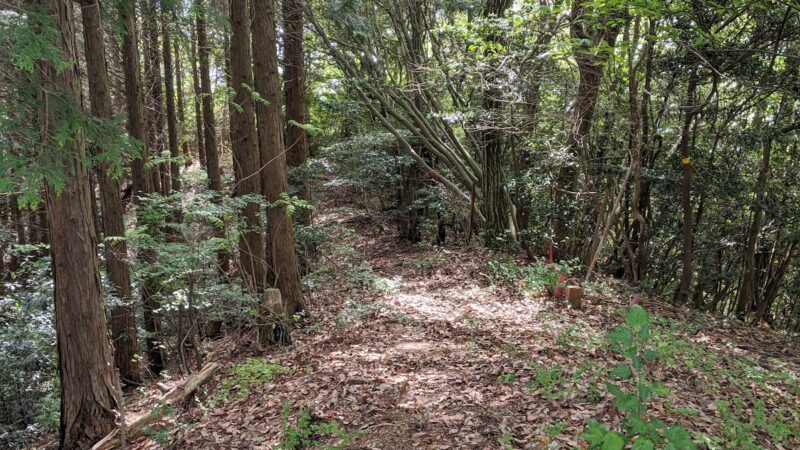
- In summer, vegetation can be overgrown, making the trail difficult to follow.
- Avoid climbing alone; visiting in a group is recommended.
- Don’t forget to stay hydrated and bring insect repellent.
Clothing and Equipment for Your Visit
The following equipment is recommended for visiting the mountain castle:
- Hiking boots or trekking shoes
- Long-sleeved shirt and long pants (to protect yourself from vegetation and insects)
- Hat and gloves
- Drinking water
- Map or GPS device
- Camera (for documenting the ruins)
- Insect repellent spray
Highlights of Kaizaki Castle
Well-Preserved Ruins
The greatest appeal of Kaizaki Castle is the relatively well-preserved remains of this medieval mountain castle. Because it has not been subjected to later development, it is easy to imagine its appearance at the time of its construction.
This is a valuable opportunity to directly observe the castle-building techniques of the Sengoku period, such as the layout of the baileys, the depth of the moats, and the traces of earthworks.
Stunning Views
From the mountaintop at an altitude of 210 meters, you can enjoy a panoramic view of the plains surrounding Mitoyo City and the Seto Inland Sea. On clear days, you can even see the Seto Ohashi Bridge and the islands of the Bisan Seto.
This view speaks to the importance of Kaizaki Castle as a surveillance base. The castle lord and soldiers of the time likely monitored the surrounding area while gazing at this scenery.
Harmony with Nature
The Kaizaki Castle ruins are now covered in forest, creating a beautiful landscape in harmony with nature. You can enjoy the changing seasons, from the fresh greenery in spring to the vibrant autumn foliage.
One of the charms of Kaizaki Castle is that it can be enjoyed not only for historical exploration but also for nature walks and hiking.
Comparison with Other Castles in Kagawa Prefecture
Differences from Marugame Castle
Marugame Castle is a representative castle of Kagawa Prefecture. It is one of the 12 castles with existing keeps and is a flatland castle known for its magnificent stone walls.
The biggest difference between Kaizaki Castle and Marugame Castle lies in their characteristics. Marugame Castle functioned as a political and administrative center as a castle of the early modern period, while Kaizaki Castle was a practical mountain castle of the medieval period, primarily used for military purposes.
Marugame Castle has existing or restored structures such as keeps, turrets, and gates, but no structures remain at Kaizaki Castle; only earthen remains exist.
Comparison with Takamatsu Castle
Takamatsu Castle (Tamamo Castle) is a seaside castle counted as one of Japan’s three great water castles. Facing the Seto Inland Sea, it is known for its unique structure that draws seawater into its moats.
Takamatsu Castle served as the central fortress of Sanuki Province and functioned as the administrative center of the Takamatsu Domain throughout the Edo period. Currently, it is maintained as Tamamo Park and is a tourist destination.
Kaizaki Castle, unlike Takamatsu Castle, was not a large-scale fortress but rather served as a regional defensive stronghold. While differing in scale and structure, it exhibits the characteristics of castles suited to their respective eras and purposes.
Position within the Sanuki Mountain Castle Group
Besides Kaizaki Castle, many other mountain castle ruins remain in Kagawa Prefecture. Hikida Castle, Katsuga Castle, Amagiri Castle, and Shōtsūji Castle are all important historical sites that tell the story of the region’s history.
These mountain castles convey the atmosphere of warring states in Sanuki during the Sengoku period. Kaizaki Castle, as one of these Sanuki mountain castles, occupies an important position in regional history research.
How to Enjoy Your Visit to Kaizaki Castle
Observing the Castle Ruins
When visiting Kaizaki Castle, paying attention to the following points will help you understand the castle’s structure more deeply:
- Layout of Enclosures: Observe the layout from the main enclosure to the secondary enclosures to grasp the overall layout of the castle.
- Depth and Width of Moats: Confirm the scale of the moats as defensive structures.
- Traces of Earthworks: Look for traces of earthworks remaining around the enclosures.
- Utilization of Topography: Observe how the natural terrain was utilized.
Photography Tips
Kaizaki Castle is also an attractive subject for photography:
- Photographing Ruins: Photograph from angles that show the characteristics of the ruins, such as moats and the elevation differences of the enclosures.
- Photographing Views: Photograph the view from the mountaintop with a wide-angle lens.
- Harmony with Nature: Capture the atmosphere of the castle ruins covered in forest.
- Seasonal Changes: Recording the Changing Seasons
The Joys of Historical Exploration
You can position your visit to Kaizaki Castle as part of a broader historical exploration:
- Visit other historical sites around Mitoyo City
- Research related materials at local history museums
- Listen to legends and folklore from local residents
- Learn about the history of Sanuki during the Sengoku period
Preservation of Kaizaki Castle and Future Challenges
Preservation Status of the Remains
The remains of Kaizaki Castle are relatively well-preserved because they escaped development. However, some parts of the remains are difficult to see due to natural weathering and overgrown vegetation.
Regular mowing and simple maintenance would make it easier for more people to visit, and would increase the value of the castle ruins.
Utilization as a Regional Resource
Medieval mountain castles like Kaizaki Castle are valuable historical resources for the region. There are various possibilities for their use, such as as a tourist resource, an educational site, and as a core element of regional identity.
It is hoped that Mitoyo City, local residents, and history enthusiasts will cooperate to widely disseminate the value of Kaizaki Castle.
Need for Research
Many aspects of Kaizaki Castle remain unclear. Due to the scarcity of historical documents regarding its builder, construction date, period of use, and circumstances of its abandonment, archaeological research is urgently needed.
If archaeological excavations and surveys are conducted, the true nature of Kaizaki Castle will become clearer, bringing new insights to the study of medieval history in Sanuki.
History and Culture of Mitoyo City
Overview of Mitoyo City
Mitoyo City is located in the western part of Kagawa Prefecture, a scenic area facing the Seto Inland Sea. It was formed in 2006 through the merger of seven towns in Mitoyo District (Takase, Yamamoto, Mino, Toyonaka, Takuma, Nio, and Saida).
It has flourished since ancient times as a vital transportation hub, playing an important role as a connecting point for both maritime and land transportation.
Historical Heritage of Mitoyo City
Besides Kaizaki Castle, Mitoyo City boasts numerous historical sites:
- Ancient Burial Mounds: Ancient tombs are scattered throughout the area.
- Temples and Shrines: Historic temples and shrines are scattered throughout the city.
- Traces of a Port Town: Historical port town landscapes remain in areas such as Nio-cho.
- Modernization Heritage: Industrial heritage from the Meiji era onward.
Tourism in Mitoyo City
Mitoyo City is an attractive region not only for its historical sites but also for its natural scenery and food culture:
- Chichibugahama Beach: A popular beach known as “Japan’s Uyuni Salt Flats.”
- Shiunideyama Mountain: A scenic spot known for its cherry blossoms.
- Seafood: Fresh seafood from the Seto Inland Sea.
- Sanuki Udon: Numerous udon restaurants specializing in Kagawa Prefecture’s famous udon noodles.
By visiting these tourist spots in conjunction with a visit to Kaizaki Castle, you can comprehensively enjoy the charm of Mitoyo City.
Summary
Kaizaki Castle is a medieval mountain castle located in Hako, Takuma-cho, Mitoyo City, Kagawa Prefecture. Built on a mountaintop 210 meters above sea level, the castle retains well-preserved remains such as baileys, moats, and earthworks, conveying its role as a regional defensive base in Sanuki during the Sengoku period.
While less well-known than famous castles like Marugame Castle or Takamatsu Castle, it is attracting attention from castle enthusiasts and history buffs as a valuable historical site that preserves the appearance of a practical mountain castle.
Visiting requires mountain climbing equipment and access is somewhat difficult, but the views from the mountaintop, the well-preserved remains, and the landscape in harmony with nature make it well worth the visit.
Kaizaki Castle is also an important element in understanding the history and culture of Mitoyo City. As a regional historical resource, further research, preservation, and utilization are expected in the future.
If you are interested in the history of Sanuki or enjoy exploring mountain castles, please visit Kaizaki Castle. Viewing the same landscape that medieval samurai saw from the same spot will deepen your understanding of history.