Yada Castle (Ibaraki Prefecture) Complete Guide | History, Highlights, and Access Information
What is Yada Castle?
Yada Castle (Yatajo, Yadajo) is a medieval mountain castle located in Yada, Daigo-machi, Kuji-gun, Ibaraki Prefecture. Built on a mountaintop approximately 212 meters above sea level, it is now part of the Daigo Wide Area Park hiking trail and is popular with history enthusiasts and castle fans.
Functioning as an important base in northern Hitachi during the early Sengoku period, this castle was the stage for conflicts between the two major powers, the Shirakawa Yuki clan and the Satake clan. While historical records regarding the exact construction date and lords are limited, along with many other castles and fortifications remaining in the region, it is a valuable historical heritage site that conveys the turbulent Sengoku period to the present day.
Basic Information on Yada Castle
- Location: 1555 Gomenzawa (Gomenzawa), Yada, Daigo-machi, Kuji-gun, Ibaraki Prefecture
- Castle Structure: Mountain Castle (Hilltop Castle)
- Elevation: Approximately 212 meters
- Relative Height: Approximately 100 meters
- Construction Period: Early Sengoku period (estimated)
- Abandonment Period: Unknown
- Remains: Enclosures, moats, earthworks, baileys
- Current Status: Hiking course within Daigo Wide Area Park
History of Yada Castle
Background and Historical Context of Construction
During the early Sengoku period, when Yada Castle was built, the northern part of Hitachi Province was under a complex political situation. This region was located on the border between the spheres of influence of the Shirakawa Yuki clan and the Satake clan, and conflicts between the two were frequently fought.
The Shirakawa Yuki clan was a powerful daimyo based in Shirakawa, Mutsu Province, and sought to expand its influence into northern Hitachi Province through a southward expansion policy. Meanwhile, the Satake clan, a powerful shugo daimyo of Hitachi Province, built several branch castles and forts in the region to counter threats from the north, establishing a defensive line.
Yada Castle is thought to be one of the castles built amidst this tense relationship. Located at a strategic transportation hub in the Kuji River basin, it is presumed to have been an important base both militarily and economically.
Castle Lord and Ruler
Regarding the specific lord of Yada Castle, there is a lack of reliable historical records, and details remain unclear. However, based on local traditions and the layout of surrounding castles, the following possibilities have been suggested:
It is highly probable that the castle lord was a local lord belonging to either the Shirakawa Yuki clan or the Satake clan, and that the ruler may have changed in accordance with shifts in the power balance between the two forces. In the vicinity of Daigo Town, several castles and fortifications built around the same time existed, including Tsukii Castle (Fukuroda Castle), Irikami Castle (Hanawa Castle), and Korofuji Castle (Ogawa Castle). It is believed that these castles cooperated in regional defense.
Role in the Sengoku Period
Yada Castle is presumed to have played the following roles based on its location:
Military Base Function: It served as a lookout post to monitor the Kuji River basin and detect enemy invasions early. As a defensive base utilizing the mountainous terrain, it also served as a refuge for surrounding residents in times of emergency.
Traffic Monitoring: It may have also had economic functions, such as monitoring the road connecting Mutsu Province and Hitachi Province and collecting tolls.
Center of Regional Governance: It is thought to have functioned as the residence of a local lord governing the surrounding villages.
Abandonment of the Castle and its Aftermath
The exact date of Yada Castle’s abandonment is unclear, but after Toyotomi Hideyoshi’s siege of Odawara in 1590, the Satake clan unified Hitachi Province. When they were transferred to Akita in 1602, many of their subsidiary castles were abandoned, suggesting that Yada Castle also ceased its function around this time.
During the Edo period, the Tokugawa shogunate’s “One Castle Per Province” decree resulted in the demolition of all castles except for the main ones. Yada Castle lost its function as a military facility and was subsequently used for farmland and forestry.
Structure and Layout of Yada Castle
Castle Layout
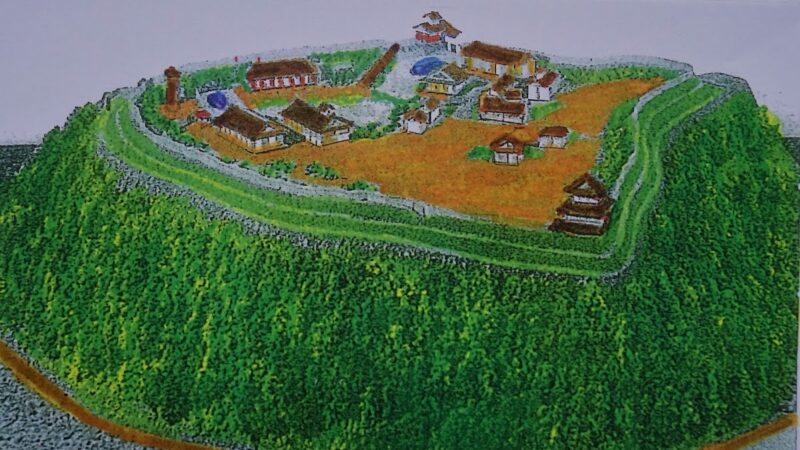
Yada Castle has a typical medieval mountain castle layout. The main enclosure is located at the 212-meter-high mountaintop, surrounded by multiple baileys in a linear, interconnected structure.
Main Enclosure (Honmaru): Located at the mountaintop, this is the most important section, presumably where the lord’s residence and command post were located. It was constructed by leveling the relatively flat terrain, and its outline can still be seen today.
Second and Third Enclosures (Ninmaru and Sanmaru): A group of enclosures arranged in stages around the main enclosure. These served to reinforce defenses and were used as garrisons for soldiers and storage for supplies.
Defensive Structures
Yada Castle exhibits defensive structures typical of medieval mountain castles.
Moat: A dry moat dug to block the ridge, an important defensive structure to prevent enemy intrusion. Multiple moats have been identified at Yada Castle, particularly prominently located in the approach to the main enclosure. The depth of the moats varies depending on the location, reaching several meters in some places.
Earthwork: A wall of earth built around the enclosure. It prevented enemy intrusion and also functioned as a foundation for watchtowers and fences. Traces of earthworks can still be seen in some areas today.
Cut Slope: A defensive structure created by carving a steep slope around the enclosure. By utilizing the natural terrain while artificially making the slope steep, it made it difficult for the enemy to climb.
Characteristics of the Castle Layout
The layout of Yada Castle has the following characteristics:
Utilization of Natural Terrain: It is designed to make the most of the mountainous terrain and achieve maximum defensive effect with minimal civil engineering work. This is a common characteristic of small-scale castles in rural areas.
Simple Structure: No large-scale structures such as stone walls or turrets have been confirmed; it is a simple structure mainly consisting of earthworks and moats. This reflects that it was built in the early Sengoku period and was the castle of a local lord.
Practical Layout: There are few decorative elements, and the layout is rational, assuming actual combat. It is characterized by a design that emphasizes practicality, such as the multi-layered defensive lines created by multiple moats.
Highlights of Yada Castle
Existing Remains
Currently, the following remains can be observed at the Yada Castle site:
Enclosures: Multiple enclosures, centered around the main enclosure, remain in relatively good condition. The flat area of the main enclosure is particularly clear, allowing one to appreciate the scale of the castle in its heyday. Each enclosure is separated by elevation differences, allowing observation of a typical structure of a medieval mountain castle.
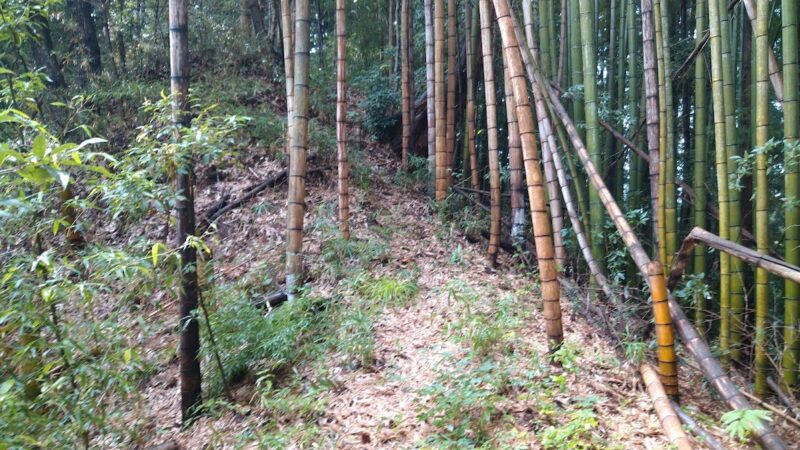
Moats: Moats can be observed in multiple locations within the castle grounds. The moat along the ridge leading to the main enclosure, in particular, is deep and wide, giving a powerful sense of its defensive capabilities. Although some parts are currently filled with fallen leaves and sediment, the typical V-shaped cross-section of a medieval moat can be observed.
Earthworks: Traces of earthworks can be seen around some enclosures. While the height is low, around 1 meter, the artificially constructed mounds of earth are clearly visible.
Cut Slopes: Around each enclosure, there are artificially carved steep slopes (cut slopes). Characterized by their straight inclines, unlike natural slopes, these demonstrate ingenuity as defensive structures.
Attractions as a Hiking Course
Yada Castle Ruins are part of the Daigo Wide Area Park hiking course, allowing visitors to enjoy both castle exploration and nature walks simultaneously.
Easy Access: Because it’s a park, the hiking trails are clear, making access to the castle ruins relatively easy. Signposts are also installed, so even beginners can explore without getting lost.
Natural Environment: The surrounding area is rich in nature, allowing visitors to enjoy the scenery of each season. The fresh greenery in spring and the autumn foliage are beautiful, allowing visitors to enjoy castle exploration and nature observation at the same time.
Views: From the mountaintop, you can overlook the Kuji River basin and the surrounding mountains. You can truly appreciate how this view was used to monitor enemy movements during the Sengoku period.
Points to Note During Your Visit
When visiting Yada Castle, paying attention to the following points will help you understand the castle’s charm more deeply.
Observation of Moats: Carefully observe the multiple moats. You can discern their defensive features from their depth, width, and shape.
Arrangement of Enclosures: Start from the main enclosure and proceed to the lower enclosures, observing their layout. You can understand the rational arrangement in accordance with the terrain.
Relationship with Topography: Pay attention to how the castle was built utilizing the natural terrain. Observing the relationship between topographic elements such as ridges, valleys, and slopes and the castle facilities reveals the intentions of the castle builder.
Connection to the Surrounding Area: If possible, visit the surrounding castle ruins such as Tsukii Castle and Irigami Castle. Understanding the castle network in this region will clarify the role of Yada Castle.
Related Historical Sites in the Surrounding Area
Castles and Fortifications in Daigo Town
Several castles and fortifications built around Yada Castle exist in the surrounding area.
Tsukii Castle (Fukuroda Castle): Located in Fukuroda, Daigo-machi, near Fukuroda Falls. Like Yada Castle, it played an important role in the conflict between the Shirakawa Yuki clan and the Satake clan.
Irigami Castle (Hanawa Residence): A castle located in Hanawa, Daigo-machi. It is believed to have functioned as the residence of a powerful local lord.
Korofuji Castle (Ogawa Castle): A castle located in Korofuji, Daigo-machi. While the remains are not well-preserved, it played a part in the regional defense network.
These castles are thought to have cooperated with each other in regional defense, and Yada Castle also functioned as part of this network.
Daigo Wide Area Park
Daigo Wide Area Park, which includes the Yada Castle ruins, is a comprehensive park where you can enjoy nature and history simultaneously. Hiking trails are maintained, and there are various points of interest besides the castle ruins.
Information boards and explanatory signs are installed throughout the park, making it enjoyable even for those unfamiliar with history. Furthermore, you can enjoy the changing seasons, so you’ll discover something new every time you visit.
Access Information
Access by Public Transportation
Train: The nearest station is Hitachi-Daigo Station on the JR Suigun Line. From the station to the castle ruins, you can walk or take a taxi.
Bus: There are local buses from Hitachi-Daigo Station, but the number of buses is limited, so it is recommended to check the timetable in advance.
Taxi: It takes about 10-15 minutes by taxi from Hitachi-Daigo Station.
Access by Car
Joban Expressway: Approximately 60 minutes from Naka IC via National Route 118
Tohoku Expressway: Approximately 90 minutes from Yaita IC via National Routes 461 and 118
Parking: Parking is available at Daigo Wide Area Park. It is free of charge.
Points to Note When Visiting
Clothing: As it is a mountain castle, comfortable walking shoes and clothing are essential. Particular caution is needed after rain, as the ground can become slippery.
Items to Bring: Bring drinking water, a towel, and insect repellent (in summer).
Time: Allow 30 minutes to an hour to visit the castle ruins. If you wish to observe thoroughly, it is recommended to allow more time.
Season: Spring to autumn is suitable for visiting, but caution is needed in winter due to the possibility of snow and ice.
Bear Precautions: As it is a mountainous area, it is recommended to carry a bear bell or similar device.
Historical Value and Preservation of Yada Castle
Historical Significance
Yada Castle possesses the following historical value:
Regional History of the Sengoku Period: It is an important historical site for understanding the Sengoku period history of northern Hitachi, specifically the conflict between the Shirakawa Yuki clan and the Satake clan. While not a famous castle that was the site of a large-scale battle, it is a valuable historical site that conveys the realities of the Sengoku period at a regional level.
Typical Example of a Medieval Castle: It retains the typical structure of a medieval mountain castle built by a local lord, making it valuable for the study of castle history. As a purely medieval castle lacking modern elements such as stone walls, it provides clues to understanding the castle-building techniques of the time.
Regional Cultural Property: It is an indispensable cultural property for telling the history of Daigo Town and is an important element in forming the region’s identity.
Preservation Status and Challenges
Yada Castle Ruins are maintained as part of Daigo Wide Area Park, so a certain level of preservation management is being carried out. However, the following challenges exist:
Natural Erosion: As it is a mountain castle, erosion due to wind and rain is progressing. In particular, earthworks and moats may be buried or collapsed over time.
Vegetation Management: There is a possibility that the remains may be covered by the growth of trees, so regular vegetation management is necessary.
Awareness: Due to its relatively low national recognition, efforts to increase interest in its preservation are needed.
Future Prospects
The following initiatives are expected for further utilization and preservation of the Yada Castle ruins:
Archaeological Excavation: Detailed archaeological investigations can clarify the castle’s history and structure.
Maintenance and Utilization: Improving explanatory signs and preserving the remains can deepen visitors’ understanding.
Collaboration with the Local Community: Utilization linked to regional development is possible, such as developing historical sightseeing routes in conjunction with surrounding castle ruins.
Educational Use: Using it as teaching material for local history in schools can help pass on history to future generations.
How to Enjoy Visiting Yada Castle
How to Enjoy for Castle Enthusiasts
Detailed Observation of Remains: Visitors can enjoy carefully observing the remains such as moats, baileys, and earthworks, taking photographs, and creating castle layout maps.
Comparison with Other Castles: Comparing this castle to other mountain castles from the same period allows you to understand its regional and historical characteristics.
Engage Your Imagination: Imagining the castle’s appearance and battles from the existing ruins is a great part of exploring castles.
Activities for Nature Lovers
Hiking: Enjoy nature walks using well-maintained hiking trails.
Bird Watching: As it is a mountainous area, there is a possibility of observing various wild birds.
Plant Observation: Enjoy the changing seasons and the beauty of nature.
Activities for Families
History Learning: This is a great opportunity to teach children about the history of the Sengoku period and the role of castles.
Picnic: You can enjoy a picnic in the park (but please be sure to take your trash home).
Exercise: Moderate hiking is good exercise and contributes to the health of your family.
Summary
Yada Castle is a valuable Sengoku period mountain castle ruin located in Daigo Town, Ibaraki Prefecture. It is an important historical site that conveys the history of the Sengoku period in northern Hitachi, specifically the conflict between the Shirakawa Yuki clan and the Satake clan. It is also a valuable place to observe the typical structure of a medieval mountain castle.
Because it is maintained as Daigo Wide Area Park, it is popular not only with castle enthusiasts but also with the general public who enjoy hiking and nature observation. The remains, such as moats and baileys, are relatively well-preserved, allowing visitors to experience the appearance of a Sengoku period castle.
While many details of its history remain unknown, this also offers the enjoyment of using one’s imagination. Several other castles from the same period, such as Tsukii Castle and Irigami Castle, exist in the surrounding area, making a historical exploration of these sites also appealing.
When visiting Ibaraki Prefecture, be sure to visit the Yada Castle ruins and feel the spirit of the Sengoku period. You’re sure to have a valuable experience of contemplating historical romance amidst abundant nature.