Takegahana Castle (Gifu Prefecture) Complete Guide | A Thorough Explanation of History, Water Siege, and Current Remains
Takegahana Castle was a flatland castle located in Takenohana-cho, Hashima City, Gifu Prefecture. Built during the Ōnin era (1467-1469), it is known for being besieged by Toyotomi Hideyoshi during the Sengoku period. Although the remains have now disappeared, its historical value is high, and it was an important castle that played a crucial role as a strategic point in Mino Province. This article provides a detailed explanation of the history of Takegahana Castle, from its construction to its abandonment, notable battles, and its current state.
Basic Information on Takegahana Castle
Castle Overview
Takegahana Castle was a flatland castle located in Haguri District, Mino Province (present-day Takenohana-cho, Hashima City, Gifu Prefecture). Originally belonging to Haguri District, Owari Province, it was incorporated into Mino Province after the Kiso River’s course shifted southward due to a major flood in 1586.
Basic Data
- Location: Marunouchi, Takenohana-cho, Hashima City, Gifu Prefecture
- Castle Structure: Flatland Castle
- Year of Construction: Onin Era (1467-1469)
- Builder: Takekoshi Naotaka (Takekoshi Izunokami)
- Main Lords: Takekoshi clan, Nagai clan, Fuwa clan, Ichiyanagi clan, Sugiura clan
- Year of Abandonment: After Keicho 5 (1600)
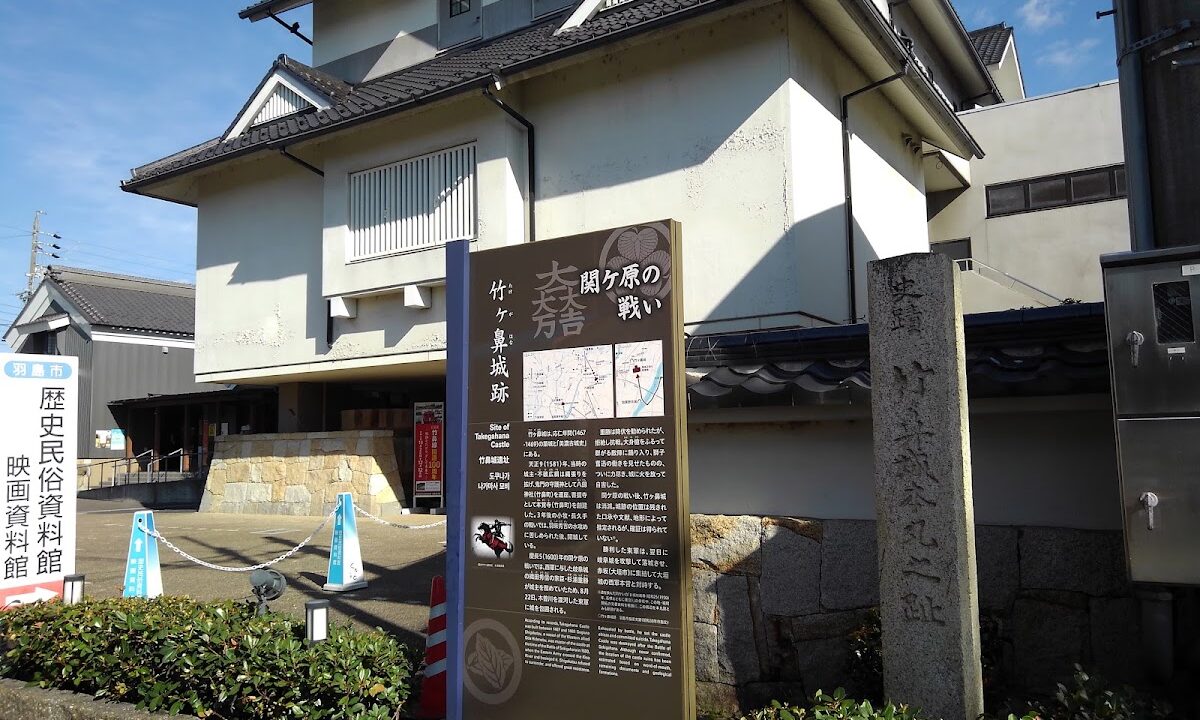
- Remains: Disappeared (Only stone monument and explanatory sign remain)
- Designation: Hashima City Designated Historic Site
Location and Geographical Characteristics
Takenohana Castle was located in a low-lying wetland area between the Kiso River and the Nagara River. This topographical feature was a factor that enabled Toyotomi Hideyoshi’s later water siege. Due to its nature as a flatland castle, unlike mountain castles which are natural strongholds, it is believed that a defensive system utilizing the surrounding rivers and moats was constructed.
Present-day Takenohana-cho in Hashima City is within walking distance of Takenohana Station on the Meitetsu Takenohana Line, and some remnants of the former castle town can still be seen.
History of Takenohana Castle
From Construction to the Early Sengoku Period
Takenohana Castle is believed to have been built during the Ōnin era (1467-1469) by Takekoshi Naotaka (Takekoshi Izunokami Naotaka). During the Ōnin War, as samurai expanded their power throughout the country, a castle as a defensive base became necessary in this region as well.
Around the Bunmei era (1469-1487), Nagai Toshitaka became the lord of the castle. The Nagai clan was a powerful local lord in Mino Province, and they built their power base at Takenohana Castle. However, in 1497, Nagai Toshitaka moved to Kanō Castle, and the rulers of Takenohana Castle changed hands several times.
The Era of Fuwa Hirotsuna and the Castle’s Renovation
During the mid-Sengoku period, Fuwa Genroku Hirotsuna (Fuwa Hirotsuna) became the lord of the castle. The Fuwa clan was a powerful warlord family in Mino Province and had maintained influence in the region even before Oda Nobunaga’s invasion of Mino. It is believed that Takegahana Castle underwent extensive renovations during Fuwa Hirotsuna’s time.
During the Fuwa clan’s rule, Takegahana Castle functioned as an important military base located on the border between Mino and Owari Provinces. As Oda Nobunaga advanced his conquest of Mino, the strategic value of this castle further increased.
Toyotomi Hideyoshi’s Water Siege
The Battle of Komaki-Nagakute and Takegahana Castle
Takegahana Castle first came to the forefront of history during the Battle of Komaki-Nagakute in 1584. This battle was a large-scale military conflict between Toyotomi Hideyoshi and the combined forces of Oda Nobuo and Tokugawa Ieyasu.
At the time, Takegahana Castle was besieged by Fuwa Hirotsuna. The Fuwa clan belonged to the Oda Nobuo faction, and for Hideyoshi, Takegahana Castle was a strategically important stronghold that needed to be captured in the Mino and Owari regions.
Implementation and Method of the Water Siege
In 1586 (Tensho 14), Hashiba Hideyoshi (Toyotomi Hideyoshi) implemented a water siege against Takegahana Castle. This water siege was one of Hideyoshi’s signature siege tactics and is known as a famous example, second only to the water siege of Bitchu Takamatsu Castle.
Hideyoshi’s army utilized the waters of the Kiso River and Nagara River, constructing embankments around Takegahana Castle to flood the castle. As a flatland castle, Takegahana Castle was vulnerable to this water siege, and supply lines to the castle were cut off.
While detailed records of the water siege are limited, Hideyoshi’s army isolated the castle in a short period, forcing Fuwa Hirotsuna to surrender. This water siege temporarily brought Takegahana Castle under Hideyoshi’s control.
Changes in Castle Lords After the Water Siege
After the water siege, Takegahana Castle was assigned to generals under the Toyotomi regime. Ichiyanagi Naosue (Ichiyanagi Kenmotsu Naosue) became the castle lord, and he oversaw the reconstruction and administration of the castle. The Ichiyanagi clan were highly trusted vassals of Hideyoshi and were entrusted with managing important strongholds within Mino Province.
Subsequently, generals such as Igi Tadatsugu, Moridera Seiemon, and Sugiura Shigekatsu served as castle lords. These lords played a role in regional governance and military affairs under the Toyotomi regime.
The Battle of Sekigahara and the Fall of Takegahana Castle
The Battle in the Prelude to Sekigahara
In 1600 (Keicho 5), the decisive Battle of Sekigahara erupted. Prior to this battle, fierce battles were fought throughout Mino Province between the Eastern Army (Tokugawa forces) and the Western Army (Ishida forces).
Takegahana Castle was a stronghold of the Western Army, defended by Sugiura Shigekatsu. In response, the Eastern Army dispatched a large force led by Fukushima Masanori and began its attack on Takegahana Castle.
Eastern Army’s General Attack and Burning
The Eastern Army, led by Fukushima Masanori, surrounded Takegahana Castle with overwhelming force. The Eastern Army included influential retainers of Tokugawa Ieyasu, such as Ikeda Terumasa, Asano Yukinaga, and Kuroda Nagamasa.
Takegahana Castle was subjected to a fierce attack and ultimately fell, burning down. This battle caused significant damage to the castle, rendering it unusable as a defensive structure. While there are various theories regarding the fate of the castle’s lord, Sugiura Shigekatsu, Takegahana Castle effectively became a ruined castle after its fall.
The Abandonment of the Castle and its Aftermath
After the Battle of Sekigahara, when Tokugawa Ieyasu seized power, Takegahana Castle was officially abandoned. From 1600 onwards, it completely lost its function as a castle, and it is believed that land reclamation had already progressed by the early Edo period.
The land after the castle’s abandonment was used for farmland, and the castle’s remains rapidly disappeared. Traces of the main keep and moats vanished over time, and now it is difficult to even pinpoint the exact location of the castle.
The Structure and Layout of Takegahana Castle
Estimated Castle Structure
While detailed layout maps of Takegahana Castle do not exist, it is believed to have had a basic structure as a flatland castle. It is presumed that the main keep was located in the center, surrounded by the second and third baileys in a concentric arrangement.
The castle’s defenses consisted mainly of moats and earthen ramparts. There are no clear records of the use of stone walls, making it highly likely that it was an earthen castle. The moat was formed by drawing water from the Kiso River and Nagara River, which was a factor that facilitated Toyotomi Hideyoshi’s water siege.
Formation of the Castle Town
A castle town formed around Takegahana Castle. In present-day Takenohana-cho, Hashima City, some traces of the former town layout remain, showing a grid-like street arrangement.
The castle town was home to merchants and artisans and functioned as a center of economic activity. Takenohana, in particular, was a key point on the Kiso River waterway and flourished as a center for the collection and distribution of goods. This economic prosperity continued even after the castle was abandoned, and Takenohana developed as a commercial town throughout the Edo period.
Current State of Takegahana Castle Ruins
Current Status of Remains
Currently, the remains of Takegahana Castle have almost completely disappeared. Urbanization has progressed, and the site where the castle once stood is now lined with houses and commercial facilities. Traces of defensive structures such as moats and earthworks cannot be seen from the ground.
The exact location of the castle ruins is still a subject of debate among researchers. Several candidate sites have been proposed, but conclusive evidence has not been found, so confirmation remains elusive. Archaeological excavations have also been limited, and further research is anticipated.
Hashima City Historical and Folk Museum and Monument
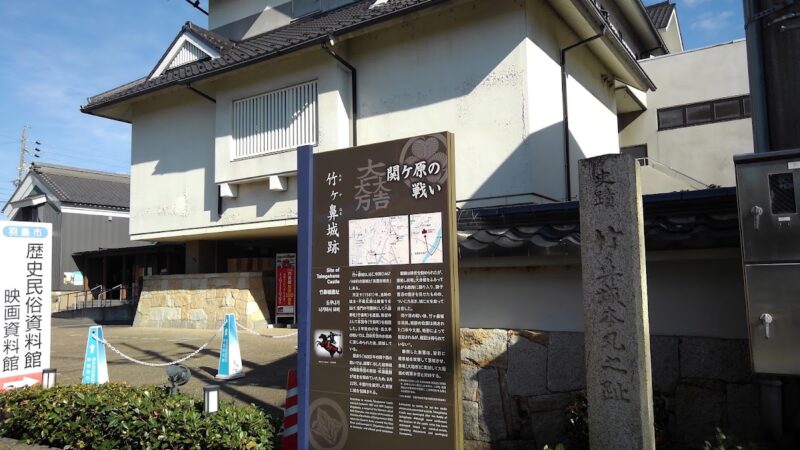
A key point of interest when visiting the Takegahana Castle ruins is the Hashima City Historical and Folk Museum. Within the museum grounds stands a monument marking the “Takegahana Castle Ruins,” along with an explanatory plaque detailing the castle’s history.
At the Hashima City Historical and Folk Museum, you can learn about Takegahana Castle and the history of Hashima City. The exhibits include imagined reconstructions of the castle, excavated artifacts, and historical documents, making it a valuable source of information for understanding the overall picture of Takegahana Castle.
Hashima City Historical and Folk Museum
- Location: Takenohana-cho, Hashima City, Gifu Prefecture
- Access: Approximately 10 minutes on foot from Takenohana Station on the Meitetsu Takenohana Line
- Opening Hours: Please check (We recommend checking in advance)
Information on the Sale of Castle Stamps
Castle stamps are sold at Takenohana Castle. Castle stamps are popular souvenirs among castle enthusiasts, and the number of collectors who collect them as a record of their visits to castle ruins is increasing.
One type of castle stamp has been confirmed for Takenohana Castle and can be purchased at designated locations within Hashima City. The design reflects the history and characteristics of the castle, making it an ideal memento of your visit. We recommend contacting the Hashima City Tourism Association or related facilities in advance regarding purchase locations and sales hours.
Access to Takegahana Castle
Access by Public Transportation
By Train
- Get off at Takehana Station on the Meitetsu Takehana Line, then walk approximately 10 minutes to the Hashima City Historical and Folk Museum.
- From Nagoya Station, take the Meitetsu Nagoya Main Line to Shin-Hashima Station, then transfer to the Takehana Line.
- Travel time: Approximately 40-50 minutes from Nagoya.
Access by Car
By Expressway
- Approximately 10 minutes from the Gifu-Hashima Interchange on the Tokai-Hokuriku Expressway.
- Approximately 10 minutes from the Gifu-Hashima Interchange on the Meishin Expressway.
- Parking: Parking is available at the Hashima City Historical and Folk Museum (limited number of spaces).
Nearby Tourist Attractions
When visiting the Takegahana Castle ruins, we recommend also visiting the surrounding historical sites.
Main Nearby Attractions
- Hashima City Historical and Folk Museum: A facility where you can learn about the history of Takegahana Castle.
- Takegahana Betsuin: A Jodo Shinshu Buddhist temple with a historical building.
- Enkyoji Temple: An ancient temple in Takegahana, known for its beautiful garden.
- Kiso River Riverbed: Enjoy the scenery of the Kiso River, which Hideyoshi once used for a water siege.
Historical Significance of Takegahana Castle
A Strategic Point on the Border of Mino and Owari Provinces
Takegahana Castle was located on the border between Mino and Owari Provinces, a crucial transportation hub connecting the two provinces. Its proximity to a crossing point of the Kiso River made it a strategically and economically important base.
During the Sengoku period, this region became the stage for power struggles between powerful daimyo such as the Oda, Saito, Toyotomi, and Tokugawa clans. Takegahana Castle was situated on the front lines, and its rulers changed with the times.
Historical Value of Water Sieges
Toyotomi Hideyoshi’s water siege of Takegahana Castle is recorded as an important example in the history of Japanese castles. While not as famous as the water siege of Bitchu Takamatsu Castle, it is studied as an example demonstrating Hideyoshi’s tactical genius.
The implementation of a water siege against a flatland castle is a classic example of siege tactics that maximized the use of terrain and water resources. This battle served as a lesson in the importance of castle location selection and the vulnerability of flatland castles.
The Stage of the Prelude to Sekigahara
As a prelude to the Battle of Sekigahara, the battle for Takegahana Castle was a crucial battle that determined the course of the war within Mino Province. The Eastern Army’s swift capture paved the way for the subsequent siege of Gifu Castle and the main battle of Sekigahara.
This battle led to the successive fall of Western Army strongholds within Mino Province, solidifying Tokugawa Ieyasu’s path to unifying Japan. The fall of Takegahana Castle can be considered one of the events symbolizing the end of the Sengoku period.
Research on Takegahana Castle and Future Challenges
Current State of Archaeological Research
Archaeological research on Takegahana Castle is significantly limited due to the disappearance of the remains. However, in recent years, comprehensive research combining historical documents and archaeology has been progressing.
While excavation surveys are limited, investigations in the surrounding area have sometimes uncovered artifacts from the medieval to early modern periods. These discoveries provide clues to understanding the extent of the castle town and the lifestyle of the time.
Analysis of Historical Materials
Historical materials concerning Takegahana Castle are scattered throughout military chronicles such as the “Nobunaga Koki” and “Taiko Ki,” as well as various ancient documents. Through careful analysis of these materials, the history, structure, and details of battles within the castle are gradually becoming clear.
In particular, historical materials concerning the Battle of Sekigahara are relatively abundant, with detailed records of the Eastern Army’s attack and the circumstances of the castle’s fall.
Future Research Topics
The biggest challenge in the study of Takegahana Castle is determining its precise location and size. While large-scale archaeological excavations are difficult in the current urbanized area, the use of non-destructive testing techniques such as ground-penetrating radar is expected.
Further research is needed on the specific methods of the water siege and the castle’s defensive system. Comparative studies with other water siege examples may clarify the characteristics of Hideyoshi’s siege tactics.
Points to Note When Visiting Takegahana Castle
Estimated Visit Time
A visit to the Takegahana Castle ruins should ideally take about 20 minutes. The main points of interest are the stone monument and explanatory plaque located on the grounds of the Hashima City Historical and Folk Museum.
If you wish to thoroughly view the exhibits inside the museum, it is recommended to add another 30 minutes to an hour. If you plan to explore the surrounding temples, shrines, and old town area, allocating half a day will make for a more fulfilling visit.
Important Points for Visitors
Takegahana Castle Ruins are located within an urban area, and very few remains are left. Please note the following points when visiting the castle ruins:
- There are no clear remains other than the stone monument and explanatory sign.
- Please be careful not to trespass on private property.
- Please check the museum’s opening days and hours in advance.
- If you wish to purchase a castle stamp, please check the sales location and hours.
- Please be considerate of local residents when taking photographs.
Recommended Time to Visit
Takegahana Castle Ruins can be visited throughout the year, but the following times are particularly recommended:
Spring (March-May)
- Mild weather, ideal for strolling
- A beautiful season with cherry blossoms and fresh greenery in the surrounding area
Autumn (October-November)
- Cool and pleasant weather for walking
- Beautiful scenery during the autumn foliage season
Event Period
- Special exhibitions and guided tours may be held during historical events in Hashima City
Summary
Takegahana Castle (Hashima City, Gifu Prefecture) was a flatland castle built during the Ōnin era and functioned as an important base on the border between Mino and Owari provinces throughout the Sengoku period. It experienced two major battles: a siege by Toyotomi Hideyoshi and its fall during the preliminary battles of Sekigahara. It was abandoned after 1600.
Currently, almost all of the castle’s remains have disappeared, but a stone monument and explanatory plaque are installed on the grounds of the Hashima City Historical and Folk Museum, preserving its history. Castle stamps are also sold, making it a popular destination for castle enthusiasts.
The history of Takegahana Castle symbolizes the turbulent period from the Sengoku period to the early Edo period. Although the remains have been lost, its historical significance is great, and it occupies an important place in the history of Japanese castles. When you visit Gifu Prefecture, why not take a visit to the ruins of Takegahana Castle and reflect on the history etched into this land?