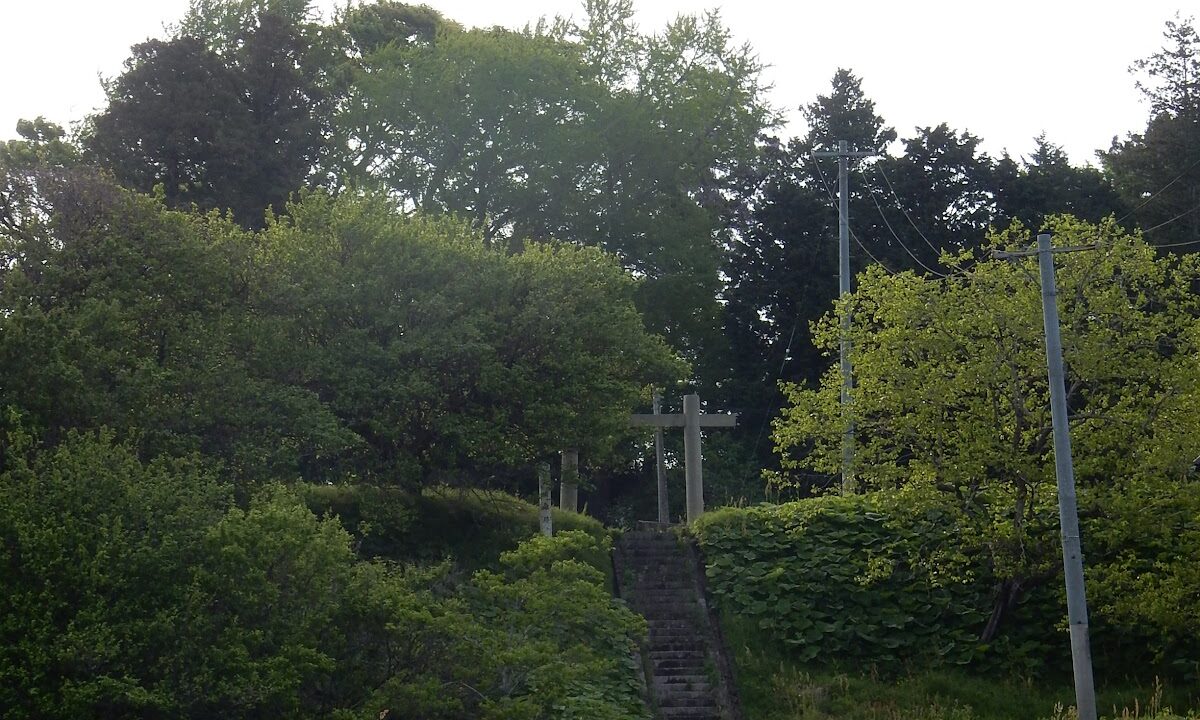
Complete Guide to Okada Castle Ruins (Fukushima Prefecture) | The Castle and Historical Value of the Okada Clan, the Head of the Soma Family
Located in Odaka Ward, Minamisoma City, Fukushima Prefecture, the Okada Castle Ruins are the remains of the castle of the Okada clan, who were renowned as the head of the Soma family during the medieval period. Built in 1334, this castle is now part of the grounds of Shohatsu Shrine and is a valuable historical site that preserves the remains of the time. This article provides a detailed explanation of the history of the Okada Castle Ruins, the characteristics of the remains, the lineage of the Okada clan, and how to access the site.
Basic Information on Okada Castle Ruins
Location and Size
The Okada Castle Ruins are located at 125 Okada Kitanochi, Odaka Ward, Minamisoma City, Fukushima Prefecture. This castle, built on a plateau in Okada Kitanochi, Odaka Ward, measures approximately 110 meters east-west and 100 meters north-south, making it a medium-sized castle for a medieval period.
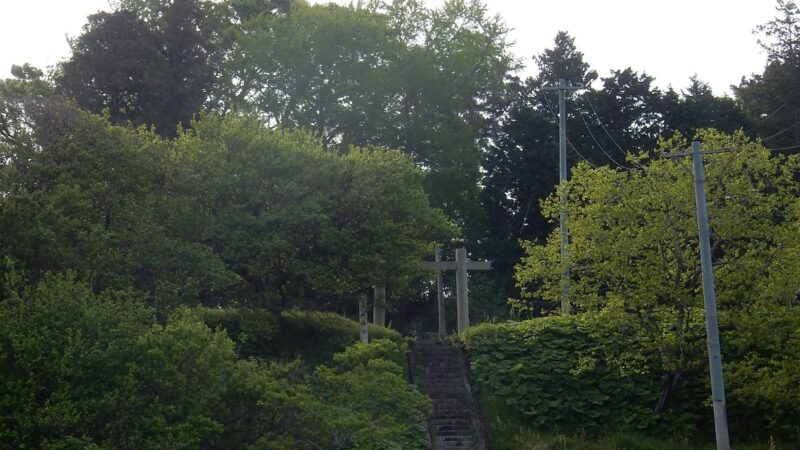
The castle site has a two-tiered structure, with the grounds of the Hatsuhatsu Shrine located at the highest point. This shrine area is believed to have been the main enclosure (the central part of the castle), and the topographical features of that time can still be observed today. Its location on high ground indicates that it served both as a military defense and as a governing center for the surrounding region.
Construction Date and Historical Background
Okada Castle is believed to have been built in 1334 (Kenmu 1). This period coincided with the Kenmu Restoration, following the fall of the Kamakura Shogunate, a time when samurai groups were being reorganized throughout Japan. Okada Castle functioned as an important base during the Soma clan’s expansion of power from Shimosa Province to Oshu Province.
In 1323 (Genkyo 3), Okada Tanemori, along with Soma Shigetane, migrated from Shimosa Province to this area (Namegata District, present-day Odaka Ward, Minamisoma City). Approximately ten years later, they constructed Okada Castle. This migration and castle construction are believed to have been part of the Soma clan’s planned territorial management during their expansion into Oshu.
History and Genealogy of the Okada Clan
Origins of the Okada Clan and its Founder, Okada Taneaki
The Okada clan traces its origins to Okada Taneaki, the son of Soma Tanemura. The Soma clan was a branch of the Chiba clan, and their base was in Soma District, Shimosa Province (present-day northern Ibaraki Prefecture to northeastern Chiba Prefecture). Taneaki’s acquisition of the Okada territory and adoption of the Okada name is considered the beginning of this clan.
Mr. Okada held the highest position within the Soma clan and played a central role in the Soma clan’s expansion into Oshu. This position as head of the clan was not merely an honorary title, but signified substantial power supporting the Soma clan in both military and political spheres.
Okada Tanemori and the Migration to Oshu
During Okada Tanemori’s time, the Soma clan’s expansion into Oshu truly began. In 1323, Tanemori, along with Soma Shigetane, migrated from Shimosa to Namegata District. This migration is an important example illustrating the movements of samurai groups from the late Kamakura period to the Nanboku-cho period.
The distance from Shimosa to Oshu was considerable, suggesting a large-scale move involving the entire family and their retainers. To establish a base in this new land, Tanemori likely dedicated himself to building relationships with local influential figures, developing land, and establishing defensive strongholds. The construction of Okada Castle in 1334 (Kenmu 1) is considered the culmination of these infrastructure developments.
The Achievements of the Okada Clan
Based at Okada Castle, the Okada clan served as a key figure within the Oshu Soma clan for generations. The Soma clan’s ability to survive as an independent force throughout the Sengoku period was largely due to the support of powerful retainers, including the Okada clan.
The Okada clan played a crucial role not only in military matters but also in territorial management and diplomatic negotiations. As the Soma clan faced powerful neighboring forces such as the Date clan, the Okada clan’s presence was indispensable for maintaining the Soma clan’s independence.
Remains and Characteristics of Okada Castle Site
Layout and Defensive Structure
Okada Castle is a flatland castle built on a plateau. Its size, approximately 110 meters east-west and 100 meters north-south, is standard for a medieval castle, but it features a distinctive two-tiered layout.
The main enclosure, located at the highest point, corresponds to the current grounds of the Hatsuhatsu Shrine. It is believed that this was the residence and administrative center of the lord of the castle. The second enclosure may have housed the residences of retainers, warehouses, and stables.
Remnants of earthworks remain along the edge of the plateau, indicating its function as a defensive structure. It is also presumed that natural defensive lines, cleverly utilizing the surrounding terrain, were employed. The presence of moats and dry ditches, typical features of medieval castles, has also been noted, clearly indicating its character as a military facility.
Existing Remains
The following remains can be observed at the current Okada Castle site:
Topographical Remains: The two-tiered enclosure structure is clearly preserved as a topographical feature, allowing visitors to experience the difference in elevation between the main and second enclosures. Partial traces of earthworks along the edge of the plateau also remain.
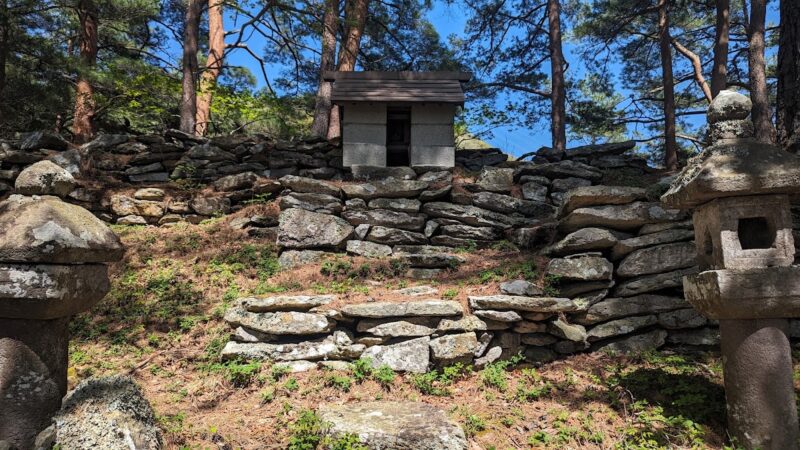
Hatsuhatsu Shrine Grounds: Hatsuhatsu Shrine, built on the site of the main enclosure, is a shrine associated with the Okada clan and continues to attract local devotion. The layout of the shrine grounds utilizes the topography of the medieval manor site, providing clues to imagining the spatial configuration of the time.
Surrounding Topography: The plateaus and valleys surrounding the manor site have preserved the medieval landscape relatively well, allowing us to understand the geographical environment in which the Okada Manor was built.
Hatsuhatsu Shrine and Myoken Worship
Hatsuhatsu Shrine, located on the main enclosure of the Okada Manor site, is deeply connected to the faith of the Soma clan. The Soma clan devoutly worshipped Myoken Bodhisattva as their guardian deity, and the name “Soma Myoken-gu” originates from this belief.
Myoken Bodhisattva is a Buddhist deity personifying the North Star, and was worshipped among samurai families as a guardian deity for military success and the security of their territories. The Soma clan, as a branch of the Chiba clan, inherited the Myoken faith passed down from the Chiba clan and maintained this faith even after migrating to Oshu.
The name “Hatsuhatsu” of Hatsuhatsu Shrine is said to originate from the fact that it was the first place in Oshu where the Soma clan enshrined a Myoken deity. The fact that the Okada clan, as the head of the Soma clan, established this important center of worship within their residence symbolizes their role as the spiritual and political center of the clan.
Relationship between Okada Residence Ruins and the Soma Clan
The Soma Clan’s Expansion into Oshu and the Role of Okada Residence
The Soma clan’s expansion into Oshu is an important example illustrating the movements of samurai groups from the Kamakura period to the Nanboku-cho period. There are several theories as to why the Soma clan, whose base was in Shimosa Province, expanded to the distant Oshu.
One theory is that they obtained territory in Oshu through the confirmation of their existing landholdings or the granting of new land grants by the Kamakura Shogunate. Another theory suggests that the Soma clan migrated in search of new territory after reaching the limits of their power expansion in Shimosa Province. In any case, the Soma clan succeeded in establishing a new power base in Oshu Province.
During this process, Okada Castle functioned as one of the Soma clan’s important bases in their control of Oshu. It is believed that the Okada clan’s rule over the surrounding region from Okada Castle, as the head of the family, was part of the Soma clan’s territorial management strategy.
The Okada and Soma Clans in the Sengoku Period
With the arrival of the Sengoku period, the Date clan rapidly expanded its power in Oshu, and the Soma clan became embroiled in conflicts with the Date clan. During this period, the Okada clan played a crucial role as a senior retainer of the Soma clan, in both military and diplomatic affairs.
While the Soma clan’s base moved from Odaka Castle to Nakamura Castle (present-day Soma City), it is believed that the Okada clan continued to govern the Odaka region from Okada Castle. Further research is needed to determine the role Okada-kan played during the turbulent Sengoku period and until when it was in use.
Surrounding Historical Sites and Related Facilities
Odaka Castle Ruins
Located approximately 2 kilometers from Okada-kan, Odaka Castle Ruins was an important stronghold of the Soma clan. Odaka Castle was used as the Soma clan’s initial base after their expansion into Oshu, and it had a close relationship with Okada-kan.
Odaka Castle was a mountain castle built on a hill approximately 100 meters above sea level. It was larger in scale than Okada-kan and possessed stronger defensive facilities. While Odaka Castle was the political and military center of the Soma clan’s territorial control, Okada-kan is thought to have played a complementary role as the residence of the chief member of the family.
Soma Nakamura Castle Ruins (Soma City)
Soma Nakamura Castle, which became the Soma clan’s later base, is located in present-day Soma City. Located approximately 20 kilometers northeast of Okada-kan, Soma Nakamura Castle served as the administrative center of the 60,000-koku Soma Nakamura Domain during the Edo period.
Soma Nakamura Castle was developed as a modern castle, and although a keep was never built, the remains such as stone walls and moats are well-preserved. Currently, the castle ruins are maintained as a park, where visitors can learn about the history of the Soma clan. Visiting both the Okada-kan ruins and the Soma Nakamura Castle ruins will allow you to trace the changes in the Soma clan’s rule over Oshu.
Minamisoma City Museum
Minamisoma City has a museum that exhibits local history, where you can see materials related to the Okada-kan ruins and the Soma clan. Exhibits include the history of the Soma region in the Middle Ages, the activities of the Soma clan’s retainers, including the Okada clan, and excavated artifacts. Visiting before or after visiting the Okada-kan ruins will provide a deeper understanding.
Historical Value and Preservation Status of the Okada Castle Site
Significance in Medieval Castle Research
The Okada Castle site is an important historical site for understanding the activities of samurai groups in the Tohoku region during the medieval period. It provides valuable examples for understanding samurai society from the late Kamakura period to the Nanboku-cho period, including the migration of samurai groups from Shimosa to Oshu, the construction of bases in new territories, and the realities of territorial management.
In particular, as it was the residence of the head of a samurai group with a clear lineage—the Soma clan—research is possible by comparing documentary sources with archaeological remains. Castle sites that meet these conditions are not necessarily numerous, and the historical value of the Okada Castle site is highly regarded.
Current Preservation Status and Challenges
Because the Okada Castle site is used as the grounds of the Hatsutatsu Shrine, some of the remains have been altered by the shrine facilities. However, the basic topography and traces of earthworks are relatively well preserved, allowing visitors to experience the atmosphere of a medieval castle.
Future challenges include detailed surveying and archaeological excavations to clarify the remains, the development of information boards and explanatory signs to enhance its use as a historical site, and its development as a place for historical education for local residents and visitors. In the process of recovery from the Great East Japan Earthquake, it is hoped that the value of the Okada-kan site will be re-evaluated as a base for reaffirming the region’s historical identity.
Access and Visiting Information for Okada-kan Site
Transportation Access
By Train: Approximately 20 minutes on foot or 5 minutes by taxi from Odaka Station on the JR Joban Line. Odaka Station is the central station of Odaka Ward, Minamisoma City, Fukushima Prefecture, and is accessible from Sendai and Iwaki.
By Car: Approximately 15 minutes from the Minamisoma Interchange on the Joban Expressway. Take National Route 6 towards Odaka town center and follow the signs to the Okada area. Aiming for Hatsuhatsu Shrine will make it easier to find.
Parking: You can use the parking space for visitors to Hatsuhatsu Shrine, but the number of spaces is limited, so please be careful during shrine events.
Points to Note When visiting the Okada Manor Ruins, paying attention to the following points will make your visit more fulfilling.
Observing the Topography: Walk around and confirm the two-tiered layout of the enclosures. By observing the difference in elevation between the main enclosure (Hatsuhatsu Shrine grounds) and the second enclosure, and the topography of the plateau’s edge, you can experience the structure of a medieval castle.
Traces of Earthworks: Traces of earthworks remain partially around the shrine grounds. It will be interesting to imagine how the defensive line was formed while you are viewing it.
View: From Okada Manor, located on a hill, you can overlook the surrounding area. You can understand why the Okada clan chose this location as their base from the view.
Hatsuhatsu Shrine: As a shrine associated with the Soma clan, look for traces of Myoken worship. Historical information may be inscribed on shrine buildings and stone monuments.
Precautions for Visiting
The Okada Residence Site is located within the grounds of Hatsutatsu Shrine and is still used as a place of worship. Please observe the following points when visiting:
- Be quiet within the shrine grounds and be considerate of other worshippers.
- Do not enter private property or restricted areas.
- Do not damage the remains or collect plants.
- Always take your trash with you.
- When taking photographs, be mindful of your surroundings.
The Roots of the Okada Surname and Okada Residence
Okada Clans Across Japan
The surname “Okada” is widely distributed throughout Japan, but its origin is not necessarily singular. The Okada clan in Fukushima Prefecture is a samurai family descended from Taneaki, the son of Soma Tanemura, but there are Okada clans with different origins in other regions.
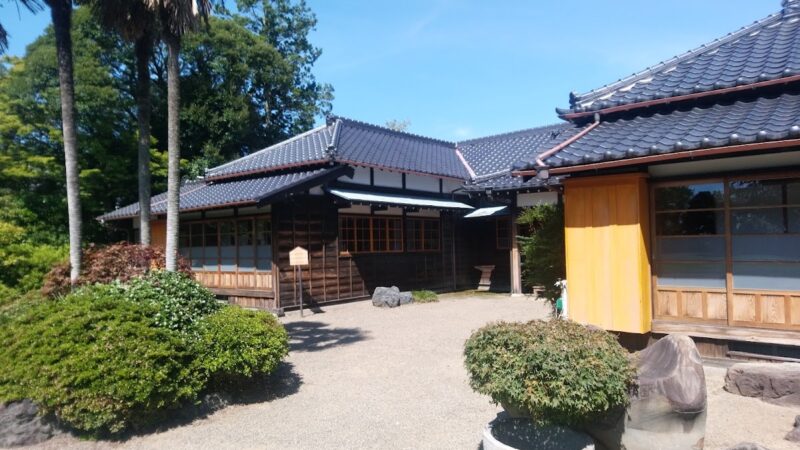
In Tochigi City, there is the Okada family, a wealthy merchant family, and their residence is now open to the public as a memorial museum. The Okada clan has roots in Samukawa Town, Kanagawa Prefecture, and also in the Kitakyushu region. The place name “Okada” originates from “Oka no Ta,” meaning rice paddies on hillsides, which explains the tendency for the Okada surname to be more prevalent in western Japan, where rice cultivation is widespread.
Characteristics of the Okada Clan in Fukushima Prefecture
The Okada clan of Minamisoma City, Fukushima Prefecture, is distinctive for its clear samurai lineage. Their position as the head of the Soma clan was not merely a place-derived surname, but rather represented their social status and role in medieval samurai society.
The Okada Manor Site is an important historical site that conveys the history of the Okada clan as samurai. The Okada Manor Site teaches us that even with the same surname “Okada,” its origins and historical background vary greatly depending on the region.
Summary
The Okada Castle ruins, located in Odaka Ward, Minamisoma City, Fukushima Prefecture, are a medieval castle built in 1334 (Kenmu 1) as the residence of the Okada clan, the head of the Soma clan. It measures approximately 110 meters east-west and 100 meters north-south, and is characterized by its two-tiered layout.
The Okada clan traces its origins to Taneaki, son of Soma Tanemura, and during the time of Okada Tanemori, they migrated from Shimosa to Oshu along with Soma Shigetane. Okada Castle functioned as an important base for the Soma clan’s rule of Oshu and became the residence of successive generations of the Okada clan.
Currently, the main enclosure of the castle ruins is the grounds of the Hatsuhatsu Shrine, and it continues to attract local worship as a place of Myoken faith associated with the Soma clan. Remains such as the two-tiered enclosure structure and traces of earthworks remain, allowing visitors to experience the atmosphere of a medieval castle.
The Okada Castle Ruins are a valuable historical site for understanding the activities of samurai groups in the Tohoku region during the medieval period, their migration from Shimosa to Oshu, and the realities of their territorial management. Visiting it along with other nearby historical sites such as the Odaka Castle Ruins and the Soma Nakamura Castle Ruins will allow for a deeper understanding of the Soma clan’s rule over Oshu.
With easy access—approximately a 20-minute walk from Odaka Station on the JR Joban Line—it’s a must-see historical site for anyone interested in medieval history in Fukushima Prefecture. Be sure to experience the historical value of the Okada Castle Ruins, perhaps in conjunction with a visit to the Hatsubatsu Shrine.