Tokiwa Castle (Tamura City, Fukushima Prefecture) Complete Guide | Thorough Explanation of History, Remains, and Access
What is Tokiwa Castle?
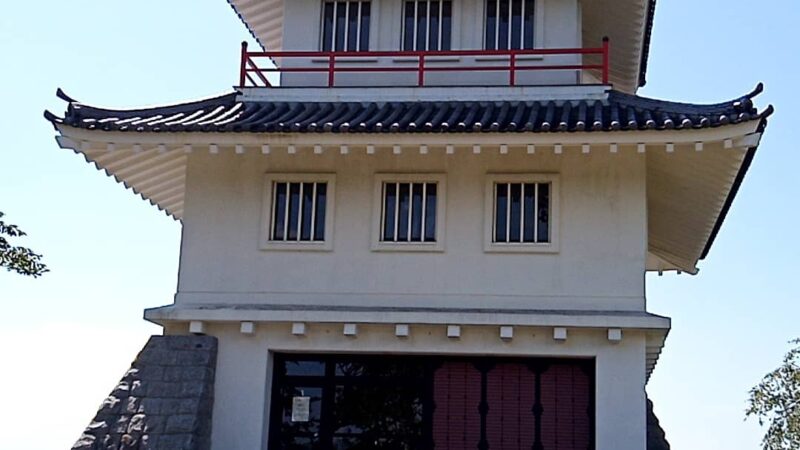
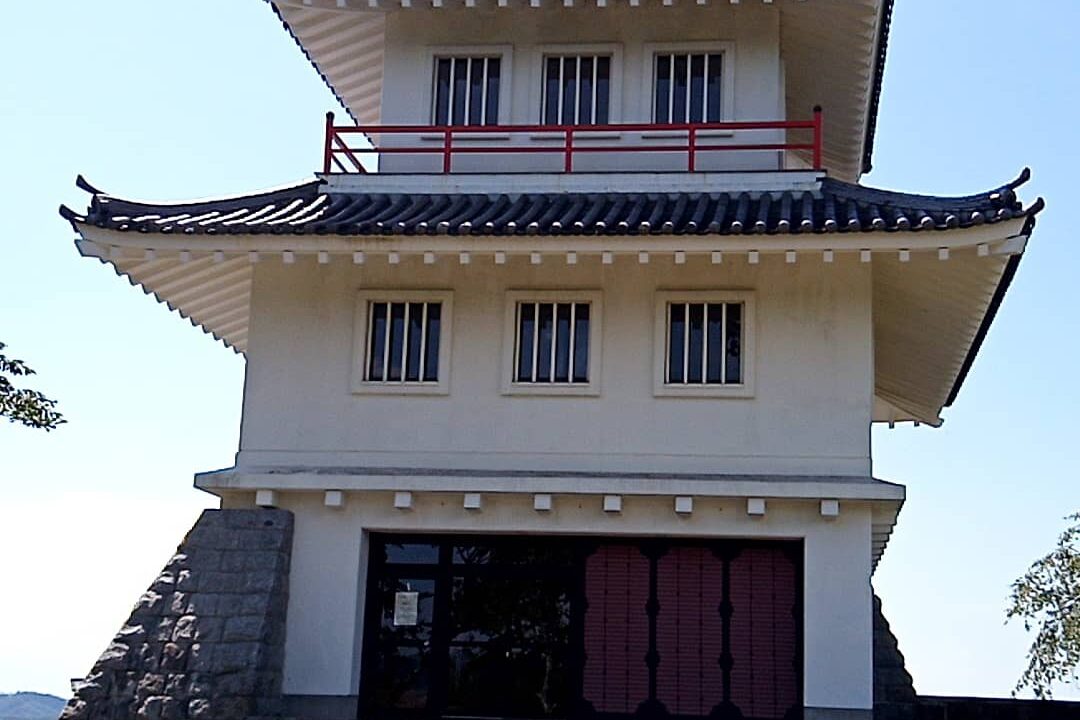
Tokiwa Castle (Tokiwa-jo) is a medieval mountain castle located in Tokiwa, Tamura City, Fukushima Prefecture. Also known as “Tokiwa Castle” and “Asahi Castle,” it is said to have been built in 1274 by Kumagai Naonori. Currently, it is maintained as Tateyama Park, with a replica keep, and is a beloved historical symbol of Tamura City.
During the Sengoku period, the Ishizawa clan, vassals of the Tamura clan, served as the castle lords, and it functioned as an important strategic castle in Iwaki Province (present-day eastern Fukushima Prefecture). It fell in 1589 to an attack by the Soma-Iwaki allied forces and was subsequently abandoned.
Basic Information on Tokiwa Castle
Location: Tokiwa, Tamura City, Fukushima Prefecture
Former Province: Mutsu Province (Iwaki Province)
Classification/Structure: Mountain Castle
Builder: Kumagai Naonori
Year of Construction: Bun’ei 11 (1274)
Main Lords: Kumagai clan, Akamatsu clan (later Tokiwa clan), Ishizawa clan
Year of Abandonment: Tensho 17 (1589)
Remains: Enclosures, moats, earthworks, cliffs
Reconstructed Structures: Mock keep (two stories)
Designated Cultural Property: None
Current Status: Developed as Tateyama Park
History of Tokiwa Castle
From the Castle’s Construction to the Kumagai Clan Era (1274-)
Tokiwa Castle is said to have been built in 1274 by Kumagai Naonori. The Kumagai clan is believed to be descended from Kumagai Naozane of Musashi Province, who played an active role in the Genpei War, and they expanded into the Tohoku region during the Kamakura period. It is thought that by establishing a castle in Tokiwa, they solidified their control over the region.
The Kumagai clan used Tokiwa Castle as their base for several generations, but detailed records are scarce, and many aspects of their specific activities remain unclear.
From the Akamatsu Clan to the Tokiwa Clan
After the Kumagai clan, the Akamatsu clan became the castle lords. The Akamatsu clan was a prominent family based in Harima Province (present-day Hyogo Prefecture), but it is believed that a branch of the family that expanded into the Tohoku region became the lord of Tokiwa Castle. The Akamatsu clan changed their surname to “Tokiwa,” adopting a surname derived from the place name. This followed the custom of medieval samurai adopting the place name of their territory as their surname.
The Tokiwa clan ruled this area for several generations, but a major turning point occurred during the time of Tokiwa Sadahisa.
Tamura Clan Rule and Ishizawa Clan’s Entry
During the Sengoku period, the area around Tokiwa Castle was within the sphere of influence of the Tamura clan, whose base was Miharu Castle. Tamura Kiyoaki is known as a brilliant general who built the Tamura clan’s golden age, and he successively brought the surrounding minor lords under his control.
During the time of Tokiwa Sadahisa, Tamura Kiyoaki captured Tokiwa Castle, driving the Tokiwa clan from their position as castle lords. Afterward, Ishizawa Shuri-no-suke, a senior retainer of the Tamura clan, entered the castle as its lord, and it began to function as a branch castle under the Tamura clan.
The Ishizawa clan was known as an influential retainer of the Tamura clan, and it is believed that they played a role in the Tamura clan’s eastern defense from Tokiwa Castle.
The Fall and Abandonment of Tokiwa Castle in 1589
In 1589, Tokiwa Castle faced a fateful moment. That year, following the death of Tamura Kiyosuke, the head of the Tamura clan, surrounding forces intervened in the succession dispute, creating a complex political situation.
Taking advantage of this chaos, a combined force of the Soma and Iwaki clans invaded the Tamura territory. Tokiwa Castle became a target, and a fierce battle ensued. According to records, the castle was attacked with fire by both armies, burned down, and fell.
With this fall, Tokiwa Castle was abandoned and never used as a castle again. With the end of the Sengoku period, the history of Tokiwa Castle, spanning over 300 years, came to an end.
Subsequent Changes
After the Edo period, the Tokiwa Castle ruins were largely neglected, but in modern times, they began to attract attention as a regional historical heritage site. Currently, the site is maintained as Tateyama Park and serves as a place of relaxation for citizens.
A replica castle tower stands on the mountaintop, serving as a symbol that conveys the history of Tokiwa Castle. While this replica tower is not based on historical fact, it is a beloved local landmark.
Tokiwa Castle’s Layout and Structure
Location and Topography
Tokiwa Castle is a typical mountain castle built on the summit of Tateyama, overlooking the town of Tokiwa. Utilizing the mountaintop at an altitude of approximately 400 meters, it occupies a strategic position offering panoramic views of the surrounding plains.
As a mountain castle, its location follows the fundamental principles of medieval castles: early detection of enemy movements and maximizing the use of advantageous terrain for defense. The steep slopes acted as natural fortifications, making it a formidable fortress that was difficult for attackers to conquer.
Layout of the Enclosures
The center of Tokiwa Castle was the Honmaru (main enclosure) at the mountaintop, where the lord’s residence and important facilities are believed to have been located. Currently, a replica keep stands on the site of the Honmaru.
Across the Honmaru, multiple enclosures (kuruwa) were arranged in a stepped pattern. These enclosures served as defensive strongholds, as well as troop encampments and storage areas for supplies.
Each enclosure was separated by steep slopes called kirigishi (cut cliffs), designed to prevent easy movement by the enemy.
Moats and Defensive Structures
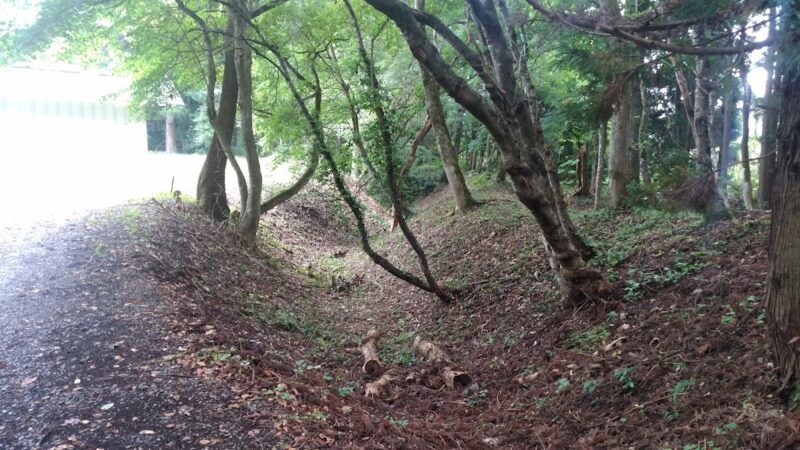
Multiple moats (horikiri) have been identified as important defensive structures of Tokiwa Castle. These moats, dug to cut across ridges, played a crucial role in preventing enemy incursions.
The moats that remain clearly visible today demonstrate the advanced civil engineering techniques of the time and speak to the meticulous attention paid to the castle’s defenses. Moats several meters deep would have been a significant obstacle for attackers.
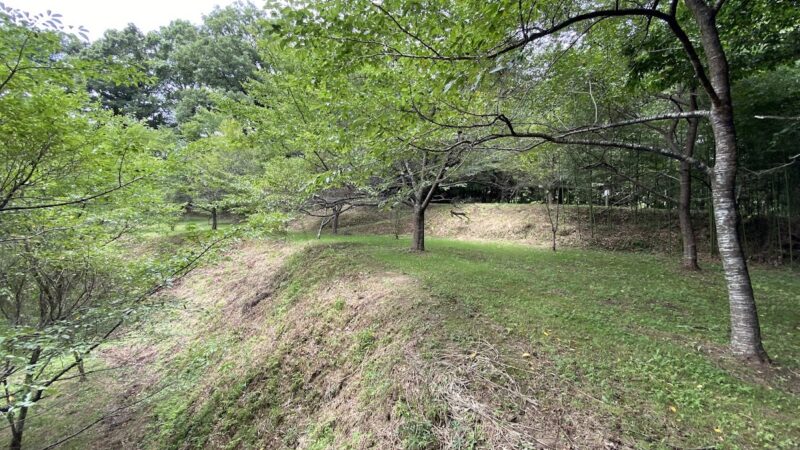
Furthermore, earthen ramparts were constructed in various places, surrounding the baileys and enhancing their defensive capabilities. It is presumed that fences or walls were built on top of these ramparts.
Entrances and Passages
The entrances to the castle, known as koguchi, were the most important defensive structures. At Tokiwa Castle, it is believed that the koguchi had a complex structure to prevent easy enemy intrusion.
The passages connecting the baileys were also designed to be winding rather than straight, a design intended to slow down the enemy’s advance.
Remains of Tokiwa Castle
Existing Remains
Currently, the following remains can be observed at the Tokiwa Castle site:
Baileys: Multiple baileys, centered around the main keep, remain despite changes in the terrain. While some alterations were made during the development of the park, the basic layout evokes the castle’s former appearance.
Moat: One of the best-preserved remains, several clear moats cutting across the ridge can be observed. Their depth and width allow us to understand the defensive strategy of the time.
Earthwork: Parts of the earthworks built around the baileys remain. Although their height is low, their arrangement allows us to estimate the defensive line.
Cliff: Cliffs separating the baileys remain in various places, revealing artificially carved steep slopes.
Replica Castle Tower
A two-story replica castle tower stands on the site of the main bailey at the mountaintop. This tower is not based on historical evidence but was constructed as a tourist attraction. During the Sengoku period, when Tokiwa Castle actually existed, castle towers were rarely built on mountain castles in the Tohoku region.
However, this replica castle tower plays an important role as a symbol of Tateyama Park and as a facility to widely disseminate the history of Tokiwa Castle. From the castle tower, you can enjoy a panoramic view of Tokiwa city and the surrounding mountains, allowing you to imagine the scenery seen by the castle’s former lords.
Preservation Status of the Ruins
While some of the ruins have been altered due to the park’s development, the main defensive structures, such as the moats and cliffs, are preserved in relatively good condition.
In recent years, the historical value of castle ruins has been re-recognized, and awareness of preservation has increased. A more appropriate balance between preservation and utilization will be required in the future.
Current State as Tateyama Park
Park Development
The Tokiwa Castle ruins are now developed as Tateyama Park, a popular recreational area for citizens. Walking paths have been constructed, making it relatively easy to access the replica castle tower at the mountaintop.
Cherry trees are planted within the park, making it a popular spot for cherry blossom viewing in spring. The combination of the castle ruins and cherry blossoms embodies traditional Japanese aesthetics, captivating many visitors.
Views
The views from the mountaintop are magnificent, offering a panoramic view of Tokiwa city, and on clear days, the mountains of the Abukuma mountain range can be seen in the distance. This view was one of the reasons why the castle lords of the Sengoku period considered Tokiwa Castle so important.
By surveying the surrounding terrain, you can truly appreciate why the castle was built in this location and what its strategic value was.
Visitor Considerations
As it is a park, basic facilities such as parking and restrooms are available. However, as it is a mountain castle, a certain level of physical fitness and appropriate clothing are necessary.
Information boards are also installed, allowing you to learn about the history and remains of Tokiwa Castle. However, if you want to obtain more detailed information, it is recommended that you research materials beforehand.
Tokiwa Castle and Surrounding Castles
Tamura Clan’s Castle Network
Tokiwa Castle was one of the castles under the control of the Tamura clan and was interconnected with the surrounding castles.
Miharu Castle: The base of the Tamura clan, located approximately 15 kilometers west of Tokiwa Castle. It functioned as the political and military center of the Tamura clan, with Tokiwa Castle responsible for its eastern defense.
Ogoe Castle: Located north of Tokiwa Castle, it was also under the control of the Tamura clan.
Funabiki Castle: One of the Tamura clan’s important strongholds, it strengthened its regional control through cooperation with Tokiwa Castle.
These castles maintained mutual communication, establishing a system of cooperative defense against enemy invasions. The fall of Tokiwa Castle symbolized the collapse of this castle network.
Nearby Historical Sites
When visiting Tokiwa Castle, visiting nearby historical sites will allow you to gain a deeper understanding of the region’s history.
Several other castle ruins remain within Tamura City, allowing you to trace the history from the medieval period to the Sengoku period. Furthermore, Miharu Castle Ruins are a representative castle ruin of Fukushima Prefecture and a popular spot visited by many castle enthusiasts.
Access to Tokiwa Castle
Access by Public Transportation
JR Ban’etsu East Line: The nearest station is “Funabiki Station”. It is approximately 8 kilometers from the station to Tokiwa Castle Ruins (Tateyama Park), requiring the use of a taxi or local bus.
Local Bus: Buses run from Funabiki Station towards Tokiwa, but the number of services is limited, so it is recommended to check the timetable in advance.
Access by public transportation is somewhat inconvenient, so visiting by private car is recommended.
Access by Car
Ban’etsu Expressway: Approximately 15 kilometers from “Funabiki-Miharu IC”, about 20 minutes by car.
National Route 288: This is a major road that runs through the town of Tokiwa. From here, follow the signs to Tateyama Park.
Parking: Tateyama Park has a parking lot that is free to use. However, it may be full during peak seasons such as cherry blossom season.
Car Navigation Settings
You can set your destination by searching for the address “Tateyama, Tokiwa-cho, Tamura City, Fukushima Prefecture” or “Tateyama Park”.
Notes for Visitors
- As it is a mountain castle, please wear comfortable shoes and clothing.
- Remember to take insect repellent in summer and warm clothing in winter.
- It is recommended to prepare drinking water in advance.
- Please use the designated walking paths to avoid damaging the ruins.
- Please take all your trash with you.
Highlights and Photo Opportunities at Tokiwa Castle
Replica Castle Tower
The replica castle tower, a symbol of Tateyama Park, is the most popular photo spot. The sight of the castle tower against the blue sky is a popular subject for photos.
During cherry blossom season, you can take photos combining the full-blooming cherry blossoms with the castle tower.
Moat
The moat, the best-preserved of the castle’s remains, is a must-see for castle enthusiasts. Observing the deeply excavated moat up close allows you to appreciate the castle’s construction techniques and defensive ingenuity of the time.
When photographing the moat’s cross-section, it’s effective to include people in the shot to convey its depth and scale.
Viewpoint
The view from the mountaintop is crucial for understanding the strategic value of Tokiwa Castle. The panoramic view of Tokiwa city and the surrounding mountains eloquently explains why the castle lords valued this location.
The view at sunset is particularly beautiful and ideal for photography.
Seasonal Scenery
Spring: Known as a famous cherry blossom viewing spot, it’s bustling with visitors during peak bloom.
Summer: Enjoy the lush green scenery of the mountain castle.
Autumn: The autumn foliage is beautiful, and the combination of the replica keep and the autumn leaves is a spectacular sight. Winter: The snow-covered castle tower creates a fantastical atmosphere.
Historical Significance of Tokiwa Castle
Position in Regional History
Tokiwa Castle is an important historical site for understanding the history of the Tamura region from the medieval period to the Sengoku period. The process of succession of castle lords—Kumagai, Tokiwa, and Ishizawa—reflects the political changes in the region.
In particular, it holds historical value as a castle symbolizing the turmoil of the Sengoku period, specifically the expansion of the Tamura clan’s power and the subsequent conflict with the Soma and Iwaki clans.
Characteristics in Castle History
Tokiwa Castle, as a typical medieval mountain castle of the Tohoku region, possesses the following characteristics:
- Location utilizing the mountaintop
- Layered defensive structure with multiple baileys
- Defensive facilities primarily using moats
- Earthen castle without stone walls
These features are common to castles in the Tohoku region, demonstrating a different development of Tohoku castle culture compared to castles in the Kinki region and western Japan that heavily utilized stone walls.
Influence on Later Generations
The history of Tokiwa Castle has been passed down to the present day as part of the region’s identity. The development of Tateyama Park and the construction of a replica keep reflect the pride and affection local residents have for their history.
Every year, it is also used as an educational venue for learning about local history, contributing to the transmission of history to future generations.
How to Enjoy Visiting Tokiwa Castle
From a History Fan’s Perspective
Those interested in castles are encouraged to carefully observe the remains. Observing details such as the scale of the moats, the angle of the cliffs, and the arrangement of the baileys offers the pleasure of deciphering the intentions of the castle’s builder.
Studying the castle layout and historical documents beforehand will allow for a deeper understanding.
Family Visit
As it is maintained as a park, it can be enjoyed by families. Climbing to the replica castle tower and strolling along the walking paths will be a good experience for children.
Visiting during cherry blossom season is also recommended.
Photography
The combination of the seasonal scenery and the replica castle tower makes for an excellent subject for photography. Many photographers visit, especially during cherry blossom and autumn foliage seasons.
Using the light of early morning or twilight will allow you to take more impressive photos.
Summary
Tokiwa Castle is a mountain castle that watched over the history of the Tamura region for over 300 years, from its construction in 1274 to its fall in 1589. The castle changed hands several times, from the Kumagai, Tokiwa, and Ishizawa clans, and ultimately functioned as an important base under the Tamura clan. The site is now developed as Tateyama Park, and a replica of the castle keep has been erected. The remains, such as the moats and earthworks, are well-preserved, conveying the appearance of a castle from the Sengoku period (Warring States period).
When visiting Tamura City in Fukushima Prefecture, be sure to stop by the Tokiwa Castle ruins and reflect on the history from the medieval to the Sengoku period. The view from the mountaintop and the remains that retain the atmosphere of yesteryear will surely transport visitors into the world of history.