Complete Guide to Okuromaru Castle (Fukui City): The Site of Nitta Yoshisada’s Demise and the History of the Seven Castles of Asuwa
Okuromaru Castle, located in Kuromaru-cho, Fukui City, Fukui Prefecture, is an important historical site that conveys the turmoil of the Nanboku-cho period. This castle attracts attention from history enthusiasts as a place deeply connected to the final moments of Nitta Yoshisada, a famous warlord in Japanese history, and as one of the seven castles of Asuwa built by Shiba Takatsune, the governor of Echizen Province.
History and Origins of Okuromaru Castle
Background of Construction and Shiba Takatsune
Okuromaru Castle was built around 1338 (Kenmu 5th year / En’en 3rd year) by Ashikaga Owari-no-kami Takatsune (Shiba Takatsune), the governor of Echizen Province. Shiba Takatsune was a senior retainer of Ashikaga Takauji and a key figure on the Northern Court side during the Nanboku-cho period.
Echizen Province was a strategic point connecting Kyoto and the Hokuriku region, and to counter the forces of the Southern Court, Shiba Takatsune strategically placed several castles there. The military chronicle *Taiheiki* records that Shiba Takatsune built seven castles in the Asuwa region, which are known as the “Seven Castles of Asuwa.” Oguromaru Castle is one of these, and is also known as “Gun-Kuromaru Castle.”
Relationship with Daikokumaru Castle
Oguromaru Castle is closely related to Daikokumaru Castle, located to the northwest. Daikokumaru Castle was built by Asakura Hirokage, who entered Kuromaru Manor in Echizen following Shiba Takatsune, and served as the main castle.
Oguromaru Castle and Daikokumaru Castle together are collectively referred to as “Kuromaru Castle,” forming an integrated defensive system. Daikokumaru Castle later became the residence of successive generations of the Asakura clan, and was used for 130 years across seven generations. However, its role ended during the Bunmei era when Asakura Takakage moved his residence to Ichijōdani.
Nitta Yoshisada and the “Battle of Fujishima”
The Stage of a Historic Event
The greatest reason why Oguromaru Castle has left its mark on history is that it was the stage for the “Battle of Fujishima,” which involved the final moments of Nitta Yoshisada, a renowned general of the Southern Court.
On July 2, 1338 (Kenmu 5th year / En’en 3rd year), Nitta Yoshisada, on his way to Fujishima Castle (near present-day Fujishima-cho, Fukui City), coincidentally encountered reinforcements from Shiba Takatsune’s army that had departed from Oguromaru Castle. According to Volume 20 of the *Taiheiki*, these reinforcements were led by Hosokawa Dewa-no-kami and Kakusa Hikotarō.
The Final Moments of Nitta Yoshisada
In a sudden, unexpected battle, Nitta Yoshisada was killed at Tomyoji-nawate. This battle, known as the “Battle of Fujishima,” marked a crucial turning point in the Nanboku-cho period (Northern and Southern Courts period).
Nitta Yoshisada was a general who contributed to the overthrow of the Kamakura Shogunate and played a vital role in the Kenmu Restoration. However, his conflict with Ashikaga Takauji led him to Echizen, where he met his end. The encounter with reinforcements from Oguromaru Castle was a tragic event born from the serendipity of history.
Structure and Characteristics of Oguromaru Castle
Location
Oguromaru Castle was built at the confluence of the Kuzuryu River and the Hino River. This location held significant military importance.
- Natural Defense by Rivers: Its location, surrounded by two major rivers, made it a natural stronghold that made enemy invasions difficult.
- Strategic Transportation Hub: It was a point where river transport and land routes intersected, which was advantageous for the transport of goods and the transmission of information.
- Monitoring of Plains: Its location overlooking the surrounding plains made it easy to monitor enemy movements.
Scale and Structure of the Castle
As a castle from the Nanboku-cho period, Oguromaru Castle is thought to have had a relatively simple structure. Castles of that time did not have stone walls or keeps like castles of the later Sengoku period, but rather defensive facilities centered on earthworks and moats.
Currently, almost no remains exist, and the area is entirely residential and rice paddies. However, the extent of the former castle can be estimated from the topography and place names.
Current Status of Oguromaru Castle Site
Castle Site Monument and Current Status
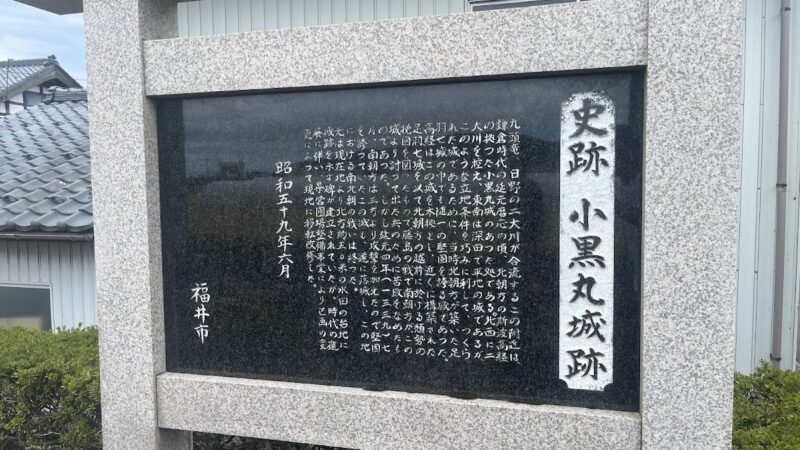
Currently, a castle site monument has been erected at the Oguromaru Castle site. This stone monument is located on the western outskirts of the Kuromaru-cho settlement, but it is believed to have originally been located 50 meters north of this spot.
The area around the castle ruins is completely urbanized, with a peaceful landscape of rice paddies and residential areas. While no earthworks or moats remain as historical remnants, the castle site monument conveys the historical importance of this place.
Surrounding Historical Environment
Near the Oguromaru Castle ruins, there are numerous historical sites that tell the story of the Nanboku-cho period.
- Fujishima Castle Ruins: The site of the castle that Nitta Yoshisada aimed to reach
- Tomyoji Nawate: The place where Nitta Yoshisada was killed in battle
- Nitta Mound: A historical site dedicated to Nitta Yoshisada
- Daikokumaru Castle Ruins: The site of the main castle
Visiting these historical sites will allow for a deeper understanding of the battles in Echizen during the Nanboku-cho period.
Access Information
Access by Car
Access to Oguromaru Castle Ruins is most convenient by car.
Route Guide:
- Proceed along National Route 416 towards Fukui City.
- Cross the Takaya Bridge over the Kuzuryu River.
- Turn right at the sign for the Disaster Prevention Center, approximately 500m past the bridge.
- After turning right, the castle ruins are located 100m ahead at the corner between rice fields and a residential area.
Parking:
There is no dedicated parking lot for the castle ruins, but the surrounding roads are relatively wide, allowing for short-term parking. However, please be considerate of nearby houses and farmland to avoid causing inconvenience.
Access by Public Transportation
If using public transportation, the following routes are possible.
Nearest Station:
JR Fukui Station is the nearest major station.
Bus Use:
From Fukui Station, you can use community buses or taxis, but since the number of services is limited, it is recommended to check the timetable in advance. Visiting on Foot:
The area around the castle ruins monument is flat, making it easy to visit on foot. However, the sun is strong in the summer, so we recommend bringing a hat and drinking water.
Points to Note When Visiting
- The area around the castle ruins is a residential area, so please be considerate of the residents’ lives.
- Please be careful not to trespass on farmland.
- Since no remains of the castle exist, the visit will mainly consist of viewing the castle ruins monument.
- When taking photographs, please be careful not to include private homes in your shots.
Highlights of Oguromaru Castle
Historical Value
The greatest highlight of Oguromaru Castle lies in its historical background. As a place associated with the final moments of Nitta Yoshisada, an important figure in Japanese history, it is a historical site of special significance for history enthusiasts.
Castle Ruins Monument
The castle ruins monument standing on the site is the only physical evidence indicating the historical importance of this place. By reading the inscription, you can gain a concise understanding of the history of Oguromaru Castle.
Surrounding Landscape
Located at the confluence of the Kuzuryu River and the Hino River, this area still forms a distinctive landscape of the Fukui Plain. Strolling around the area while imagining the scenery seen by the former castle lords is an interesting experience.
About the Seven Castles of Asuwa
Overview of the Seven Castles of Asuwa
Oguromaru Castle held an important position as one of the “Seven Castles of Asuwa.” The Seven Castles of Asuwa is a collective term for seven castles built by Shiba Takatsune in the Asuwa region of Echizen Province.
While there are various theories regarding the Seven Castles of Asuwa, it is generally believed to include the following castles:
- Oguromaru Castle (Gunkuromaru Castle)
- Daikokumaru Castle (Miyakekuromaru Castle)
- Asuwa Castle
- Yasui Castle
- Haramitsu Castle
- Fujishima Castle
- Takasu Castle
Strategic Placement
These castles were strategically placed to control key points in Echizen Province. This network of castles was built with the clear objective of resisting the forces of the Southern Court and securing the Hokuriku Road.
Echizen during the Nanboku-cho period
The Importance of Echizen Province
During the Nanboku-cho period, Echizen Province was an extremely important region for both sides, serving as a strategic point connecting Kyoto and Hokuriku. Controlling this area meant controlling the entire Hokuriku region, leading to fierce battles for control.
Shiba Takatsune’s Rule of Echizen
Shiba Takatsune, appointed as the governor of Echizen by Ashikaga Takauji, constructed a systematic network of castles to eliminate the forces of the Southern Court. Oguromaru Castle was one of its important strongholds, serving as a key point for controlling Echizen.
Related Historical Figures
Nitta Yoshisada
One of the key figures in the overthrow of the Kamakura Shogunate. He held an important position in the Kenmu Restoration, but clashed with Ashikaga Takauji and retreated to Echizen. In 1338, he died in the Battle of Fujishima, bringing his turbulent life to an end.
Shiba Takatsune
A senior retainer of Ashikaga Takauji and governor of Echizen Province. Also known as Ashikaga Owari-no-kami Takatsune. As a central figure for the Northern Court in Echizen Province, he commanded battles against the Southern Court. He built the seven castles of Asuwa, solidifying his control over Echizen.
Asakura Hirokage
He followed Shiba Takatsune into Kuromaru Manor in Echizen and built Daikokumaru Castle. He laid the foundation for the Asakura clan’s base in Echizen and created the foundation for their later prosperity.
Oguromaru Castle and the Asakura Clan
The Asakura Clan’s Entry into Echizen
The Asakura clan entered Echizen Province following Shiba Takatsune and established their base in Kuromaru Manor. It is believed that they used Daikokumaru Castle as their headquarters, and Oguromaru Castle was also under their control.
Relocation to Ichijōdani
The Asakura clan used Daikokumaru Castle as their base for 130 years across 7 generations, but during the Bunmei era, Asakura Takakage moved their base to Ichijōdani. This led to a decline in the military importance of Kuromaru Castle (Daikokumaru Castle and Oguromaru Castle).
Nearby Tourist Attractions
Fukui Castle Ruins
Located in the heart of Fukui City, Fukui Castle Ruins were the residence of the Echizen Matsudaira family during the Edo period. While the Fukui Prefectural Government building now stands on the site, parts of the moat and stone walls remain.
Ichijōdani Asakura Clan Ruins
The Asakura clan’s base after relocating from Daikokumaru Castle. Designated a National Special Historic Site, it is a valuable historical site that conveys the appearance of a castle town during the Sengoku period.
Nittazuka and Fujishima Shrine
A historical site dedicated to Nitta Yoshisada. It was built to comfort the spirit of Nitta Yoshisada, who died in battle after encountering reinforcements from Oguromaru Castle.
Maruoka Castle
The only castle in the Hokuriku region with an existing keep. It is believed to have been built in 1576 by Shibata Katsutoyo, a retainer of Oda Nobunaga. While it dates from a different era than Oguromaru Castle, it is an important historical site for understanding Fukui’s castle culture.
Best Season to Visit
Spring (March-May)
The weather is mild, making it an ideal season for strolling. The surrounding scenery is beautiful during cherry blossom season, and can be enjoyed in conjunction with historical walks.
Autumn (September-November)
The temperature drops, making it a pleasant season. The surrounding nature is beautiful during the autumn foliage season, making it a perfect time to immerse yourself in historical romance.
Summer/Winter Precautions
In summer, the sun is strong, and there is little shade due to the lack of historical remains. In winter, snow may fall, so caution is needed when walking.
Cultural Value of Oguromaru Castle
Historical Significance
Oguromaru Castle is a witness to the Nanboku-cho period, a crucial era in Japanese history. As the site of Nitta Yoshisada’s final moments and as a base for Shiba Takatsune’s rule over Echizen Province, it holds significant importance in historical research.
Importance in Local History
Oguromaru Castle is indispensable when discussing the history of Fukui City. This castle served as the starting point for the unfolding history of Echizen, from the Nanboku-cho period to the Sengoku period.
How to Enjoy Visiting Oguromaru Castle
Immerse Yourself in Historical Romance
Although no remains exist, standing before the castle monument, you can reflect on the historical events that unfolded here approximately 680 years ago. Imagine the tension of that time, keeping in mind that the site where Nitta Yoshisada met his end is nearby.
Combining with Surrounding Historical Sites
By creating a route that includes not only the Oguromaru Castle ruins but also historical sites related to the Battle of Fujishima, you can gain a deeper understanding. A historical walk tracing the footsteps of Nitta Yoshisada, visiting Nitta-zuka, Fujishima Shrine, and Tomyoji-nawate, is highly recommended.
Photography
You can also enjoy taking photographs centered around the castle ruins monument, including the surrounding rural landscape. However, since this is an area with many private residences, please be mindful of privacy when taking photos.
Summary: The Historical Weight Conveyed by Oguromaru Castle
Although no remains of Oguromaru Castle exist, it was the stage for important events in Japanese history. As a castle associated with the final moments of the hero Nitta Yoshisada, and as a base for the Northern Court in Echizen during the Nanboku-cho period, this castle holds significant historical value.
When visiting Fukui City, be sure to visit the Oguromaru Castle ruins and reflect on the historical drama that unfolded here approximately 680 years ago. Though it is a small historical site consisting of only a single stone monument, the spirit of the people who shaped Japanese history still remains there.
Oguromaru Castle is indispensable for understanding Echizen during the Nanboku-cho period. As one of the seven castles of Asuwa built by Shiba Takatsune, and as the castle closest to the site of Nitta Yoshisada’s demise, this historical site continues to quietly tell its history.