Kumagawa Castle (Wakasa Town, Fukui Prefecture) Complete Guide | History, Remains, Access, and Highlights Explained in Detail
Located in Wakasa Town, Mikata-Kami-Naka District, Fukui Prefecture, Kumagawa Castle is a mountain castle situated at an altitude of 185 meters, overlooking a strategic point on the Wakasa Road (Saba Kaido), which connected Wakasa and Omi Provinces. Towering behind Kumagawa-juku, a nationally designated Important Preservation District for Groups of Traditional Buildings, it is attracting attention as a valuable historical site that conveys the tension of the Sengoku period.
This article comprehensively explains everything you need to know before visiting Kumagawa Castle, from its historical background and castle structure to its highlights and access methods.
What is Kumagawa Castle? | A Strategic Mountain Castle Protecting the Wakasa Road
Kumagawa Castle is a mountain castle built on a ridge extending northeast from Nishiyama-dake, near the border between Wakasa and Omi Provinces. The Wakasa Road passed below, giving it a strategic position to monitor the important transportation route used to transport seafood caught in Wakasa Bay to Kyoto. At the foot of the castle, Kumagawa-juku developed and flourished as a post town. The history of the castle and post town working together to support the defense and economy of Wakasa can still be seen in the current topography and townscape.
The Importance of Kumagawa Castle in Wakasa
Wakasa has long been a region that supplied seafood to the imperial court as a “Miketsukuni” (a region that supplied food to the emperor), and Kumagawa Castle was a crucial point in protecting this logistics route. In particular, the Wakasa Road, known as the Saba Kaido (Mackerel Road), was a major route for transporting salted mackerel to Kyoto, and ensuring the safety of this road was of paramount importance to the lords of Wakasa.
As a natural stronghold surrounded by the flow of the Kawachi River and steep slopes, Kumagawa Castle made maximum use of the terrain, allowing it to be defended even with a small force.
The History of Kumagawa Castle | From the Numata Clan to its Abandonment
Construction and Prosperity by the Numata Clan
Kumagawa Castle was built by the Numata clan, who served as close retainers of the Ashikaga Shogun. The Numata clan served the Takeda clan, the shugo (military governor) of Wakasa Province, and used Kumagawa Castle as their base to guard the Wakasa Road and collect taxes.
A notable aspect of the Numata clan is that they were the family of Jakō, who became the principal wife of Hosokawa Fujitaka (later Hosokawa Yūsai). This kinship would significantly influence the fate of the Numata clan.
Turmoil and Battles During the Eiroku Era
In 1565 (Eiroku 8), the “Eiroku Incident” occurred in Kyoto, when the forces of the Miyoshi and Matsunaga clans attacked Shogun Ashikaga Yoshiteru. Records indicate that Kumagawa Castle, belonging to the Numata clan who had close ties to the Shogun, was also attacked during this incident. The fact that a castle located in the mountains of Wakasa was directly affected by the political upheaval in Kyoto speaks to the importance of the Numata clan’s political position.
Conflict and Defeat with the Matsumiya Clan
During the Tensho era, power struggles within Wakasa intensified. The Numata clan suffered a defeat in a battle against Matsumiya Kiyonaga (Genba), the lord of Uryu Castle, losing Kumagawa Castle and forcing them to flee to Omi Province.
In Omi, the Numata clan was welcomed as guest generals by the Hosokawa family, with whom they were related by marriage, and continued to serve the Hosokawa family thereafter. The actions of the Numata clan during this period can be considered a classic example of how warlords of the Sengoku period relied on blood ties to survive.
Niwa Nagahide’s Rule of Wakasa and the Abandonment of the Castle
After the Honnoji Incident in 1582, Wakasa Province came under the rule of Niwa Nagahide, a senior retainer of Oda Nobunaga. It is believed that the Niwa clan reorganized the administrative system of Wakasa Province, and that Kumagawa Castle was abandoned during this process.
Niwa Nagahide established his base at Goseyama Castle, and the military value of Kumagawa Castle, a small mountain castle, declined. After its abandonment, the castle site returned to nature, and many of the remains visible today are well-preserved in their original form.
Structure and Layout of Kumagawa Castle | Defensive Techniques of Mountain Castles
Overall Layout and Utilization of Terrain
Kumagawa Castle is a mountain castle with a main enclosure located on a ridge 185 meters above sea level, and the enclosures arranged in a stepped pattern towards the northeast. The west and south sides are steep slopes, and the Kawachi River flows to the east, creating a strong structure protected on three sides by natural moats.
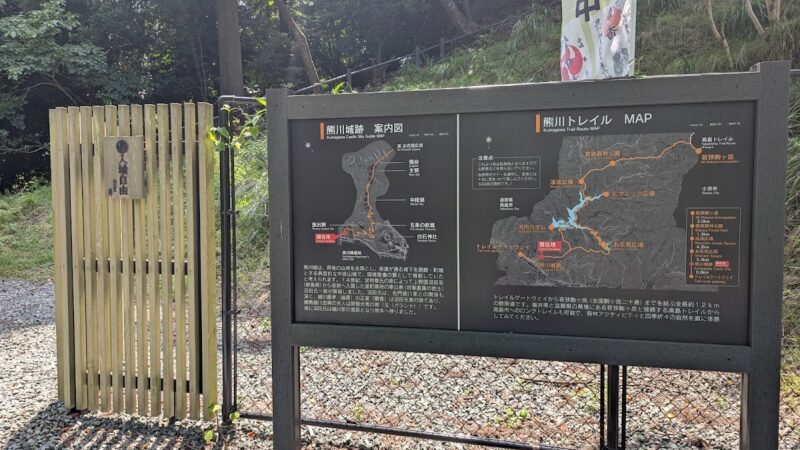
The approach to the castle begins at Shiraishi Shrine in Kumagawa-juku, and ascends a mountain path that also serves as a shrine approach. Shiraishi Shrine itself is thought to have functioned as part of the castle, and was an important facility located at the boundary between the castle town and the castle grounds.
Main Enclosure and Group of Enclosures
The main enclosure at the mountaintop measures approximately 30 meters east-west and 20 meters north-south, and is presumed to have housed the lord’s residence and command post. From the main enclosure, one can overlook the Wakasa Highway and Kumagawa-juku, making it an excellent location for monitoring people and supplies traveling along the road.
Several enclosures are arranged around the main enclosure, each functioning as an independent defensive unit. The enclosures are separated by steep slopes, making enemy intrusion difficult.
Defensive System of Moats and Vertical Ditches
The greatest highlight of Kumagawa Castle is its well-preserved moats and vertical ditches.
Moats are dry moats dug to cut across the ridge, preventing enemies from invading along the ridge. At Kumagawa Castle, a clear moat can be seen behind the main enclosure (southwest side), reaching a depth of approximately 3-4 meters.
Vertical moats are moats dug vertically along a slope, preventing enemies from climbing the slope and also serving as drainage channels for rainwater. At Kumagawa Castle, multiple vertical moats can be seen on the slope on the Shiraishi Shrine side, with the group of vertical moats on the northern slope being particularly impressive.
Ridge moats and projecting enclosures
Traces of ridge moats have also been confirmed in some areas. Ridge moats are defensive structures consisting of multiple vertical moats arranged in parallel, demonstrating more advanced castle construction techniques.
Furthermore, a small enclosure called a projecting enclosure protrudes from the front of the main enclosure, serving to monitor and defend against approaches to the main enclosure. The view from the projecting enclosure is excellent, allowing for early detection of approaching enemies.
Highlights of Kumagawa Castle | Remains that can be seen on-site
Shiraishi Shrine and the entrance to the castle
The ascent to Kumagawa Castle begins at Shiraishi Shrine located within Kumagawa-juku. Shiraishi Shrine is believed to have functioned as part of a castle, and castle-like elements such as stone walls and flat areas can be seen within the shrine grounds.
The shrine’s approach also serves as a hiking trail, and guide signs are installed, so even first-time visitors can climb to the castle without getting lost. The climb takes approximately 20-30 minutes one way.
Clear Moats
As you proceed along the climbing path, you will encounter several moats. The moat behind the main enclosure, in particular, is deep and clearly defined, providing a tangible sense of the mountain castle’s defensive structure. Standing at the bottom of the moat, you will be overwhelmed by the height of the cliffs on both sides.
The moats are not simply ditches; they utilize the “Yagenbori” technique, where excavated soil is piled up on both sides to emphasize the difference in elevation, making them valuable learning materials for studying Sengoku period castle construction techniques.
Continuous Vertical Moats
Walking across the slope, you can see the continuous arrangement of vertical moats. Unlike natural erosion, the vertical moats remain as clearly defined, artificially excavated trenches, demonstrating their role in forming the castle’s defensive line.
The vertical moats on the northeast slope are particularly well-preserved and are recommended as a photography spot.
View from the Main Enclosure
Upon reaching the main enclosure, you can enjoy a panoramic view of the town of Kumagawa-juku and the Wakasa Highway. On a clear day, you can even see as far as Omi Province, giving you a real sense of the castle’s importance in monitoring the highway.
The main enclosure is relatively flat and spacious, suggesting the presence of watchtowers and other buildings in the past. While currently surrounded by trees, these were likely cleared to ensure a clear view.
Tokuhōji Temple and the Numata Clan Memorial Tower
Within Kumagawa-juku lies Tokuhōji Temple, where a memorial tower for the Numata clan remains. Visiting Tokuhōji Temple after exploring the castle ruins will provide a deeper understanding of the Numata clan’s history.
The memorial tower is a stone five-tiered pagoda, erected to commemorate the Numata family. It’s an essential spot for tracing the footsteps of the castle lord’s family.
Integrated Tourism with Kumagawa-juku | The Relationship Between the Castle and the Post Town
History of Kumagawa-juku and its Important Preservation District for Groups of Traditional Buildings
Kumagawa-juku, located at the foot of Kumagawa Castle, is a historical townscape that flourished as a post town on the Wakasa Highway (Saba Kaido). From 1589 onwards, it developed into a full-fledged post town, with a magistrate’s office, guardhouse, and storehouses established there.
In 1996, it was designated a national Important Preservation District for Groups of Traditional Buildings, and the townhouses and irrigation canals dating back to the Edo period are well-preserved. In 2015, it was also designated a Japan Heritage site as part of “Miketsukuni Wakasa and the Saba Kaido.”
Functional Linkage Between the Castle and the Post Town
Kumagawa Castle and Kumagawa-juku (Kumagawa Post Town) were closely linked in both military and economic aspects. The castle defended the post town and the highway, while the post town supported the castle’s economic base—a mutually dependent relationship.
The post town was lined with wholesalers and inns, bustling with merchants and travelers passing through the highway. It is believed that the castle lord, the Numata clan, also managed the post town, earning income from tolls and lodging fees.
Highlights of Kumagawa-juku
When visiting Kumagawa-juku, the following spots are must-sees.
- Former Hemmi Kanbei Residence: A building belonging to a prominent merchant family in the post town.
- Maekawa Waterway: A historical waterway flowing along the townscape.
- Wakasa Kumagawa-juku Roadside Station: Convenient for obtaining tourist information and taking a break.
- Kumagawa-juku Historical Museum (Post Town Hall): A facility where you can learn about the history of the post town.
Combining a stroll around the castle ruins with sightseeing in the post town allows for a more fulfilling historical experience.
Access and Visiting Information | How to Get to Kumagawa Castle
Access by Car
If using the Hokuriku Expressway:
- Approximately 30 minutes from Tsuruga IC via National Route 27 and National Route 303.
- Approximately 15 minutes from Wakasa Kaminaka IC via National Route 27 and National Route 303.
There is free parking at Kumagawa-juku (Wakasa Kumagawa-juku Roadside Station). Park your car here and walk to Shiraishi Shrine (approximately 5 minutes on foot).
Access by Public Transportation
Take a bus from JR Obama Line “Kaminaka Station”.
- From JR Kaminaka Station, take the community bus “Wakasa Town Bus” for approximately 20 minutes and get off at the “Kumagawa-juku” bus stop.
- From the bus stop, it’s about a 5-minute walk to Shiraishi Shrine.
Since the number of buses is limited, it is recommended to check the timetable in advance.
Precautions When Visiting the Castle
- Estimated Time: Approximately 20-30 minutes one way from Shiraishi Shrine to the main enclosure, about 1 hour round trip.
- Clothing: As you will be walking on mountain paths, athletic shoes or trekking shoes are essential.
- Season: Spring to autumn is suitable for visiting the castle. Caution is needed in winter due to the possibility of snow.
- Equipment: It is recommended to bring drinking water, insect repellent (in summer), and rain gear.
- Bear Precautions: There have been bear sightings in the mountainous areas of Fukui Prefecture. Carry something that makes noise, such as a bell or radio.
Estimated Visiting Time
- Kumagawa Castle Ruins only: Approximately 1.5 hours
- Kumagawa Castle Ruins + Kumagawa-juku Stroll: Approximately 3-4 hours
- Kumagawa Castle Ruins + Kumagawa-juku + Surrounding Area Sightseeing: Half a day to a full day
We recommend planning with ample time.
Nearby Tourist Spots | Historical Heritage of Wakasa Town
Goseyama Castle Ruins
Goseyama Castle Ruins, the residence of the Takeda clan, the shugo (military governor) of Wakasa Province, is located about 30 minutes by car from Kumagawa Castle. It was a central castle in Wakasa Province, and larger-scale remains are preserved.
Uryu Castle Ruins
Uryu Castle Ruins, the residence of the Matsumiya clan, is also an essential spot for a tour of Wakasa’s mountain castles. Visiting the base of Matsumiya Kiyonaga, who conquered Kumagawa Castle, will give you a deeper understanding of the power struggles of the time.
Mikata Five Lakes
Mikata Five Lakes, a representative natural landscape of Wakasa Town, is a Ramsar Convention-registered wetland. Enjoying the beautiful lake scenery after visiting the castle ruins is highly recommended.
Other Post Towns on the Wakasa Saba Kaido
Besides Kumagawa-juku, several other post towns are scattered along the Wakasa Kaido. By following different routes of the Saba Kaido, such as the Harihata Pass and the Negoro Pass, you can experience the transportation history of Wakasa.
The Charm and Significance of Visiting Kumagawa Castle
Kumagawa Castle is not a large-scale castle, but it is a historical site well worth visiting for the following reasons:
- Excellent Preservation of Historical Remains: Clearly preserved moats, trenches, and baileys make it ideal for learning about the structure of a mountain castle.
- Rich Historical Background: Involvement with multiple powerful warlords, including the Numata, Hosokawa, and Matsumiya clans.
- Integration with Kumagawa-juku: A rare environment where you can experience both the castle and the post town simultaneously.
- Easy Access: Well-maintained climbing paths make it easy even for beginners.
- Understanding the Wakasa Highway: A location where you can experience the history of the Saba Kaido (Mackerel Highway).
This spot is highly recommended not only for mountain castle enthusiasts, but also for those interested in history and culture, and those who enjoy strolling through post towns.
Summary | Experience the History of Wakasa at Kumagawa Castle
Kumagawa Castle in Wakasa Town, Fukui Prefecture, is a mountain castle built on a strategic point overlooking the Wakasa Highway, and played an important role in the history of Wakasa as the residence of the Numata clan. The well-preserved remains of the castle, such as the moats and trenches, are valuable historical materials that convey the castle-building techniques of the Sengoku period (Warring States period).
Kumagawa-juku, located at the foot of the mountain, is preserved as a nationally designated Important Preservation District for Groups of Traditional Buildings, allowing visitors to enjoy the historical landscape where the castle and post town are integrated. It’s a place where you can learn about history from multiple perspectives, including the history of the Saba Kaido (Mackerel Road), Wakasa’s role as a “Miketsukuni” (a region that supplied food to the imperial court), and the movements of regional powers during the Sengoku period.
When visiting Wakasa, be sure to climb to the ruins of Kumagawa Castle and reflect on the history of yesteryear while gazing at the Wakasa Kaido from the mountaintop. Combining a stroll through the castle ruins with a visit to Kumagawa-juku will make for a more fulfilling trip to Wakasa.