
Saichiyama Castle, Takahama Town (Fukui Prefecture) Complete Guide
Located in Takahama Town, Oi District, Fukui Prefecture, Saichiyama Castle is known as the largest mountain castle in Fukui Prefecture. The magnificent remains, which tell the story of the turbulent history of the Sengoku period, remain in excellent condition within the mountain forest, attracting considerable attention from castle enthusiasts and history buffs.
This article provides a thorough explanation of this valuable mountain castle, covering its historical background, structural features, highlights, visitor guide, and access information.
What is Saichiyama Castle? – The Largest Mountain Castle in Fukui Prefecture
Saichiyama Castle is a large-scale mountain castle built on the entire Saichiyama mountain (approximately 180m above sea level) behind Sakiji Shrine. Its remains extend approximately 900 meters east-west and 500 meters north-south, covering a vast area known as the “Saichiyama Castle Group.”
Basic Data
- Location: Miyazaki, Takahama-cho, Oi-gun, Fukui Prefecture
- Castle Type: Mountain Castle
- Relative Height: Approximately 130 meters
- Year of Construction: Late Muromachi period (late 15th to 16th century)
- Builder: Henmi Suruga-no-kami Masatsune
- Main Remains: Enclosures (kuruwa), moats (horikiri), cliffs (kirigishi), earthworks
- Current Status: Forest (partially developed walking trails)
This mountain castle boasts the largest scale in Wakasa Province and is highly regarded by castle researchers as one of the largest medieval castles in Fukui Prefecture.
The History of Saidōzan Castle – The Conflict Between Henmi Masatsune and the Wakasa Takeda Clan
About the Builder, Henmi Masatsune
Henmi Masatsune, who is said to have built Saidōzan Castle, was a powerful vassal of the Takeda clan, the shugo (military governor) of Wakasa Province. The Henmi clan, as local lords serving the Takeda clan, controlled the area around Takahama, but historically they are known for frequently rebelling against their lord.
The Rebellion of 1561
The most important event in the history of Saidōzan Castle is Henmi Masatsune’s rebellion which occurred in 1561.
Masatsune, together with Awaya Katsuhisa of Kuniyoshi Castle (Mihama Town), rebelled against Takeda Yoshimune, the shugo of Wakasa Province. At this time, Masatsune holed up in Saidōzan Castle and is said to have extensively expanded it to accommodate approximately 8,000 people, including his subjects and troops.
However, in June of the same year, Saidōzan Castle was captured and fell to Takeda Yoshimune, who had received reinforcements from the Asakura clan of Echizen. Even with Saidōzan Castle’s defensive capabilities, the combined forces of the Echizen Asakura and Takeda clans could not withstand the invasion.
Relocation to Takahama Castle
Even after the fall of Saidōzan Castle, Masatsune Hemmi did not give up. He attempted a comeback and, in Eiroku 8 (1565), built Takahama Castle and moved his base of operations there. Takahama Castle was a flatland castle located in the area of the present-day Shiroyama Park, a location quite different from that of Saidōzan Castle.
The “Tsuneda Documents” state, “Hemi Suruga-no-kami built a castle on Hachianayama in Eiroku 8 (1565), and resided there for 17 years until Tensho 9 (1581).” This indicates that Masatsune ruled from Takahama Castle for approximately 17 years until Tensho 9 (1581).
Relationship between the Wakasa Takeda and Hemi Clans
The Wakasa Takeda clan was a branch of the Kai Takeda clan and served as the governor of Wakasa Province from the Muromachi period. The Hemi clan held considerable power as important retainers, but during the turbulent Sengoku period, their lord-vassal relationship became unstable, leading to frequent conflicts.
Hemi Masatsune’s rebellion also took advantage of the internal strife within the Wakasa Takeda clan, reflecting the characteristic trend of gekokujo (overthrowing superiors) during the Sengoku period.
Structure and Layout of Saidōzan Castle – A Primitive Yet Ingenious Defensive System
Arrangement of Enclosures (Kuruwa)
The most distinctive feature of Saidōzan Castle is the numerous enclosures spread throughout the entire mountain. Enclosures are sections created on flat ground within the castle grounds, used as garrisons for soldiers and storage for supplies.
Dozens of enclosures, both large and small, have been identified at Saidōzan Castle, arranged in stages around the main enclosure. These groups of enclosures support the legend that the castle accommodated approximately 8,000 people.
Defense by Moats (Horikiri)
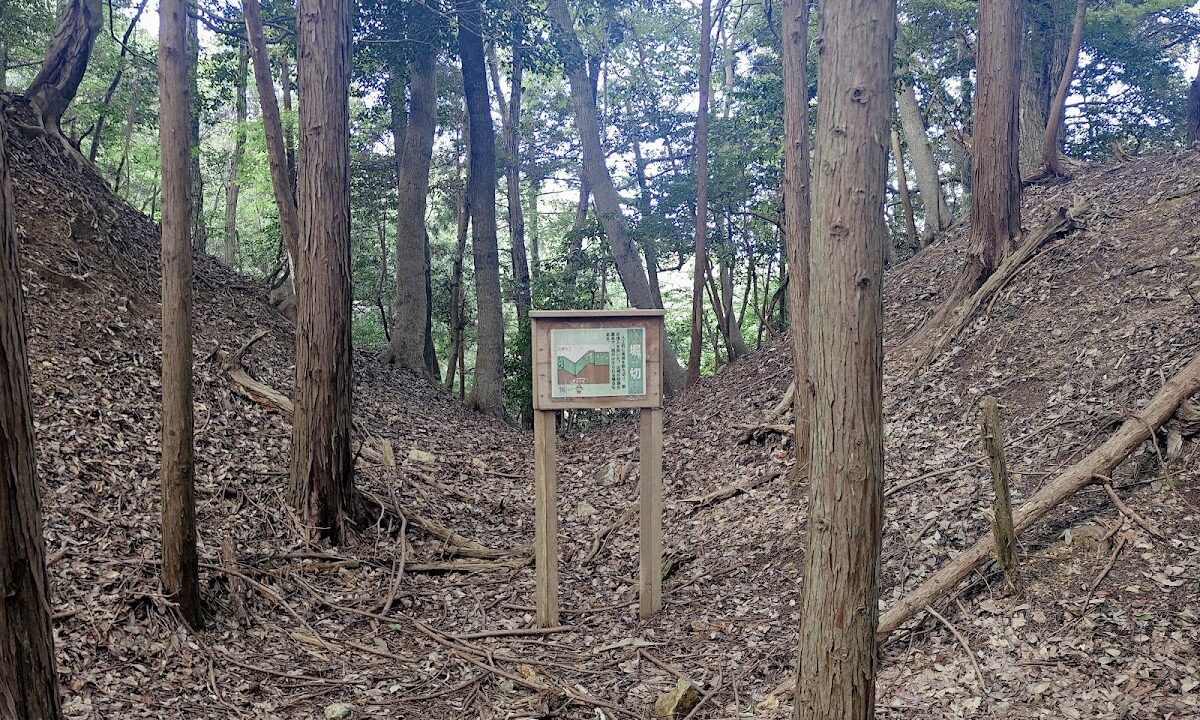
Moats play a crucial role as defensive structures in mountain castles. Moats are dry ditches dug to cut across ridges, functioning as obstacles to prevent enemy advances.
Multiple moats have been identified at Saidōzan Castle, with particularly deep and large moats along the main ridgelines. These trenches remain clearly visible even today, attesting to the high level of defensive awareness at the time.
Techniques of Cut-Off Ridges
Cut-off ridges are artificial cliffs created by cutting the edge of a bailey at a near-vertical angle. Numerous clear cut-off ridges can be seen in the baileys of Saidōzan Castle, demonstrating a design intended to prevent enemies from easily climbing.
These cut-off ridges, reaching several meters in height, are a classic example of Sengoku period castle construction techniques, skillfully utilizing natural terrain while artificially modifying it to enhance defensive capabilities.
Placement of Earthworks
Earthworks have also been found in some baileys. Earthworks are embankment-like defensive structures made by piling up earth, serving to protect against arrow and gunfire attacks.
While the earthworks at Saidōzan Castle are not large in scale, they are consistently placed in important baileys, indicating their role in strengthening key defensive points.
Characteristics of a Primitive Mountain Castle
Saidoyama Castle is considered a primitive mountain castle, primarily utilizing “kuruma” (enclosures), “kirigishi” (cliffs), and “horikiri” (moats) as its main defensive structures. It lacks elements of modern castles such as stone walls and keeps, preserving the typical structure of a medieval mountain castle.
However, its large scale and the ingenious layout of its enclosures indicate that it was not merely a primitive castle, but a sophisticated military facility based on the practical castle-building philosophy of the Sengoku period.
Highlights of Saidoyama Castle – Checkpoints for Visitors
Entrance to the Castle from Sakiji Shrine
The ascent to Saidoyama Castle begins beside Sakiji Shrine. The shrine is located at the foot of Mount Saidoyama and serves as the entrance to the castle ruins.
Information boards and explanatory signs are installed within the shrine grounds, providing basic information about the history and structure of Saidoyama Castle. Gaining this background knowledge before your visit will allow for a deeper understanding of the castle ruins.
Trail Maintenance Status
A walking trail is maintained at the site of Saidoyama Castle, allowing visitors to explore the main remains. However, since the trail goes through a forest, appropriate clothing and shoes for hiking are necessary.
While the trail is relatively well-maintained, there are steep slopes and areas with uneven footing, so please be careful while exploring. It is especially recommended to check the weather before visiting, as the trails become slippery after rain.
Main Enclosure (Honmaru) Area
Near the summit lies the main enclosure, the central part of the castle. The main enclosure is the largest enclosure and is thought to have housed the lord’s residence and command post.
From the main enclosure, you can enjoy a panoramic view of the town of Takahama and Wakasa Bay, allowing you to imagine the lord of the castle overlooking his territory from this spot. The view is one of Saidoyama Castle’s major attractions.
Myoken-gu and Atago Shrines
Myoken-gu and Atago Shrine are enshrined at the summit. These are believed to have been worshipped as guardian deities of the castle, and are important remains that show the relationship between medieval mountain castles and religious beliefs.
Large-scale moats
One of the biggest highlights of Saidōzan Castle is the moats remaining in various places. In particular, large-scale moats, several meters deep and over 10 meters wide, can be seen along the main ridges.
The moats are also popular as photography spots, and are remains that castle enthusiasts will definitely want to record.
Terraced baileys
The baileys arranged like terraced fields on the mountain slope are also impressive. These baileys are said to have been constructed to accommodate as many as 8,000 people, and you can really feel the scale of it.
The cliffs of each bailey are clearly defined, demonstrating the high level of civil engineering technology of the time.
Visiting Guide to Saidoyama Castle – Access and Visiting Information
Access Methods
Access by Public Transportation
- Approximately 15 minutes on foot from JR Obama Line “Wakasa-Takahama Station” to reach Sakiji Shrine.
- Proceed southeast from the station and follow the signs.
- Takahama Station is approximately 2 hours from Kyoto Station by limited express train, and approximately 1 hour from Tsuruga Station by local train.
Access by Car
- Approximately 10 minutes from Maizuru-Wakasa Expressway “Oi-Takahama IC”
- Parking is available near Sakiji Shrine (limited number of spaces).
- Approximately 1 hour and 30 minutes from Fukui City via National Route 27.
Notes for Visitors
- Clothing: Hiking boots or trekking shoes are recommended. Long sleeves and long pants are recommended.
- What to bring: Drinking water, towel, insect repellent spray, map (smartphone app is also useful)
- Estimated time: Approximately 1.5 to 2 hours round trip from Sakiji Shrine to the main enclosure
- Difficulty: Intermediate (elevation difference 130m, walking trail available)
- Best season: Spring (April-May) and Autumn (October-November). Be careful of the heat and insects in summer.
Guided Tours and Event Information
Regular guided tours are held at Saidoyama Castle, organized by the Saidōyama Castle Preservation Society and the Takahama Town Board of Education.
In the past, a guided tour with commentary by Hitoshi Nakai, Professor Emeritus of Shiga Prefectural University, a leading expert in castle research, was held, attracting approximately 40 castle enthusiasts from within and outside the prefecture. By touring the remains while listening to expert commentary, you can gain a deeper understanding of Saidoyama Castle.
Information on guided tours can be found on the websites of the Wakasa Takahama Tourism Association and the Saidoyama Castle Preservation Society.
Nearby Tourist Attractions
Takahama Castle Ruins (Shiroyama Park)
Takahama Castle Ruins, built by Masatsune Hemmi after the fall of Saidoyama Castle, are now maintained as “Shiroyama Park.” With scenic spots such as Meikyodo Cave, it is one of the prefecture’s leading parks where you can enjoy the scenery of each season.
Shiroyama Park has a lawn area and walking paths, making it enjoyable for families. Visiting it in conjunction with Saidoyama Castle allows you to trace the footsteps of Masatsune Hemmi.
Sakiji Shrine
Sakiji Shrine, which is also the entrance to Saidoyama Castle, has been worshipped as the local guardian deity since ancient times. The quiet grounds are perfect for a visit before or after exploring the castle ruins.
Wakasa Takahama Coastline
Takahama Town is known for its beautiful coastline overlooking Aobayama Mountain, also known as “Wakasa Fuji.” After exploring the castle ruins, we recommend enjoying the seafood of Wakasa Bay.
Activities of the Saidōzan Castle Preservation Society
The Saidōzan Castle Preservation Society is engaged in preservation and maintenance activities of the ruins to pass on this valuable cultural asset to future generations.
Main activities of the Preservation Society:
- Maintenance and management of walking trails
- Installation of information boards and explanatory signs
- Holding of tours and lectures
- Public relations activities (website operation, distribution of flyers, etc.)
- Support for history education at local elementary and junior high schools
The Preservation Society’s website contains detailed information about Saidōzan Castle and the latest activity reports, which are useful for gathering information before visiting.
Why Saidōzan Castle is the Largest in Fukui Prefecture
The reason why Saidōzan Castle is considered the “largest mountain castle in Fukui Prefecture” lies in the vast scale of its ruins.
Measuring approximately 900 meters east-west and 500 meters north-south, this castle is one of the largest not only in Wakasa Province but also in all of Fukui Prefecture. This is thought to be because it needed to accommodate approximately 8,000 people during the siege of 1561 (Eiroku 4).
For comparison, the area of the remains of Saidōyama Castle is far superior to that of Kuniyoshi Castle (Mihama Town) and Goseyama Castle (Obama City) in the same Wakasa Province.
Furthermore, it is not only large, but the excellent state of preservation of remains such as baileys, moats, and cliffs is also highly valued. Because it has undergone few alterations since the early modern period and retains almost the original form of a medieval mountain castle, it is a valuable castle site from an academic perspective.
The Relationship Between Saidōyama Castle and the Echizen Asakura Clan
An essential aspect of discussing the history of Saidōyama Castle is its relationship with the Echizen Asakura Clan.
In 1561, during the rebellion of Hemmi Masatsune, Wakasa Province’s governor, Takeda Yoshimune, requested reinforcements from the Asakura clan of Echizen Province. At that time, the Asakura clan was a powerful Sengoku-period daimyo controlling Echizen Province and exerting considerable influence over Wakasa.
With the Asakura’s support, the Takeda clan captured Saidōzan Castle and suppressed Hemmi Masatsune’s rebellion. This event is an important example illustrating the process by which Wakasa Province was incorporated into the sphere of influence of the Echizen Asakura clan.
Subsequently, the Wakasa Takeda clan came under the Asakura’s control and remained under their influence until Oda Nobunaga’s invasion of Echizen Province (1573).
Evaluation of Saidōzan Castle in Castle Research
In the field of castle research, Saidōzan Castle is highly regarded as a typical example of a medieval mountain castle.
Professor Hitoshi Nakai, Professor Emeritus of Shiga Prefectural University, explained the clever arrangement of moats and cliffs as “the remains of defensive facilities built to prevent enemy invasions” during a tour of Saidōzan Castle.
Features of Saidōzan Castle:
- Large-scale group of enclosures: A vast arrangement of enclosures capable of accommodating a large number of personnel.
- Effective moats: Large-scale moats cutting off major ridgelines.
- Clear cliffs: Near-vertical cliffs enhancing defensive capabilities.
- Good state of preservation: Remains that retain almost their medieval appearance.
- Practical structure for the Sengoku period: A practical layout designed for siege warfare.
These features indicate that Saidōzan Castle was not merely the castle of a local powerful family, but a practical military facility designed to cope with the fierce conflicts of the Sengoku period.
Impressions of Visitors to Saidōzan Castle
The following are some comments from castle enthusiasts who have visited Saidōzan Castle:
- “I was surprised that such a large-scale mountain castle ruin remains in Fukui Prefecture.”
- “The scale of the moat was beyond my imagination, and I truly felt the high level of castle-building technology of the time.”
- “The walking paths are well-maintained and easy to walk, making it enjoyable even for beginners.”
- “The view from the main enclosure was magnificent, and I could see all the way to Wakasa Bay.”
- “I am grateful for the efforts of the preservation society in protecting these valuable remains.”
Saidōzan Castle also receives high praise on castle information websites such as Kōjōdan, and many reviews from “100 Castle Lords” are also posted.
Summary – The Charm and Value of Saidōzan Castle
Saidōzan Castle in Takahama Town, Fukui Prefecture, is of high value as the largest mountain castle in Fukui Prefecture and as a valuable historical site that tells the history of Wakasa Province during the Sengoku period.
The historical history of Saidoyama Castle—from its construction and expansion by Masatsune Hemmi, to its siege and fall in 1561, and its subsequent relocation to Takahama Castle—vividly illustrates the struggles of local powerful families during the Sengoku period.
The vast remains, spanning approximately 900 meters east-west and 500 meters north-south, with numerous baileys, large moats, and clearly defined cliffs, are academically valuable as a typical example of a medieval mountain castle.
The well-maintained walking trails and regularly scheduled guided tours make it easily accessible, which is another attractive feature. It’s a historical site recommended not only for castle enthusiasts but also for history buffs and those who enjoy mountain hiking.
When visiting Wakasa Takahama, be sure to visit Saidoyama Castle and experience the spirit of the Sengoku period. This magnificent mountain castle ruin, a source of pride for Fukui Prefecture, is sure to captivate you.


