History and Highlights of Iiju Castle (Sakura City, Chiba Prefecture) – A Complete Overview of a Medieval Castle that Functioned as a Branch Castle of Hon-Sakura Castle
Iiju Castle is a medieval castle located in Iiju, Sakura City, Chiba Prefecture. Currently used as the grounds of Omiya Shrine, the remains of earthworks and moats are well-preserved. While the castle remains shrouded in mystery due to the scarcity of records, it is believed to have played an important role as a branch castle of Hon-Sakura Castle.
Basic Information on Iiju Castle
Iiju Castle is a hilltop castle located in Iiju, Sakura City, Chiba Prefecture, built around the current site of Omiya Shrine. It is located approximately 3 km northeast of Hon-Sakura Castle, strategically situated to monitor the road leading to Lake Inbanuma.
Location: Iizumi, Sakura City, Chiba Prefecture
Castle Structure: Hilltop Castle
Construction Period: Muromachi period to Sengoku period (estimated)
Lord: Unknown
Remains: Earthworks, moats, bailey remains
Current Status: Within the grounds of Omiya Shrine
Iizumi Castle held an important position as one of the branch castles protecting Hon-Sakura Castle, the base of the Chiba clan, a central power in Shimosa Province. Many other castles, such as Usui Castle and Shizu Castle, exist within Sakura City, and these sites are attracting attention as evidence of the Chiba clan’s sphere of influence.
History of Iizumi Castle
Background and Period of Construction
Since there are no reliable historical records regarding the construction period of Iizumi Castle, the exact date is unknown. However, based on the castle’s structure and location, it is estimated to have been built during the late Muromachi period to the Sengoku period.
It is believed that Hon-Sakura Castle was built by the Chiba clan in the mid-15th century, and that Iiju Castle was also developed around this time as a subsidiary castle forming part of Hon-Sakura Castle’s defense network. At that time, Shimosa Province was controlled by forces centered around the Chiba clan, but it was also a border region with the neighboring Kazusa and Hitachi Provinces, making the development of defensive strongholds a matter of urgency.
Relationship between the Castle Lord and the Chiba Clan
There are no reliable records regarding the lord of Iiju Castle. It is generally presumed that a member or vassal of the Chiba clan, the lords of Hon-Sakura Castle, served as the castle lord.
The Chiba clan was a prestigious samurai family that ruled Shimosa Province from the late Heian period, and played an active role as important retainers of the shogunate during the Kamakura period. From the Muromachi period to the Sengoku period, they maintained their power with Hon-Sakura Castle as their base, and controlled their territory by establishing many subsidiary castles in the surrounding area.
Iizumi Castle is thought to have been part of the Chiba clan’s network of branch castles, playing a role in preparing for invasions from the Inbanuma area. Due to its proximity to Hon-Sakura Castle, it likely also functioned as a relay point for communication and reinforcements in emergencies.
Trends during the Sengoku Period
During the Sengoku period, Shimosa Province became a fierce battleground, with the Hojo, Satomi, and Satake clans vying for power. The Chiba clan initially maintained its independence, but gradually fell under the influence of the Hojo clan.
When the Hojo clan was destroyed in Toyotomi Hideyoshi’s Odawara campaign in 1590, the Chiba clan also declined. It is believed that Hon-Sakura Castle and its surrounding branch castles were abandoned at this time. It is presumed that Iizumi Castle also disappeared from the historical stage around this period.
Structure and Layout of Iizumi Castle
Basic Structure of the Castle
It is believed that the main enclosure of Iizumi Castle was located in the area south of the present-day Omiya Shrine. Built as a hilltop castle, it sits on a plateau slightly higher than the surrounding area.
The castle grounds extend around the grounds of Omiya Shrine, and a clear earthen embankment remains in the area presumed to be the main enclosure. The castle is not particularly large, indicating its character as a subsidiary castle.
Existing Remains
Earthen Embankments Earthen embankments remain in good condition within the grounds of Omiya Shrine. Clear embankments are particularly visible on the north and east sides of the shrine. They are approximately 1.5 to 2 meters high, conveying the appearance of the defensive facilities at the time.
Moats Moats, used to demarcate the castle grounds, can also be seen. While some parts are now filled in, the location of the moats can be estimated from the topography. The moats served to prevent enemy intrusion and to demarcate the enclosures.
Enclosure Sites The grounds of Omiya Shrine are thought to be the main enclosure, and it is presumed that several enclosures were arranged around it. Although much has been lost due to residential development and other factors, observations of the terrain suggest the existence of multiple baileys.
Characteristics of the Defensive System
The defensive system of Iiju Castle exhibits the typical form of a medieval castle, combining earthworks and moats. There are no structures like stone walls, which are found in early modern castles; instead, construction techniques primarily using earth were employed.
As a subsidiary castle intended to cooperate with Hon-Sakura Castle, it is thought to be a structure primarily intended for temporary defense and information transmission, rather than a large-scale defensive facility designed for long-term sieges.
Highlights and Points of Interest at Iiju Castle
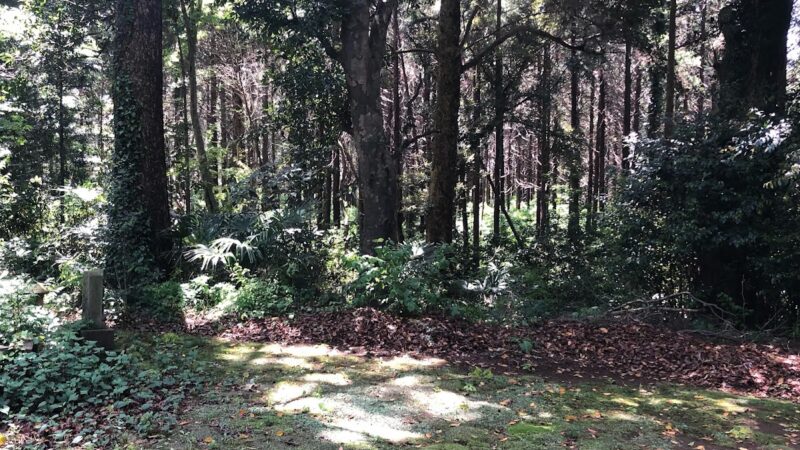
Earthworks within the Omiya Shrine Grounds
The greatest highlight of Iiju Castle is the earthworks remaining within the grounds of Omiya Shrine. Particularly clear earthworks remain on the north and east sides of the shrine, allowing for close observation of the approximately 2-meter-high earthworks.
It is possible to walk on top of the earthworks, allowing for a panoramic view from the perspective of the castle’s soldiers. The shape and scale of the earthworks make it a valuable historical site that allows one to experience the reality of medieval castle defenses. ### Traces of the Moat
Around Omiya Shrine, traces of a moat remain as part of the topography. While some parts are now completely filled in, the location of the moat can be estimated from the undulations and elevation changes of the terrain.
Moats were important defensive structures that demarcated castle grounds and prevented enemy intrusion. Although the moat at Iiju Castle is relatively small, it is thought to have been large enough to function as a subsidiary castle.
Surrounding Landscape
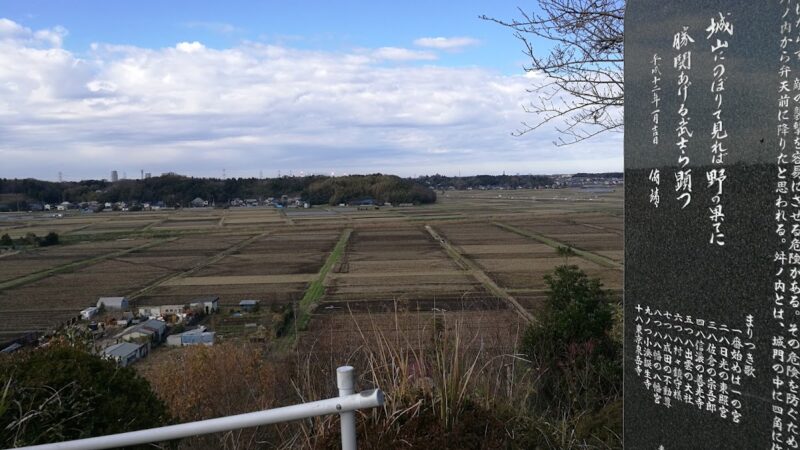
From the grounds of Omiya Shrine, one can enjoy a panoramic view of the surrounding rural landscape. The castle’s soldiers likely monitored the area towards Lake Inba and Hon-Sakura Castle from this location.
Although residential development is progressing, fields and farmlands remain around the shrine, allowing for some imagination of the landscape at the time. In particular, the view towards Lake Inba opens up from the east side of the shrine, highlighting its strategic location for monitoring the highway.
Access to Iiju Castle
Access by Public Transportation
Using Keisei Electric Railway
The nearest stations are Keisei Usui Station or Keisei Sakura Station on the Keisei Main Line. Access from the stations is by foot or bus.
- Approximately 30 minutes on foot from Keisei Usui Station
- Approximately 40 minutes on foot from Keisei Sakura Station
Using Buses
You can also use the Sakura City Community Bus, but since the number of buses is limited, it is recommended to check the timetable in advance.
Access by Car
Using the Higashi-Kanto Expressway
- Approximately 15 minutes from Sakura IC
- Approximately 20 minutes from Yotsukaido IC
There is a parking space for visitors at Omiya Shrine, but it is not very large, so please be careful. Please avoid parking on the surrounding streets and observe proper etiquette when visiting.
Address: Iizumi, Sakura City, Chiba Prefecture
Car Navigation Setting: Search for “Omiya Shrine, Sakura City”
Precautions for Visiting
Since the Iizumi Castle ruins are located within the grounds of Omiya Shrine, it is important to observe proper shrine etiquette when visiting. Please pay attention to the following points:
- Be considerate of other shrine visitors.
- Be careful not to damage the remains such as earthworks.
- Always take your trash with you.
- Take photographs with consideration for your surroundings.
- Do not trespass on private property.
Visiting during daylight hours is recommended. Allow approximately 30 minutes to 1 hour for your visit.
Nearby Castles and Tourist Spots
Hon-Sakura Castle (approx. 3km)
Hon-Sakura Castle, the main castle of Iizumi Castle, flourished as the base of the Chiba clan. It is a nationally designated historical site, and its remains, such as earthworks and dry moats, are well-preserved.
Sakura Castle is about a 10-minute drive from Iiju Castle, and visiting both together allows you to understand the structure of the Chiba clan’s network of branch castles. There is also a guidance facility where you can learn about the history of the Chiba clan and the structure of the castles.
Usui Castle (approx. 4km)
Usui Castle is a famous castle known for repelling an attack by Uesugi Kenshin. Currently, it is maintained as Usui Castle Ruins Park, where you can see remains such as earthworks and dry moats.
Located on a hill overlooking Lake Inba, it is a castle ruin with a magnificent view. It is about a 15-minute drive from Iiju Castle.
Sakura Castle (approx. 6km)
Sakura Castle, which flourished as the residence of the Sakura Domain during the Edo period, is now maintained as Sakura Castle Ruins Park. The National Museum of Japanese History is also adjacent, where you can learn about Japanese history and culture.
Visiting Sakura Castle is also worthwhile for understanding the transition from medieval to early modern castles. It’s about a 20-minute drive from Iiju Castle.
Shizu Castle (approx. 5km)
Shizu Castle is also considered one of the Chiba clan’s branch castles and, like Iiju Castle, formed part of the defense network of Hon-Sakura Castle. While residential development is progressing, some remains still exist.
Sightseeing around Lake Inbanuma
Lake Inbanuma stretches around Iiju Castle, offering beautiful natural scenery. The Lake Inbanuma Cycling Road is also well-maintained, making it enjoyable to combine a castle tour with cycling.
Iiju Castle and Medieval Castles in Chiba Prefecture
Distribution of Castles in Chiba Prefecture
Numerous medieval castles remain in Chiba Prefecture. In particular, castles related to the Chiba clan are concentrated around Sakura City, which was the center of Shimosa Province.
Major castles include Hon-Sakura Castle, Usui Castle, Sakura Castle, Otaki Castle, and Kururi Castle. These castles played important roles in their respective eras. ### Chiba Clan’s Network of Branch Castles
The Chiba clan, in order to control Shimosa Province, constructed a network of branch castles centered around Hon-Sakura Castle. Iiju Castle is thought to have played a role in this network, responsible for guarding the area around Lake Inba and monitoring the roads.
The branch castle network was interconnected, creating a system capable of responding quickly to enemy invasions. It is presumed that a communication system using signal fire platforms and watchtowers was also in place.
Characteristics of Medieval Castles
Medieval castles like Iiju Castle have characteristics that differ from early modern castles with stone walls and keeps. They are characterized by defensive structures primarily consisting of earthworks and moats, and their layouts skillfully utilize the terrain.
Medieval castles prioritized defense over habitability and functioned as temporary bases during wartime. In peacetime, the lord and retainers typically resided in residences in the town below the castle, only taking refuge in the castle during wartime.
Medieval castles prioritized defense over habitability and functioned as temporary bases during wartime. ## Research and Preservation of Iiju Castle
Current State of Academic Research
Due to the scarcity of reliable historical materials, academic research on Iiju Castle is limited. However, recent advances in castle research have led to surveys of the remains and the creation of layout maps.
While full-scale archaeological excavations have not been conducted, observations of the ground surface and topographic surveys have deepened our understanding of the castle’s structure and scale.
Preservation Status of the Remains
The fact that the site is used as the grounds of Omiya Shrine has indirectly contributed to the preservation of the remains. The shrine’s management has maintained the remains, such as earthworks, in good condition.
However, many remains have been lost due to surrounding residential development, making it difficult to grasp the entire castle area. Appropriate preservation and management are needed to pass on the existing remains to future generations.
Future Challenges
To raise awareness of the historical value of Iiju Castle, the installation of information boards and the improvement of explanatory materials are desirable. Furthermore, developing tourist routes that connect with surrounding castles, including Hon-Sakura Castle, is important from the perspective of regional development.
Academically, continued historical research and archaeological investigations are expected to clarify the actual state of the castle. In particular, the discovery of new historical materials regarding the construction period and the castle’s lord is eagerly awaited.
Model Course for Visiting Iishige Castle
This section introduces a model course for efficiently visiting Iishige Castle and surrounding castles.
Half-Day Course (Approx. 4 Hours)
- Iishige Castle (Duration: Approx. 1 hour)
Visit to Omiya Shrine and view the earthworks and moats
- Hon-Sakura Castle (Duration: Approx. 2 hours)
Visit to the guidance facility and stroll through the castle ruins
- Usui Castle (Duration: Approx. 1 hour)
Stroll through Usui Castle Ruins Park and enjoy the view of Lake Inbanuma
Full-Day Course (Approx. 8 Hours)
Morning:
- Iishige Castle (Duration: Approx. 1 hour)
- Hon-Sakura Castle (Duration: Approx. 2 hours)
Lunch: Enjoy local cuisine in Sakura City
Afternoon:
- Usui Castle (Duration: Approx. 1 hour)
- Sakura Castle (Duration: Approx. 2 hours)
Includes a visit to the National Museum of Japanese History
- Samurai Residences (Duration: Approximately 1 hour)
A tour of the samurai residences in Sakura.
This course allows you to systematically understand the changes in castles from the medieval to the early modern period.
Summary – The Historical Value of Iiju Castle
Iiju Castle is a mysterious castle with few records, but it is an important historical site for understanding the Chiba clan’s network of branch castles. The earthworks and moats remaining within the grounds of Omiya Shrine are valuable remains that convey the reality of a medieval castle.
Located approximately 3 km from Hon-Sakura Castle, Iiju Castle was built in a strategic location to monitor the road towards Lake Inba, and it represents a part of the Chiba clan’s territorial control system. Although not large in scale, it possessed a structure that allowed it to fully fulfill its role as a branch castle.
Currently, Sakura City in Chiba Prefecture has castles representing various eras, such as Hon-Sakura Castle, Usui Castle, and Sakura Castle. Visiting Iiju Castle together with these castles will allow you to gain a deeper understanding of the history of this region. While you’re visiting Omiya Shrine, why not also take a look at the remains of Iiju Castle and reflect on the medieval castle? The earthen ramparts remaining in the tranquil shrine grounds will surely quietly tell you about the history of over 500 years ago.