Complete Guide to Iinuma Jinya Ruins (Choshi City, Chiba Prefecture) | History, Highlights, and Access Information
The Iinuma Jinya Ruins, located in Choshi City, Chiba Prefecture, are the remains of an outpost office established by the Takasaki Domain during the Edo period. Currently developed as Jinya-cho Park, it is a valuable historical site that conveys the history of Choshi to the present day. This article comprehensively introduces information you should know before visiting, from the historical background of Iinuma Jinya to local highlights and surrounding tourist information.
What are the Iinuma Jinya Ruins?
The Iinuma Jinya Ruins are the remains of an Edo period administrative facility located in Jinya-cho, Choshi City, Chiba Prefecture. Built in 1717 (Kyoho 2) by the Okouchi Matsudaira clan, lords of the Takasaki Domain in Kozuke Province (present-day Gunma Prefecture), it is an important historical site that shows the reality of governing exclaves in the Kanto region.
A Jinya is an administrative and residential facility established during the Edo period to manage small domains or exclaves with a stipend of less than 10,000 koku. Rather than large-scale defensive structures like castles, these facilities were established in various locations, emphasizing practical administrative functions.
Management of the Takasaki Domain’s Enclave
The Takasaki Domain, while based in Kōzuke Province (Gunma Prefecture), possessed an exclave of approximately 10,000 koku in Kaijō District, Shimōsa Province (northern Chiba Prefecture). To efficiently manage this remote territory, a jinya (fortified residence) was established in Iinuma, Chōshi, with one district magistrate and two deputies permanently stationed there.
The reasons for choosing Iinuma included its proximity to the Tone River estuary, its convenient water transport, the surrounding area being a fertile granary, and Chōshi’s economic importance as a fishing base. The jinya was not merely an administrative center, but also handled a wide range of administrative functions, including tax collection, maintaining public order, and handling civil lawsuits.
History of Iinuma Jinya
Background and Circumstances of Establishment
The Iinuma Jinya was established during the Kyoho era, a period when the Kyoho Reforms were being implemented by Tokugawa Yoshimune, the 8th Shogun of the Edo Shogunate. As part of these reforms, there was a demand for nationwide reforms of domain administration and increased efficiency in territorial management. The Takasaki Domain also needed to strengthen its management system for its exclaves in line with this trend.
The Okochi Matsudaira clan, as a Fudai daimyo (hereditary vassal daimyo), enjoyed the Shogunate’s deep trust and played a crucial role in implementing Shogunate policies in the Kanto region. The establishment of the Iinuma Jinya is thought to have served not only to improve the efficiency of territorial management but also to maintain the Shogunate’s influence in the Choshi region, a key point on the Tone River waterway.
Functions of the Jinya during the Edo Period
At the Iinuma Jinya, the dispatched district magistrate and deputy chief primarily carried out the following duties:
Administrative Functions: They were responsible for basic administrative tasks such as tax collection, household registration, and land register maintenance. Choshi, in particular, was a region where soy sauce brewing and fishing flourished, making the supervision of commercial activities a crucial task.
Judicial Function: The Iinuma Jinya (fortified residence) handled mediation in civil lawsuits and trials for minor offenses. For serious cases, it reported to the main domain in Takasaki and sought instructions.
Economic Management: Choshi played a vital role as a supply base for goods to Edo, and the Jinya supervised distribution and collected commercial taxes. The transportation of soy sauce and fish to Edo, in particular, was a vital economic activity utilizing the Tone River waterway.
Changes After the Meiji Restoration
With the Meiji Restoration in 1868 (Meiji 1), the Iinuma Jinya was abolished. The exclave of the Takasaki domain came under the jurisdiction of the new government, and the Jinya buildings were gradually demolished. The land was sold off to private individuals, and some parts were used for residential areas and farmland.
After the Meiji era, the remains of the Jinya (fortified residence) gradually disappeared, but the local place name “Jinya-machi” (Jinya Town) remains, continuing to convey that this area was an important administrative center during the Edo period. In the Showa era, local historians and community researchers re-recognized the historical value of the Iinuma Jinya, and a preservation movement was launched.
Current Highlights of the Iinuma Jinya Site
Jinya-machi Park
Currently, the Iinuma Jinya site has been developed into “Jinya-machi Park,” a place of relaxation for citizens. The park includes a portion of the original Jinya site, making it a valuable space where one can imagine the atmosphere of the Edo period.
The park is appropriately planted with trees, and benches and playground equipment are also installed, making it suitable not only for historical walks but also for daily use by local residents. Cherry blossoms bloom in spring, and the autumn leaves are beautiful, allowing visitors to enjoy the scenery of each season.
Stone Monument at the Former Jinya Site
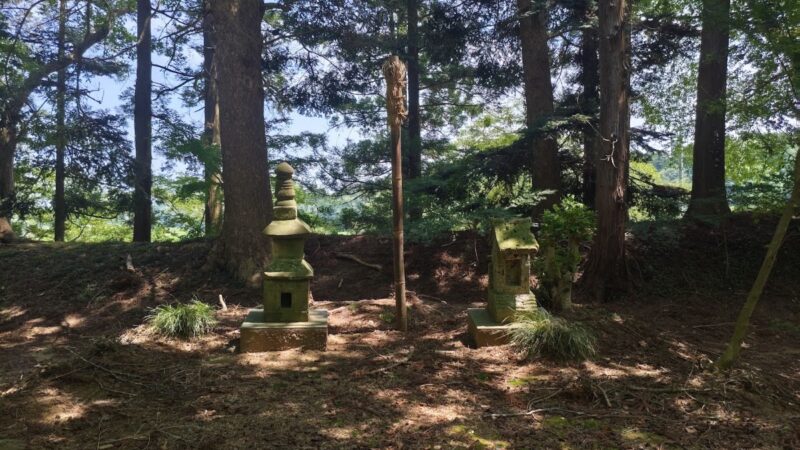
In the northeast corner of the park stands a stone monument inscribed with “Former Jinya Site.” This monument, erected by a local history preservation group, serves as evidence that this site was once an important branch office of the Takasaki Domain.
The area around the monument is well-maintained, providing a quiet space where visitors can feel the history. History enthusiasts can be seen taking commemorative photos in front of the monument.
Information Board and Explanation
In the center of the park is an information board that provides a detailed explanation of the history of the Iinuma Jinya. The board clearly describes the circumstances of the Jinya’s establishment, the layout of the buildings at the time, and its relationship with the Takasaki Domain, making it very helpful for visitors to understand the historical background of the Jinya.
The information board also includes a hypothetical diagram of the facility at the time, allowing visitors to visualize its scale and structure. The Choshi City Board of Education regularly updates the information board, reflecting the latest research findings.
Surrounding Historical Landscape
Remnants of the town layout from the Edo period can be seen around Jinya-cho Park. Besides the place name “Jinya-machi,” the surrounding road layout also retains traces of the past, allowing visitors to enjoy a truly historical stroll.
Within walking distance of the park is Iinuma Kannon (Enpuku-ji Temple), another temple indispensable to understanding Choshi’s history. Iinuma Kannon is known as the 27th temple of the Bando Thirty-Three Kannon Pilgrimage and has attracted many worshippers since ancient times.
Relationship with Iinuma Castle
When visiting the Iinuma Jinya ruins, it is often confused with “Iinuma Castle.” Iinuma Castle is a separate facility from the Iinuma Jinya, a castle built in the medieval period by the Kaijo clan, a branch family of the Chiba clan.
History of Iinuma Castle
Iinuma Castle is thought to have functioned as a branch castle of Nakajima Castle, the residence of the Kaijo clan. During the Sengoku period, it played an important role as a regional defense base, but it is believed to have been abandoned during the Tensho era (1573-1592).
Currently, the site of Iinuma Castle is within the grounds of Enpuku-ji Temple (Iinuma Kannon), and very few remains of the castle exist. However, it is possible to infer that a castle once stood there based on the temple’s location and topography.
Differences between a Jinya and a Castle
Iinuma Castle and Iinuma Jinya are facilities of different eras and characteristics. Iinuma Castle was a military facility until the Sengoku period, while Iinuma Jinya was an administrative facility during the peaceful Edo period.
While castles were designed with defense in mind, Jinya were designed to prioritize practical administrative functions. Therefore, Jinya lacked large-scale defensive structures such as keeps and stone walls, and consisted of relatively simple buildings that served as both offices and residences.
Access Information
Access by Train
If using JR
- Approximately 15 minutes on foot from JR Sobu Main Line “Choshi Station”
- Exit the station and head southeast towards Jinya-machi.
If using Choshi Electric Railway
- Approximately 10 minutes on foot from Choshi Electric Railway “Kannon Station”
- This station is close to Iinuma Kannon Temple, making it convenient to visit in conjunction with a visit to the temple.
The Choshi Electric Railway is a popular tourist attraction in Choshi, and enjoying the retro atmosphere while traveling will create lasting travel memories. Kannon Station is the closest station to Iinuma Kannon Temple and is also close to the Jinya ruins, making it an ideal starting point for historical exploration.
Access by Car
From Tokyo
- Approximately 40 minutes from the Higashi-Kanto Expressway “Sawara-Katori IC” via National Route 356
- Enter Choshi city center and head towards Jinyamachi
Parking Information
- There is no dedicated parking lot at Jinyamachi Park
- We recommend using the nearby Iinuma Kannon parking lot (free) and walking from there
- You can also use paid parking lots around Choshi Station
Address and Map Information
Location: Jinyamachi, Choshi City, Chiba Prefecture
Jinyamachi Park is located in a residential area, so searching for “Jinyamachi Park” or “Jinyamachi, Choshi City” on your car navigation system or smartphone map app will show the exact location.
Points of Interest and Estimated Time Required
Estimated Time Required for Visiting
Visiting the Iinuma Jinya Ruins (Jinyamachi Park) usually takes about 20-30 minutes. If you plan to carefully examine the stone monument and information boards and enjoy the surrounding atmosphere, allow about 40 minutes.
If you are also visiting Iinuma Kannon, we recommend allocating 1.5 to 2 hours for the entire visit.
Best Season for Visiting
Jinya-cho Park is open year-round, but the following times are particularly recommended:
Spring (Late March to Early April): This is the cherry blossom season, when the park’s cherry trees are in full bloom. It’s the perfect season to enjoy both cherry blossom viewing and historical sightseeing.
Autumn (Late October to Mid-November): The autumn foliage is beautiful, and you can enjoy historical sightseeing in pleasant weather. It also coincides with the Choshi Autumn Festival, allowing you to experience local culture.
Early Summer (May to June): The fresh greenery is beautiful, and the weather is mild, making it ideal for strolling. There are relatively few tourists, allowing for a leisurely visit.
Photography Tips
For history enthusiasts and castle fans, documenting the site of the Jinya (fortified residence) is an important activity. Keeping the following points in mind will help you take more impressive photos:
- Photographing the Stone Monument: The morning hours when the light hits the monument are recommended.
- Recording the Information Board: Recording the contents of the information board will be helpful when reviewing history later.
- Surrounding Landscape: Recording the townscape and road layout of the Jinya town will provide clues to imagining what it was like at the time.
Nearby Tourist Spots
Iinuma Kannon (Enpuku-ji Temple)
Located about a 5-minute walk from the Jinya site, Iinuma Kannon is an ancient temple known as the 27th temple of the Bando Thirty-Three Kannon Pilgrimage. The principal image, the Eleven-Faced Kannon Bodhisattva, is said to have been consecrated by Gyoki Bodhisattva during the Nara period.
With attractions such as a five-story pagoda and a Niomon gate, it is an important temple where you can experience the history and culture of Choshi. The temple’s Goshuin (temple/shrine stamp) is also popular, attracting many pilgrims.
Choshi Port Tower
This 57.7-meter-tall observation tower, adjacent to Choshi Fishing Port, is a symbol of Choshi. From the observation deck, you can enjoy panoramic views of the Tone River estuary, the Pacific Ocean, and the city of Choshi. On clear days, you can even see Mount Fuji.
It’s about a 10-minute drive from the Jinya Ruins and about a 15-minute bus ride from Choshi Station.
Inubosaki Lighthouse
This white lighthouse, located at the easternmost point of the Kanto region, was built in 1874 (Meiji 7). It’s one of “Japan’s 50 Best Lighthouses,” and you can climb to the top.
It’s about a 20-minute drive from the Jinya Ruins and about a 10-minute walk from Inubosaki Station on the Choshi Electric Railway. It’s also famous as a spot to watch the first sunrise of the year.
Byobugaura
This scenic spot features cliffs 40-60 meters high stretching for approximately 10 kilometers, and is known as the “Dover of the East.” The magnificent natural landscape is breathtaking, and it is also a geologically valuable site.
It is approximately a 15-minute drive from the Jinya ruins.
Yamasa Soy Sauce Factory
Choshi has been known as a soy sauce brewing town since the Edo period. A factory tour of Yamasa Soy Sauce allows you to learn about the history and manufacturing process of soy sauce. Factory tours require advance reservations, and you can purchase Choshi-exclusive soy sauce products at the shop.
It is approximately a 20-minute walk from the Jinya ruins and approximately a 7-minute walk from Choshi Station.
Jinya and Castles of Shimosa Province
The Iinuma Jinya is one of the few Jinya (fortified residences) that existed in Shimosa Province (present-day northern Chiba Prefecture). Shimosa Province also has many other historical castles and Jinya scattered throughout, making it an interesting area for history enthusiasts to explore.
Major Jinya (Fortified Residences) in Chiba Prefecture
Iino Jinya (Futtsu City): Located in Kazusa Province (southern central Chiba Prefecture), this fortified residence was ruled by the Hoshina clan. Similar to the Iinuma Jinya, it was a small but important administrative center.
Sakura Domain Branch Offices: The Sakura Domain also established small branch offices throughout its territory, enabling efficient territorial management.
Famous Castles of Shimosa Province
Sakura Castle: A representative castle of Shimosa Province, it played an important role as the residence of a Fudai daimyo (hereditary vassal) during the Edo period. Currently, it is maintained as Sakura Castle Ruins Park, with well-preserved remains such as earthworks and dry moats.
Sekiyado Castle: Located at the confluence of the Tone River and Edo River, it was a strategic point for water transport and an important castle for the northern defense of Edo. Currently, the Sekiyado Castle Museum stands there, where visitors can learn about the history of the river and the castle.
Hon-Sakura Castle: This castle flourished during the Sengoku period as the base of the Chiba clan, and its earthen castle remains are well-preserved. Designated a national historic site, it is a valuable historical site that conveys the appearance of a medieval castle.
Points to Note When Visiting the Iinuma Jinya Ruins
Visitor Etiquette
Jinya-cho Park is also a living space for local residents. Please observe the following points when visiting:
- Be considerate of noise, as it is located within a residential area.
- Always take your trash with you.
- Do not trespass on private property.
- Do not damage stone monuments or information boards.
- Do not collect plants in the park.
Facilities
Jinya-cho Park is a small park, so please note the following:
- There are no restrooms in the park (please use facilities near Iinuma Kannon Temple or Choshi Station).
- There are no vending machines or shops.
- There is little shade, so it is recommended to bring a hat or parasol in the summer.
- There are a limited number of benches, so it is not suitable for long stays.
Weather and Clothing
Choshi is close to the sea and often windy, so please keep the following in mind when visiting:
- Take precautions against the wind, such as making sure your hat doesn’t blow away.
- Wear comfortable walking shoes (the park is paved, but suitable shoes are necessary for exploring the surrounding area).
- Prepare clothing appropriate for the season (sun protection in summer, warm clothing in winter).
History and Culture of Choshi
Knowing the historical background of Choshi will allow you to understand the historical site more deeply when visiting the Iinuma Jinya Ruins.
The Geographical Importance of Choshi
Choshi is located at the mouth of the Tone River and flourished during the Edo period as a key point for water transport connecting Edo (present-day Tokyo) with Tohoku and northern Kanto. With the Tone River diversion project, which allowed the river to flow into the Pacific Ocean at Choshi, Choshi’s importance increased even further.
As a transit point for transporting goods to Edo and as a fishing base, Choshi was an economically important town. For this reason, the Takasaki Domain established a military headquarters in Choshi as the central hub of its exclave.
A Town of Soy Sauce Brewing
Choshi has been known as a town of soy sauce brewing since the Edo period. Many long-established soy sauce manufacturers, such as Yamasa Soy Sauce and Higeta Soy Sauce, which still exist today, were founded in the Edo period, supporting Edo’s food culture.
Soy sauce brewing requires high-quality water, soybeans, and wheat. Choshi had easy access to these raw materials, and transportation to Edo was convenient, leading to the development of the soy sauce industry. It is believed that the Iinuma Jinya (fortified residence) was also involved in supervising the soy sauce industry and collecting taxes.
A Fishing Town
Choshi is still known as one of Japan’s leading fishing ports, but fishing has been thriving since the Edo period. Sardine fishing, in particular, was prosperous, and it played an important role as a source of fish for Edo (present-day Tokyo).
The development of fishing supported Choshi’s economy and had a significant impact on the operation of the Jinya. Supervising commercial activities related to fishing and managing fishermen were also important duties of the Jinya.
Historical Research and Future Challenges
Research Status of the Iinuma Jinya
The existence and general outline of the Iinuma Jinya have been revealed through records of the Takasaki Domain and local historical documents. However, many aspects of the detailed layout of the buildings and the actual daily operations remain unclear.
In recent years, local historians and university researchers have been excavating and analyzing new historical materials, making the true image of the Iinuma Jinya clearer. In particular, by comparing the records with those of the Takasaki Domain remaining in Takasaki City, the actual operation of the Jinya (fortified residence) is gradually becoming clearer.
Preservation and Utilization of Remains
Currently, no visible remains such as buildings remain at the Iinuma Jinya site, but there is a possibility that remains from that time are buried underground. If archaeological excavations are conducted in the future, the structure and scale of the Jinya may be revealed in more detail.
Choshi City is working on the preservation and utilization of historical heritage within the city, including the Iinuma Jinya site, and is making progress in improving information boards and strengthening information dissemination. Efforts to pass on history to future generations are continuing, while balancing its use as a tourist resource with academic research.
Collaboration with the Community
The understanding and cooperation of local residents are essential for the preservation and utilization of the Iinuma Jinya site. With the place name “Jinya-machi” (fortified residence town) remaining and becoming part of the local identity, resident-led historical preservation activities are also underway.
Local elementary and junior high schools are conducting lessons on the history of the Iinuma Jinya as part of local history education, promoting the transmission of history to the next generation. Furthermore, guided tours by local volunteers are also conducted, continuing efforts to provide visitors with a deeper understanding of the area.
Summary
The Iinuma Jinya Ruins are a valuable historical site that conveys the reality of detached territory administration during the Edo period. Currently, it is maintained as Jinya-cho Park, where its history can be learned through stone monuments and information boards.
When visiting Choshi, why not visit historical spots like the Iinuma Jinya Ruins, in addition to tourist attractions such as Inubosaki Cape and Choshi Port Tower? You will be able to feel the essence of local administration during the Edo period and truly appreciate the depth of Choshi’s history.
Visiting it together with Iinuma Kannon Temple allows you to experience Choshi’s history from the Middle Ages to the Edo period and into the present day all at once. It is a recommended spot not only for history buffs but also for anyone interested in local culture and history.
When visiting Choshi City, Chiba Prefecture, be sure to stop by the Iinuma Jinya Ruins and get a glimpse into a part of local administration during the Edo period. It is a small park, but an important page in Japanese history is etched there.