Matsumushi Castle (Inzai City, Chiba Prefecture): History and Highlights: The Base of the Usuihara Clan and the Site of Kuribayashi Yoshinaga’s Camp
What is Matsumushi Castle?
Matsumushi Castle is a medieval castle site located in Matsumushi, Inzai City, Chiba Prefecture. As one of the many castles that developed around Lake Inba, it is a historical site that played a role in the power struggles in the Shimosa region during the Sengoku period.
Currently, detailed historical records of Matsumushi Castle are scarce, and much remains are shrouded in mystery. However, it is presumed to have been one of the bases of the Usuihara clan. Furthermore, there is a legend that Kuribayashi Shimosa-no-kami Yoshinaga, a renowned general known as the “Zhuge Liang of Kanto,” established a camp there when he attacked the Chiba clan of Sakura, making it a castle of significant importance in local history.
Even today, remnants such as earthworks and moats remain at the castle site, allowing us to imagine the castle’s structure at the time. As a historical heritage site of Inzai City, it is a valuable presence that tells the story of the region’s medieval history.
Historical Background of Matsumushi Castle
The Usuihara Clan and Matsumushi Castle
Matsumushi Castle is believed to have functioned as one of the bases of the Usuihara clan. The Usuihara clan was a family based around Usui in Shimosa Province, and they had several castles and residences in the area centered around Lake Inba. It is presumed that Matsumushi Castle was part of this network of branch castles.
The Usuihara clan, as a branch of the Chiba clan, were powerful local lords in Shimosa Province. The area around Lake Inba was a key point for water transport and had high agricultural productivity, so controlling this area was strategically important. It is thought that Matsumushi Castle was built as a base for such regional control.
Kuribayashi Yoshinaga and Matsumushi Castle
A noteworthy aspect of Matsumushi Castle’s history is its connection to Kuribayashi Yoshinaga, the governor of Shimosa Province. Yoshinaga Kuribayashi was a renowned general of the Sengoku period, often described as the “Zhuge Liang of Kanto,” and his military strategy and tactical acumen were widely known.
According to legend, when Yoshinaga Kuribayashi attacked the Chiba clan of Sakura, he established a camp at Matsumushi Castle. During this period, the Shimosa region was a complex web of conflicts involving various powers, including the Chiba, Usui, and Later Hojo clans. As a general serving the Hojo clan, Yoshinaga Kuribayashi likely utilized Matsumushi Castle, a strategically important location in the region.
Considering its location relative to Sakura Castle and Hon-Sakura Castle, Matsumushi Castle was ideally situated as a base for marches towards Sakura. It is also presumed that Matsumushi Castle played a crucial role in securing supply lines using the water transport of Lake Inba and in demonstrating a military presence in the surrounding areas.
The Inbanuma Area During the Sengoku Period
The area around Inbanuma Lake, where Matsumushi Castle once stood, became the stage for fierce power struggles during the Sengoku period (Warring States period). In addition to local forces such as the Chiba, Usui, and Hara clans, major powers like the Odawara Hojo and Uesugi clans were also involved, resulting in a complex political situation.
Besides Matsumushi Castle, numerous other castles and fortifications existed around Inzai City, including Moroto Castle, Iwato Castle, Takadayama Castle, Funato Castle, Jounouchi Castle, and Yoshitaka Castle. These castles sometimes cooperated with each other, and sometimes clashed, vying for control of the region. Matsumushi Castle, as part of this castle network, also experienced the turmoil of the Sengoku period.
Structure and Remains of Matsumushi Castle
Castle Location
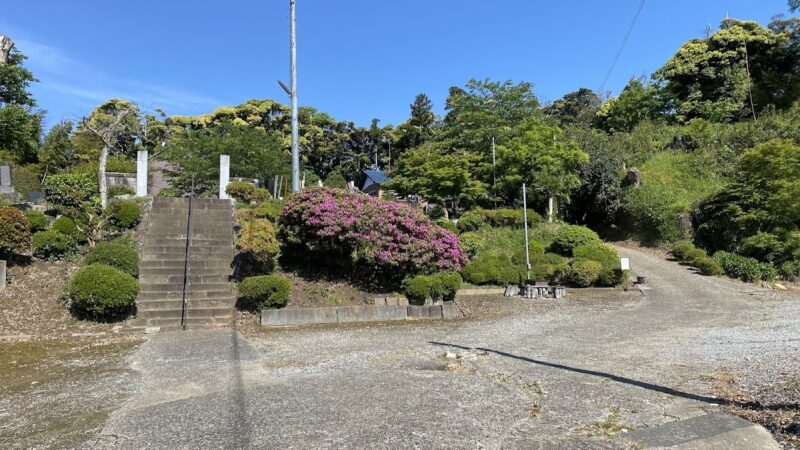
Matsumushi Castle was built on a plateau in the Matsumushi district of Inzai City. Its location near Inbanuma Lake offered both convenient access to water transport and the defensive advantages of a plateau. Although the surrounding area is still farmland and residential, parts of the castle site retain the original topography.
The construction of the castle utilizing the edge of a plateau is a common characteristic of medieval castles in the Shimosa region. By making maximum use of the natural terrain, it was possible to construct effective defensive structures with minimal effort.
Existing Remains
The following remains can still be seen at the Matsumushi Castle site:
Earthworks: Partially remaining earthworks, important defensive structures for the castle, still exist. These earthworks, built by piling up earth, served to prevent enemy intrusion and ensure visibility from within the castle. The existing earthworks offer a glimpse into the castle-building techniques of the time.
Moat Remains: Traces of a moat that surrounded the castle have also been confirmed. It is thought to have functioned as a dry moat, and combined with the earthworks, it enhanced defensive capabilities. While some parts have been buried or altered, it is possible to estimate the moat’s layout from the topography.
Traces of Enclosures: While the clear divisions of the enclosures (kuruwa) are difficult to discern, the presence of multiple enclosures is suggested based on the flat areas and elevation changes of the terrain.
Scale of the Castle
The exact scale of Matsumushi Castle is unclear due to the lack of detailed archaeological excavations. However, judging from the distribution of existing remains, it is thought to have been a small to medium-sized castle.
Considering its history as a branch castle of the Usuihara clan and a temporary encampment for Kuribayashi Yoshinaga, it is more likely that it was a strategic base castle controlling a key location rather than a large-scale residence.
Highlights of Matsumushi Castle
Observation of Earthworks and Moat Remains
The main highlight of a visit to Matsumushi Castle is the existing earthworks and moat remains. These remains are basic defensive structures of medieval castles and are valuable resources for directly observing the castle construction techniques of the time.
By observing the height and width of the earthworks, and the depth and arrangement of the moats, one can understand the castle’s defensive philosophy and structure. In particular, the cross-section of the earthworks (where observable, such as in collapsed sections) allows for the interpretation of castle construction techniques, including rammed earth construction.
Layout Utilizing the Topography
Matsumushi Castle was built skillfully utilizing the plateau’s topography. You can experience firsthand the ingenuity of medieval castle layout (design), such as the use of natural elevation differences to set defensive lines and the securing of views.
Walking through the castle ruins, you can enjoy understanding the intentions behind the castle’s design by considering which directions are easily defended and where its weaknesses lie.
Engaging Historical Imagination
Standing on-site, you can imagine Kuribayashi Yoshinaga setting up camp here and directing military operations toward Sakura. You can also picture the scene during the time when the Usuihara clan ruled the region from this base.
Although the remains are only partial, this is precisely what allows for historical imagination, enabling each visitor to freely envision the landscape of the Sengoku period.
Access and Visiting Information for Matsumushi Castle
Location
- Address: Matsumushi, Dangisho, Inzai City, Chiba Prefecture
- Former Place Name: Matsumushi, Inba Village, Inba District (now part of Inzai City due to municipal mergers)
Transportation Access
By Train/Bus:
- The nearest stations are “Inba Nihon Iryo Daigaku Station” or “Chiba New Town Chuo Station” on the Hokuso Line.
- From the station, you will need to take a bus or taxi.
- Walking is a long distance, so it is recommended to check the route in advance.
By Car:
- Accessible via National Route 464 (Kita Chiba Road) or prefectural roads.
- There is no dedicated parking lot, so please check the surrounding area and park in a place that will not cause inconvenience.
- Search for “Inzai City Matsumushi” on your car navigation system.
Notes for Visitors
- The castle ruins are preserved as a historical site, but it is not a developed tourist facility.
- There may be private property included, so please be very careful when entering.
- Signboards and explanatory signs may not be available.
- It is recommended to contact the Inzai City Board of Education or other relevant authorities in advance before visiting.
- Wear comfortable clothing and shoes.
- Remember to take precautions against insects in summer and warm clothing in winter.
Best Season for Visiting
The best time to visit Matsumushi Castle Ruins is from late autumn to early spring when there is less vegetation. During this time, the remains are easier to observe, and there are fewer insects, making for a comfortable stroll. However, the castle ruins also have a charming atmosphere during the seasons of fresh greenery and autumn leaves.
Related Castles in the Surrounding Area
When visiting Matsumushi Castle, visiting other castles in the Inzai City area will allow you to gain a deeper understanding of the medieval history of this region.
Moroto Castle
Located in Moroto, Inzai City, this castle is said to have been the residence of the Moroto clan, a branch of the Usui clan. Built on a strategic location facing Lake Inba, it, like Matsumushi Castle, was part of the Usui clan’s network of branch castles. The remains of earthworks and trenches are relatively well-preserved.
Iwato Castle
This castle is located in Iwato, Inzai City. While its detailed history is unknown, it is believed to have functioned as one of the defensive strongholds around Lake Inba.
Funato Castle
This castle is located in Funato, Inzai City, and is situated in a strategic location controlling a key waterway. It is suggested that it may have been a management base for the transportation of goods using the waterways of Lake Inba.
Yoshitaka Castle
This castle is located in Yoshitaka, Inzai City. It is presumed to have functioned as a control center for the surrounding area.
Sakura Castle/Hon-Sakura Castle
Located south of Matsumushi Castle, Sakura City contains Hon-Sakura Castle (one of the Continued Top 100 Japanese Castles), the base of the Chiba clan, and Sakura Castle (one of the Top 100 Japanese Castles) from the Edo period. It is believed that Kuribayashi Yoshinaga targeted the Sakura region, including these castles, from Matsumushi Castle.
Sakura Castle played a significant role as the residence of the Chiba clan during the Sengoku period, and even today, its magnificent earthworks and dry moats remain, making it a truly impressive castle. Sakura Castle is a modern castle built during the Edo period and is now maintained as Sakura Castle Ruins Park.
Matsumushi Castle and Medieval Castles in Chiba Prefecture
Characteristics of Castles in Chiba Prefecture
Numerous medieval castles exist in Chiba Prefecture. Many of these are earthen castles (dojo), characterized by their lack of stone walls. Techniques developed to utilize the plateau terrain and construct defensive lines using earthworks and moats.
Diverse castles were built in various locations, such as around Lake Inbanuma, the Tone River basin, and the plateau areas of the Kujukuri Plain, adapting to the local topography. Matsumushi Castle is a typical example of such a medieval castle in Chiba Prefecture.
Conflict between the Chiba and Hojo Clans
During the Sengoku period, a power struggle unfolded in the Chiba Prefecture area between the local Chiba clan and the Odawara Hojo clan. The Chiba clan was a powerful daimyo in Shimosa Province, but gradually came under the influence of the Hojo clan.
Kuribayashi Yoshinaga was a samurai who served the Hojo clan, and his activities at Matsumushi Castle can be understood within the larger context of the Hojo clan’s expansion into Shimosa. His attack on the Chiba clan in Sakura is thought to have been part of the Hojo clan’s strategy to expand their power.
Strategic Importance of Lake Inba
Lake Inba was an important water transport route in the Middle Ages. Connected to the Tone River system, it was used for the movement of goods and people. Controlling this water transport had significant economic and military implications.
The castles around Lake Inba, including Matsumushi Castle, played a crucial role in the struggles for control of this water transport.
Current Status and Preservation of Matsumushi Castle
Preservation Status of Remains
While some of the remains of Matsumushi Castle have been lost due to development and agricultural conversion, important parts such as earthworks and moat traces still remain. However, no full-scale archaeological excavations or restoration work has been conducted, and protective measures as a historical site are limited.
As a regional historical heritage site, its future preservation and utilization are anticipated.
Current Research Status
Academic research on Matsumushi Castle is limited due to the scarcity of historical materials. While investigations have been conducted by castle researchers and local historians, the creation of detailed layout maps and archaeological excavations remain future challenges.
It is necessary to clarify the historical position of Matsumushi Castle through research into local traditions and its relationship with surrounding castles.
Regional Positioning
In addition to Matsumushi Castle, Inzai City has numerous other castle ruins, which are valuable cultural assets that tell the story of the medieval regional history. Comprehensive research into these castle groups is expected to clarify the medieval history around Lake Inbanuma.
Matsumushi Castle will likely continue to attract attention as an important piece in such regional history research.
Summary
Matsumushi Castle is a medieval castle located in Inzai City, Chiba Prefecture. It holds historical significance as a base for the Usuihara clan and as the encampment of Kuribayashi Yoshinaga, known as the “Zhuge Liang of Kanto.” While detailed historical records are scarce, the existing earthworks and moat remains are valuable historical artifacts that convey the castle’s appearance at the time.
Located in a strategically important location around Lake Inba, Matsumushi Castle was a stage for power struggles in the Shimosa region during the Sengoku period. Tracing its history is crucial for understanding the medieval history of Chiba Prefecture, particularly the actions of the Chiba and Hojo clans.
Although it is a quiet castle site with few visitors, this is precisely what makes it so appealing for a leisurely stroll while reflecting on history. Visiting it along with nearby castles such as Moroto Castle, Sakura Castle, and Hon-Sakura Castle will allow you to experience the medieval castle culture of this region more deeply.
As a regional historical heritage site, Matsumushi Castle is expected to be preserved and further researched in the future. We hope that this valuable historical site, where you can feel the spirit of the Sengoku period, will become known to many history enthusiasts.