Miyamoto Castle (Minamiboso City, Chiba Prefecture) Complete Guide | A Thorough Explanation of the History of the Satomi Clan and the Highlights of the Ruins
Located in Minamiboso City, Chiba Prefecture, Miyamoto Castle is a mountain castle built by the Satomi clan, who ruled the Boso Peninsula during the Sengoku period. Built on a mountain 183 meters above sea level, this castle played an important role as a subsidiary castle of Inamura Castle and is also known as the site of the “Tenbun Incident (Inamura Rebellion),” an internal conflict within the Satomi clan. This article provides a detailed explanation of Miyamoto Castle, including its historical background, layout, current state of the ruins, and access methods.
Historical Background of Miyamoto Castle
Construction History and the Satomi Clan’s Rule of Awa Province
Miyamoto Castle is believed to have been built by Satomi Naruyoshi (also written as Yoshinari), the second head of the Satomi clan. The Satomi clan entered Awa Province (present-day southern Chiba Prefecture) in the late Muromachi period. The first head of the Satomi clan, Satomi Yoshizane, unified Awa and established Inamura Castle (present-day Tateyama City) as his base. His son, Naruyoshi, strengthened the defenses of Inamura Castle by constructing several subsidiary castles in the surrounding area.
Miyamoto Castle, as one of these subsidiary castles, played a crucial role in defending Inamura Castle, working in conjunction with Takita Castle, located approximately 2 kilometers east of Inamura Castle. The eastern ridge of the castle led to Takita Castle, suggesting that the two castles formed a unified defensive line.
Satomi Naruyoshi and the Changes in Castle Lords
The existence of Satomi Naruyoshi, the castle’s builder, is debated among historians due to a lack of historical evidence. However, according to tradition, Naruyoshi’s third son, Satomi Sanetaka, was appointed lord of Miyamoto Castle.
Sanetaka later became the fourth head of the Satomi clan, but this change in castle lord became a contributing factor to the tragic internal conflict that followed. Satomi Yoshitoyo, who would become the fifth head of the Satomi clan, was raised in Miyamoto Castle during his childhood. Yoshitoyo was supposed to become the lord of Miyamoto Castle upon reaching adulthood, but he harbored resentment because his uncle, Sanetaka, had not fulfilled the promise.
The Tenbun Conflict (Inamura Incident) and Miyamoto Castle
In 1533 (Tenbun 2), the “Tenbun Conflict,” the most significant event in the history of the Satomi clan, occurred. This incident, also known as the “Inamura Incident,” marked a turning point that greatly declined the power of the Satomi clan.
Satomi Yoshitoyo, who grew up in Miyamoto Castle, resented the failure to keep the promise of becoming the castle lord and planned to assassinate his uncle, the fourth head of the clan, Satomi Sanetaka. Yoshitoyo invited Sanetaka to Inamura Castle and successfully assassinated him, becoming the 5th head of the Satomi clan. However, this act of violence created serious internal conflict within the Satomi family.
Sanetaka’s younger brother, Satomi Yoshimichi (later Yoshitaka), raised an army to avenge his brother’s death and attacked Yoshitoyo. Ultimately, Yoshitoyo was defeated and killed, and Yoshimichi succeeded to the Satomi clan as the 6th head. This internal conflict temporarily and significantly weakened the Satomi clan’s power and reduced their defensive capabilities against external enemies such as the Hojo clan.
While the exact role of Miyamoto Castle in this internal conflict is unclear, it is undoubtedly a place that influenced Yoshitoyo’s character development and later actions, as it was where he spent his childhood.
The Role of Miyamoto Castle in the Late Sengoku Period
After the Tenbun internal conflict, the Satomi clan gradually recovered its power and survived as a powerful daimyo controlling the southern part of the Boso Peninsula during the late Sengoku period. However, as the conflict with the Hojo clan intensified, the Satomi clan’s base of operations moved from Inamura Castle to Kururi Castle.
It is unclear how long Miyamoto Castle maintained its military function, but considering that the Satomi clan was granted control of Awa Province after Toyotomi Hideyoshi’s siege of Odawara and survived until the early Edo period, it is possible that it maintained its role as a subsidiary castle for a certain period.
Miyamoto Castle’s Layout and Structure
Location and Utilization of Topography
Miyamoto Castle is built on Shiroyama, a mountain 183 meters above sea level, located in the inland area of Minamiboso City, east of the current “Otsu no Sato” roadside station. With a relative elevation difference of approximately 160 meters, it is a typical Sengoku period mountain castle that utilizes the steep terrain.
The castle’s location was an important base for eastern defense within the Satomi clan’s network of subsidiary castles centered around Inamura Castle. Located inland from the coast facing Tokyo Bay, Miyamoto Castle boasts a strategically advantageous terrain for early detection and defense against enemy incursions.
Structure of the Main Enclosure (Enclosure 1)
The main enclosure, the heart of Miyamoto Castle, is situated on the mountaintop. The enclosure is roughly diamond-shaped, with a long axis of approximately 60 meters. This size is relatively large for a subsidiary castle, suggesting it housed the lord’s residence and important defensive facilities.
Earthworks surround the main enclosure, enhancing its defensive capabilities. Furthermore, the main enclosure offers excellent visibility, allowing for clear views of the surrounding terrain and monitoring enemy movements.
Multi-Enclosure Structure and Lower Enclosures
The most distinctive feature of Miyamoto Castle is its multi-enclosure structure, with multiple lower enclosures built around the main enclosure. These lower enclosures are arranged in a stepped fashion on the mountain slope, serving to defend against enemy attacks in stages.
This multi-enclosure structure is a design choice that maximizes the limited area of the mountaintop, allowing for the deployment of many soldiers, and is a common feature of mountain castles from the Sengoku period. Each enclosure was demarcated by earthworks and moats, functioning as an independent defensive stronghold.
Arrangement of Moats and Earthworks
Multiple moats were strategically placed within the castle, separating the enclosures. These moats hindered enemy advances and enhanced the independence of each enclosure.
Earthworks were built around the main enclosure and other key enclosures, further enhancing defensive capabilities. While the height and scale of the earthworks varied depending on the location, traces of them can still be seen today.
Coordination with Takita Castle
The eastern ridge of Miyamoto Castle continues to Takita Castle, approximately 2 kilometers away. This topographical continuity indicates a close coordination between the two castles. If the enemy attacked one castle, reinforcements could be sent from the other, creating a mutually supportive defensive system.
Such coordination between branch castles was an important strategy in the Satomi clan’s rule of their territory and functioned as part of a defense network centered around their main base, Inamura Castle.
Current State and Remains of Miyamoto Castle
Hiking Trail and Maintenance Status
A hiking trail to Miyamoto Castle is maintained, and it was once relatively easy to reach the main enclosure. However, recent typhoons have caused significant damage to fallen trees, worsening the condition of the trail.
Especially since Typhoon Hagibis (Typhoon No. 15 of 2019), many fallen trees have blocked the trail. While it is possible to walk through the fallen trees to the area below the eastern edge of the main enclosure, the main enclosure itself is overgrown with vegetation. When planning a visit, it is important to check the latest information and prepare appropriate equipment.
Preservation Status of Remains
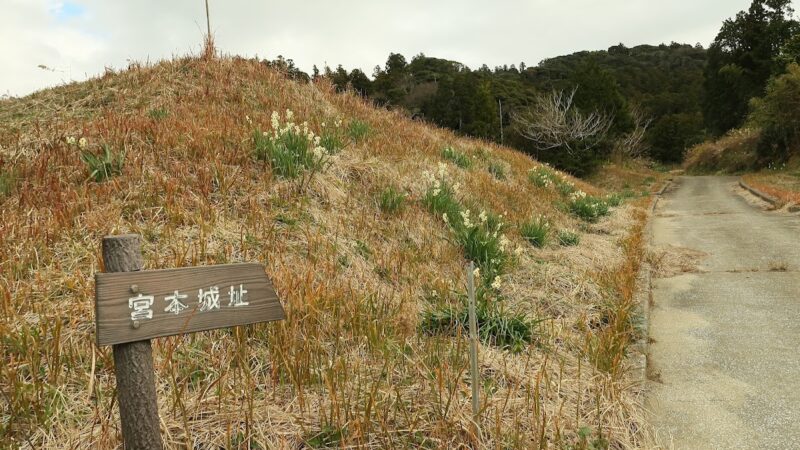
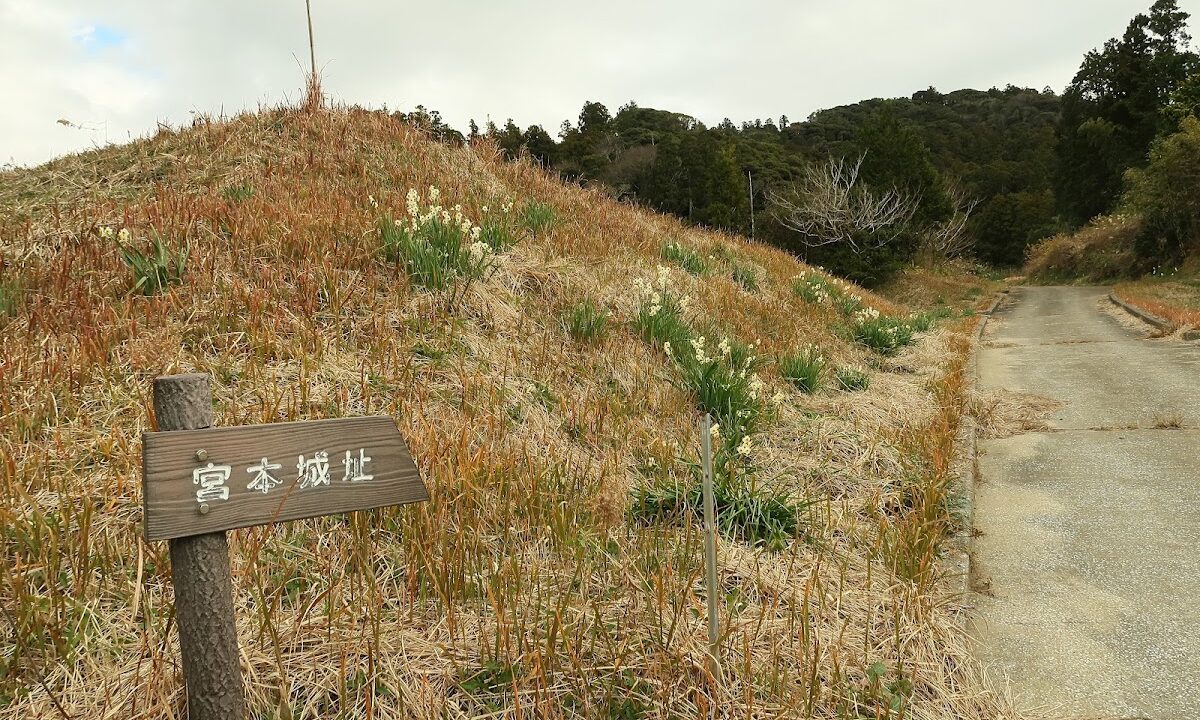
Although the visibility of the remains has decreased due to fallen trees and vegetation, the basic structure of the castle, such as the earthworks of the main enclosure and the steps of the lower enclosures, still remains as part of the topography. The diamond shape of the main enclosure and the arrangement of the surrounding terraced enclosures can be confirmed by carefully observing the terrain.
Traces of moats can also be seen in some areas, and can be observed as changes in terrain indicating the divisions between enclosures. However, due to years of weathering and the effects of vegetation, only a limited number of areas retain the clear shape from when the castle was built.
Photography and Documentation
Numerous photographic records by castle enthusiasts and history researchers are available online. These photographs are valuable resources for understanding the remains of Miyamoto Castle. Photographs taken before typhoon damage, in particular, document the state of the remains, which is now difficult to confirm, and are of high historical value.
When visitors take new photographs, care must be taken to protect the remains and avoid damaging the earthworks and moats. Furthermore, given the current situation with many fallen trees, sufficient consideration must be given to safety.
Access to Miyamoto Castle
Access by Public Transportation
Miyamoto Castle is located in the inland area of Minamiboso City, and access by public transportation is limited. The nearest train station is Tomiura Station on the JR Uchibo Line, but the castle ruins are quite far from the station, making walking impractical.
If using the bus, take a JR Bus Kanto or Tateyama Nitto Bus from Tateyama Station or Tomiura Station and get off at the “Otsu” bus stop. While the castle ruins are accessible on foot from the bus stop, finding the trailhead can be difficult, so it’s recommended to check a map beforehand.
Access by Car
Access by car is the most convenient. It’s about a 10-minute drive from the Tomiura Interchange on the Futtsu-Tateyama Expressway to the “Otsu no Sato” roadside station. The roadside station has parking and restrooms and can be used as a base for visiting Miyamoto Castle.
From the roadside station to the castle ruins, it’s a walk, but the trailhead can be difficult to find, so using a map app or GPS is recommended. Setting “Michi-no-Eki Otsu no Sato” (320 Otsu, Tomiura-cho, Minamiboso City, Chiba Prefecture) in your car navigation system is a good idea.
Preparations and Precautions for Hiking
Miyamoto Castle is a mountain castle located at an altitude of 183 meters, with a relative height difference of approximately 160 meters. A certain level of physical fitness is required for the climb. Furthermore, as mentioned above, the condition of the hiking trails has deteriorated due to recent typhoon damage, so the following preparations and precautions are necessary.
Clothing and Equipment
- Wear long sleeves and long pants (to protect against bushwhacking)
- Wear non-slip shoes such as trekking shoes
- Wear gloves (useful when climbing over fallen trees)
- Wear a hat (to protect your head from branches and insects)
- Wear insect repellent spray (especially in summer)
Items to Bring
- Drinking water (especially plenty in summer)
- Map or GPS device (smartphone map apps are also useful)
- Flashlight (forests can be dark)
- First-aid kit
Safety Precautions
- Avoid hiking alone; visit with others if possible
- Inform family or friends of your destination and expected return time in advance
- Avoid hiking on days with bad weather or after rain (due to slippery conditions)
- Be aware of wild animals (wild boars, venomous snakes, etc.)
- Proceed cautiously when climbing over fallen trees
Nearby Satomi Clan Related Historical Sites
Inamura Castle Ruins
Inamura Castle, the main castle of Miyamoto Castle, is located in Ina, Tateyama City. As the base of the Satomi clan, it was the political and military center of the Boso Peninsula during the Sengoku period. Currently, it is maintained as Inamura Castle Mountain Park, and the observation deck offers a panoramic view of Tateyama Bay. Visiting it together with Miyamoto Castle provides a deeper understanding of the Satomi clan’s system of rule.
Takita Castle Ruins
Located approximately 2 kilometers east of Miyamoto Castle, Takita Castle played a role in defending Inamura Castle in conjunction with Miyamoto Castle. Visiting both castles allows you to appreciate the relative positions and defensive systems between the subsidiary castles.
Okamoto Castle Ruins
In addition to Miyamoto Castle, there are several other castle ruins related to the Satomi clan within Minamiboso City. Okamoto Castle is one of them, located near the coast, and is thought to have been involved in monitoring and defending maritime traffic.
Tateyama Castle (Tateyama City Museum)
Tateyama Castle, located in Tateyama City, is a replica keep built on the site of the Satomi clan’s last residence. Currently the Tateyama City Museum, it offers detailed information about the history of the Satomi clan and the Sengoku period (Warring States period) of the Boso Peninsula. Visiting before or after your visit to Miyamoto Castle will deepen your understanding of the historical background.
Miyamoto Castle and Historical Tourism in Minamiboso
Combining Miyamoto Castle with Minamiboso City’s Tourism Resources
Minamiboso City boasts diverse tourism resources, including not only historical sites like Miyamoto Castle, but also beautiful coastlines, abundant nature, and fresh seafood. Incorporating a visit to Miyamoto Castle as part of a comprehensive Minamiboso City sightseeing plan will provide a fulfilling travel experience.
At the “Otsu no Sato” roadside station, you can purchase local agricultural and marine products, and there are also dining facilities, making it ideal for a rest after hiking. There are also hot spring facilities nearby, perfect for relaxing after a hike.
A Tour of Mountain Castles in Minamiboso for History Enthusiasts
Besides Miyamoto Castle, Minamiboso City has numerous other mountain castle ruins. A “mountain castle tour” visiting these ruins is an attractive theme for history enthusiasts and castle fans. The Minamiboso City Tourism Association provides information to guide you through the mountain castles, allowing you to learn about the location and historical background of each castle site. Visiting multiple castle sites will give you a more comprehensive understanding of the defense system and territorial control practices on the Boso Peninsula during the Sengoku period.
Best Season to Visit Miyamoto Castle
The best time to visit Miyamoto Castle is in spring (March-May) or autumn (October-November), when the weather is mild and hiking is easy. Summer is hot and humid with many insects, and winter has early sunsets, limiting hiking time.
However, during typhoon season (August-October) and immediately afterward, there is a possibility of more fallen trees, so it is important to check the latest information before visiting. It is a good idea to check the condition of the hiking trails in advance through the local tourism association or blogs of castle enthusiasts.
Historical Value and Preservation Challenges of Miyamoto Castle
Importance in Regional History
Miyamoto Castle is an important historical site for understanding the Sengoku period history of the Boso Peninsula. In particular, its significance in regional history is high, as it is a site related to the “Tenbun Internal Conflict,” a historical turning point for the Satomi clan.
Furthermore, the castle’s layout is relatively well-preserved, making it a valuable resource for studying castle construction techniques and defensive philosophies of the Sengoku period. The multi-enclosure structure and the arrangement of the lower enclosures represent a typical form of mountain castles of that time, and its archaeological value is also recognized.
Current Status of Preservation and Maintenance
Because Miyamoto Castle is not designated as a national or prefectural historical site, organized preservation and maintenance activities are limited. Maintenance of the hiking trails largely depends on the voluntary activities of local volunteers and castle enthusiasts, and recovery after typhoon damage has not progressed.
While the remains themselves remain as a topographical feature, and therefore the risk of complete loss is low, there are concerns that the increasing difficulty of access will lead to a decrease in visitors and a decline in recognition as a historical heritage site.
Future Use and Challenges
There are several challenges in utilizing the group of mountain castles in Minamiboso City, including Miyamoto Castle, as a regional historical tourism resource. Firstly, the maintenance and upkeep of the hiking trails are essential. Establishing a system for rapid recovery after natural disasters such as typhoons will ensure visitor safety and improve accessibility.
Secondly, comprehensive academic research and documentation of the ruins are required. Detailed surveys and archaeological excavations will allow for a more accurate understanding of the castle’s structure and historical changes, clarifying its value.
Thirdly, strengthening information dissemination and educational outreach activities is crucial. Communicating the historical significance of Miyamoto Castle in local school education and tourism promotion will increase interest among local residents and tourists, fostering understanding and cooperation for preservation efforts.
How to Enjoy Visiting Miyamoto Castle
Experiencing Historical Romance
The greatest appeal of visiting Miyamoto Castle is the opportunity to experience the historical romance of the Sengoku period firsthand. Standing in the place where Satomi Yoshitoyo spent his childhood and where a tragic internal conflict later occurred, one can truly feel the weight of history.
Standing on the site of the main enclosure, gazing at the surrounding mountains and the distant sea, imagining the scene where the castle lord and samurai once lived and strategized is a blissful experience for history enthusiasts.
Observing the Castle Layout
For those interested in castles, Miyamoto Castle’s multi-enclosure structure is one of its highlights. Observing the changes in terrain from the main enclosure to the lower enclosures and considering how the defenses were planned is an intellectually satisfying experience.
Walking while searching for the arrangement of earthworks and traces of moats allows you to understand the ingenuity of the castle builders and the level of technology at the time. Bringing a topographic map or layout map and comparing it with the actual terrain while walking will lead to a deeper understanding.
Connecting with Nature
Hiking to Miyamoto Castle is also an opportunity to connect with the rich nature of Minami-Boso. Walking through the forest and observing the vegetation that changes with the seasons is refreshing for both mind and body.
In spring, you can enjoy the fresh greenery, and in autumn, the vibrant autumn leaves. Hiking while listening to the birdsong and smelling the forest air offers a healing escape from the hustle and bustle of the city.
The Joy of Photography
Photographing the castle ruins is a major source of enjoyment for many visitors. Beyond documenting the details of the remains, artistic photography is possible, capturing the interplay of light and shadow in the forest, and the seasonal scenery.
Photographing in the soft light of early morning or evening creates a particularly magical atmosphere. However, care must be taken to protect the ruins by avoiding entering the earthworks or moats, and not damaging the vegetation.
Summary: The Charm and Significance of Visiting Miyamoto Castle
Miyamoto Castle in Minamiboso City, Chiba Prefecture, is a valuable historical site that conveys the history of the Satomi clan, who ruled the Boso Peninsula during the Sengoku period. Built on a mountaintop 183 meters above sea level, this multi-bailey mountain castle is an important historical site demonstrating the castle-building techniques and defensive philosophies of the time. Its connection to the historical event known as the “Tenbun War” gives the castle profound historical significance. Currently, the condition of the hiking trails has deteriorated due to typhoon damage, but with proper preparation and caution, you can enjoy both the historical romance of the Sengoku period and the rich nature of southern Boso at the same time. Visiting nearby historical sites such as Inamura Castle and Takita Castle in conjunction with Miyamoto Castle will allow you to gain a deeper understanding of the Satomi clan’s rule and the history of the Boso Peninsula during the Sengoku period.
A visit to Miyamoto Castle holds significance beyond mere sightseeing. It is the first step in actually visiting local historical heritage, recognizing its value, and passing it on to future generations. We recommend Miyamoto Castle to history enthusiasts, castle fans, and anyone interested in the history and nature of southern Boso.
Use the “Otsu no Sato” roadside station as your base for access. Remember to prepare thoroughly and take safety precautions to fully appreciate the charm of this historical mountain castle. Miyamoto Castle is a valuable historical witness, indispensable when discussing the Sengoku history of the Boso Peninsula.