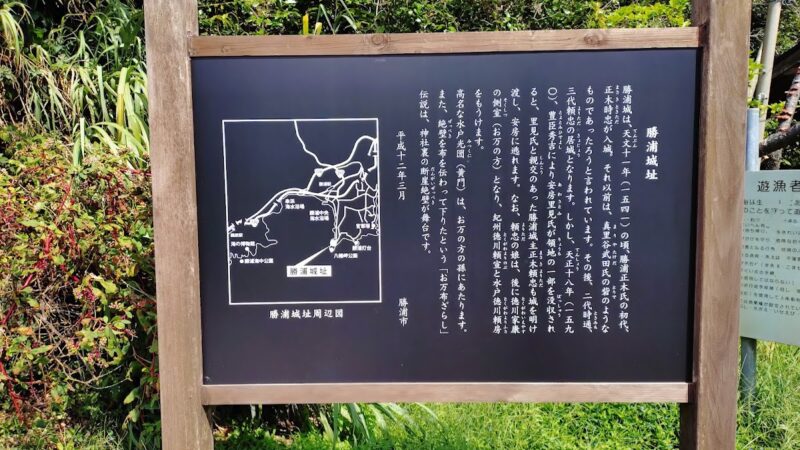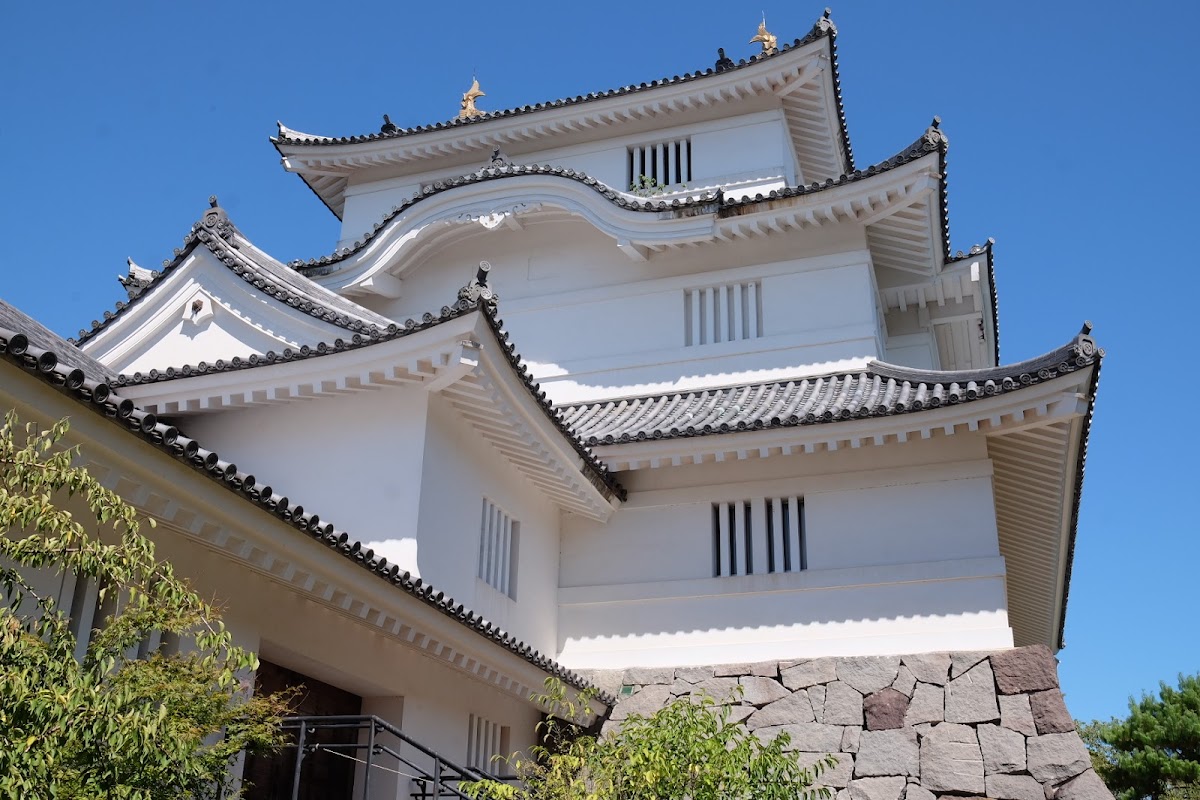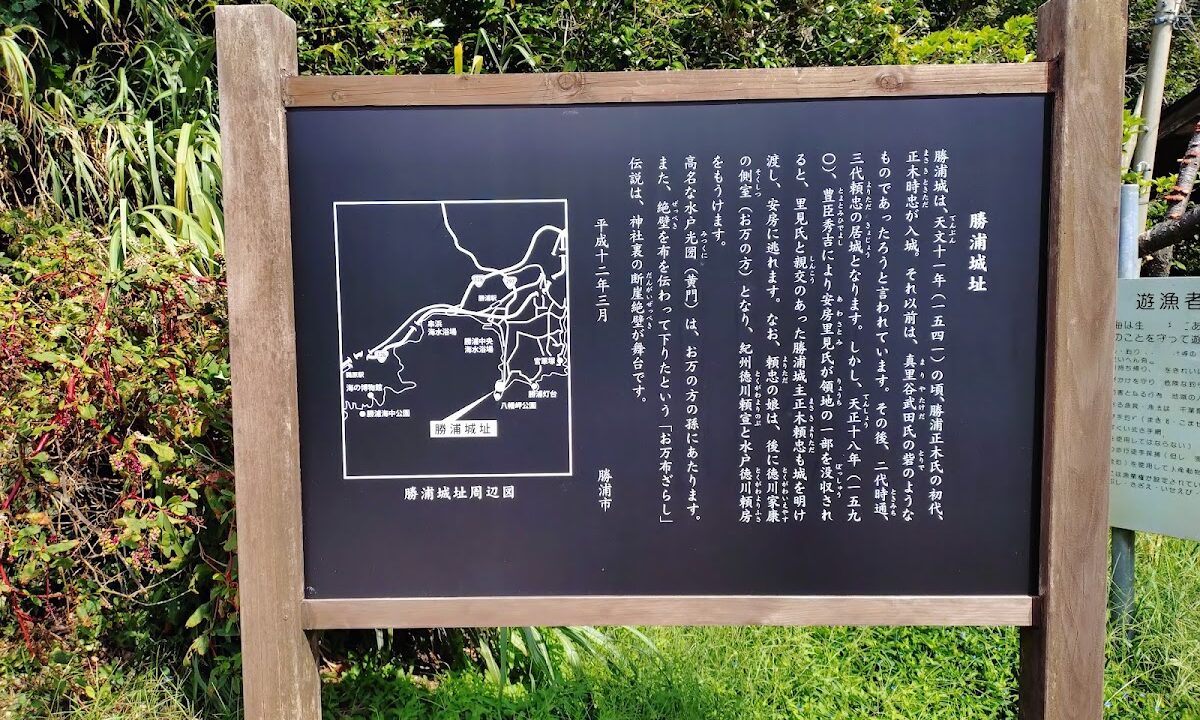
Katsuura Castle (Chiba Prefecture) Complete Guide | History and Highlights of a Natural Fortress jutting out into the Sea
What is Katsuura Castle? An Overview of Chiba Prefecture’s Proud Coastal Castle
Katsuura Castle (Katsuura-jo) was a Japanese castle located in Hamakatsuura, Katsuura City, Chiba Prefecture. It was a coastal castle built on the cliffs of Hachiman Cape, which juts out at the southeastern end of Katsuura Bay. Surrounded by the sea on three sides, this castle functioned as a natural fortress and was an important military base on the Boso Peninsula during the Sengoku period.
Currently, it is protected as a Katsuura City designated historical site and is maintained as Hachiman Cape Park. Remains such as baileys and moats remain within the park, conveying the atmosphere of the past. From the Katsuura Castle ruins, you can enjoy a magnificent view of the Pacific Ocean, making it an attractive spot where you can enjoy historical walks and nature appreciation simultaneously.
Characteristics as a Coastal Castle
The greatest characteristic of Katsuura Castle lies in its location. Located at the tip of Yawata Cape, and surrounded on the east, south, and west by cliffs and the sea, Katsuura Castle utilized its natural fortifications to its advantage against land attacks. This geographical advantage allowed for effective defense even with a small force.
Its function as a maritime castle was not merely defensive; it was also crucial as a naval base. Katsuura Bay was a natural harbor, suitable for ship mooring and resupply, making it strategically valuable as a key point for maritime traffic.
History of Katsuura Castle | From Construction to Abandonment
Construction History and Period
While many details about the construction of Katsuura Castle remain unclear, the most widely accepted theory is that it was built in 1521 by Mariya Nobuoki (or possibly Mariya Nobukiyo), a member of the Kazusa Takeda clan and lord of Mariya Castle. The purpose of its construction was to serve as a subsidiary castle to prevent the expansion of Satomi Yoshitaka’s power as he advanced northward from Awa Province. At that time, the Boso Peninsula was embroiled in a power struggle between the Kazusa Takeda clan (Maritani Takeda clan) and the Satomi clan, and Katsuura was a strategically important location situated on the border between these two forces. Taking advantage of its natural fortress-like terrain facing the sea, Katsuura Castle was developed as a defensive stronghold, marking its beginnings.
The Masaki Clan Era | As the Residence of the Katsuura Masaki Clan
The most important period in the history of Katsuura Castle was the era when the Masaki clan served as its lords. The Masaki clan were powerful vassals of the Satomi clan, and played a central role in the naval forces, particularly those responsible for the naval operations. This family, known as the Katsuura Masaki clan, established control over the eastern part of the Boso Peninsula with Katsuura Castle as their base.
During the Masaki clan’s era, the castle grounds are believed to have been significantly expanded. The main keep and third bailey were located at the southern tip of Yawata Cape (present-day Yawata Cape Park), and the castle grounds expanded to the hilly area to the north. At its peak, the castle complex stretched approximately 1.5 km from north to south and 0.5 km from east to west, boasting a scale befitting the base of the Katsuura Masaki clan.
Among the Masaki clan, Masaki Yoritada was particularly famous. Yoritada commanded the Satomi clan’s navy and played a key role in maritime military operations. Katsuura Castle was not merely a defensive stronghold; it also functioned as a naval base, exerting influence in the sea area from off the coast of Boso Peninsula to Sagami Bay.
The Conflict Between the Satomi and Hojo Clans
In the late Sengoku period, the Boso Peninsula became the stage for the power struggle between the Satomi clan and the Odawara Hojo clan. Katsuura Castle was no exception, situated on the front lines of the conflict between these two forces. Katsuura Castle, defended by the Masaki clan, vassals of the Satomi clan, functioned as a crucial defensive base against the Hojo clan’s invasion of Boso.
During the Tensho era (1573-1592), fierce battles raged between the Hojo and Satomi clans, and Katsuura Castle was affected. Taking advantage of its coastal location, it offered a strong defense against land attacks. However, the changing political landscape at the end of the Sengoku period drastically altered the castle’s fate.
Fall and Abandonment
The history of Katsuura Castle came to an end in 1590 during Toyotomi Hideyoshi’s siege of Odawara. At this time, Honda Tadakatsu, a retainer of Tokugawa Ieyasu, advanced into the Boso Peninsula and captured various castles belonging to the Satomi clan. Katsuura Castle was also targeted and fell to Honda Tadakatsu’s forces.
After the siege of Odawara, the Satomi clan pledged allegiance to the Toyotomi regime and their territories were secured. However, Katsuura Castle’s strategic importance diminished, and it was abandoned. Afterward, the castle was never reused as a castle throughout the Edo period, and the castle ruins became integrated into the living area of the local residents.
Layout and Structure of Katsuura Castle
Castle Layout | From the First to the Third Enclosure
The central part of Katsuura Castle is concentrated at the tip of Hachiman Cape, and the current Hachiman Cape Park corresponds to its main area. The castle was composed of three main enclosures (kuruwa).
The First Enclosure (Honmaru) was located at the very tip of the cape, surrounded on three sides by the sea and cliffs, making it the most defensible location. It is believed that the lord’s residence and important facilities were located here. Currently, an observation deck and lighthouse are installed, offering spectacular views of the Pacific Ocean.
The Second Enclosure is located north of the First Enclosure, corresponding to the flat area where the playground equipment in the current park is located. This area played a role in defending the First Enclosure and functioned as a garrison for soldiers and a storage area for supplies.
The Third Enclosure was located near Hachiman Shrine. Hachiman Shrine was incorporated into the castle grounds as the guardian shrine of the castle, playing an important role in both religious and defensive purposes.
Defensive Structures and Remains
Katsuura Castle had defensive structures unique to coastal castles. The following are examples of remains that can still be seen today:
Horikiri (moat) is a defensive structure built at the base of the cape, a structure that cuts through the terrain to prevent intrusion from the land side. Traces of it can be seen near the entrance to Hachiman Cape Park.
Kirigishi (cut slope) is a defensive structure created by artificially creating a steep slope, intended to make it difficult for enemies to climb. The cliffs of Hachiman Cape functioned as natural cut slopes, but it is possible that some parts were artificially modified.
Earthwork traces also remain in some areas, serving to demarcate the enclosures and enhance defensive capabilities.
Extent of the Castle Area
The area developed as Hachiman Cape Park is the core of Katsuura Castle, but the actual castle area extended over a much wider area. The entire hilly area from Yawata Cape to the vicinity of Tomisaki Shrine is thought to have been the castle grounds, extending approximately 1.5 km north-south and 0.5 km east-west.
This vast castle area also included samurai residences and merchant districts, suggesting that it possessed not only military facilities but also urban functions as a base of operations for the Katsuura Masaki clan.
The current Katsuura Castle site, now developed as Yawata Cape Park
Park Overview and Access
The Katsuura Castle site is now developed as Yawata Cape Park, a place of relaxation for citizens. Walking paths are maintained within the park, allowing visitors to enjoy historical walks and nature appreciation.
Access Information
- Approximately 2km south from JR Sotobo Line “Katsuura Station,” about a 25-minute walk.
- Take a local bus from Katsuura Station bound for “Katsuura Marine Park,” get off at “Katsuura City Hall,” and walk for about 10 minutes.
- By car, about 40 minutes from Ken-O Expressway “Ichihara Tsurumai IC,” parking available.
Basic Information
- Location: Hamakatsuura, Katsuura City, Chiba Prefecture
- Opening Hours: Always open
- Admission Fee: Free
- Parking: Available (Free)
Highlights and Sightseeing Points
Yawata Cape Park offers not only historical remains but also various other attractions.
From the Observation Deck, you can enjoy a panoramic view of the Pacific Ocean, and on clear days, you can see all the way to the horizon. The sunrise view is particularly spectacular and a popular spot for photography.
The Katsuura Lighthouse is a white lighthouse standing at the tip of the cape, a place where you can truly appreciate the location of Katsuura Castle, which was once a seaside castle. From the area around the lighthouse, you can see sheer cliffs and crashing waves up close, experiencing the natural fortress-like terrain.
Hachiman Shrine is a shrine revered as the guardian deity of the castle and still attracts local worshippers today. It is believed that the third bailey was located around the shrine, giving a sense of historical atmosphere.
Exploring the Ruins allows you to imagine the castle’s structure during the Sengoku period by examining the flat areas and traces of moats that remain. Information boards are also installed to deepen your understanding of the history.
Nearby Tourist Spots
Around the Katsuura Castle ruins, there are many tourist spots where you can enjoy the charm of Katsuura.
Katsuura Morning Market is one of Japan’s three major morning markets and is a traditional market with a history of over 400 years. Fresh seafood and local agricultural products are on display, and you can enjoy interacting with the locals.
Tomisaki Shrine is the guardian shrine of Katsuura, and every spring it becomes the venue for the “Katsuura Big Hina Festival,” where the hina dolls displayed on the stone steps create a breathtaking spectacle.
Katsuura Marine Park allows visitors to observe the marine ecosystem of Katsuura from the underwater observation tower, giving them a real sense of the richness of the sea that Katsuura Castle, a castle built on the sea, once faced.
Legends and Anecdotes Related to Katsuura Castle
The Legend of “Oman’s Cloth Bleaching”
The most famous legend related to Katsuura Castle is “Oman’s Cloth Bleaching.” This legend is a tragic tale about a woman named Oman, the wife of a retainer of the castle lord, the Masaki clan.
According to the legend, Oman was a beautiful woman, but while her husband was away at war, the castle lord made advances towards her. To maintain her fidelity, Oman is said to have thrown herself from the cliffs of Hachiman Cape. Afterward, sightings of Oman’s spirit washing white cloth began to be made, and this story became known as “Oman’s Cloth Washing.”
This legend, born from the harsh historical context of the Sengoku period and the unique environment of a coastal castle, is cherished and passed down locally.
The Masaki Clan’s Naval Activities
The Katsuura Masaki clan played a crucial role in the Satomi clan’s naval forces. Masaki Yoritada and the rest of the Masaki family were active in the waters from off the coast of Boso Peninsula to Sagami Bay, securing maritime trade routes, suppressing piracy, and handling maritime transport for military operations.
The naval activities based at Katsuura Castle were not merely military operations; they were also deeply involved in economic activities such as protecting maritime trade and managing fisheries. Katsuura Bay, a natural harbor, served as a vital base supporting these activities.
Historical Value and Cultural Property Designation of Katsuura Castle
Protection as a Katsuura City Designated Historic Site
The Katsuura Castle ruins are designated as a Katsuura City Historic Site, representing an important cultural property of Katsuura City. This designation ensures the preservation and proper management of the castle ruins, thereby ensuring the transmission of its historical value.
As a city-designated historic site, the Katsuura Castle ruins are not only preserved as historical remains, but also emphasized for educational use. They are used as teaching materials for local history in local schools and contribute to regional development as a tourist resource.
The Importance of Coastal Castles on the Boso Peninsula
Katsuura Castle, as one of the few remaining coastal castle ruins on the Boso Peninsula, occupies an important position in the study of castle history. Its location surrounded by the sea on three sides, its function as a naval base, and its defensive structure utilizing the natural terrain, possess characteristics unique to coastal castles, making it a valuable example for understanding maritime strategies during the Sengoku period.
The Boso Peninsula is a region surrounded by the sea, and maritime transportation played a crucial role. Coastal castles like Katsuura Castle symbolize the historical characteristics of this region and are significant legacies when considering the history of Japan as a maritime nation.
Points to Note When Visiting Katsuura Castle
Best Season for Visiting
Katsuura Castle Ruins (Hachiman Cape Park) can be visited year-round, but each season offers a different charm.
Spring (March-May) offers a mild climate, perfect for strolling. March, in particular, hosts the “Katsuura Big Hina Festival,” which can be enjoyed in conjunction with other nearby sightseeing.
Summer (June-August) offers a beautiful contrast between the blue Pacific Ocean and the sky, allowing you to truly appreciate the castle’s coastal location. However, the sun is strong, so sun protection such as a hat and sunscreen is necessary.
Autumn (September-November) offers a stable climate, making it the most suitable season for strolling. The clear air allows for expansive views, allowing you to fully enjoy the scenery from the castle ruins.
Winter (December to February) offers clear air and excellent visibility, making it a particularly beautiful season for sunrise viewing. With proper cold-weather gear, you can enjoy a peaceful historical stroll.
Estimated Time and Sightseeing Route
For a thorough visit to Katsuura Castle Ruins, allow approximately 1-2 hours.
Recommended Sightseeing Route
- From the parking lot/entrance to Hachiman Shrine (confirm the site of the third bailey)
- Proceed along the walking path to the site of the second bailey (flat area in the park)
- Proceed to the tip of the cape (site of the first bailey) and visit the observation deck and lighthouse
- Experience the topography of the coastal castle along the cliffside walking path
- Return to the entrance while observing the traces of the moat
Information boards and explanatory signs are installed; referring to them while strolling will allow you to understand the history more deeply.
Photography Tips
Katsuura Castle Ruins is also an attractive photography spot.
The view of the Pacific Ocean from the observation deck can be captured with a wide-angle lens to convey a sense of magnificent scale. The early morning sunrise and twilight hours are particularly golden times for taking dramatic photographs.
Katsuura Lighthouse is a beautiful white structure, and with the blue sea and sky as a backdrop, it makes for a picturesque composition.
The cliffs and rough waves are a subject that symbolizes the location of the castle by the sea. Capturing the moment the waves crash against the rocks can express the power of this natural fortress.
Precautions and Preparations
When visiting Katsuura Castle Ruins, please note the following:
- Foot Safety: While the walking paths are well-maintained, some sections are along cliffs, so comfortable shoes are recommended.
- Weather: Due to its coastal location, it can be windy on some days. Warm clothing is especially necessary during winter.
- Toilets and Drinks: While there are toilets in the park, vending machines for drinks are limited, so it’s best to prepare in advance.
- Sun Protection: Since there is little shade in the summer, please bring a hat, sunscreen, and drinking water.
Summary | The Charm and Historical Significance of Katsuura Castle
Katsuura Castle is a valuable remains of a coastal castle located in Katsuura City, Chiba Prefecture. It played a crucial role as a military and maritime transportation hub on the Boso Peninsula during the Sengoku period. Its location as a natural fortress surrounded on three sides by the sea and cliffs, its function as a naval base by the Satomi and Masaki clans, and its historical fate of falling during the Siege of Odawara speak to the unique character of this castle.
Currently, the Katsuura Castle ruins, developed as Hachimanmisaki Park, are a prime example of how historical preservation and utilization as a tourist resource can be successfully combined. The environment, where visitors can enjoy the spectacular view of the Pacific Ocean while examining remains such as baileys and moats, is an attractive spot not only for history enthusiasts but also for general tourists.
By visiting the Katsuura Castle ruins, you can gain a deeper understanding of the realities of coastal castles during the Sengoku period, the history of the Boso Peninsula, and the relationship between the sea and people. When you visit Katsuura, be sure to stop by this historic castle ruin and experience the remnants of its past and the magnificent natural scenery.
Katsuura Castle is not merely a historical relic, but a living cultural asset that conveys the history and culture of the region to the present day. It will continue to be carefully preserved and cherished by many people.