Complete Guide to Iino Jinya Ruins (Futtsu City, Chiba Prefecture) | A Thorough Explanation of the History and Highlights of Japan’s Three Great Jinya
Located in Futtsu City, Chiba Prefecture, the Iino Jinya Ruins are a valuable historical site that preserves the appearance of a daimyo’s residence from the Edo period. Considered one of Japan’s three great jinya, its well-preserved moat and earthworks captivate visitors. This article provides a detailed explanation of the history, structure, highlights, and access methods of the Iino Jinya Ruins.
What are the Iino Jinya Ruins? Basic Information and Overview
The Iino Jinya was a jinya (fortified residence) built in 1648 (Keian 1) as the administrative center of the Iino Domain in Kazusa Province. A jinya was a small-scale residence of a daimyo without a castle, and the Iino Jinya was a particularly large and prestigious facility among them.
Location and Basic Data
- Location: 833 Shimo-Iino, Futtsu City, Chiba Prefecture, and other locations
- Builder: Hoshina Masasada
- Year of Construction: Keian 1 (1648)
- Year of Abandonment: Meiji 4 (1871)
- Remains: Earthworks, moat (water moat)
- Designated Cultural Property: Chiba Prefecture Designated Historic Site “Iino Jinya Moat Ruins” (Designated in Showa 42, 1967)
- Nearest Station: Approximately 20 minutes on foot from Aohori Station on the JR Uchibo Line
What are the Three Great Jinya of Japan?
Iino Jinya is commonly referred to as one of the “Three Great Jinya of Japan,” along with Tokuyama Jinya of the Tokuyama Domain of Suo Province (Shunan City, Yamaguchi Prefecture) and Tsuruga Jinya of the Tsuruga Domain of Echizen Province (Tsuruga City, Fukui Prefecture). This was valued not only for its large scale, but also for the perfection of its structure and its excellent state of preservation.
History of Iino Jinya | The Hoshina Clan and the Establishment of the Iino Domain
Hoshina Masasada and the Birth of the Iino Domain
The history of Iino Jinya begins with Hoshina Masasada. Masasada was born the third son of Hoshina Masanao and the younger brother of Hoshina Masayuki, the lord of the Aizu Domain. The Hoshina clan was a prestigious family originating from the Takato Domain in Shinano Province, and had close ties to the Tokugawa shogunate.
In 1648 (Keian 1), Masasada received an increase in his stipend, bringing his total to 17,000 koku, and he was elevated to the rank of daimyo. This granted him territory in the Moda and Shuwai districts of Kazusa Province, and he established a jinya (fortified residence) in Iino. Initially a hatamoto (direct retainer of the shogun) with less than 10,000 koku, this increase in stipend formally established the Iino Domain as a daimyo.
The History of the Iino Domain
The Iino Domain was ruled by the Hoshina clan for approximately 220 years. Throughout its rule, the clan focused on developing new rice fields and flood control projects within its territory, contributing to regional development. Flood control in the Obitsu River basin was a particularly important issue, and successive lords of the domain worked on embankment construction and river improvement.
Although a small domain with a rice yield of 17,000 koku, the Hoshina clan, as hereditary daimyo, sometimes held important positions in the shogunate. Towards the end of the Edo period, Lord Hoshina Masayoshi served as a junior councilor, demonstrating their involvement in shogunate politics.
With the abolition of the feudal domains and establishment of prefectures in 1871 (Meiji 4), the Iino Domain was abolished, and the Iino Jinya (fortified residence) ceased to function. The site of the Jinya was subsequently sold to private individuals, but the moat remains were preserved in relatively good condition and remain so to this day.
Structure and Scale of Iino Jinya | A Vast Site Consisting of Inner and Outer Residences
Overall Layout of the Jinya
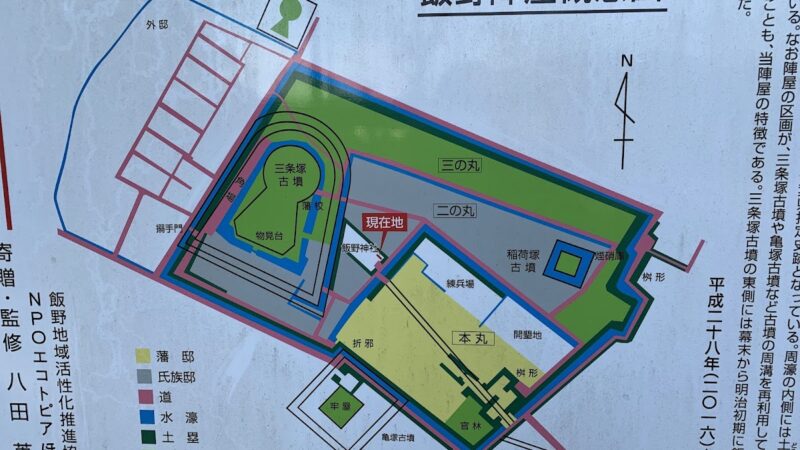
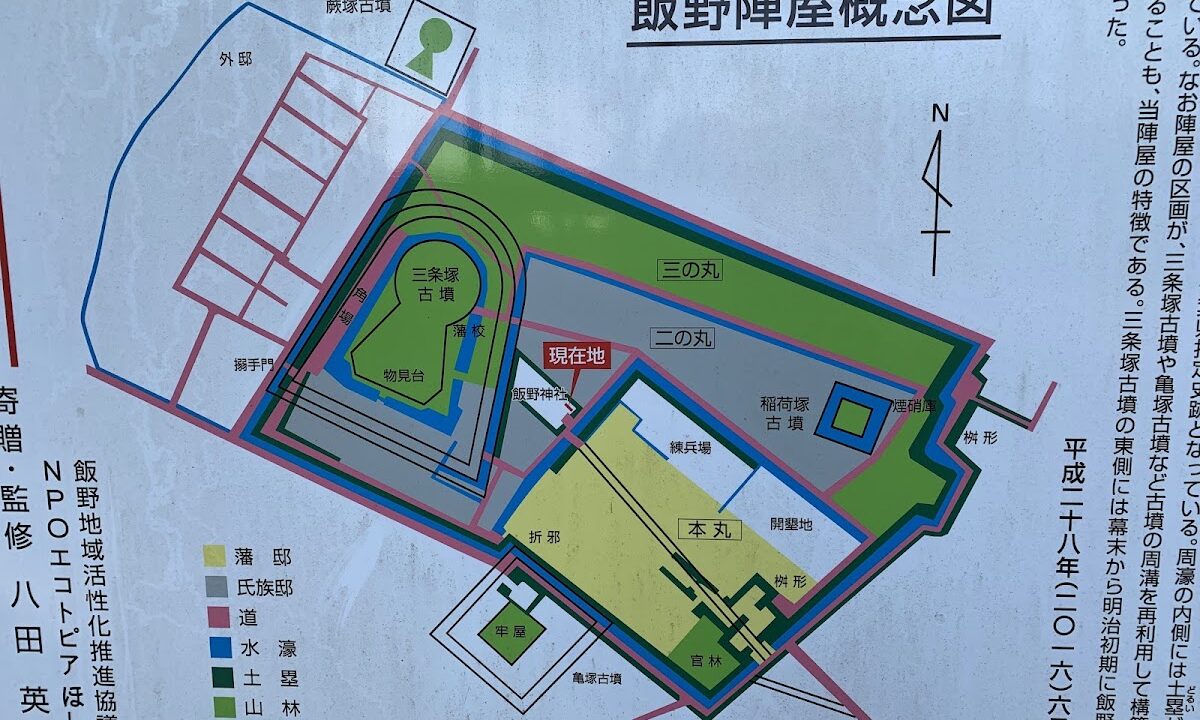
The Iino Jinya consisted of an “inner residence” surrounded by earthworks and a moat, and an “outer residence” outside of it. It was an extremely large facility for a jinya, with a total area of approximately 176,000 square meters.
- Inner Residence: The central area including the main keep, second bailey, and third bailey. Area approximately 128,000 square meters. Dimensions approximately 430m east-west and 290m north-south.
- Outer Residence: Samurai residences and facilities extending outside the moat. Area approximately 48,000 square meters.
Characteristics of the Moat and Earthworks
The most distinctive feature of the Iino Jinya is its well-preserved water moat. Protected as a Chiba Prefecture designated historical site, “Iino Jinya Moat Site,” the moat has the following characteristics:
- Width: Approximately 5 meters
- Shape: A V-shaped moat (Yagenbori)
- Current Status: Still holds water, retaining much of its original form
- Earthwork: Parts of the earthwork built inside the moat remain.
A Yagenbori is a moat with a narrow bottom and steep slopes on both sides, considered to have high defensive capabilities. The moat of the Iino Jinya is remarkably well-preserved for an Edo period jinya moat and is a valuable historical site for understanding the civil engineering techniques of the time.
Architectural Layout
The inner residence contained a group of buildings with administrative functions, including the “Goten,” the residence of the feudal lord. According to records, the following facilities existed:
- Omote-Goten: The place where official government affairs were conducted
- Naka-Oku: The private living space of the feudal lord
- Nagaya: The garrison of retainers
- Kura: Rice storehouse and armory
- Umaya: Facilities for raising horses
Unfortunately, the buildings no longer exist, but archaeological excavations have confirmed the foundations and cornerstones of the buildings, allowing us to estimate the original layout.
Dairizuka Kofun Group and Iino Jinya | Jinya built on top of burial mounds
One of the distinctive features of Iino Jinya is that it was built within the Futtsu Kofun Group (Dairizuka Kofun Group). Numerous burial mounds constructed in the late Kofun period (6th-7th centuries) exist in this region, and several burial mounds have been confirmed within and around the Jinya grounds.
Burial mounds within the Jinya grounds
It is believed that at least several burial mounds existed within the Jinya grounds. These burial mounds may have been partially altered during the construction of the encampment, but they were not completely destroyed and were incorporated as part of the terrain.
The mounds were utilized as natural elevations, and it is speculated that they may have been used as lookout posts or observation posts. Furthermore, the surrounding terrain may have also served to defend the encampment.
Surrounding Burial Mounds
Several burial mounds remain around the Iino encampment. These are protected as important cultural properties of Futtsu City and tell the story of the prosperity of this region during the Kofun period. When visiting the encampment site, visiting the surrounding burial mounds as well will allow you to feel the deeper layers of history.
Highlights of the Iino Encampment Moat Site | Points to Enjoy on-Site
Beautiful Moat Scenery
The first thing that catches the eye when visiting the Iino encampment site is the beautiful moat that still holds water. The tranquil surface of the water, surrounded by greenery, evokes the atmosphere of the Edo period. The scenery is particularly beautiful during the following times:
- Spring: Cherry blossoms bloom in the surrounding area, and petals float on the water’s surface.
- Early Summer: Fresh greenery colors the moat.
- Autumn: Autumn leaves are reflected on the water’s surface.
- Winter: Enjoy the tranquil atmosphere in the crisp air.
Remains of the Earthworks
Partial remains of earthworks remain inside the moat. The height varies depending on the location, but the best-preserved sections are about 2-3 meters high. Walking on the top of the earthworks allows you to experience the scale of the encampment at that time.
Cross-section of the Yagenbori Moat
In a part of the moat, you can observe the distinctive Yagenbori cross-section. The steep, V-shaped slope speaks to its function as a defensive structure. During periods of low water, the shape of the moat bottom is sometimes more clearly visible.
Information Boards and Explanations
Information boards provided by the Chiba Prefectural Board of Education and Futtsu City are installed at the site, allowing you to learn about the history and structure of the Iino Jinya (encampment). By strolling around while reading these explanations, you can gain a deeper understanding of the historical site.
Results of Archaeological Excavations | The True Image of the Jinya Revealed
Multiple archaeological excavations have been conducted at the Iino Jinya site in the past, gradually revealing the structure of the jinya and the lifestyle of those who lived there.
Main Research Findings
- Confirmation of Building Remains: The size and layout of the buildings were determined from the arrangement of foundation stones and post holes.
- Excavation of Ceramics: Numerous pieces of tableware used in daily life were unearthed, providing insight into the standard of living at the time.
- Moat Structure: Excavations revealed the depth and detailed structure of the moat.
- Relationship with Burial Mounds: The existence of burial mounds within the jinya grounds was confirmed, elucidating the layered history of the burial mounds and the jinya.
Excavated Artifacts
The excavations have yielded ceramics, roof tiles, and metal products from the Edo period. In particular, a diverse range of artifacts reflecting the trade of the time have been identified, including Hizen porcelain and pottery from Seto and Mino, providing clues to the economic power and cultural level of the Iino domain.
Access and Visiting Information
Access by Public Transportation
- Train: Get off at Aohori Station on the JR Uchibo Line, approximately 20 minutes on foot.
- Bus: Futtsu City Loop Bus available from Aohori Station (limited service).
Access by Car
- Tateyama Expressway: Approximately 10 minutes from Futtsu Chuo IC.
- Parking: There is no dedicated parking lot; please use nearby public facilities or paid parking lots.
Notes for Visitors
- Free Viewing: The exterior can generally be viewed freely.
- Private Property: Some areas are private property; please be aware of restricted areas.
- Caution Regarding Footing: There are slippery areas around the moat; please wear comfortable shoes.
- Summer: Insect repellent is recommended.
- Photography: Please be careful not to include private property or houses in your photos.
Nearby Tourist Attractions
When visiting the Iino Jinya Ruins, we recommend also visiting the surrounding historical sites and tourist attractions.
Sanuki Castle Ruins
Located approximately 5km northeast of Iino Jinya, these are the ruins of a medieval mountain castle. An important historical site in Futtsu City, it retains remains from the Sengoku period (Warring States period).
Shinbukone Jinya Ruins
Like Iino Jinya, these are the ruins of a former jinya (fortified residence) located within Futtsu City. Although smaller in scale, they offer insights into the appearance of a jinya at that time.
Futtsu Cape
A cape jutting out into Tokyo Bay, developed as Futtsu Park. Enjoy swimming and barbecues, and take in the spectacular view of Tokyo Bay from the observation deck.
Kofun (Ancient Burial Mounds) in Futtsu City
Numerous kofun, including the Dairizuka Kofun Group, are scattered throughout the city. For those interested in the history of the Kofun period, a kofun tour is highly recommended.
Preservation and Utilization of the Iino Jinya Ruins
Protection as a Cultural Property
The Iino Jinya moat ruins were designated a Chiba Prefecture historical site in 1967 and are protected as a cultural property. However, much of the jinya site is still privately owned, making the balance between preservation and utilization a challenge.
Local Initiatives
The Futtsu City Board of Education and local history enthusiast groups are working on the preservation and utilization of the Iino Jinya ruins. Regular cleaning activities, the installation of information boards, and guided tours are carried out, and efforts continue to pass on this valuable cultural heritage to future generations.
Future Prospects
The Iino Jinya ruins are a nationally valuable historical site as one of Japan’s three major jinya (fortified residences), but their recognition is not necessarily high. Further research, development, and improvements are expected in the future, and it is hoped that it will be utilized as a tourist resource.
The Significance of Visiting Iino Jinya | A Place to Feel the Layers of History
The Iino Jinya ruins are not merely an Edo period ruin. This place is a condensed embodiment of multi-layered history, from the Kofun period to the daimyo culture of the Edo period and the changes that followed the Meiji Restoration.
As you gaze upon the tranquil moat, imagine the days when the domain’s administration took place here and many people lived. What thoughts did the successive lords of the Hoshina clan harbor in this land, and what were their concerns for their people?
Although the Iino Jinya ruins now stand quietly amidst a residential area, you can certainly feel the breath of history in its stillness. When you visit Chiba Prefecture, be sure to visit this precious historical site.
Summary
The Iino Jinya ruins are a valuable Edo period historical site remaining in Futtsu City, Chiba Prefecture. It is counted as one of Japan’s three great jinya (fortified residences), and its well-preserved moat and earthworks still convey its former appearance. Built in 1648 by Hoshina Masasada, it served as the administrative center of the Iino Domain for approximately 220 years, playing a central role in the region.
Iino Jinya boasts many attractions, including its unique location amidst a cluster of ancient burial mounds, its beautiful Yagenbori moat, and its vast grounds. Access is relatively good, within walking distance of JR Aohori Station, and other tourist spots such as Sanuki Castle ruins and Futtsu Cape are scattered throughout the surrounding area.
For history buffs, those seeking a quiet historical site, and those looking for hidden gems in Chiba Prefecture, Iino Jinya ruins are a must-see. Be sure to visit and experience firsthand the Edo-period daimyo culture and local history.