Complete Guide to Tsukuroumi Castle | History and Access Information for a Sengoku Period Coastal Castle in Futtsu City, Chiba Prefecture
What is Tsukuroumi Castle?
Tsukuroumi Castle was a Sengoku period mountain castle that once existed in Takeoka, Futtsu City, Chiba Prefecture. Also known as “Hyakushu Castle” or “Hyakushu Fortress,” it was an important military base on the Boso Peninsula, built on a hill overlooking the Uraga Channel, the mouth of Tokyo Bay.
The castle’s name, “Tsukuroumi,” originates from the local place name in the medieval period. Located just 12km across the Uraga Channel from the Miura Peninsula, it served as a frontline fortress during the Sengoku period, where the Satomi and Hojo clans clashed, playing a crucial role in monitoring this vital point of maritime traffic.
Currently, the castle ruins are preserved as a historical site by Futtsu City, Chiba Prefecture, and are a valuable historical remains that convey the appearance of a Sengoku period coastal castle in Boso.
History of Tsukumi Castle
Construction and the Mariya and Kazusa Takeda Clans
Traditionally, Tsukumi Castle was believed to have been built in 1461 by Mariya Nobuoki (or Takeda Nobunaga). The Mariya clan was a branch of the Kazusa Takeda clan and a powerful Sengoku daimyo who controlled the southern part of the Boso Peninsula.
However, recent research has presented a different view. Historian Motoki Kuroda interprets “Kazusa no Kuni no Miyatsuko Hosogō,” which Ashikaga Shigeuji gave to Takeda Nobunaga, the first head of the Kazusa Takeda clan and ancestor of the Mariya clan, as a mistake for “Tsukumi-gō,” and proposes that Tsukumi Castle was the first base of operations for Takeda Nobunaga, i.e., the Kazusa Takeda clan. According to this theory, the expansion into Mariya Castle and Chōnan Castle occurred in subsequent generations.
The Kazusa Takeda clan was a branch of the Kai Takeda clan and expanded its power in the Boso Peninsula from the mid-Muromachi period. Because Tsukumi Castle was strategically located overlooking Tokyo Bay, it is believed to have played a crucial role in controlling maritime traffic and defending against forces on the opposite shore.
Satomi Clan’s Rule and the Front Line Against the Hojo Clan
From 1537 onwards, Tsukumi Castle came under the control of the Satomi clan. During this period, the Satomi clan was expanding its power in the Boso Peninsula, while the power of the Mariya and Kazusa Takeda clans was declining.
The Satomi clan was a Sengoku daimyo based in Awa Province (present-day southern Chiba Prefecture) and wielded influence throughout the Boso Peninsula. For the Satomi clan, who acquired Tsukumi Castle, this castle became a key strategic point against the Hojo clan.
Across the Uraga Channel lay the sphere of influence of the Later Hojo clan, based in Odawara, and Uraga Castle (Yokosuka City) on the Miura Peninsula was a crucial base for the Hojo navy. From Tsukumi Castle, Uraga Castle was directly visible, making it a frontline fortress symbolizing the tense relationship between the two forces.
The Satomi clan utilized Tsukumi Castle as a base for their navy, making it a frontline base in the struggle for control of the seas in Tokyo Bay. Its location overlooking the mouth of the Shirakogawa River was likely ideal for monitoring ship traffic and anchoring warships.
Role and Abandonment During the Sengoku Period
Throughout the Sengoku period, Tsukumi Castle continued to function as a key element of the Satomi clan’s maritime defense. It played a vital role in monitoring the Uraga Channel, a vital sea route, and in check of the Hojo clan’s movements.
However, after Toyotomi Hideyoshi’s siege of Odawara in 1590, the Hojo clan was destroyed, and the strategic importance of Tsukumi Castle was lost. The Satomi clan was also dispossessed of their lands in 1614 after the Battle of Sekigahara, and it is believed that Tsukumi Castle was abandoned around this time.
During the Edo period, this area became a direct territory of the shogunate and a territory of hatamoto (direct retainers of the shogun), and the ruins of Tsukumi Castle were buried in history. Since the Meiji era, local historians and castle researchers have conducted investigations, and it has come to be recognized as an important medieval castle in the Boso Peninsula.
Structure of Tsukumi Castle
Location and Layout
Tsukumi Castle was built on the tip of a semi-independent hill facing the Uraga Channel in Tokyo Bay. The elevation is approximately 50-60m, and the relative height from the sea is about 40m. The castle faces Tokyo Bay to the east, and the Shirakogawa River valley on the west side acts as a natural moat, making it a strategically important location protected on three sides by steep slopes.
The castle’s layout is typical of a mountain castle, skillfully utilizing the hilly terrain. Multiple baileys are arranged in a stepped fashion around the main enclosure, with defensive structures built along the ridges and valleys.
The castle grounds extend approximately 300m east-west and 400m north-south, making it a medium-sized mountain castle. While sometimes classified as a “sea castle” due to its location facing the sea, it is actually a mountain castle on a hill, distinct from flatland castles or water castles with port facilities.
Major Remains
Currently, the remains of a Sengoku period mountain castle remain in relatively good condition at the site of Tsukumi Castle. The main remains include the following:
Main Enclosure (Honmaru)
The main enclosure, the center of the castle, is located at the highest point of the hill. The flat area is relatively large, suggesting the presence of the lord’s residence and other important buildings. Traces of earthworks can be seen around the main enclosure, indicating the existence of defensive structures.
Enclosures
Several enclosures are arranged in a stepped pattern around the main enclosure. These enclosures are thought to have been used as barracks for soldiers and storage areas for supplies. Each enclosure is separated by steep slopes called “kirigishi,” enhancing its defensive capabilities.
Moats
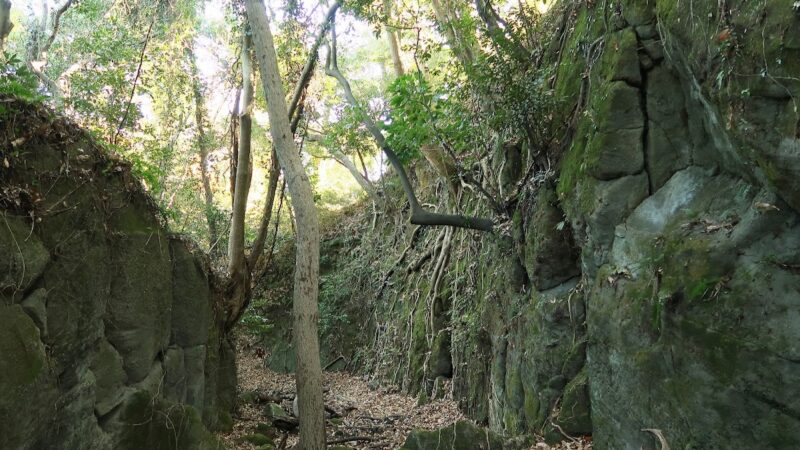
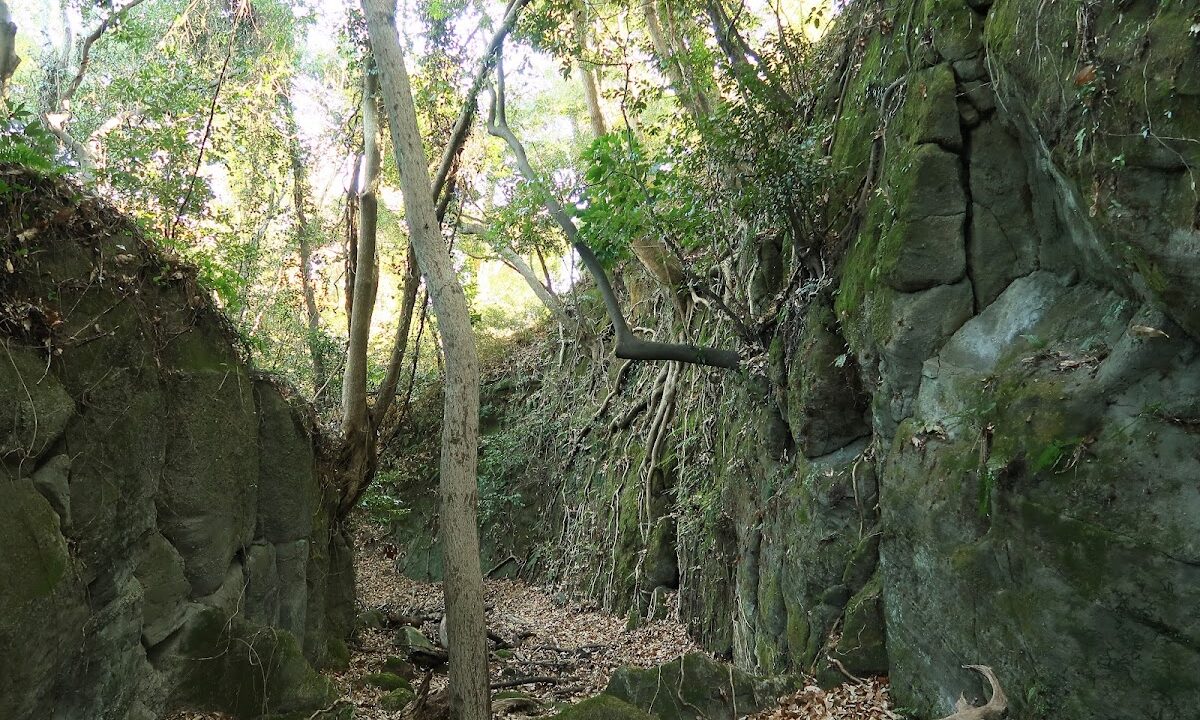
Several moats cut across the ridgeline are present. Moats are important defensive structures to prevent enemy intrusion, and relatively large moats have been identified at Tsukumi Castle.
Earthworks
Traces of earthworks remain along the edges of the enclosures. Earthworks are earthen walls built by piling up soil, serving to protect against arrow and gunfire attacks, as well as preventing enemy intrusion.
Entrance (Koguchi)
The remains of a koguchi (entrance to the castle) have also been confirmed. The tiger’s mouth (koguchi) is a weak point in a castle’s defenses, so it was designed with complex structures to make enemy intrusion difficult.
Presence or Absence of Stone Walls
Tsukumi Castle is a mountain castle from the Sengoku period, and no full-fledged stone walls were built there. Castles from the Sengoku period in the Kanto region primarily used earthworks, differing from the Oda-Toyotomi period castles that made extensive use of stone walls.
However, traces of stonework using natural stones can be found in some baileys and around the tiger’s mouth. These are thought to be more for reinforcing earthworks or improving pathways rather than full-fledged stone walls.
Characteristics as a Coastal Castle
The most distinctive feature of Tsukumi Castle is its location facing the Uraga Channel. From the castle, one could see Tokyo Bay, making it an ideal location for monitoring maritime traffic. On clear days, the Miura Peninsula and Mount Fuji on the opposite shore could be seen.
The mouth of the Shirakogawa River was suitable for anchoring small boats, and it is presumed that the Satomi naval forces’ warships came and went there. It is believed that the castle functioned as a maritime castle, integrating both a castle and a port.
During the Sengoku period (Warring States period), maritime traffic played a crucial role on the Boso Peninsula, and maritime castles functioned not only as military bases but also as centers for maritime trade. It is possible that Tsukumi Castle also played an economic role in addition to its military one.
Highlights of Tsukumi Castle
Remains Visible at the Site
Visiting the Tsukumi Castle ruins allows you to experience the structure of a Sengoku period mountain castle firsthand. The main highlights are as follows:
View
The view from the castle ruins is magnificent, offering a panoramic view of Tokyo Bay and the Uraga Channel. On a clear day, you can see the Miura Peninsula and Mount Fuji on the opposite shore, allowing you to truly feel the history of the confrontation between the Satomi and Hojo clans during the Sengoku period. This view is arguably the greatest highlight of Tsukumi Castle.
Arrangement of Enclosures
The arrangement of enclosures, utilizing the hilly terrain, is valuable information for understanding Sengoku period castle construction techniques. Walking through the series of baileys that descend from the main enclosure allows you to understand the castle’s three-dimensional structure.
Moat
The moat built along the ridge is still clearly visible today. Its depth and width reveal the defensive ingenuity of the time.
Information Board
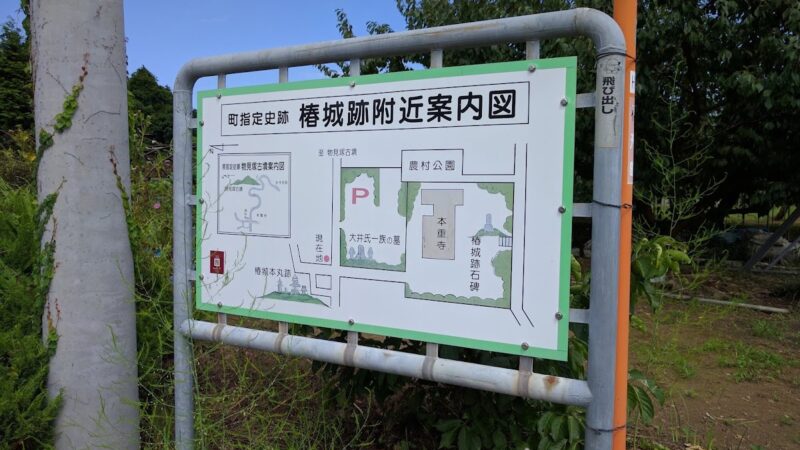
Information boards are installed at the castle ruins, allowing you to learn about the history and structure of Tsukumi Castle. When visiting the site, referring to the information on the boards while exploring will deepen your understanding.
Nearby Historical Spots
There are other historical spots scattered around Tsukumi Castle.
Tokyo Bay Kannon
A representative tourist spot in Futtsu City, this is a giant Kannon statue standing 56 meters tall. It is relatively close to the Tsukumi Castle ruins and is a popular spot for its spectacular views of Tokyo Bay.
Futtsu Cape
A cape jutting out into Tokyo Bay, it has been developed into Futtsu Park. On a clear day, you can see Mount Fuji, and enjoy beach walks and clam digging.
Sanuki Castle Ruins
Another medieval castle located in Futtsu City, it was an important base for the Satomi clan. Visiting it together with Tsukumi Castle will deepen your understanding of the Sengoku period history of the Boso Peninsula.
Access
Access by Car
Tsukumi Castle Ruins are easily accessible by car.
From Tokyo
- Via Tokyo Bay Aqua-Line: Approximately 1 hour
- Exit at Futtsu-Takeoka IC on the Tateyama Expressway, approximately 5 minutes
- Via National Route 127 to the Takeoka area
Parking
There is no dedicated parking lot for the castle ruins, but parking spaces at nearby public facilities and tourist attractions may be available. It is recommended to check with the Futtsu City Tourism Association before visiting. Please avoid street parking and be considerate of local residents.
Access by Public Transportation
Train/Bus
- Get off at JR Uchibo Line “Takeoka Station,” then walk for approximately 20-30 minutes.
- From the station to the castle ruins, follow the path along the Shirakogawa River.
- Bus services are limited, so it is recommended to check the timetable in advance.
Points to Note When Visiting
Clothing and Equipment
- As it is a mountain castle, comfortable walking shoes (such as trekking shoes) are essential.
- In summer, bring insect repellent, a hat, and drinking water.
- Even in winter, don’t forget to take precautions against the cold.
Safety Considerations
- There are steep slopes and areas with uneven footing, so please walk carefully.
- It is best to avoid visiting during or after rain, as it can be slippery.
- Visiting in a group is recommended rather than alone.
Manners
- The castle ruins are a valuable cultural asset. Please be careful not to damage the ruins.
- Please take all your trash with you.
- Please do not trespass on private property.
Recommended itinerary for visiting Tsukumi Castle
Half-Day Course
It is recommended to allow 1-2 hours for a visit to the Tsukumi Castle ruins. The following plan is recommended:
- Arrive at JR Takeoka Station (if using public transport)
- Walk to Tsukumi Castle Ruins (20-30 minutes)
- Visit the castle ruins (1-2 hours): Visit the main enclosure, baileys, moats, etc., and enjoy the view.
- Stroll around the area: Explore the Shirakogawa River estuary and coastline.
- Return to Takeoka Station
Full-Day Course
This is a full-day plan combining Tsukumi Castle with surrounding tourist attractions.
Morning
- Visit to the Tsukumi Castle Ruins (1-2 hours)
- Visit to the Tokyo Bay Kannon (1 hour)
Afternoon
- Stroll around Futtsu Cape and Futtsu Park (1-2 hours)
- Seafood Lunch
- Visit to the Sanuki Castle Ruins (Optional)
Photo Spots
The Tsukumi Castle Ruins are also attractive as photo spots.
- View from the Main Enclosure: A spectacular view overlooking Tokyo Bay and the Miura Peninsula
- Terrain Differences in the Enclosures: A photograph illustrating the structure of a Sengoku period mountain castle
- Moat: A photograph conveying the impressive defensive structure
- Evening View: The silhouette of the castle ruins against the setting sun over Tokyo Bay
Current Status and Future of Tsukumi Castle Research
Academic Research
Regarding Tsukumi Castle, several academic research projects have been conducted, including the Chiba Prefectural Board of Education’s “Research Report on Chiba’s Medieval and Early Modern Castle Ruins, Vol. 15: Tsukumi Castle” (1994).
Research on coastal castles in the Boso Peninsula, including Tsukumi Castle, is progressing, as seen in Tsuneaki Takigawa’s “The Form of Existence of ‘Pirates’ on the Edo Bay Coast During the Sengoku Period” (Chiba Castle Research No. 3, 1994).
In recent years, new research findings have been published, such as Motoki Kuroda’s new theory regarding the base of the Kazusa Takeda clan, and the historical positioning of Tsukumi Castle may be updated in the future.
Preservation and Utilization
The Tsukumi Castle ruins are being preserved and utilized as an important cultural property of Chiba Prefecture. The Futtsu City Board of Education and local history enthusiast groups are carrying out maintenance of the castle ruins and the installation of information boards.
In the future, efforts are expected to balance the use of the site as a tourist resource with the protection of cultural properties, while conveying the value of Tsukumi Castle to a wider audience.
Summary
Tsukumi Castle is a valuable coastal castle ruin from the Sengoku period remaining in Futtsu City, Chiba Prefecture. Its location overlooking the Uraga Channel conveys the tension of the Sengoku period when the Satomi and Hojo clans confronted each other. Built by the Mariya and Kazusa Takeda clans, and later playing a crucial role as a naval base for the Satomi clan, Tsukumi Castle is an indispensable historical site for understanding the Sengoku period history of the Boso Peninsula.
A visit to the site allows you to enjoy well-preserved remains and magnificent views. For those interested in the history of the Sengoku period or those who enjoy visiting castles, Tsukumi Castle is a place well worth visiting.
Why not visit Tsukumi Castle, a Sengoku period maritime castle, while experiencing the rich nature and history of Futtsu City? Standing on the castle ruins overlooking Tokyo Bay, you can relive the view seen by the Satomi clan’s warriors.