Complete Guide to Kururi Castle | A Thorough Explanation of the History and Charm of Kimitsu City [Chiba Prefecture]
Located in Kimitsu City, Chiba Prefecture, Kururi Castle is a representative historical mountain castle of the Boso Peninsula, beloved by many history enthusiasts and tourists. Also known as “Ujo” (Rain Castle), “Kirifuri Castle,” and “Urata Castle,” this castle played a crucial role as the political and military center of the Kazusa region for approximately 500 years, from the Muromachi period to the Edo period.
This article comprehensively explains everything you need to know when visiting Kururi Castle, from its historical background and highlights to the exhibits at the Kimitsu City Kururi Castle Ruins Museum, access methods, and surrounding tourist information.
History of Kururi Castle | From the Muromachi Period to the Meiji Restoration
Construction and the Era of the Kazusa Takeda Clan
The history of Kururi Castle dates back to the Muromachi period. It is believed to have been built around 1454 by Takeda Nobunaga of the Kazusa Takeda clan. Takeda Nobunaga was a member of the Kai Takeda clan, and he built this mountain castle in the process of expanding his power into Kazusa Province.
Kururi is located in the inland part of the Boso Peninsula, surrounded by mountains, making it a natural stronghold. The castle, built on Shiroyama (Kururi Castle Mountain) at an elevation of 145 meters, functioned as a strategically important location overlooking the surrounding area.
The Sengoku Period and the Satomi Clan’s Residence
During the Sengoku period (Warring States period), Kururi Castle became a battleground for the struggle for supremacy on the Boso Peninsula. During the Tenbun era (1532-1555), the Satomi clan, based in Awa Province, brought this area under their control. While repeatedly clashing with the Hojo clan, the Satomi clan considered Kururi Castle an important base for their control of Kazusa Province.
During the reigns of Satomi Yoshitaka and Yoshihiro, Kururi Castle served as one of the Satomi clan’s main strongholds and was the site of numerous battles. During the Eiroku era (1558-1570), fierce battles with the Hojo clan took place, leading to the strengthening of the castle’s defensive capabilities.
Kururi Domain in the Edo Period
In the Edo period, Kururi Castle took on a new role as the administrative center of the Kururi Domain. Beginning with Tsuchiya Tadanao’s appointment in 1614 with a 30,000 koku stipend, the castle saw successive lordships, including the Osuga and Kuroda clans.
In 1624, Kuroda Naosumi was appointed with a 30,000 koku stipend, and the Kuroda clan ruled the Kururi Domain for nine generations. During the Edo period, Kururi Castle’s role as the center of the domain’s administration was prioritized over its military function as a mountain castle, and the development of the castle town progressed accordingly.
Meiji Restoration and Abolition of the Castle
With the Meiji Restoration, the Kururi Domain became Kururi Prefecture through the return of land and people to the Emperor, and was later incorporated into Chiba Prefecture via Kisarazu Prefecture. In 1873 (Meiji 6), the Castle Abolition Order officially abolished Kururi Castle, and many of its buildings were demolished.
The Legend of “Rain Castle” | Origin of Kururi Castle’s Alternate Name
Kururi Castle is known by the beautiful alternative name “Rain Castle” (Ujō). Several interesting legends surround this name.
The Legend of 21 Rainfalls
The most famous legend is that “after the castle was completed, it rained 21 times, once every three days.” This mysterious phenomenon is said to have given the castle the alternative name “Rain Castle.” This legend is thought to have enhanced the castle’s mystique and had a psychological intimidating effect on enemies.
Natural Phenomena of Fog and Rain
Another theory is based on geographical characteristics. Records indicate that “this mountain was often shrouded in fog, making it appear as if it were raining from a distance, concealing the castle and making it difficult for enemies to attack.”
In fact, the castle mountain where Kururi Castle is located is prone to fog due to the surrounding terrain and climate. It is believed that this natural phenomenon, which worked to the castle’s advantage in defense, gave rise to its alternative names, “Rain Castle” and “Fog Castle.”
Current Kururi Castle | Castle Mountain Park and Replica Keep
Reconstructed Keep
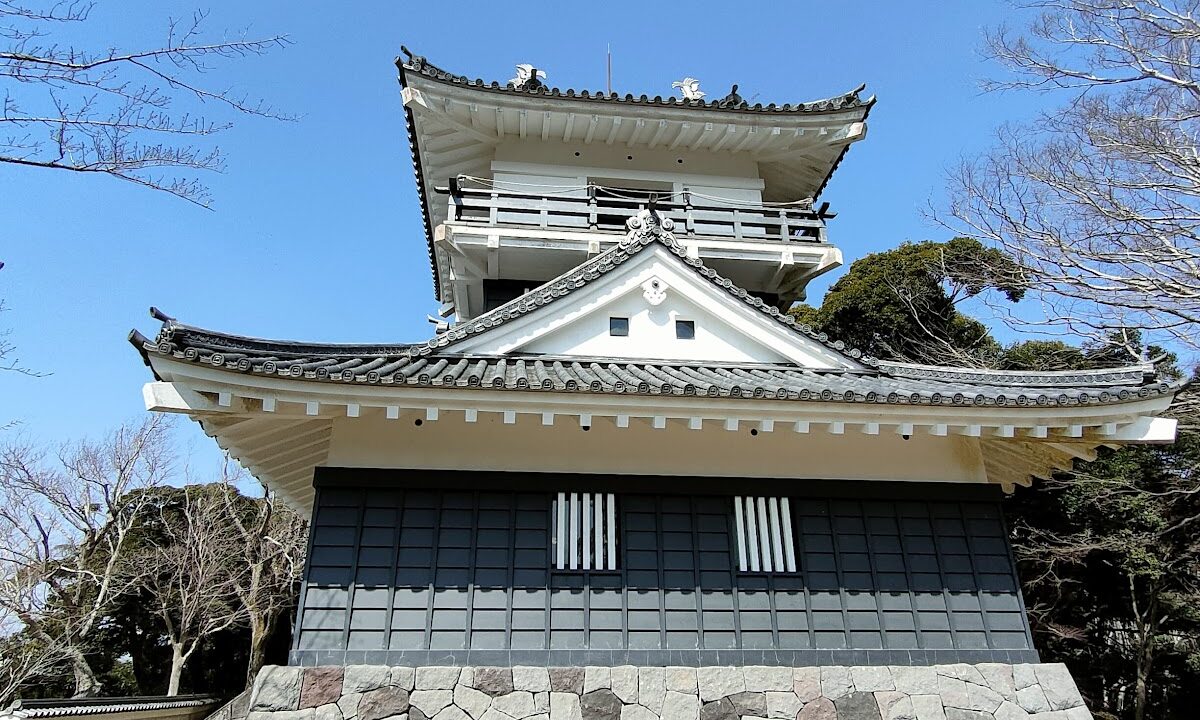
Currently, a two-story, three-tiered replica keep, rebuilt in 1979, stands on the site of the former main keep of Kururi Castle. This keep was not designed based on historical documents, but is a replica structure functioning as an observation deck.
From the castle tower, you can enjoy a panoramic view of Kimitsu city and the surrounding mountains, and on clear days, you can admire the beautiful scenery of the Boso Peninsula. Especially during cherry blossom season, the entire Shiroyama Park is adorned with cherry blossoms, attracting many visitors.
Development of Shiroyama Park
The Kururi Castle ruins have been developed into “Shiroyama Park,” a place of relaxation for citizens. Walking paths are maintained within the park, allowing visitors to enjoy nature walks while exploring the castle ruins.
The remains of the main keep, second bailey, and third bailey (kuruwa) are still present, allowing visitors to imagine the structure of the castle in its heyday. Furthermore, remains such as dry moats and earthworks are preserved, allowing visitors to learn about the changes in castle architecture from the medieval to the early modern period.
Kimitsu City Kururi Castle Ruins Museum | Highlights and Exhibits
Museum Overview
The Kimitsu City Kururi Castle Ruins Museum is a historical museum that opened on August 1, 1979. Built on the site of the second bailey, the museum functions as a facility that introduces not only the history of Kururi Castle but also the history and culture of Kimitsu City as a whole.
Admission is free, and anyone can easily visit. Opening hours are from 9:00 to 16:30, and the museum is closed on Mondays (or the following day if Monday is a public holiday), the day after public holidays, and during the New Year holidays.
Three-Part Permanent Exhibition
The museum’s permanent exhibition is divided into three parts: “Excavating Local History,” “Castles and Samurai,” and “Faith and Culture,” each exploring the history of Kimitsu City in depth through its respective theme.
Digging Up Local History displays pottery, stone tools, and buried cultural artifacts excavated from archaeological sites within the city, introducing the history of the Kimitsu region from ancient to medieval times. Visitors can learn about the changes in people’s lives from the Jomon period to the Yayoi and Kofun periods through actual excavated artifacts.
Castles and Samurai introduces the history of Kururi Castle and the lives of the samurai who ruled this area. Actual swords, firearms, armor, and other weapons are on display, allowing visitors to concretely imagine the lives of samurai from the Sengoku period to the Edo period. In particular, the furnishings used by the Satomi clan and the lords of the Kururi domain demonstrate the high level of samurai culture at that time.
Faith and Culture displays votive tablets, Kagura (sacred dance) equipment, and Buddhist statues from local shrines and temples, introducing the faith and cultural activities of the people. Visitors can learn about the spiritual world of ordinary people in the Edo period and the traditional culture rooted in the region.
Kazusa-bori Well-Drilling Exhibit
One of the museum’s distinctive exhibits is the display of tools used in the Kazusa-bori well-drilling technique. Kazusa-bori is a well-drilling technique that originated in the Kazusa region, including Kimitsu City, and spread throughout Japan from the Meiji era to the early Showa era.
This technique uses a unique drilling device made of bamboo strips, allowing for the efficient drilling of deep wells. The museum displays actual Kazusa-bori tools used in the technique, showcasing the development of this unique regional technology. Kazusa-bori is still applied to well-drilling in developing countries today and is attracting attention in the field of international cooperation.
Access Information | How to Get to Kururi Castle
Access by Public Transportation
Using the JR Kururi Line
- Transfer to the JR Kururi Line at Kisarazu Station on the JR Uchibo Line
- Get off at Kururi Station and walk for approximately 35 minutes (approx. 2.5 km)
- If taking a taxi from Kururi Station, it takes approximately 5 minutes
The JR Kururi Line has infrequent service, so it is recommended to check the timetable in advance. The walk from Kururi Station to the castle allows you to enjoy the atmosphere of the castle town, making it an enjoyable walk.
Access by Car
From the Tokyo Metropolitan Area
- Approximately 20 minutes (approx. 12 km) from Kimitsu IC on the Tateyama Expressway
- Approximately 25 minutes (approx. 15 km) from Kisarazu East IC on the Ken-O Expressway
There is a free parking lot at Shiroyama Park, which can accommodate approximately 30 regular cars. However, it can get full during peak seasons such as cherry blossom season, so early arrival is recommended. ### Location and Contact Information
Kururi Castle (Shiroyama Park)
- Address: Uchiyama, Kururi, Kimitsu City, Chiba Prefecture
Kimitsu City Kururi Castle Ruins Museum
- Address: Uchiyama, Kururi, Kimitsu City, Chiba Prefecture
- Phone Number: 0439-27-3478
- Opening Hours: 9:00 AM – 4:30 PM
- Closed: Mondays (or the following day if Monday is a public holiday), the day after a public holiday, and during the New Year holidays
- Admission Fee: Free
Tourist Attractions Around Kururi Castle
Kururi’s Famous Water
The Kururi area is known for its pure spring water, selected as one of the “100 Famous Waters of the Heisei Era.” Water-drawing stations are set up throughout the castle town, and people from far away, as well as locals, constantly come to draw water.
Kururi’s water is soft water that springs forth through the geological layers of the Boso Hills, and is characterized by its smooth taste. This pristine water is also used in Kururi’s sake brewing, and is the source of the delicious taste of the local sake, “Kururi-jo.”
Exploring Kururi’s Castle Town
The townscape of Kururi retains the atmosphere of an Edo-period castle town. Narrow alleys, old merchant houses, and storehouses are scattered throughout, making for a pleasant stroll while experiencing history.
In particular, in the heart of the castle town, there are long-established sake breweries and soy sauce breweries where you can purchase local specialties made using traditional methods. Kururi’s local sake is known for its delicate flavor, made with this pristine water, and is a popular souvenir.
Seasonal Highlights
Spring (Late March to Early April)
Shiroyama Park is known as a famous cherry blossom viewing spot, with approximately 200 Somei Yoshino cherry trees in full bloom. During cherry blossom season, the contrast between the castle tower and the cherry blossoms is beautiful, attracting many photography enthusiasts.
Summer (July-August)
The lush green Shiroyama (castle hill) remains relatively cool even in summer, making it ideal for nature walks. Enjoy a stroll while reflecting on history amidst the sounds of cicadas.
Autumn (November-December)
During the autumn foliage season, the entire Shiroyama is dyed in red and yellow, offering a beautiful landscape. The view from the castle tower is particularly spectacular.
Winter (December-February)
On clear winter days, you can even see Mount Fuji from the castle tower. The quiet winter atmosphere of Shiroyama is perfect for a leisurely study of its history.
Cultural Value of Kururi Castle
Representative Castle of the Boso Peninsula
Kururi Castle possesses high historical value as a representative castle of the Boso Peninsula from the medieval to early modern period. It retains characteristics of the transitional period from mountain castles to flatland castles, making it an important resource for castle research.
The remains of the castle, such as baileys, earthworks, and dry moats, are valuable historical materials that convey the castle-building techniques of the Sengoku period (Warring States period). In particular, the group of baileys arranged in stages from the main keep at the mountaintop down to the foot of the mountain exhibits a typical structure of a medieval mountain castle.
Preservation and Utilization Efforts
Kimitsu City is actively working on the preservation and utilization of the Kururi Castle ruins. Regular surveys and maintenance are conducted to maintain the state of preservation of the remains while promoting its use as a tourist resource.
Exhibits and explanations at the museum, guided tours, and other initiatives are being undertaken to help visitors understand the history and value of Kururi Castle. It is also used as teaching material for learning local history in local schools.
Points to Note and Recommendations for Visitors
Clothing and Items to Bring
Kururi Castle is a mountain castle, and you will need to climb slopes and stairs to reach the keep. We recommend wearing comfortable shoes and clothing suitable for walking. Particular caution is needed on rainy days, as the ground can become slippery.
In the summer, it’s a good idea to bring insect repellent, a hat, and drinks. Bringing a camera will allow you to photograph the beautiful scenery and historical buildings.
Estimated Time Required
Including a visit to the museum and climbing to the castle tower, the required time is approximately 1 hour 30 minutes to 2 hours. If you plan to stroll through the castle town and visit surrounding tourist spots, it’s best to allocate about half a day.
Photography Tips
The contrast between the castle tower and cherry blossoms is a classic spring photo spot. The view from the castle tower is also worth photographing. The old townscape of the castle town and the spring with its famous water are also popular photogenic spots.
Summary | Enjoy History and Nature at Kururi Castle
Kururi Castle in Kimitsu City, Chiba Prefecture, is a mountain castle with a long history dating from the Muromachi period to the Edo period. Known by its beautiful alternative name, “Amejo” (Rain Castle), it conveys a mystical atmosphere woven from legend and natural phenomena.
Currently, the site is maintained as Shiroyama Park, where visitors can learn about the region’s history and culture through the reconstructed replica castle tower and the Kimitsu City Kururi Castle Ruins Museum. As a representative castle of the Boso Peninsula, the numerous remaining structures are valuable cultural assets that convey the atmosphere of the past.
The area around Kururi Castle boasts abundant attractive tourist resources, including the beauty of cherry blossoms, spring water selected as one of Japan’s 100 best waters, and the charm of the castle town. It’s a recommended spot not only for history buffs but also for those who enjoy nature walks and photography.
When visiting Kimitsu City, be sure to visit Kururi Castle and experience the charm of Boso’s history and nature. The free-to-enter museum and the beautiful scenery throughout the seasons will warmly welcome visitors.
Contact Information for this Page
For inquiries regarding Kururi Castle and Kimitsu City tourism information, please contact the following:
Kimitsu City Economic Department, Economic Promotion Division, Tourism Promotion Section
- Address: 2-13-1 Kubo, Kimitsu City, Chiba Prefecture
- Phone: 0439-56-1325
- FAX: 0439-56-1314
Kimitsu City Kururi Castle Ruins Museum
- Phone: 0439-27-3478
The Kimitsu City official website also features the latest information on Kururi Castle, surrounding tourist spots, and event information. We recommend checking it before your visit.