Shiokoshi Castle (Nikaho City) Complete Guide | History, Highlights, and Access Information [Medieval Castles in Akita Prefecture]
Shiokoshi Castle, also known as “Yasoshima Castle,” is a medieval mountain castle located in Kisakata-machi, Nikaho City, Akita Prefecture. Built on a hill overlooking the Sea of Japan, this castle is an important historical site indispensable to understanding the history of the Yuri region, attracting attention from castle enthusiasts and history buffs. This article comprehensively introduces all the information necessary for a visit, from the detailed history of Shiokoshi Castle to the highlights of the existing remains and access methods.
Overview and Basic Information of Shiokoshi Castle
Shiokoshi Castle is a medieval castle located in the Maru district of Kisakata-machi, Nikaho City, Akita Prefecture. Built on a hill not far from the town center of Kisakata, it is now surrounded by residential areas, but remains that retain traces of its former glory can still be seen.
Basic Data
- Location: Maru, Kisakata-machi, Nikaho City, Akita Prefecture
- Alternate Name: Yasoshima Castle
- Castle Classification: Hilltop Castle
- Construction Period: Sengoku period (estimated around the 16th century)
- Builder: Several theories exist (details below)
- Main Lord: Estimated to be a member of the Yuri clan
- Remains: Enclosures, earthworks, moats, etc.
- Designated Cultural Property: Not designated
The name Shiokoshi Castle originates from the place name “Shiokoshi” in this area. Regarding the alternative name Yasoshima Castle, a connection to the Kujukushima (Yasoshima) islands of Kisakata has been suggested, but the detailed origin is unclear.
History of Shiokoshi Castle
Background of Construction and the Situation in the Yuri Region
During the Sengoku period (Warring States period) when Shiokoshi Castle was built, the Yuri region, including present-day Nikaho City, was a region where local lords known as the “Yuri Twelve Lords” held sway. The Yuri Twelve Lords were a confederation of local lords centered around the Yuri clan, each with their own castles and residences, forming a complex relationship of sometimes cooperating and sometimes conflicting.
Due to its geographical location on the Sea of Japan coast in southern Akita Prefecture, the Yuri region was a crucial point for maritime traffic and an economically important area as a trading hub for salt and marine products. Shiokoshi Castle is believed to have been built in a strategic location to control these trade routes.
Castle Lords and Changes
Regarding the specific lords of Shiokoshi Castle, there is a lack of reliable historical records, and several theories exist. Based on local traditions and research by scholars, it is considered highly likely that a member of the Yuri clan or a samurai under their command resided there.
In the Yuri region, power struggles among the Twelve Lords of Yuri continued throughout the 16th century. In particular, with the influence of surrounding daimyo such as the Mogami and Ando clans (later the Akita clan), each castle strengthened its function as a defensive stronghold. It is presumed that Shiokoshi Castle was also renovated and expanded during this period.
Abandonment of the Castle and the Early Modern Period
Around the time of the Battle of Sekigahara during the Keicho era (1596-1615), the Yuri region came under the influence of Mogami Yoshiaki, and subsequently under the rule of the Akita clan (a branch of the Satake clan). During this process, many of the Twelve Lords of Yuri were disbanded, and it is believed that Shiokoshi Castle was abandoned with the end of the Sengoku period.
During the Edo period, Kisakata developed as a port town under the rule of the Akita domain. The Kisakata earthquake of 1804 (Bunka 1) caused dramatic topographical changes, with the Kujukushima Islands becoming land, but the ruins of Shiokoshi Castle remained largely unaffected.
Since the modern era, the area around the castle ruins has gradually been developed into residential land, but the topographical features and some of the remains can still be seen today.
Structure and Layout of Shiokoshi Castle
Location and Topographical Features
Shiokoshi Castle is built on a hill close to the town of Kisakata. Although the elevation is relatively low, it overlooks the surrounding plains and offers views towards the Sea of Japan. This location indicates a dual strategic intention: monitoring maritime traffic and controlling a key point on land routes.
To the north of the castle lies the townscape of Kisakata, and to the west, the Sea of Japan can be seen. The south and east sides are gentle slopes, suggesting that defensive measures were taken there.
Major Remains
The main remains of Shiokoshi Castle that can be seen today are as follows:
Main Enclosure (Honmaru)
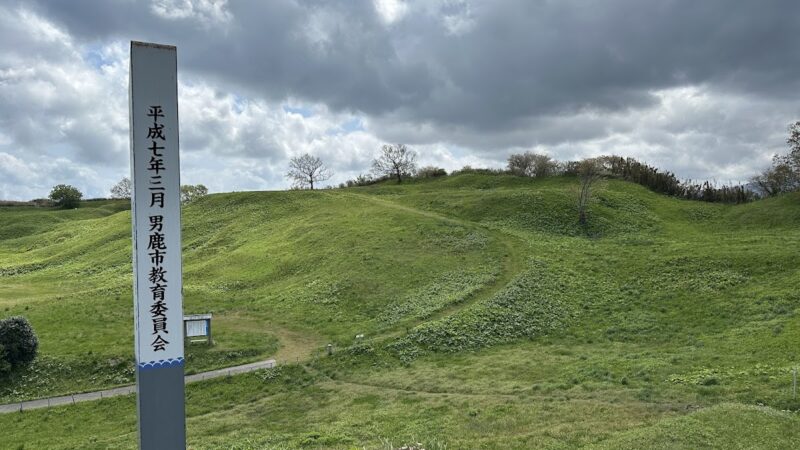
This is the central enclosure of the castle and is located at the highest point. The area is currently flat, and no traces of former buildings can be seen on the surface. However, the extent of the main enclosure can be estimated from the topographical features.
Enclosures
It is believed that multiple enclosures were arranged surrounding the main enclosure. Terraced terrain remains in some areas, and these are thought to be possible traces of the enclosures.
Earthworks
Traces of earthworks can be seen in some sections. Although their height is low, the shape of the mounds suggests they were defensive structures.
Moats and Dry Moats
Traces of moats that divided the hillside remain in part. While some areas are now buried or altered, the depressions in the terrain allow us to imagine the defensive lines of the past.
Characteristics of the Castle Layout
The layout of Shiokoshi Castle exhibits typical characteristics of a medieval mountain castle. Defensive lines are arranged concentrically around the main enclosure, with moats strategically placed to prevent enemy intrusion. While smaller in scale compared to large mountain castles, it is considered to have possessed sufficient defensive capabilities as a regional base fortress.
Highlights of Shiokoshi Castle
Historical Value
The greatest value of Shiokoshi Castle lies in its status as a valuable historical site that tells the story of the medieval history of the Yuri region. It is attracting attention from researchers as a concrete example of the political and military situation in this region during the time of the Twelve Lords of Yuri.
While many medieval castles exist in Akita Prefecture, castles located near the coast are relatively few, and Shiokoshi Castle is positioned as a good example of a castle that controlled a junction of maritime and land transportation.
Defensive System Deciphered from Topography
When visiting the castle ruins, paying attention to the elevation differences and the arrangement of the baileys allows you to experience the castle-building techniques of the Sengoku period. In particular, the elevation differences around the main bailey indicate that measures were taken to defend against enemy attacks in stages.
Walking around the site, you can understand that even slight differences in elevation and topographical changes held significant defensive importance. For castle enthusiasts, observing these subtle topographical features will be a great source of enjoyment.
Connection to the History of Kisakata
When visiting Shiokoshi Castle, understanding the historical background of Kisakata will lead to a deeper appreciation. Kisakata is famous as a place visited by Matsuo Basho in his “Oku no Hosomichi” (The Narrow Road to the Deep North), and the scenery of the Kujukushima Islands has captivated many writers and artists.
The topographical changes caused by the 1804 Kisakata earthquake are a noteworthy event in the history of earthquakes in Japan. From the ruins of Shiokoshi Castle, you can view the townscape of Kisakata, which has undergone these historical changes, and truly feel the passage of time.
Access Information
Access by Public Transportation
Using the JR Uetsu Main Line
- Nearest Station: JR Uetsu Main Line “Kisakata Station”
- Walking distance from the station: Approximately 12 minutes (approximately 900m)
- The path from the station to the castle ruins is flat, and there are few signs, so it is recommended to check the location in advance using a map or smartphone map app.
Route Bus
Nikaho City’s community bus operates from in front of Kisakata Station, but there is no bus stop directly near the castle ruins. Access is on foot from the nearest bus stop.
Access by Car
Using the Nihonkai Tohoku Expressway
- From Kaneura IC: Approximately 7 minutes (approximately 5km)
- From Kisakata IC: Approximately 6 minutes (approximately 4km)
From either IC, head towards Kisakata town center via National Route 7 and follow the signs.
Parking Information
There is no dedicated parking lot for the castle ruins. When visiting, please use the parking lots of nearby public facilities or tourist attractions and access the site on foot. Since it is located in a residential area, please avoid street parking and be considerate of local residents.
Points to Note When Visiting
- Respect for Private Property: Part of the castle ruins may be private property. Please do not enter areas marked “No Entry.”
- Safety Precautions: Please be careful of your footing when observing the ruins. The ground can be particularly slippery after rain.
- Season: Spring to autumn is the best season to visit. Visiting may be difficult in winter due to snow.
- Estimated Time Required: Visiting the castle ruins itself takes approximately 30 minutes to 1 hour.
Nearby Tourist Attractions
When visiting Shiokoshi Castle, combining your visit with other tourist attractions in Nikaho City will make your trip even more fulfilling.
Kisakata
A scenic spot visited by Matsuo Basho, it once boasted a landscape of ninety-nine islands floating in the sea. Even after being converted into land by the 1804 earthquake, it retains its unique scenery. The view from Kanmanji Temple is a must-see.
Michi-no-Eki Kisakata Nemunooka
Located at 73-1 Oshio-goe, Kisakata-machi, Nikaho City, Akita Prefecture, this roadside station features the popular “Chokai-no-Yu” observation hot spring, offering panoramic views of Mount Chokai and the Sea of Japan. Local specialties and fresh seafood can also be purchased.
TDK History and Future Museum
Nikaho City is the birthplace of the electronic components manufacturer TDK. This facility showcases the company’s history and cutting-edge technologies, offering insights into Nikaho City’s role as a high-tech industrial hub.
Mount Chokai
A 2,236m-high active volcano straddling Akita and Yamagata Prefectures, it is characterized by its beautiful shape and is also known as “Dewa Fuji.” It is a popular spot for hiking and trekking.
Nikahotto
A direct sales market for agricultural and marine products located at 36-1, Oshio-goe, Kisakata-machi, Nikaho City, Akita Prefecture. You can purchase fresh local vegetables, fruits, and processed goods. In the summer, you can even enjoy fresh, natural rock oysters on the spot.
History and Culture of Nikaho City
Origins of Nikaho City
Nikaho City was formed on October 1, 2005, through the merger of three towns: Nikaho-machi, Kanoura-machi, and Kisakata-machi. It is the only municipality in Akita Prefecture whose name is written in hiragana. The city name is a combination of the first letters of the three former towns, chosen for its familiarity and ease of remembering.
Geography and Climate
Nikaho City is located in the southwestern part of Akita Prefecture, facing the Sea of Japan. To the east lies the sacred Mount Chokai, and to the west, the Sea of Japan, making it a naturally rich region. It enjoys a relatively mild climate compared to other parts of Akita Prefecture, with less snowfall in winter.
Industry and Economy
Nikaho City is known as the prefecture’s leading high-tech industrial cluster. Numerous electronic component companies, including TDK, are located here, and manufacturing plays a central role in the regional economy. Agriculture and fisheries are also thriving, and its natural rock oysters, especially in summer, are highly regarded nationwide.
Sample Itinerary for Visiting Shiokoshi Castle
Half-Day Course (Approx. 4 Hours)
9:00 Arrive at JR Kisakata Station
9:15 Visit Shiokoshi Castle Ruins (12-minute walk)
10:30 Stroll around Kisakata (Kujukushima Islands)
11:30 Visit Kanmanji Temple and enjoy the view
12:30 Lunch and hot springs at Michi-no-Eki Nemunooka
Full-Day Course (Approx. 8 Hours)
9:00 Arrive at Kanpo IC by car
9:30 Visit Shiokoshi Castle Ruins
11:00 Stroll around Kisakata (Kujukushima Islands)
12:30 Lunch at Nikahotto (including natural rock oysters)
14:00 Visit TDK History & Future Museum
16:00 Hot springs and shopping at Michi-no-Eki Nemunooka
18:00 Depart for home
Current Status of Castle Research and Preservation
Academic Evaluation
Shiokoshi Castle, as one of the medieval castles in the Yuri region, holds an important position in the study of castles in Akita Prefecture. In recent years, local historians and castle researchers have been conducting investigations, creating layout maps and detailed records of the remains.
Preservation and Challenges
Currently, Shiokoshi Castle ruins are not designated as a cultural property, but they are recognized as a regional historical heritage site. However, due to the progress of residential development, there is a possibility that some of the remains may be lost, making future preservation measures a challenge.
Local history enthusiasts and researchers have called for surveying of the remains and the formulation of a preservation plan, and continuous investigations by the Nikaho City Board of Education are expected.
How to Enjoy Visiting Shiokoshi Castle
Points for Castle Fans
Those interested in castles can enjoy their visit more deeply by paying attention to the following points.
- Observing the Topography: Confirm the layout of the main enclosure and baileys, and the elevation differences to imagine the defensive structure.
- Traces of Earthworks: Decipher the former defensive facilities from the slight earthen mounds.
- Confirming the Line of View: Confirm the range visible from the castle and consider what was being monitored.
- Relationship with the Surrounding Topography: Understand the relationship between the townscape of Kisakata and the Sea of Japan.
How to Enjoy a Historical Walk
For those interested in history, exploring the medieval history of the Yuri region starting from Shiokoshi Castle is recommended.
- Compare with other castle ruins of the Twelve Lords of Yuri (Akaotsu Castle, Hirasawa Castle, etc.)
- Understand in relation to the historical changes of Kisakata (landification of the Kujukushima Islands)
- Trace the footsteps of Basho and Kisakata during the Edo period.
Photography Tips
When enjoying photography at the castle ruins, the following times and compositions are recommended.
- Early Morning: The combination of Mt. Chokai and the castle ruins illuminated by the morning sun
- Evening: The silhouette of the castle ruins against the backdrop of the sunset over the Sea of Japan
- Spring: The ruins amidst the fresh greenery
- Autumn: The scenery of the castle ruins against the backdrop of autumn leaves
Summary
Shiokoshi Castle is a valuable medieval castle ruin remaining in Nikaho City, Akita Prefecture. It is a historical site with multifaceted appeal, possessing historical value that tells the story of the Twelve Lords of Yuri, the charm of its location surrounded by the Sea of Japan and Mt. Chokai, and its connection to the historical town of Kisakata.
Compared to castles with large stone walls and keeps, it may seem unassuming, but the layout that utilizes the terrain and the traces of earthworks allow you to feel the castle-building techniques of the Sengoku period and the tension of that time.
When you visit Nikaho City, be sure to visit the Shiokoshi Castle ruins and reflect on the history of the Yuri region. Combined with the beautiful scenery of Kisakata, the hot springs and gourmet food at the roadside station, and the magnificent nature of Mount Chokai, you can enjoy a fulfilling historical exploration trip.
For castle enthusiasts, history buffs, and anyone looking to discover the hidden charms of Akita Prefecture, Shiokoshi Castle is a historical site well worth visiting. Researching its historical background beforehand will lead to a deeper understanding and a more moving experience.