Yoshida Castle (Mito City, Ibaraki Prefecture) Complete Guide: History, Remains, and Access Information
Overview of Yoshida Castle
Yoshida Castle is a medieval residence that existed before the Edo period in Moto-Yoshida-cho, Mito City, Ibaraki Prefecture. It is known as a castle site that existed for approximately 400 years, from the late Heian period to the end of the Sengoku period, as a base for the Daijo clan in Hitachi Province.
Currently, the Butsunichizan Joshōji Temple, built by Tokugawa Mitsukuni (Mito Kōmon), stands on the castle site, and the remains of the earthworks and dry moats from that time are well preserved. Located about 2 km south of Mito Castle, it is a historical spot with good access from Mito city center, attracting attention from castle enthusiasts and history lovers.
Basic Information on Yoshida Castle
- Location: 2723 Moto-Yoshida-cho, Mito City, Ibaraki Prefecture
- Other Names: None
- Castle Structure: Hilltop Castle (Residence)
- Construction Period: Late Heian Period (Estimated)
- Builder: Yoshida Kiyomoto
- Year of Abandonment: Tensho 18 (1590)
- Main Lords: Yoshida Clan (Daijo Clan Branch)
- Remains: Earthworks, Dry Moat, Well Remains
- Designated Cultural Property: None
- Current Status: Within the grounds of Joshoji Temple
History of Yoshida Castle
Late Heian Period to Kamakura Period: Construction by the Yoshida Clan
The exact construction date of Yoshida Castle is uncertain, but it is estimated to have been built by Yoshida Kiyomoto in the late Heian period. The Yoshida clan was a branch of the Daijō clan, a powerful local family in Hitachi Province, and descended from the Hitachi Taira clan.
The Daijō clan was a prominent family that controlled southern Hitachi Province from the Heian period, based around the Hitachi Provincial Capital (present-day Ishioka City). The Yoshida clan is believed to have been a branch of this family, entrusted with the control of the Mito area.
Yoshida Castle was built on a peninsula-shaped plateau, a natural stronghold surrounded on three sides by swamps. One side, in particular, faced the former Senba Lake (part of present-day Senba Lake), and the forested terrain provided ideal conditions for a samurai residence.
Muromachi Period to Sengoku Period: Relationship with the Edo Clan
From the Muromachi period to the Sengoku period, the Edo clan expanded their power in Hitachi Province, based at Mito Castle. The Edo clan was a samurai family that entered Hitachi Province during the Kamakura period, and controlled the Mito region from Mito Castle.
It is believed that the Yoshida clan was either subordinate to or allied with the Edo clan, and Yoshida Castle likely functioned as a subsidiary castle of Mito Castle. Given its proximity to Mito Castle (approximately 2 km south), it is presumed to have also served as a defensive base for Mito Castle.
During this period, the Satake clan was expanding its power from the north in Hitachi Province, deepening conflict with the southern forces centered around the Edo clan. Yoshida Castle is thought to have played an important role in this political and military tension.
1590 (Tensho 18): Satake Clan Invasion of Mito and Abandonment of the Castle
In 1590 (Tensho 18), following Toyotomi Hideyoshi’s siege of Odawara, the situation in Hitachi Province changed dramatically. That year, the Satake clan, led by Satake Yoshinobu, attacked Mito Castle and destroyed the Edo clan. This “Battle of Mito Castle” marked the end of the Edo clan’s rule.
With the fall of the Edo clan, Yoshida Castle, which had been their subsidiary castle, was also abandoned. It is believed that the Satake clan placed Mito Castle under their direct control and decided that smaller branch castles like Yoshida Castle were unnecessary. Thus, the history of Yoshida Castle, which had lasted for approximately 400 years, came to an end.
Edo Period: Construction of Joshōji Temple by Tokugawa Mitsukuni
In the Edo period, the Mito Domain was established as one of the three main branches of the Tokugawa family. Tokugawa Mitsukuni (known as Mito Kōmon), the second lord of the Mito Domain, built Butsunichizan Joshōji Temple on the site of Yoshida Castle in 1689.
A plaque bearing the name of Tokugawa Mitsukuni (Minamoto no Mitsukuni) hangs above the temple gate, preserving the connection between Mitsukuni and the Yoshida Castle site. Mitsukuni was enthusiastic about historical research, including compiling the “Dai Nihon Shi” (Great History of Japan), and he may have intended to preserve the historical significance of this place for future generations by building a temple on the former Yoshida Castle site.
Structure and Layout of Yoshida Castle
Location and Topographical Characteristics
Yoshida Castle was built on a peninsula-shaped plateau in the southern part of Mito City. This plateau was surrounded on three sides by marshes, and the western side in particular faced the former Senba Lake. While Senba Lake still forms a representative landscape of Mito City today, it once formed a much larger wetland area, serving as a natural moat.
The plateau was covered in forests, obstructing the view and simultaneously functioning as a defensive structure. Such terrain provided ideal conditions for a medieval residence, making the reason why the Yoshida clan chose this location clear.
Arrangement of Remains
Currently, the following remains have been confirmed at the Yoshida Castle site:
Earthworks: Earthworks from that time remain in various places within the grounds of Joshōji Temple. The height varies depending on the location, but the best-preserved sections are approximately 1-2 meters high. The earthworks were arranged to surround the residence and functioned as a defensive structure.
Dry Moat: Traces of a dry moat remain outside the earthen rampart. While parts are now filled in, the terrain’s undulations allow us to estimate the moat’s original location. Dry moats were important defensive structures designed to prevent enemy intrusion.
Well Remains: A hole believed to be the remains of a well has been identified within the temple grounds. In medieval castles, securing a water source during sieges was crucial, and it was common to dig multiple wells.
Estimated Enclosure: The flat area where the main hall and living quarters of Joshōji Temple now stand may have been the former main enclosure (honmaru). Based on the surrounding terrain, it is presumed that multiple enclosures were arranged, but many parts have likely been altered by the construction of the temple.
Castle Scale
Yoshida Castle was not a large mountain or flatland castle, but rather a small to medium-sized castle centered around a samurai residence. The castle area was limited to the current Joshōji Temple grounds and its surroundings, estimated to have covered an area of approximately 150 meters east-west and 200 meters north-south.
This size is standard for a branch castle or residence of a local lord during the Sengoku period, and it is thought to have served as both a living space for daily life and a defensive base in emergencies.
Highlights of Yoshida Castle
Joshōji Temple Gate and Tokugawa Mitsukuni’s Plaque
The biggest highlight when visiting the Yoshida Castle ruins is the gate of Joshōji Temple. This gate bears a plaque bearing the name of Tokugawa Mitsukuni (Minamoto no Mitsukuni), known as Mito Kōmon.
The gate retains the architectural style of the early Edo period, clearly demonstrating the characteristics of temple architecture at that time. The characters on the plaque are powerful, conveying Mitsukuni’s character. Passing through the gate, a tranquil temple space unfolds, allowing one to sense the remnants of the former castle.
Stone Monument at Yoshida Castle Ruins
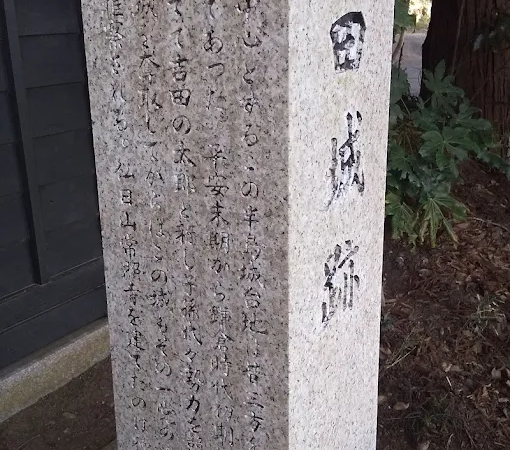
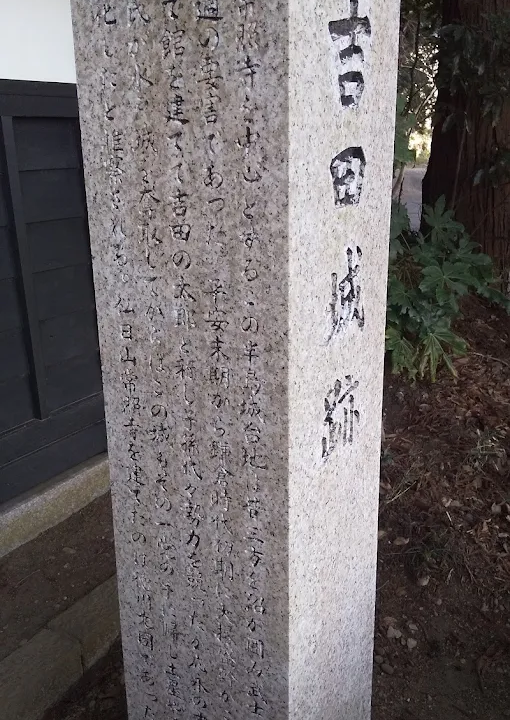
To the right of the gate stands a stone monument marking the “Yoshida Castle Ruins.” The side of this stone monument concisely records the history of Yoshida Castle, making it a valuable source of information for understanding the castle’s history.
Although the monument is relatively new, it reflects the local people’s determination to carefully preserve the castle ruins. Standing before the monument, one can feel the weight of the history of this place, which dates back to the Heian period.
Remains of Earthworks and Dry Moats
While strolling through the grounds of Joshōji Temple, traces of earthworks and dry moats can be seen in various places. In particular, relatively clear earthworks remain on the north and east sides of the grounds, giving a sense of the atmosphere of a medieval castle.
There are places where you can walk on top of the earthworks, and looking down at the grounds from there, you can imagine the structure of the former castle. The beauty of the cherry blossoms in spring and the autumn leaves in fall makes it an attractive place to view the remains while enjoying the scenery of each season.
Well Remains and Castle Ruins
There are holes on the temple grounds that appear to be the remains of a well. Based on its depth and structure, it is highly likely to be a well from the medieval period. This is a valuable historical site that allows us to imagine the life of the people at the time and how they secured water sources during sieges.
Furthermore, a careful observation of the topography within the grounds reveals artificially created flat areas and elevation changes. These may be the remains of baileys and provide clues to understanding the castle’s layout.
Surrounding Landscape and Lake Senba
Looking west from the Yoshida Castle ruins, you can see the current Lake Senba. You can appreciate how the once much larger Lake Senba played a vital role in the castle’s defense.
The area around Lake Senba is now developed as a recreational area for Mito citizens, with walking and cycling paths. A stroll around Lake Senba in conjunction with a visit to the Yoshida Castle ruins is highly recommended.
About the Yoshida and Daijo Clans
History of the Hitachi Taira and Daijo Clans
To understand the Yoshida clan, it is necessary to know about their parent family, the Daijo clan. The Daijō clan adopted this surname after holding the position of “Daijō,” the deputy governor of the Hitachi Province (present-day Ishioka City, Ibaraki Prefecture) during the Heian period.
The Daijō clan was the main lineage of the Hitachi Taira clan, which traced its lineage back to the Kanmu Taira clan, and is considered to be descended from Taira no Kunika. They ruled southern Hitachi Province from the mid-Heian period and served the shogunate as gokenin (vassals) during the Kamakura period. During the Sengoku period, they split into many branches and expanded their influence throughout Hitachi Province.
Genealogy and Role of the Yoshida Clan
The Yoshida clan was a branch of the Daijō clan and was responsible for governing the area around Mito. While Yoshida Kiyomoto is said to have built Yoshida Castle, the exact timing and circumstances are unclear due to a lack of historical records.
From the Muromachi period to the Sengoku period, the Yoshida clan deepened their relationship with the Edo clan and acted as influential local lords in the Mito region. It is believed that the Yoshida clan played a wide range of roles, including agricultural production management, maintaining local security, and military defense.
There are no clear records of what happened to the Yoshida clan after the Satake clan’s capture of Mito Castle in 1590. It is possible that the Yoshida clan declined along with the castle’s abandonment, or that they survived by serving the Satake or Tokugawa clans, but the details are unknown.
Relationship between Mito Castle and Yoshida Castle
History of Mito Castle
Mito Castle was one of the most important strongholds in Hitachi Province, and is believed to have been built by Baba Sukemoto during the Kamakura period. Later, the Edo clan took control, and it functioned as their residence until the Sengoku period.
Mito Castle was a flatland castle built on a plateau between the Naka River and Lake Senba, and was a strong fortress surrounded by a natural moat. During the Edo period, it became the residence of the Mito Tokugawa family, one of the three main branches of the Tokugawa family, and remained so until the Meiji Restoration.
Yoshida Castle in the Branch Castle Network
During the Sengoku period, castles did not exist in isolation, but rather formed a network of branch castles centered around the main castle. Yoshida Castle is located approximately 2 km south of Mito Castle and is believed to have played an important role as a branch castle of Mito Castle.
The roles of branch castles included the following:
- Defensive Base: Early detection and defense against enemy approaches to the main castle
- Logistical Base: Stockpiling of provisions and weapons, and stationing of soldiers
- Territorial Control: Governing the surrounding area and collecting taxes
- Information Gathering: Monitoring local developments and reporting to the main castle
Yoshida Castle is presumed to have held a particularly important position in the southern defense of Mito Castle. Its location facing Lake Senba was also advantageous for the transportation of supplies using waterways, providing a logistical advantage.
Access Information
Access by Public Transportation
By Train and Bus:
- Get off at Mito Station on the JR Joban Line.
- Take the Ibaraki Kotsu bus bound for Renjoji Temple from the north exit of Mito Station (approximately 15 minutes).
- Get off at the Asahi-cho 2-ku bus stop.
- From the bus stop, it’s about a 5-minute walk to Joshoji Temple (Yoshida Castle Ruins).
Buses run approximately 1-2 times per hour. We recommend checking the timetable on the Ibaraki Kotsu website in advance.
By Taxi:
Approximately a 10-minute taxi ride from Mito Station, costing around 1,500 yen.
Access by Car
If using the expressway:
- Approximately 10 minutes from the Mito-Minami IC on the Kita-Kanto Expressway
- Approximately 20 minutes from the Mito IC on the Joban Expressway
Car Navigation Settings:
- Facility Name: Joshōji Temple
- Address: 2723 Moto-Yoshida-cho, Mito City, Ibaraki Prefecture
Parking Information
Joshōji Temple has a free parking lot for visitors. It can accommodate approximately 10 cars. It may be crowded on holidays and during events, so it is recommended to visit with plenty of time to spare.
The parking lot is near the temple entrance and is a short walk from the main gate. Parking for large vehicles is difficult, so if you are visiting by bus, it is recommended to contact the temple in advance.
Nearby Tourist Attractions
Mito Castle Ruins (Mito Castle Site)
Located approximately 2km north of Yoshida Castle, the Mito Castle Ruins are a must-see tourist spot. Currently, remnants such as the Kodokan and Yakuimon gate remain, allowing visitors to learn about the history of the Mito Domain. The Kodokan, in particular, is designated a National Special Historic Site and is a valuable example of Edo-period domain school architecture.
Kairakuen Garden
Kairakuen Garden, one of Japan’s three most famous gardens, is within walking distance of the Mito Castle ruins. Built by Tokugawa Nariaki, it boasts approximately 3,000 plum trees of about 100 varieties, and its spring plum blossom festival is nationally renowned.
Senba Lake
Senba Lake, located west of the Yoshida Castle ruins, is a popular recreational spot for Mito residents. A promenade runs along the lakeshore, and swans and mute swans migrate there. Bicycle rentals are available, allowing visitors to enjoy cycling around the lake.
Ibaraki Prefectural Museum of History
Near the Mito Castle ruins, the Ibaraki Prefectural Museum of History offers detailed information about the history and culture of Hitachi Province. The museum also features exhibits on the Daijo, Edo, and Satake clans, which are beneficial for understanding the historical background of Yoshida Castle.
Notes for Visitors
Visiting Etiquette
Yoshida Castle Ruins are located within the grounds of Joshoji Temple, an active temple. Please observe the following points during your visit:
- Don’t forget to pay your respects at the main hall.
- Refrain from loud conversations.
- Eat and drink only in designated areas on the temple grounds.
- Always take your trash with you.
- Photography is permitted, but refrain from taking pictures during religious services.
- When climbing on earthworks and other remains, be careful of collapses and avoid damaging the vegetation.
Best Time and Season for Visiting
Yoshida Castle Ruins are open year-round, but the following times are especially recommended:
Spring (March-May): Cherry blossoms and fresh greenery are beautiful, and the weather is mild, making it ideal for visiting.
Autumn (October-November): The autumn leaves are beautiful, and the weather is pleasant.
Summer (June-August): The greenery is lush, and there are many insects such as mosquitoes, so insect repellent is necessary.
Winter (December-February): It may snow, but the air is clear and the ruins are clearly visible.
The best time to visit is during the daytime (around 9:00-16:00). Please visit according to the temple’s opening hours.
Clothing and Items to Bring
- Comfortable walking shoes (for walking on earthworks and temple grounds)
- Hat, sunscreen (summer)
- Warm clothing (winter)
- Camera (for documenting the ruins)
- Drinking water
- Insect repellent spray (spring-autumn)
- Rain gear (in case of bad weather)
Historical Significance of Yoshida Castle
Position in the Medieval History of Hitachi Province
Yoshida Castle is an important historical site that shows the development of medieval samurai groups in Hitachi Province and the realities of regional rule during the Sengoku period. Although smaller in scale compared to large mountain castles and early modern castles, Yoshida Castle played an important role in the local community as the residence of a local lord and as part of a network of branch castles.
In particular, as a castle built by the Daijō clan, a branch of the prestigious Hitachi Taira clan, it is a valuable historical site that tells the story of the changes in samurai groups from the Heian period to the Sengoku period.
Value in Castle Research
While many small to medium-sized castles like Yoshida Castle exist throughout Japan, most have been lost due to development. Yoshida Castle’s remains were miraculously preserved because it became a temple called Jōshōji.
The remains, such as earthworks and dry moats, are relatively well-preserved, making it a valuable sample for studying the structure of medieval castles. In particular, it clearly demonstrates the characteristics of medieval castles, such as the use of plateaus for its layout and the placement of defensive facilities that utilize the natural terrain.
As a Regional Historical Heritage Site
The Yoshida Castle ruins are an important element in forming the historical identity of southern Mito City. For the local people, this castle ruin is a place to remember the era in which their ancestors lived and also serves as a learning tool for the region’s history.
In recent years, with the rise of castle enthusiasts and interest in historical tourism, attention has been drawn to small and medium-sized castle ruins like Yoshida Castle. Appropriate preservation and utilization of these sites as regional historical heritage is essential.
Summary
Yoshida Castle (Mito City, Ibaraki Prefecture) is a medieval castle that existed for approximately 400 years, from the late Heian period to 1590. It was built by the Yoshida clan, a branch of the Daijo clan, and functioned as a subsidiary castle of Mito Castle.
Currently, it is the grounds of Joshōji Temple, built by Tokugawa Mitsukuni, and remains such as earthworks, dry moats, and well remains are still present. Located about 10 minutes by car from Mito Station and accessible by bus, it is ideally situated for a visit in conjunction with other tourist attractions such as Mito Castle ruins, Kairakuen Garden, and Senba Lake.
As the site of a medieval local lord’s residence and a valuable historical site that tells the story of Hitachi Province, it’s a place well worth a visit for castle enthusiasts and history buffs. Why not reflect on the lives of the samurai who once lived in the tranquil temple grounds?
By visiting the Yoshida Castle ruins, you can gain a deeper understanding of Japanese medieval history, particularly the complex political situation and the realities of samurai groups in Hitachi Province. It’s a historical spot you should definitely visit when you’re in Mito.

-800x450.png)